-


Runner take-out robot with servo driven kick axis
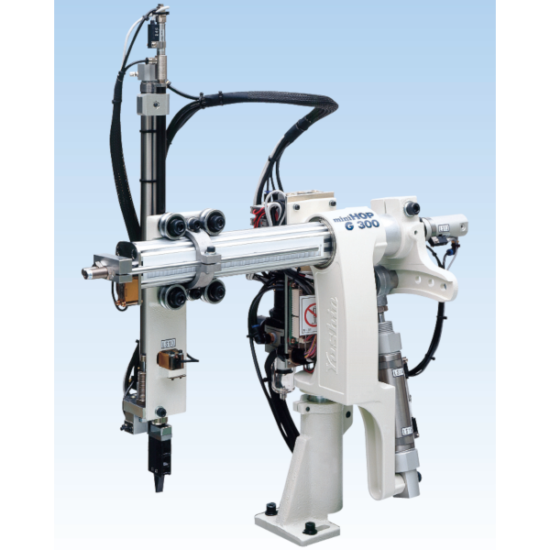
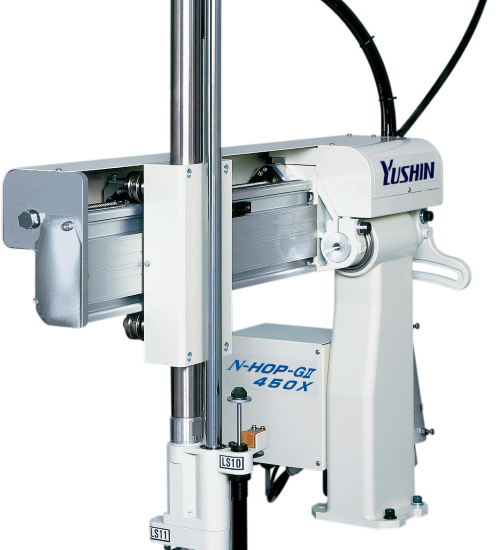
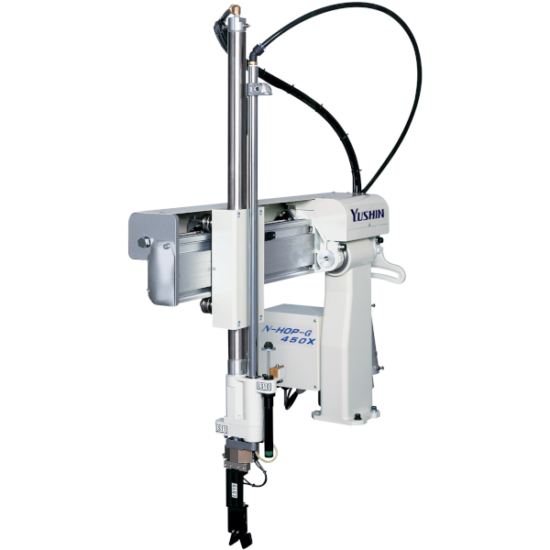
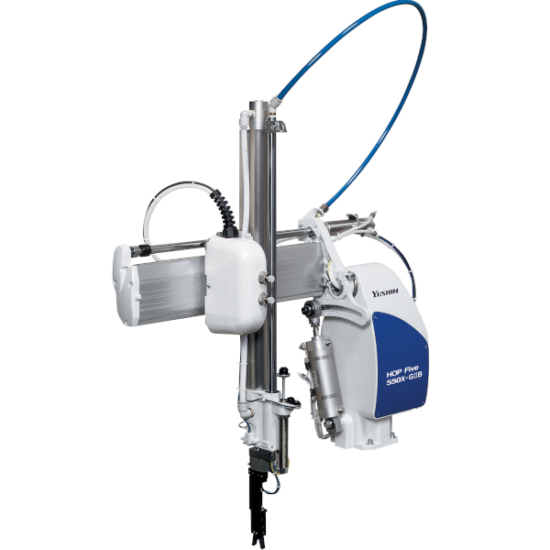
With swing-type take-out robots, the parameter that is most often adjusted when setting up production is the kick stroke. But, the N-HOP-GII employs an NC servo-driven kick axis, so adjustments can be made safely and assuredly from the controller without touching the molding machine. Moreover, servo control means that runners can be stably taken out at high speed. -
Reliable Stability with Compact Body
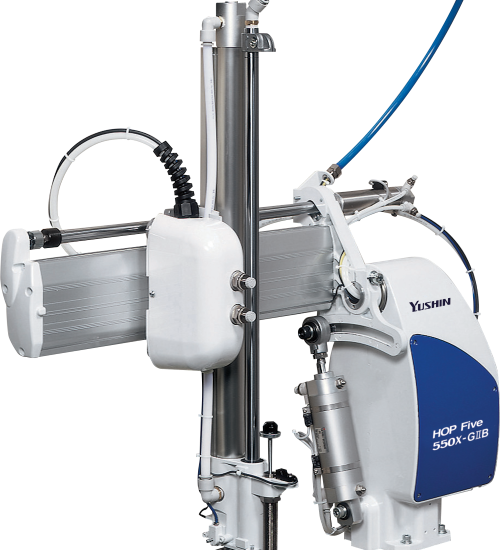
Swing type runner take-out robots have evolved alongside Yushin’s history as a business. HOP Five models house the transformer and control board in the robot body, instead of using standalone units of the past, and yet they require less installation space. Moreover, these robots are built so that principle adjustments like kick stroke can be made at the operator side of the molding machine, which makes production setup more efficient. -
Double Wing
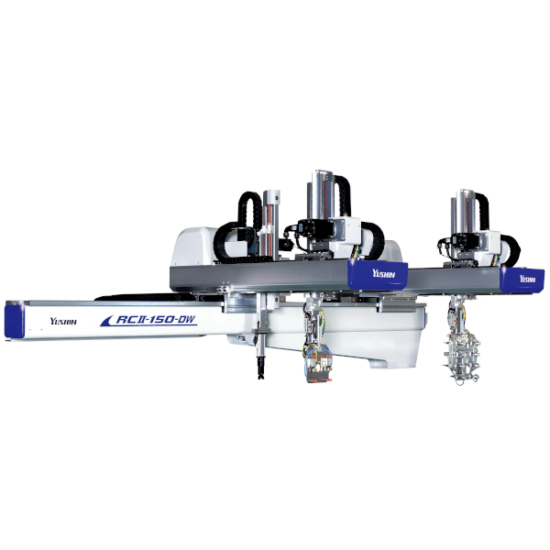
One machine that performs two jobs inherently has all sorts of advantages. For one, users can lower the initial cost of their entire system and, two, enhance the efficiency of their molding plants. [1] Stocking system application Aligns and cases molded parts. [2] Assembly and stocking system application Positions the molded part, assembles it with another workpiece, inspects and stocks the final product. [3] Gate cut and stocking system application 1. Allows molded part to cool, then performs gate cut and stocks [4] Gate cut and stocking system application 2. Removes gate and stocks molded part. [5] Insert system application 1. Inserts multiple workpieces [6] Insert system application 2.(vertical molding machine) Insertion on A side, extraction on B side. [7] Double capacity robot for high-speed molding system In a high-speed molding system where time must be allowed for the downstream machine, the A and B sides alternately extract parts for the fastest possible cycle. [8] 10-axis dual mold system Take-out and stocking are carried out independently on the A and B sides. -

Why is a several hundred kilogram robot needed to pick a molded part of just a few grams?
To answer this question, Yushin sought an application-specific robot through its Optimum Design approach. Design Optimization is what Yushin calls its use of CAE (Computer—Aided Engineering) to determine the theoretically best configuration of a robot based on its mechanisms and movements, rather than relying solely on designer experience. This approach has been used in recent years to make aircraft and automobiles lighter and more reliable. Curiously enough, we have often been amazed by how closely optimized designs resemble trees and animals in the natural world. Designed to deliver speeds and safety unachievable with predecessor models, we are confident that the HSA series will usher in a new era in take-out robots. The HSA incorporates Design Optimization for higher speed and rigidity with less weight. With take-out times as fast as 0.32 sec proven during live molding, the HSA is 13% lighter and 11% faster than previous models (measurements are relative to previous comparable model). -
Improved productivity via high speed + vibration control
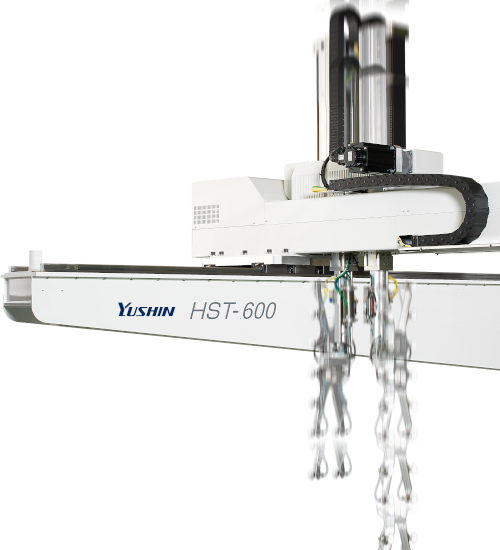
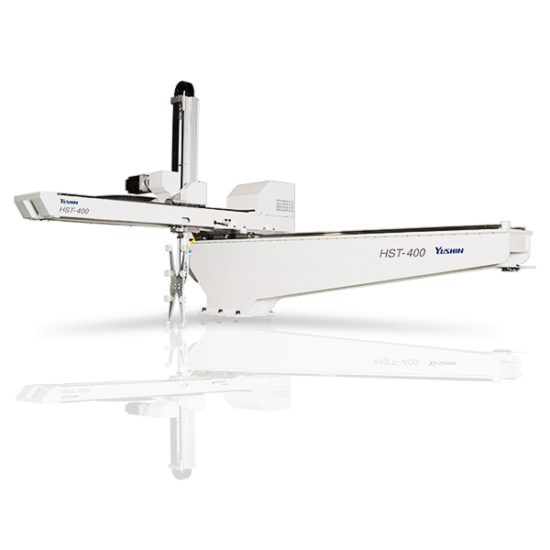
HST robots bring to the table the tools and means for improving productivity in the form of high-speed operation and thorough vibration controls. Higher speeds have been achieved by employing Optimum Design approach to reduce the mass of moving parts, while the enhanced vibration dampening of the CFRP arm combines with anti-vibration measures to shorten settling time. Optimum Design Joint research with Kyoto University Optimum Design is what Yushin calls its use of CAE (Computer—Aided Engineering) to determine the theoretically best configuration of a robot based on its mechanisms and movements. This approach has been used in recent years to make aircraft and automobiles lighter and more reliable. Through joint research conducted with Kyoto University, Yushin first tested and applied CAE to an EOAT. Following the good results, this Optimum Design approach was employed with take-out robots of the HSA, TSXA, YC and HST series. Winner of the JSME Technology Award Great reviews in engineering circles In 2011, Yushin was honored with the prestigious Technology Award of the Japan Society of Mechanical Engineers (JSME) for “developing high-performance take-out robots for molding machines by structural optimization”. -

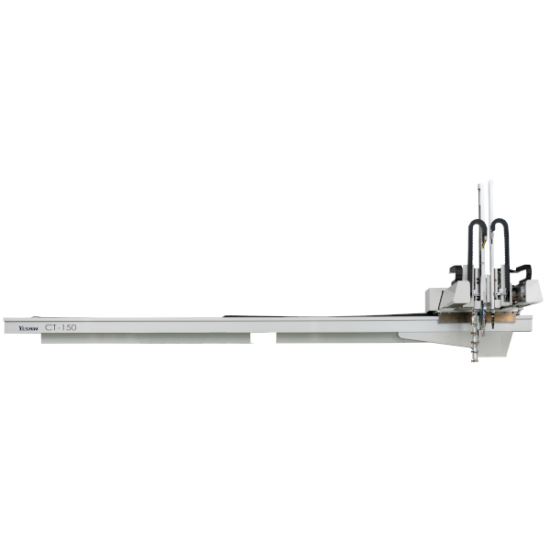
Clamp-end traverse type robot for 3-plate mold that releases molded parts to the movable platen side of the IMM
The CT and CT2 transition the former design concept of take-out robots as tools for replacing line operators to the starting point for automating part take-out. Developed from this new concept, these take-out robots provide users with the impetus to completely change the layout of their entire plant. -
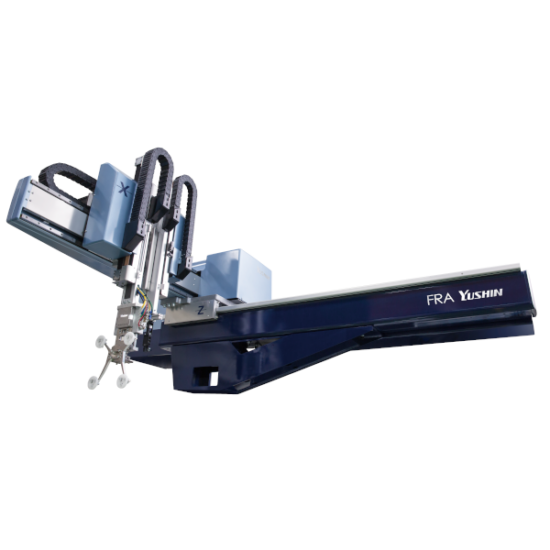
Robots that have the future interests of the molding industry in mind
It used to be a dream that vast numbers of people could use the same product and similarly enjoy the same benefits. Then, plastic engineering miraculously made that happen. Since the advent of injection molding, industry has incessantly pursued better products of better quality at a faster clip. The merits of injection molding have been amplified by the take-out robot. But, molding plants have never been without issues – highly complicated products, small lot wide variety production, labor shortages and inherent dangers of the workplace -- to name a few. Yushin’s purpose is to make robots that help solve these issues. Moreover, Yushin goes another step further by making robots that have the future interests of the molding industry in mind. That mindset spawned the FRA series.Compliant with the most stringent international safety regulations as a standard feature
Safety circuits There is no compromising at Yushin when it comes to safety. As the bottom-line, redundant safety circuits maintain functional capacity in the unlikely event that a primary circuit goes down.
Speed monitoring Robot movements are monitored during teaching so that safe speeds are not exceeded and jobs can be performed safely. Compliant with international safety standards Our FRA robots qualify as Safety Category 3 devices under EN/ISO 12100, EN 60204 and EN/ISO 10218, and comply with safety requirements under CE, GB and KCs.Another step closer to “no downtime”
INTU LINE IoT service Included with every FRA robot, this software application gives users immediate intuitive control over their new robot on the very same day it is installed.
Read more on how you can setup a 'lights out' production facility....
Production monitoring Intu Line displays production counts, uptime ratios, operating statuses, cycle times, error tallies, short stoppage logs and visuals of production floors, which users can easily view anytime, anywhere from a smartphone or PC. It visualizes molding operations in terms of short stoppage frequency and duration, which was difficult to grasp before. Troubleshooting If trouble occurs, Intu Line shares the customer’s error information with Yushin over an IoT system. It’s like having a Yushin service rep on-site as customers are spared the hassles of explaining what happened, which logically leads to quicker solutions.
INTU LINE - Yushin IoT Solution Service brochure







Yushin America, Inc.
USA Corporate Headquarters
35 Kenney Drive, Cranston, RI 02920
Phone: (401) 463-1800
Email: [email protected]