AI-driven palletizing robots address both sides of this equation. They operate without cold-related performance degradation, adapt to changing product mixes without reprogramming, and maintain consistent throughput around the clock.
This guide covers what makes cold storage uniquely difficult for palletizing systems, how AI changes the engineering equation, the technical requirements buyers must verify, and a practical selection framework for operations managers evaluating automation.
TL;DR
- Cold storage workers face measurable productivity loss and serious injury risk — EU-OSHA data shows cold environments cause critical manual dexterity impairment and a 4% higher work-related injury risk
- AI palletizing robots combine machine vision, adaptive algorithms, and cold-rated hardware to palletize 24/7 without performance loss
- Cold-rated robots require specific lubrication, cable jacketing, sealed enclosures, and cold-compatible EOAT to function reliably
- Standard industrial robots are not built for these conditions and typically fail below 0°C
- Key selection criteria: verified temperature rating, EOAT material compatibility, AI software flexibility, and service network reach
Why Cold Storage Demands AI-Driven Palletizing
Cold storage facilities span three distinct temperature zones, each posing different challenges:
| Zone | Temperature Range | Typical Contents |
|---|---|---|
| Ambient | 15–30°C | Dry goods, packaging |
| Refrigerated | 0–15°C | Dairy, produce, beverages |
| Deep-freeze | Below -15°C | Frozen food, pharmaceuticals |
Refrigerated and deep-freeze zones create distinct mechanical and biological problems for human palletizers — and for the standard robots that most integrators default to.
The Human Cost of Cold Environment Work
According to EU-OSHA's OSHwiki, thermal stress risks increase noticeably below +10°C and become acute below +5°C. Manual dexterity drops measurably when skin temperature falls under 22°C, reaching critical impairment below 15°C. Thin protective gloves — the practical minimum in many cold rooms — can reduce finger dexterity by 60%.
The injury picture is worse in frozen areas. The same EU-OSHA source reports:
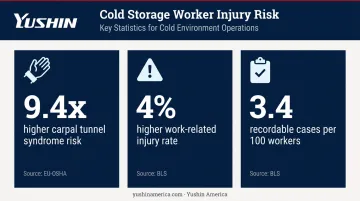
- Workers in frozen food plants face 9.4 times higher carpal tunnel syndrome risk than those in temperate environments
- Cold exposure correlates with a 4% higher risk of work-related injuries overall
- BLS 2024 data puts the total recordable case rate for refrigerated warehousing (NAICS 49312) at 3.4 per 100 full-time workers
The downstream effects — workers' compensation claims, absenteeism, and turnover — add real cost. Cold chain labor is already scarce; GCCA's 2019 employee turnover study cited 32.6% average annual turnover across North American cold storage warehouses, a figure that makes continuous manual palletizing operations difficult to staff reliably.
Cold Chain Integrity and Throughput Pressures
Those workforce pressures compound a separate operational risk: temperature excursions during palletizing. Under 21 CFR 1.908, food shippers must maintain adequate temperature control throughout transport — and excursions can block distribution until safety is confirmed. WHO TRS 1025 Annex 7 applies equivalent scrutiny to pharmaceutical cold chain products.
Throughput pressure is accelerating these risks. The cold chain market is projected to reach $455 billion by 2031 at a 10.5% CAGR, according to MarketsandMarkets. Three demand drivers are adding volume to facilities not designed for current scale:
- E-commerce grocery fulfillment compressing order cycle times
- Just-in-time food logistics tightening palletizing windows
- Pharmaceutical cold chain expansion requiring validated handling
Standard industrial robots don't bridge this gap cleanly. Most are rated to 0°C minimum — non-functional in deep-freeze environments without expensive protective enclosures. Cold-proofed hardware paired with AI-driven adaptive software represents a specialized category, and the specifications that differentiate those systems are worth understanding before selecting one.
How AI-Driven Palletizing Robots Work in Cold Environments
An AI-driven palletizing robot combines three layers: a cold-rated mechanical arm, adaptive end-of-arm tooling, and an AI software layer. That software layer (machine vision plus machine learning) enables the robot to identify products, generate pallet patterns, and adjust in real time without manual reprogramming per SKU.
AI Vision and Real-Time Adaptive Palletizing
Machine vision cameras and 3D sensors scan incoming products as they arrive on the conveyor, capturing dimensions, weight class, and orientation. In cold storage facilities handling dozens of frozen SKUs — cases, bags, tubs, irregular shapes — this matters more than in single-SKU lines. The system adapts without an operator intervening to reprogram pallet patterns.
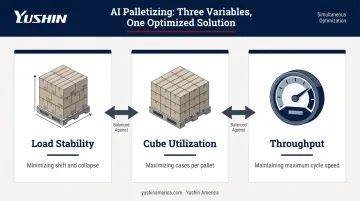
Machine learning algorithms then optimize stacking sequences, balancing three variables simultaneously:
- Load stability — minimizing shift and collapse risk during transport
- Cube utilization — maximizing cases per pallet to reduce freight cost
- Throughput — sequencing picks to maintain maximum speed
Traditional programmable palletizers require a configuration change for every new pallet pattern; AI-driven systems recalculate without stopping. KUKA's DAREGAL installation demonstrates this in practice: two KR QUANTEC PA Arctic robots running 35 palletizing plans via smartPAD in a -25°C frozen-herb facility.
Predictive Maintenance in Cold Environments
Cold environments accelerate component wear. Lubrication viscosity changes, condensation builds on sensors during temperature transitions, and joint wear increases with thermal cycling. Predictive maintenance systems (monitoring motor temperature, vibration, and mechanical stress in real time) convert unexpected failures into scheduled maintenance events.
ABB's connected services data indicates that data-driven robot monitoring can deliver up to 25% fewer incidents and 60% faster fault response time. For cold storage operations running overnight or unmanned shifts, remote alert systems are where that ROI becomes concrete.
Yushin's YC Email Notification Module illustrates the approach: it sends customizable error notifications to any device when the robot encounters a fault, allowing lights-out operations to continue with off-site oversight rather than on-site staffing.
Cold-Proofed Mechanical and Electrical Systems
Standard industrial components fail in sub-zero environments through predictable failure modes:
- Lubricants become viscous at low temperatures, increasing joint resistance and wear
- Cable jacketing becomes brittle — a static cable may survive freezing, but a moving cable undergoing thousands of flex cycles will crack without cold-rated jacketing
- Plastic housings and seals contract and become brittle
- Electronics accumulate condensation during temperature transitions
Cold-rated robots address each of these with low-temperature greases, corrosion-resistant materials, dynamic cold-flex cable materials, and sealed IP-rated enclosures. FANUC's M-410iC datasheet specifies 0–45°C with no dew or frost — confirmation that condensation is outside standard installation parameters. Purpose-built cold-storage robots are engineered to operate where standard models cannot.
Key Technical Requirements for Cold-Rated Palletizing Robots
Before comparing systems, operations managers need to verify specific thresholds — not just general industrial robot specs.
Temperature Rating and Operating Range
The gap between standard and cold-rated robots is significant:
| Robot Type | Standard Operating Temp | Notes |
|---|---|---|
| FANUC M-410iC (standard palletizer) | 0 to +45°C | No dew or frost |
| ABB IRB 120 (standard industrial) | +5 to +45°C | +5°C with food-grade lubrication |
| KUKA KR QUANTEC PA Arctic | Down to -30°C | No protective suit or mechanical heater required |
The KUKA Arctic designation is the clearest published benchmark for deep-freeze capability — verified in DAREGAL's -25°C installation. Some facilities opt for standard robots in heated ROBOSUITS enclosures (MMCI's frozen-food installation ran a FANUC M-410iB/140H this way for three years without downtime beyond scheduled maintenance), but the enclosure adds bulk, maintenance overhead, and cost.
The key question for any buyer: does the robot's rated temperature match your coldest operating zone without requiring a heated enclosure?
End-of-Arm Tooling (EOAT) for Cold Environments
EOAT failure is one of the most common cold storage palletizing problems. Standard rubber vacuum cups harden below certain temperatures and lose suction — a Piab/MCRI case study found that standard cups in a 35°F cold room dropped cases weighing up to 42 lb before silicone cups resolved it.
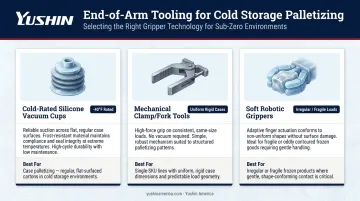
EOAT options for cold storage:
- Cold-rated silicone vacuum cups — Piab's B75 Silicone line is rated from -40°F to 392°F, making it the standard recommendation for case palletizing in refrigerated and freezer environments
- Mechanical clamp/fork tools — reliable for uniform rigid cases, but limited in tight spaces and inflexible with mixed SKUs
- Soft robotic grippers — suited for irregular or fragile frozen products where vacuum grip is unreliable
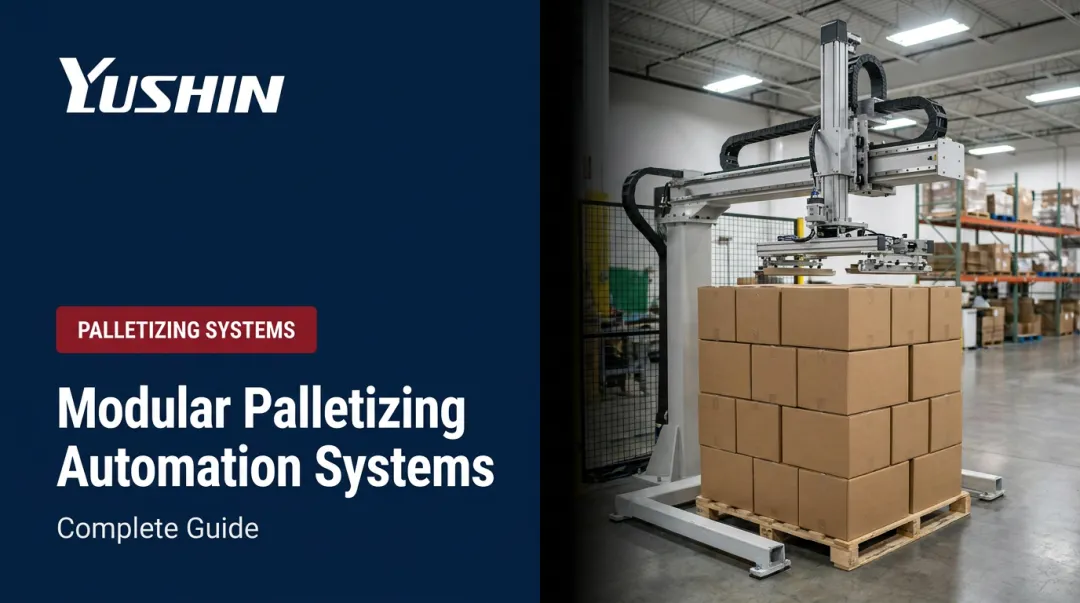
Cold storage palletizing often involves heavy cases stacked to full pallet height, which means payload capacity and reach need to be verified together. The Yushin PA-40 handles payloads up to 40 kg (including EOAT), with a horizontal reach of 1,800mm and vertical stroke up to 3,000mm — enough range for full pallet height in most cold storage configurations without sacrificing throughput.
For EOAT specifics in cold environments, Yushin's engineering team provides custom tooling design support and can be reached at Salesinfo@yushin.com to discuss application requirements.
Top Benefits of AI-Driven Palletizing in Cold Storage
Worker Safety and Labor Retention
Removing workers from repetitive heavy-lift tasks in sub-zero environments directly reduces the injury and turnover cycle that plagues cold storage operations. The EU-OSHA data cited earlier — 9.4x carpal tunnel risk, 4% higher overall injury rate — translates directly to workers' compensation claims and absenteeism costs when facilities remain manually operated.
Robot adoption doesn't necessarily mean job elimination. KUKA's documentation of the DAREGAL installation notes that employees who previously palletized manually were retrained to manage and supervise the automated system, with no job losses. This retraining model addresses the retention problem more effectively than continuing to staff physically demanding cold-room roles.
Throughput, Accuracy, and Cold Chain Integrity
AI palletizing robots don't tire, don't slow down during cold exposure, and don't introduce fatigue-related stacking errors. MMCI's frozen-food case study recorded 16 hours/day, 365 days/year, for three years without unplanned downtime.
Consistent stacking precision also protects cold chain integrity: stable loads don't shift in transit, reducing the product exposure events that occur when pallets are re-stacked or products are dropped. For frozen goods that cannot be re-frozen after thaw, load stability is a product safety issue with direct liability implications.
ROI and Operational Efficiency
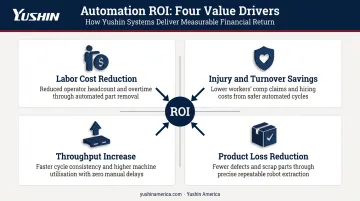
The ROI model for cold storage palletizing automation typically runs through four variables:
- Labor cost reduction — replacing or redeploying workers from difficult cold-room roles
- Injury and turnover savings — reduced workers' comp claims, recruitment, and training costs
- Throughput increase — more pallets per shift without adding headcount
- Product loss reduction — fewer dropped cases and damaged loads
Cold storage rental premiums add another dimension: JLL data from Hong Kong puts refrigerated space at 30–50% above dry warehouse rates. A palletizing cell with a compact footprint frees that premium square footage for storage rather than equipment.
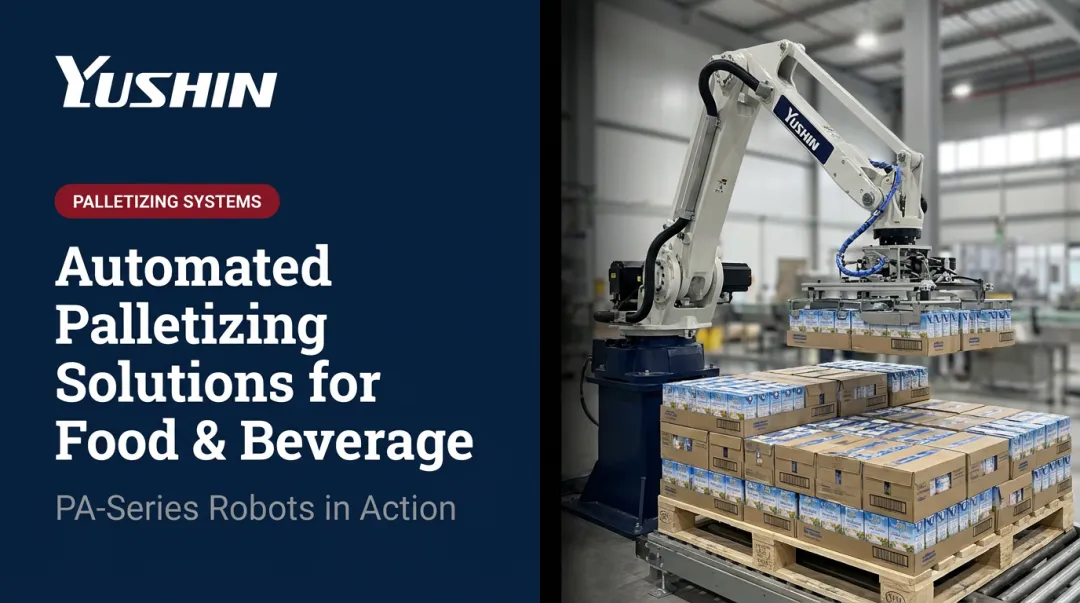
Yushin's PA Compact Palletizing Robot addresses this directly. Its cantilever design minimizes obstructive stanchions, enabling flexible layout in constrained cold-room spaces.
How to Choose the Right AI Palletizing Robot for Cold Storage
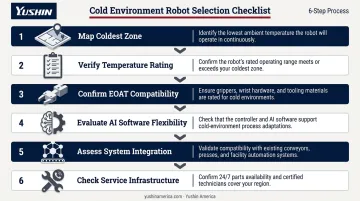
Use this selection sequence before comparing vendors:
- Map your coldest operating zone — identify your minimum temperature requirement: refrigerated (0–15°C) or deep-freeze (below -15°C)
- Verify the robot's rated operating range — confirm ratings for the robot body, controller, cabling, lubrication, and EOAT against your zone temperature, not just the arm specification
- Confirm EOAT compatibility — specify silicone vacuum cups or mechanical alternatives based on your product type and temperature; don't leave this to the commissioning phase
- Evaluate AI software flexibility — assess how many pallet plans the system supports, whether reprogramming is required per SKU change, and whether no-code/low-code operation is available for non-specialist operators
- Assess integration with existing systems — confirm communication protocol compatibility with conveyor lines and WMS before finalizing selection
- Check service infrastructure — for lights-out cold storage shifts, confirm the vendor offers 24/7 technical support and fast spare parts availability before you commit
That last point deserves real weight. Yushin America supports its palletizing systems with a nationwide network of technical service engineers, 24/7 phone support, remote diagnostics via the INTU LINE IoT system, and virtual troubleshooting via video conferencing. For facilities running overnight or unmanned cold storage shifts, a service gap at 2 a.m. can cost more than the robot itself.
If cold storage floor space is constrained, the PA Compact Palletizing Robot is built for exactly that environment. Contact Yushin America at Salesinfo@yushin.com or call (888) 70-ROBOT for application-specific guidance.
Frequently Asked Questions
Which AI-driven palletizing robot is best for cold storage environments?
The right choice depends on your temperature zone, payload, and product mix. Deep-freeze environments below -20°C require robots explicitly rated for those conditions (the KUKA KR QUANTEC PA Arctic is a purpose-built example). Evaluate based on verified temperature rating, EOAT compatibility, and AI software flexibility rather than brand recognition.
What temperature range can cold storage palletizing robots operate in?
Standard industrial palletizing robots (such as the FANUC M-410iC) are rated to 0°C minimum. Purpose-built cold storage robots extend this to -25°C or -30°C without heated enclosures. Using standard robots in freezers via protective ROBOSUITS is possible but adds bulk and maintenance overhead.
How does AI improve palletizing accuracy in cold storage?
AI vision systems identify product dimensions and orientation in real time, enabling pick-angle and stacking-sequence adjustments without manual reprogramming when the product mix changes. Machine learning also improves pallet stability optimization over time, reducing load failures during transport.
What end-of-arm tooling works best in freezer environments?
Cold-rated silicone vacuum cups — rated to -40°F — are the standard recommendation for case palletizing in refrigerated and freezer environments. Standard rubber cups harden at low temperatures and lose suction. Mechanical clamp tools are a reliable alternative for uniform rigid cases where vacuum performance is uncertain.
How long does it take to implement a cold storage palletizing robot?
Pre-engineered compact systems can commission in weeks; fully custom cells with complex integration may take several months. Cold storage installations add time for component cold-testing before go-live. Yushin's PA series supports quick installation with low production disruption during setup.
What is the ROI timeline for automating cold storage palletizing?
ROI timelines vary by facility size, throughput, and labor costs. High-turnover cold environments typically see faster payback because replacement and training costs are substantial. Build your model around four inputs: labor cost reduction, injury and turnover savings, throughput gains, and product loss reduction.