Automated Palletizing Solutions for Food & Beverage

Introduction

End-of-line operations are where food and beverage production either flows smoothly or falls apart. After hours of precisely controlled filling, sealing, and labeling, products pile up at the palletizing station — and manual crews can't keep pace.

U.S. manufacturing faces a projected shortfall of 1.9 million workers by 2033, and F&B operations feel this acutely. Palletizing is physically grueling, repetitive work — exactly the type most difficult to staff and retain.

Modern packaging lines compound the problem. Output volumes routinely outstrip what any manual crew can stack safely and consistently.

Automated palletizing is now a standard fixture on competitive F&B lines — not because it's a trend, but because the staffing math and throughput demands leave few alternatives. This guide covers the system types available, how they address F&B-specific challenges, and how to build a business case for the investment.


TL;DR

  • Manual palletizing handles 3–6 cases per minute; robotic systems can reach 30+ cases per minute
  • End-of-line operations face mounting pressure from labor shortages, repetitive-strain injury rates, sanitation requirements, and growing SKU complexity
  • Robotic arms, layer palletizers, and cobots each address different throughput volumes and product-mix demands
  • Automated palletizing reduces direct labor costs, cuts workers' comp exposure, and supports sanitation and compliance requirements
  • Total cost of ownership — not just purchase price — should drive system selection

What Is an Automated Palletizer?

An automated palletizer is a robotic or mechanical system that stacks finished products onto pallets in a defined pattern, replacing manual labor with programmable machinery that runs at consistent speed, day and night.

Manual palletizing relies on workers physically lifting cases, bags, or containers and positioning them on pallets — typically averaging 3 to 6 cases per minute according to Cisco-Eagle's palletizing benchmarks. Automated systems operate at multiples of that rate without fatigue-driven variability.

Why Food & Beverage Leads Adoption

The robotic palletizer market is growing steadily, projected to reach $1.9 billion by 2029 according to MarketsandMarkets — and food and beverage manufacturing is one of the highest-adoption sectors driving that growth.

F&B operations are structurally suited to automation. They combine:

  • High output volumes that demand consistent end-of-line throughput
  • Strict hygiene requirements where human contact with finished product creates compliance risk
  • Extreme product diversity — from fragile glass bottles to 24-packs of canned goods to flexible pouches
  • Harsh working environments including wet floors, cold storage areas, and repetitive heavy lifting

Four key F&B palletizing automation drivers including volume hygiene diversity and environment

Robotic palletizing has been deployed in F&B production for decades. The technology — vision-guided arms, intelligent software, and configurable end-effectors — is well-proven across demanding production environments.

Unique Challenges of Palletizing in Food & Beverage

The Product Variety Problem

F&B lines frequently run multiple SKUs with different shapes, weights, and packaging formats. A single facility might handle several distinct formats across a single shift:

  • Glass bottles in the morning
  • Flexible pouches mid-shift
  • Rigid injection-molded containers by late afternoon

Each format demands a different stacking pattern, grip approach, and end-of-arm tool. Manual crews can adapt instinctively; traditional mechanical palletizers often can't without lengthy reprogramming. Modern robotic systems address this directly — programmable recipe libraries let operators switch formats without manual reconfiguration.

Labor Shortages and Turnover

The numbers here are hard to argue with. NAM reports 65% of manufacturers identify attracting and retaining talent as their primary business challenge. In F&B specifically, palletizing roles see some of the highest turnover — Cascade Coffee reported more than 60% turnover for end-line operators before deploying cobot palletizing.

Palletizing is physically demanding by design: repetitive heavy lifting, awkward postures, sustained pace requirements. Automation removes these roles from the retention equation entirely.

Workplace Injury Exposure

The injury burden from manual material handling is substantial. The NSC reports overexertion and repetitive motion produced nearly 946,290 DART cases in a recent measurement period — and the average workers' compensation claim runs $47,316 per incident.

Palletizing concentrates exactly the physical stressors — repetitive lifting, bending, twisting — that drive musculoskeletal injuries. Automating end-of-line operations removes workers from that exposure before an incident occurs.

Speed Mismatches and Bottlenecks

People and safety challenges aside, there's a straight throughput problem too. Modern filling and packaging equipment runs fast — manual palletizing crews can't match the pace, which means the end of the line becomes a constraint on everything upstream.

When palletizing can't keep up, finished product queues, packaging gets damaged waiting, and production managers face a choice between slowing upstream equipment or building inventory backlogs. Neither is acceptable at scale.

Temperature and Environmental Factors

Fast palletizing minimizes the time products spend outside their temperature-controlled zones. Wet, cold environments are also difficult working conditions for human operators — automated systems handle cold environments without performance loss.


How Automated Palletizing Systems Work

A fully integrated automated palletizing cell follows a clear sequence — one that applies across food and beverage applications whether you're handling sealed pouches, glass bottles, canned goods, or bulk bags:

  1. Product reception — cases, bags, or containers arrive via conveyor from upstream packaging equipment
  2. Identification and orientation — vision systems scan each product to confirm size, position, and condition; damaged packaging is flagged for rejection
  3. Pattern calculation — software determines the optimal stacking sequence for load stability and pallet space efficiency
  4. Pick and place — the robotic arm, fitted with the appropriate end-effector, lifts each product and places it precisely on the pallet
  5. Layer completion — slip sheets are inserted between layers if required for stability
  6. Pallet wrapping — completed pallets move to stretch-wrapping equipment
  7. Verification and handoff — labels are generated, inventory records updated, and pallets transferred to staging or storage

Seven-step automated palletizing process flow from product reception to pallet handoff

End-Effectors: The Critical Variable

The end-of-arm tool determines what a palletizing system can actually handle. In food and beverage environments, product variety makes tooling selection especially consequential. Common options include:

  • Vacuum grippers — for sealed cartons, flexible pouches, and smooth-surfaced packaging common in snack, dry goods, and beverage lines
  • Mechanical clamps — for cases of canned goods, rigid containers, and bundled products
  • Foam-padded tools — for fragile glass bottles where contact pressure must be minimized

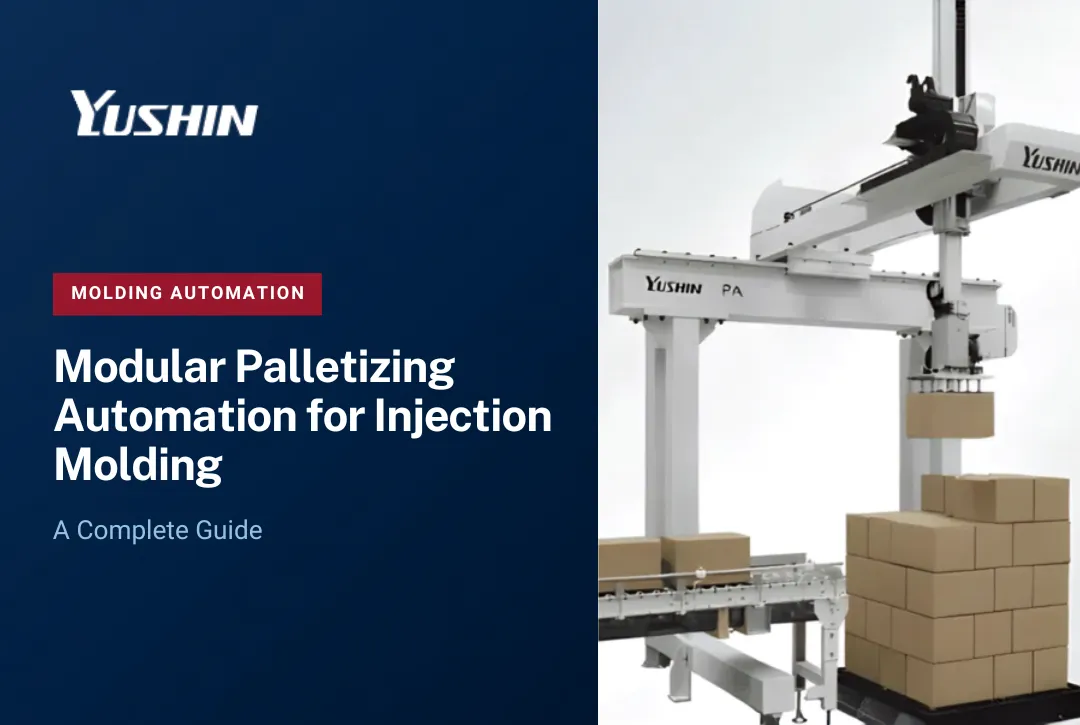
Yushin America's engineering team provides custom end-of-arm tooling design as part of the PA series palletizing robot offering — evaluating each application and building tooling suited to the specific product and packaging format.

Software and Controller Integration

The palletizing software manages more than arm movement. Controllers calculate stacking patterns, store multiple product recipes, and coordinate with conveyor systems and downstream equipment.

Yushin's E-touch Compact controller drives the PA series robots and handles the full scope of palletizing logic. Key capabilities include:

  • Automatically calculates optimal palletizing patterns for each product recipe
  • Stores multiple recipes for fast changeovers between product lines
  • Includes an Automap feature that detects pallet position changes and triggers Auto-Run Start — no manual recalibration required
  • 7.5-inch touchscreen interface designed for straightforward operation, reducing training time for new operators

Types of Automated Palletizing Systems for Food & Beverage

Robotic Arm Palletizers

Robotic arm systems are the most versatile option for F&B operations. Six-axis arms handle complex stacking patterns, mixed SKU loads, and irregular packaging formats — making them the right choice for facilities with diverse product lines or frequent changeovers.

Compact robotic palletizers, such as Yushin America's PA series, add footprint flexibility to the equation. The PA-40 reaches 420 boxes per hour at up to 40 kg payload (including end-of-arm tooling), with a cantilever structure that minimizes floor space and allows free layout — useful in facilities where production space is limited. The PA-20 handles payloads from 15 kg to less than 35 kg for lighter applications.

Both models use the E-touch Compact controller with automatic pattern calculation, making SKU changeovers faster and less dependent on specialist programming.

Yushin PA series compact robotic palletizer with E-touch Compact controller on production floor

Layer Palletizers

Layer palletizers stack entire product layers at once rather than individual cases. This approach delivers exceptional throughput for uniform, high-volume products — beverage cases or standardized packaged food formats running at consistent volume are typical applications.

The tradeoff is flexibility. Layer palletizers excel at speed for single-format, high-volume production but require more significant reconfiguration when product formats change. They're best suited for dedicated production lines with limited SKU variety.

Collaborative Robots (Cobots)

For facilities that need throughput gains without committing to a dedicated high-volume line, cobots offer an accessible starting point. Mid-size F&B producers and first-time end-of-line automation projects benefit from:

  • Smaller footprint with no safety cage required in many configurations
  • Simpler programming and faster deployment
  • Side-by-side operation with human workers without full line reconfiguration

Cascade Coffee's rollout shows what's possible: six cobot units installed in roughly six weeks, handling 2,500 to 6,500 cases per day per line — while cutting end-line operator turnover that had previously exceeded 60%.


Key Benefits of Automated Palletizing for Food & Beverage

Throughput and Consistency

The speed gap between manual and robotic palletizing is significant. Manual crews average 3–6 cases per minute; modern palletizing robots — including Yushin's PA-series systems — reach up to 30 cases per minute, with certain configurations running higher for specific applications.

More practically, robotic systems don't slow down at the end of a shift. They deliver the same performance at hour eight as hour one — eliminating the throughput variability that manual operations introduce.

Manual versus robotic palletizing speed comparison showing cases per minute throughput gap

Labor Cost Reduction and Workforce Redeployment

Automated palletizing reduces direct headcount at end-of-line stacking, cutting wage costs and eliminating overtime dependency during peak production periods.

The benefit extends beyond cost reduction. Workers moved off palletizing roles can be redeployed to positions requiring judgment and skill — supporting better satisfaction and retention across the facility.

Workplace Safety

Palletizing automation eliminates the primary injury exposure at end-of-line operations. Removing the repetitive heavy lifting task — the leading cause of MSDs in manufacturing — directly reduces workers' compensation claims and the operational disruption that comes with workforce injuries.

At an average workers' comp claim cost of $47,316, even preventing a handful of incidents annually generates meaningful financial return.

Product Quality and Load Stability

Consistent robotic placement creates uniform, stable pallet loads that resist shifting in transit. Research from Packaging Digest indicates up to 11% of unit loads arriving at distribution centers show some level of case damage, with rejection of unstable loads costing more than $1,000 per pallet. Robotic palletizing eliminates that stacking inconsistency by placing every case to spec, every cycle.

Food Safety and Compliance

Load stability addresses structural damage — but in food & beverage, the compliance stakes go further. Automated systems minimize human contact with finished product, reduce contamination pathways, and generate detailed handling logs with timestamps and lot-level data.

For facilities operating under 21 CFR Part 117, robotic systems built to food-grade specifications satisfy sanitary maintenance requirements more consistently than manual handling. That same documentation supports HACCP compliance and provides the audit trail FDA inspectors and third-party certification bodies expect.


How to Select the Right Automated Palletizing Solution

Start With Your Operation's Requirements

Before evaluating specific systems, document:

  • Current and projected throughput volumes — cases or bags per hour, per shift
  • SKU count and changeover frequency — how often product formats change
  • Product characteristics — weight range, fragility, packaging format
  • Floor space constraints — available footprint for the palletizing cell
  • Environmental conditions — ambient, chilled, or frozen

These factors drive which system type is appropriate. High-volume single-SKU beverage lines typically suit a layer palletizer. When a facility runs six different packaging formats with daily changeovers, a robotic arm or cobot system is the better fit.

Five-factor palletizing system selection criteria framework for food and beverage operations

Evaluate Integration Requirements

The palletizing system needs to communicate with existing conveyor infrastructure, packaging equipment, and any MES or WMS platforms in use. Protocol compatibility matters — systems that support common standards like EtherNet/IP allow integration with equipment from multiple manufacturers.

Key integration checkpoints to verify before purchase:

  • Communication protocols — confirm EtherNet/IP or equivalent support for your existing equipment
  • Conveyor hand-off points — upstream and downstream conveyor compatibility with the palletizing cell
  • WMS/MES connectivity — data exchange requirements for production tracking and inventory systems
  • Commissioning support — whether the supplier provides on-site engineers during startup

Yushin America's PA series supports standard industrial communication protocols, and technical service engineers are available across the US to support installation and commissioning in food and beverage production environments.

Assess Total Cost of Ownership

Purchase price is the starting point, not the full picture. Factor in:

  • Installation and commissioning
  • Programming and operator training
  • Ongoing maintenance and spare parts
  • Supplier service network coverage and response times

A system at the lower end of the purchase price range with limited local support can cost more over its operational life than a well-supported system at a higher initial price. Yushin America's nationwide service network, 24/7 phone support, and the predictive maintenance capabilities built into the E-touch Compact controller are all worth weighing against the capital cost.


Frequently Asked Questions

What is an automated palletizer?

An automated palletizer is a robotic or mechanical system that stacks products onto pallets for storage or shipping. It replaces manual labor with programmable machinery that delivers consistent speed, precision, and continuous operation, eliminating the fatigue, variability, and injury risk that come with manual stacking.

Can food production be automated?

Yes — food production including palletizing, packaging, sorting, and inspection is widely automated. Robotic systems are specifically designed to meet food safety and hygiene requirements, with food-grade materials and reduced human contact throughout the process.

What types of products can automated palletizers handle in food & beverage?

The range is broad — from fragile glass bottles and flexible pouches to heavy cases of canned goods and rigid injection-molded containers. The right end-of-arm tooling and system configuration determine what each palletizer handles. Yushin's application engineers can help match the right end-effector to the specific product.

How much does an automated palletizing system cost?

Entry-level palletizing robots start around $25,000–$50,000 for the robot itself, with installation and integration adding $15,000–$70,000 on top. Full robotic palletizing systems from integrators typically start in the $175,000–$300,000 range, and total cost of ownership (maintenance, parts, and support) should be factored into any purchase decision.

What food safety benefits does automated palletizing provide?

Automation reduces human contact with finished product, minimizes contamination pathways, and generates detailed handling logs with lot-level traceability data. This directly supports HACCP compliance, FDA inspection readiness, and third-party certification documentation.

How long does it take to implement an automated palletizing system?

Pre-engineered and cobot systems can be operational in weeks — Cascade Coffee went from order to six units running in roughly six to eight weeks. Fully custom installations take longer depending on integration complexity. Yushin's installation process is structured to minimize production disruption.