
What Is Small Scale Injection Molding?

Small scale injection molding typically means one or more of the following:
- Small IMM size: Machines from 30 to 100 tf, producing small parts or low-cavitation molds
- Low annual volumes: Annual production runs measured in thousands rather than hundreds of thousands of parts
- Prototype or bridge tooling: Aluminum or soft-steel molds used for early production before hardened production tooling is qualified
- Short runs with frequent mold changes: Operations with many SKUs, each running for short periods
- Specialty applications: Medical devices, electronics components, and similar applications where parts are small, precise, and often low-volume by design
Each of these scenarios has different automation economics and different application requirements.
When Automation Is Justified at Low Volumes

Low volume does not automatically mean no automation. Consider automation even at smaller scales when:
Operator safety is a concern. Even low-volume production on a small IMM requires the operator to reach into or near the mold area if manual handling is used. Take-out robots eliminate the operator from the mold zone entirely, regardless of production volume.
Part quality requires consistency. Small medical components, precision electronics parts, and insert-molded assemblies may require handling consistency that manual operation cannot reliably deliver—even at low volumes. Cosmetic defects, dimensional variation from inconsistent cooling during handling, and part damage from manual grip are real risks.
Multi-shift or unattended production. If the plant runs multiple shifts or wants to operate lightly staffed or unattended during overnight cycles, a take-out robot provides the coverage an operator cannot.
Insert loading or insert molding. Insert loading requires consistent insert placement and part extraction on every cycle. Manual insert loading can be slower, less repeatable, and more operator-dependent, while also requiring operators to work near the mold area. A take-out robot with engineered EOAT and servo wrist capability handles this more reliably.
Plans to scale production. If a small-scale application is expected to grow, integrating a robot early avoids the disruption of retrofitting automation later. It also allows the automation system to be sized for where production is going, not just where it is today.
Repetitive ergonomic risk. Even at modest cycle rates, repetitive reach-in-and-extract handling causes cumulative ergonomic strain. This is a real risk in small-IMM cells where operators are working close to the machine continuously.
When Automation May Not Be Justified
Be honest about cases where automation does not make economic sense:
- True prototyping and one-off runs: If a mold will be used for 50–500 parts before being replaced, robot integration cost and setup time are difficult to justify.
- Extreme mold-change frequency with very different part geometries: If the cell changes molds multiple times per day across very different parts, EOAT changeover complexity may reduce the efficiency gains from automation.
- Very short production windows with no repeat: If the application is one-time or very infrequent, the capital investment and programming time are hard to recover.
- Budget constraints that do not allow proper EOAT design: A robot with generic or poorly designed EOAT on a small-cell application causes more problems than it solves. If budget does not allow proper EOAT engineering, manual handling may produce better results.
Application engineering note: The honest answer is not "always automate" or "never automate at low volume." It is: analyze the specific part, mold, cycle time, shift structure, volume growth projection, and safety requirements before deciding.
Automation Solutions for Small-Scale Injection Molding
YD-0310 Compact Take-Out Robot for Small IMMs

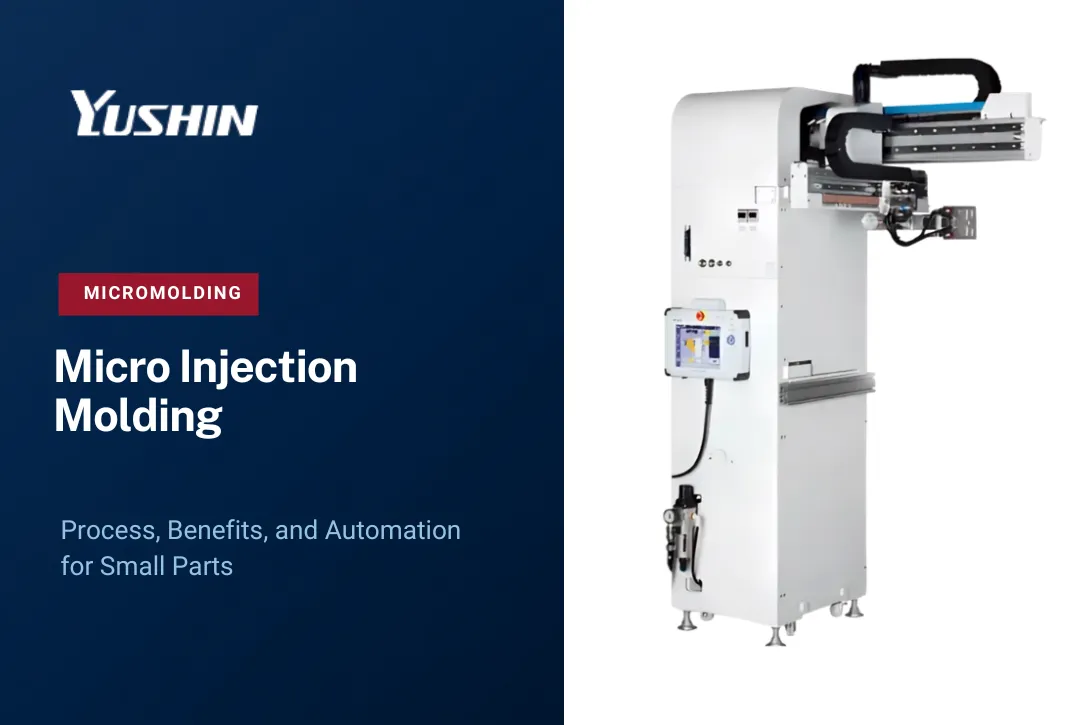
For small injection molding machines—30 to 100 tf clamp force—Yushin's YD-0310 is the compact take-out robot designed for this range.
Verified specifications:
- Target IMM clamp force: 30–100 tf
- Digital servo motor
- E-touch Compact 3 controller
- Working air pressure: 0.49 MPa
- 90° flip angle
- Standard payload: 3 kg including EOAT (YD-0310 source)
The YD-0310 is appropriate for small-part production on compact machines: medical components, electronics parts, small consumer goods, and similar applications where the IMM is in the 30–100 tf range and part and EOAT weights are within the 3 kg payload.
YD/YD2 Series for Broader Small-to-Mid Range
For applications slightly above the YD-0310 range—or where parts are larger but the molding machine is still modest in size—the YD/YD2 Series standard take-out robots cover IMMs from 30 tf through larger ranges with higher payload capability.
Insert Loading and Complex Orientation at Small Scale
Some small-scale applications involve insert molding, where an insert must be placed into the mold before each cycle. Even at low volumes, insert loading benefits from automation: consistent insert placement is difficult to achieve manually at production rates, and operators are exposed to the mold area on every cycle during manual insertion.
Yushin supports insert loading applications through:
- Engineered EOAT designed for the specific insert geometry and grip requirements
- NC servo wrist units in A/C, B/C, or A/B/C configurations for controlled insert orientation
- Application engineering support for EOAT, servo wrist configuration, and operator workflow
Insert molding is an important Yushin America capability even in small-scale applications. It requires deeper engineering review than standard part take-out—but that engineering review is exactly what Yushin America provides.
Sprue Pickers for Cold-Runner Small-Scale Molds
For small-scale applications with cold-runner molds, runner removal can be handled by Yushin sprue pickers—including the miniHOP for compact cells where floor space and machine clearance are limited.
ROI Considerations for Small-Scale Automation

At low volumes, payback timelines for automation are longer. A realistic ROI analysis for small-scale injection molding automation should include:
- Labor cost per shift: If the cell requires a dedicated operator, the cost of that coverage over 1–3 years is substantial even at low production rates.
- Part quality and scrap cost: If manual handling produces cosmetic defects or damage that requires sorting or scrap, the defect cost may be significant even at modest volumes.
- Safety risk and compliance: Worker's compensation, ergonomic injury, and OSHA compliance costs are real even at low production volumes.
- Growth trajectory: If the application is expected to scale, robot payback is calculated on future volume, not current volume.
There is no universal payback threshold for small-scale automation. Discuss the specific volume, shift structure, part value, and growth projection with Yushin America to evaluate whether automation is justified for your application.
Implementation and Support
Yushin America provides installation, EOAT engineering, operator training, field service, and parts support for all Yushin take-out robot systems, including compact small-cell configurations.
- 24/7 phone support: 888-707-6268
- Over $1.3M in spare parts inventory with overnight shipping
- Yushin University: Yushin robot training and programming
- Yushin America field service and support
Frequently Asked Questions
What IMM size qualifies as small scale for injection molding? Small-scale injection molding commonly refers to machines in the 30–100 tf clamp force range, though "small scale" can also describe low annual volumes or short-run production regardless of machine size. For robot selection, IMM clamp force and platen dimensions drive the traverse beam span and stroke requirements.
Does low-volume injection molding justify a take-out robot? It depends on the specific application. Low volume does not automatically rule out automation if operator safety, part quality consistency, insert loading, multi-shift coverage, or planned production growth are factors. A payback analysis based on actual labor cost, defect rate, and volume projection is the right starting point—not a blanket rule.
What take-out robot is designed for small injection molding machines? Yushin's YD-0310 compact take-out robot is designed for 30–100 tf injection molding machines with a 3 kg payload including EOAT. For slightly larger small-cell applications, the YD/YD2 Series covers a broader range. Confirm payload, stroke, and cycle requirements with Yushin America for your specific machine and part.
Can small-scale injection molding use insert molding automation? Yes. Insert loading benefits from automation even at low volumes because manual insert placement exposes operators to the mold area and introduces handling variation. Yushin supports insert molding applications with engineered EOAT and NC servo wrist configurations that provide controlled insert orientation. This requires application engineering review but is not limited to high-volume production.
What is the YD-0310 and what does it handle? The YD-0310 is Yushin's compact servo take-out robot for 30–100 tf injection molding machines. It has a 3 kg payload (including EOAT), a 90° flip axis, digital servo motor, and E-touch Compact 3 controller. It is appropriate for small medical, electronics, and consumer parts on compact machines.
Is it worth automating a cell that will run for only 6–12 months? Probably not for a one-time run. For short-run applications that will repeat across the same part or similar parts over multiple years, automation may be worth evaluating based on cumulative volume. For true one-off or very infrequent runs, manual handling and robot integration cost is difficult to justify.
Conclusion

Small scale injection molding includes a wide range of scenarios—some where automation is clearly justified, some where it is not. The decision is not about machine size or volume alone; it is about safety, quality, shift structure, insert requirements, and growth plans.
Yushin America can help you evaluate whether automation makes sense for your small-scale molding operation—what robot configuration, EOAT, and servo wrist setup fit your part, volume, and production environment. If your compact cell is dealing with operator safety concerns, insert loading challenges, or quality consistency issues, contact Yushin America to discuss the right approach for your application.