
Linear robots move along straight-line axes rather than rotating through joint angles - and in injection molding, this simple mechanical fact explains why they dominate part take-out applications. The mold opens along a defined path, the part sits at a predictable location, and the downstream placement point is fixed. Linear motion matches this structure directly. Yushin America has designed linear robots for injection molding take-out and downstream automation for over 35 years.

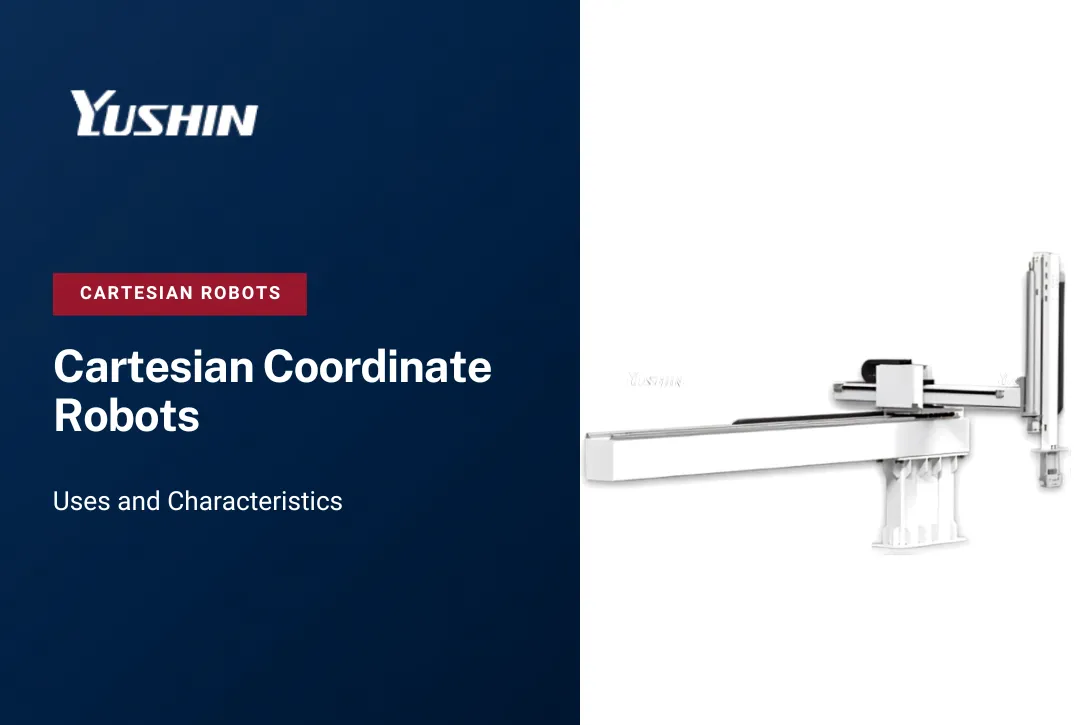
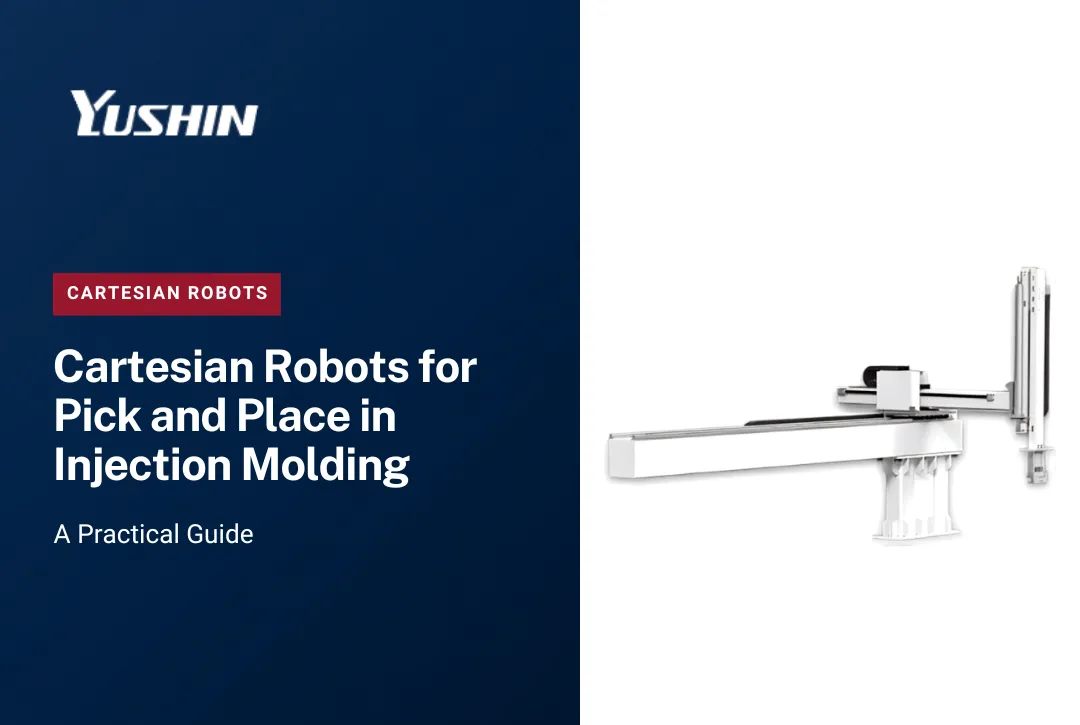
A linear robot moves along one or more straight-line axes - typically X (horizontal traverse), Y (horizontal kick or reach), and Z (vertical stroke). Each axis extends and retracts along a fixed path rather than rotating around a joint. This architecture is also called Cartesian, since the robot's position at any point is defined by its X, Y, Z coordinates.
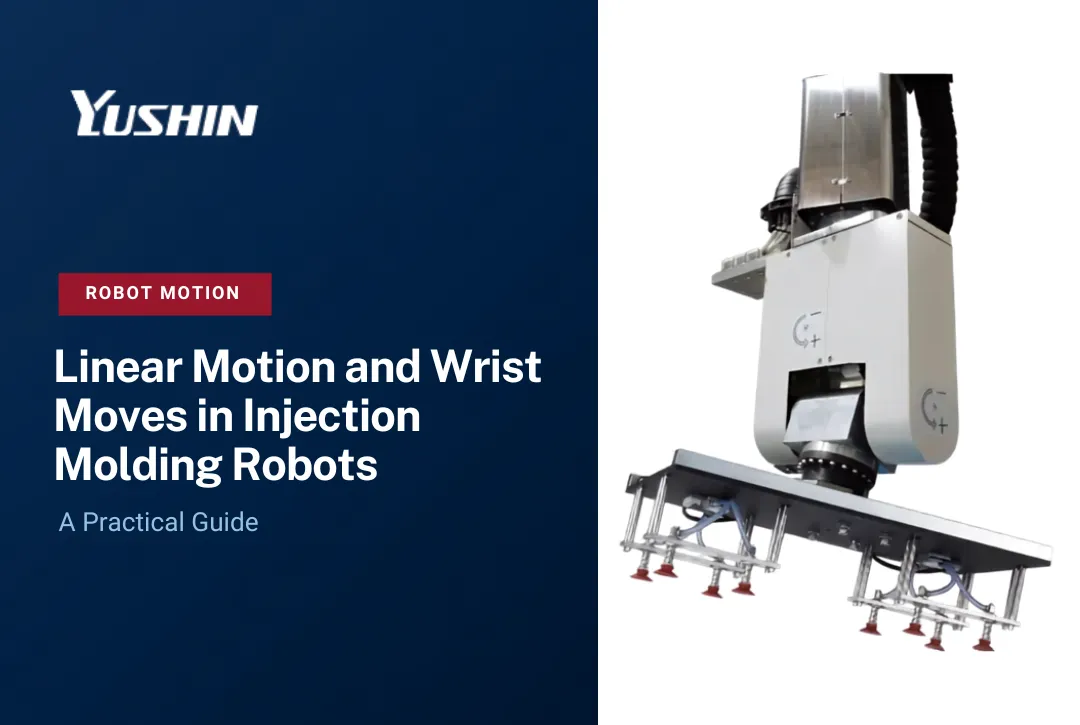
Additional axes can be added for orientation control - a flip axis for 180-degree rotation, or NC servo wrist units for more precise angular control - but the primary motion remains linear.
Application engineering note: "Linear robot," "Cartesian robot," and "gantry robot" all describe variations of the same fundamental architecture. In injection molding specifically, "take-out robot" is the application term for a linear robot performing part extraction.
Why Linear Motion Fits Injection Molding
Injection molding take-out is a structured task with defined, repeatable positions:
- The mold opens at a known position: The robot's vertical stroke can be sized precisely to reach into the mold space and no further.
- The part sits at a predictable location: No search or vision-guided positioning is typically needed for standard applications - the pick point is fixed.
- The downstream placement point is fixed: The traverse stroke moves the part to the same conveyor, fixture, or station on every cycle.
Because every position in this sequence is known and repeatable, linear axes are mechanically well matched to the task. They accelerate and decelerate efficiently over short, defined strokes, and they maintain positional accuracy without the cumulative joint-angle tolerances that articulated robots can introduce.
In injection molding and plastics processing, linear robots are widely used because they can deliver very fast take-out performance while staying straightforward to teach and maintain. Their motion matches the predictable geometry of the molding cell, and Yushin robots are designed specifically to synchronize with the injection molding machine for repeatable extraction and downstream handling.
Linear Robot Types Used in Injection Molding
Top-Entry Take-Out Robots
The most common configuration. The traverse axis spans the injection molding machine's platen. The vertical stroke descends into the open mold space from above; the horizontal kick axis positions the EOAT at the part.
Yushin solutions: YD/YD2 Series standard take-out robots (30-1,300 tf), RC-SE high-end high-speed take-out robot for fast-cycle applications, FRA Series high-end take-out robots for safety-critical and advanced cells.
Side-Entry Robots
Access the mold from the side rather than from above, used where overhead clearance is limited or where side entry offers a faster path for high-speed applications.
Yushin solutions: SX-41, SXB, SXC-HS, SXC, TSXA.
Sprue Pickers
Simplified linear robots designed specifically for runner and sprue removal in cold-runner molds - not for full part take-out.
Yushin solutions: HOP Five, N-HOP, miniHOP, V-HOP, V-HOP-II.
Robots for Vertical Injection Molding Machines
Vertical IMMs open the mold vertically rather than horizontally, requiring a different linear-axis entry geometry than standard horizontal-machine take-out robots.
Yushin solutions: SVR-C50, V-HOP, V-HOP-II.
Large Traverse Robots
For large molded parts on large machines, linear architecture scales through longer traverse beams, higher-payload servo drives, and multi-stage vertical arms.
Yushin solution: MKA-2000S large full-servo traverse robot - for 1,500+ tf machines, handles 30-50 kg including EOAT, traverse beam adjustable up to 5,000 mm.
Palletizing Robots
Downstream of the take-out robot, linear-axis palletizing robots stack packed or boxed molded parts at the end of the line.
Yushin solution: PA Series compact palletizing robot - PA-40 achieves up to 420 boxes/hour in a compact cantilever Cartesian layout.
How a Linear Take-Out Robot Cycle Works
- Mold opens at the end of the injection molding cycle
- Traverse axis positions the robot over the mold
- Vertical axis descends into the mold space
- EOAT grips the part (and runner, if applicable)
- Vertical axis retracts; part exits the mold space
- Traverse axis moves the part to the downstream placement position
- EOAT releases the part; robot returns to home position
- Mold closes; next cycle begins
Linear Robots vs. Articulated Robots for Injection Molding Take-Out

| Factor | Linear (Cartesian) | Articulated (6-axis) |
|---|---|---|
| Mold access | Direct vertical or lateral entry | Requires clear path around joint geometry |
| Programming | Axis-based, straightforward | Joint-angle programming, more complex for simple take-out |
| Speed at short strokes | High - efficient acceleration over defined distances | Optimized more for reach than short-stroke speed |
| Positional accuracy | High - no cumulative joint tolerances | High, but joint stacking introduces more error sources |
| Floor space | Minimal - overhead mounted | Requires floor or pedestal mount |
Articulated robots have applications in molding cells too - insert loading, complex assembly, or overmolding sequences that benefit from non-linear approach paths. For standard part take-out, linear robots remain the dominant choice because their motion matches the task structure directly.
Advanced Applications: Adding Orientation to Linear Robots

Insert loading, overmolding, and complex part orientation require more than straight-line extraction. Yushin's NC servo wrist units add A/C, B/C, or A/B/C rotational axes to linear take-out robots, giving them controlled orientation capability without abandoning the linear-axis architecture that handles the primary extraction task efficiently.
Some insert loading or overmolding applications require deeper engineering review, especially when insert geometry, mold access, or orientation requirements are complex. Yushin supports these applications through engineered EOAT, insert-handling tooling, and A/C, B/C, or A/B/C NC servo wrist units added to linear take-out robot platforms. Insert loading, overmolding, and complex orientation are advanced Yushin-supported applications, not reasons to reject linear take-out robots.
Selection Criteria for Linear Robots in Injection Molding
- IMM clamp force and platen size: Determines traverse beam span and stroke requirements
- Part weight plus EOAT weight: Total payload calculation
- Cycle time: Determines whether standard or high-speed linear axes are needed
- Mold access geometry: Top-entry, side-entry, or vertical-IMM configuration
- Runner/sprue handling: Cold-runner molds may need a separate sprue picker
- Orientation requirements: Determines whether NC servo wrist units should be added
- Downstream placement: Traverse stroke must reach the placement point within the cycle time
When a Linear Robot May Not Be the Right Fit
- Very low production volume: Automation payback may not be reached at low annual cycle counts, regardless of robot architecture.
- Highly variable part geometry with frequent mold changes: May require modular EOAT investment to keep changeover time manageable.
Implementation and Support
Yushin America provides installation, EOAT engineering, operator training, field service, and parts support for linear take-out robot systems across North America.
- Sales / Robot, EOAT and Custom Equipment Quotes: (401) 463-1800, Option 7 or Extension 3454
- 24/7 Technical Support: (888) 707-6268
- Over $1.3M in spare parts inventory with overnight shipping
- Yushin University: Yushin robot training and programming
- Yushin America field service and support
Frequently Asked Questions
What is a linear robot in injection molding? A linear robot moves along straight-line X, Y, and Z axes to extract molded parts from the mold and place them downstream. Most injection molding take-out robots use this architecture, also called Cartesian, because the task - fixed pick point, fixed placement point - matches linear motion directly.
What is the difference between a linear robot and a gantry robot? The terms describe the same fundamental architecture. A gantry robot is specifically a linear robot mounted on an overhead frame or bridge structure. Most top-entry take-out robots in injection molding are gantry-style linear robots.
Why are linear robots preferred over articulated robots for take-out? Linear robots match the fixed, repeatable geometry of the mold-to-downstream sequence. They accelerate efficiently over short strokes, maintain positional accuracy without cumulative joint tolerances, and require less floor space than articulated alternatives mounted on the floor.
Can linear robots handle insert loading and overmolding? Yes, when equipped with NC servo wrist units that add controlled orientation axes. These applications require additional engineering, but they are supported Yushin capabilities on linear robot platforms.
What payload range do linear take-out robots cover? Depending on the model, Yushin linear take-out robots cover roughly 3 kg (small IMMs, YD-0310) up to 50 kg including EOAT (large IMMs, MKA-2000S). Confirm payload requirements including EOAT weight with Yushin America for your specific application.
Do linear robots require a lot of floor space? No. Most linear take-out robots mount overhead on the IMM platen or on a beam structure, requiring minimal floor space within the molding cell. This is one practical advantage over floor-mounted articulated alternatives.
Conclusion
Linear robots are the dominant robot architecture in injection molding because their straight-line motion matches the fixed, repeatable structure of part extraction and downstream placement. From standard top-entry take-out to side-entry, sprue removal, vertical IMM applications, large-part handling, and end-of-line palletizing, Yushin America builds linear robot platforms across this full range.
If you are evaluating robot options for your molding cell, contact Yushin America to discuss which linear robot configuration fits your IMM, part, and production requirements.