
Thin wall injection molding produces parts with wall thicknesses typically around 1.0 mm, and often up to about 1.5 mm depending on part design and application, with cycle times that can fall under 5 seconds in high-cavitation tooling. At those cycle speeds, part removal is not a secondary concern—it is a primary one. The extraction window is short, parts are fragile immediately after ejection, and the robot must clear the mold before the next cycle begins. Yushin America has built high-speed take-out robots and engineered EOAT specifically for the demands of thin-wall and packaging molding applications. This article explains the process, the automation requirements it creates, and how to match the robot, EOAT, and downstream handling to the application.
What Is Thin Wall Injection Molding?

Thin wall injection molding is a process variant that produces plastic parts with wall thicknesses typically around 1.0 mm, and often up to about 1.5 mm depending on the part design and application, requiring high injection speeds and pressures to fill the mold cavity before the material freezes. It is widely used in packaging (cups, lids, containers), medical devices, electronics housings, and consumer goods where light weight, material cost reduction, and cycle-time efficiency are priorities.
The defining characteristics of thin-wall molding—compared to standard injection molding—are:
- Higher injection speeds and pressures to fill thin cavities before freeze-off
- Shorter cooling times because wall mass is low
- Shorter overall cycle times, often 3–8 seconds for packaging applications
- Higher cavitation (more cavities per mold) to increase output per cycle
- Greater sensitivity to part handling immediately after ejection—thin walls cool and set faster, but also distort more easily if gripped or placed incorrectly
Each of these characteristics creates specific requirements for take-out automation.
How Short Cycle Times Create Take-Out Challenges

In a standard molding cell with a 20–30 second cycle, the take-out robot has relatively generous time to enter, extract, and clear the mold. In thin-wall packaging at 4–6 second cycles, the take-out robot must complete the entire extraction sequence—entry, grip, retraction, and safety-gate clearance—within 1–3 seconds of available time.
This tight window creates several practical requirements:
- Robot entry and retraction must be fast. Slow axes and high settling times eat into the cycle window and force the mold to wait, reducing output.
- Axis settling must be controlled. A high-speed robot with poor vibration control will cause positioning errors at the pick point, leading to part damage or misgrip.
- EOAT must grip parts reliably at speed. Thin-wall parts cannot tolerate the grip force variation that would be acceptable on a thick-walled structural part.
- Downstream placement must match the cycle rate. If the take-out robot is fast but the conveyor or packaging station cannot keep pace, parts stack and jam.
Application engineering note: In thin-wall molding cells, take-out time is often the cycle-time constraint. A robot that cannot keep up with the mold is not just a nuisance—it is the limiting factor on plant output. Robot selection must start with cycle time, not payload.
Thin-Wall Molding: Where Automation Fits

The standard thin-wall molding cell automation sequence:
- Mold completes cycle and opens
- High-speed take-out robot enters the mold space
- EOAT contacts and grips parts (all cavities simultaneously in multi-cavity molds)
- Robot retracts; parts exit the mold space
- Robot traverses to placement position (conveyor, cooling station, inspection, stacking)
- EOAT releases parts to downstream process
- Robot clears safety gate; mold closes and begins next cycle
The robot's traverse speed, vertical stroke speed, settling time, and EOAT design all determine whether this sequence completes within the available extraction window.
Fragile Parts and EOAT Design for Thin-Wall Applications

Thin-wall parts are dimensionally unstable immediately after ejection. They are hot, flexible, and prone to deformation from incorrect grip pressure, uneven contact, or poorly timed release. EOAT for thin-wall applications must be designed around:
- Part geometry and contact area. Grippers must contact the part at stable, non-cosmetic surfaces. Vacuum cups must be positioned so suction does not deform the part wall.
- Grip force and release timing. Too much grip force collapses a thin wall; too little causes part drops and misplacement.
- Multi-cavity handling. In 8-, 16-, or 32-cavity molds, the EOAT must handle all parts simultaneously, with consistent grip across all cavities.
- Downstream placement accuracy. Parts must be released in consistent orientation for downstream stacking, lidding, inspection, or packaging.
Yushin America designs and builds EOAT as part of complete automation integration. For thin-wall packaging applications with high cavitation and short cycles, EOAT engineering is as important as robot selection.
Yushin High-Speed Take-Out Robots for Thin-Wall Molding

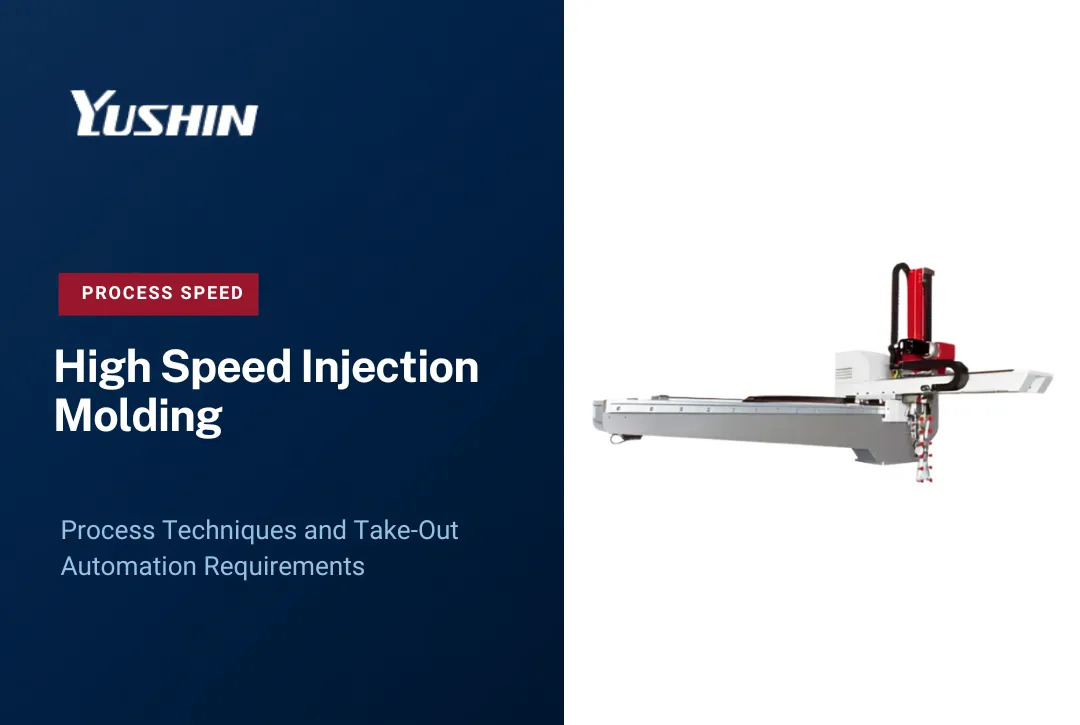
HSA-150S / HSA-250S — Super-High-Speed Take-Out Robots
The HSA series is designed specifically for thin-wall and high-speed molding applications.
- Target clamping force range: 100–300 tf
- 3-axis, dual-support, reduced-height configuration
- Take-out times as fast as 0.27 sec proven during live molding
- 13% lighter and 25% faster than previous models
- HSA-150S payload: 3 kg including EOAT
- HSA-250S payload: 5 kg including EOAT
For thin-wall packaging applications on 100–300 tf machines, the HSA series is the primary Yushin solution. (HSA-150S/250S source)
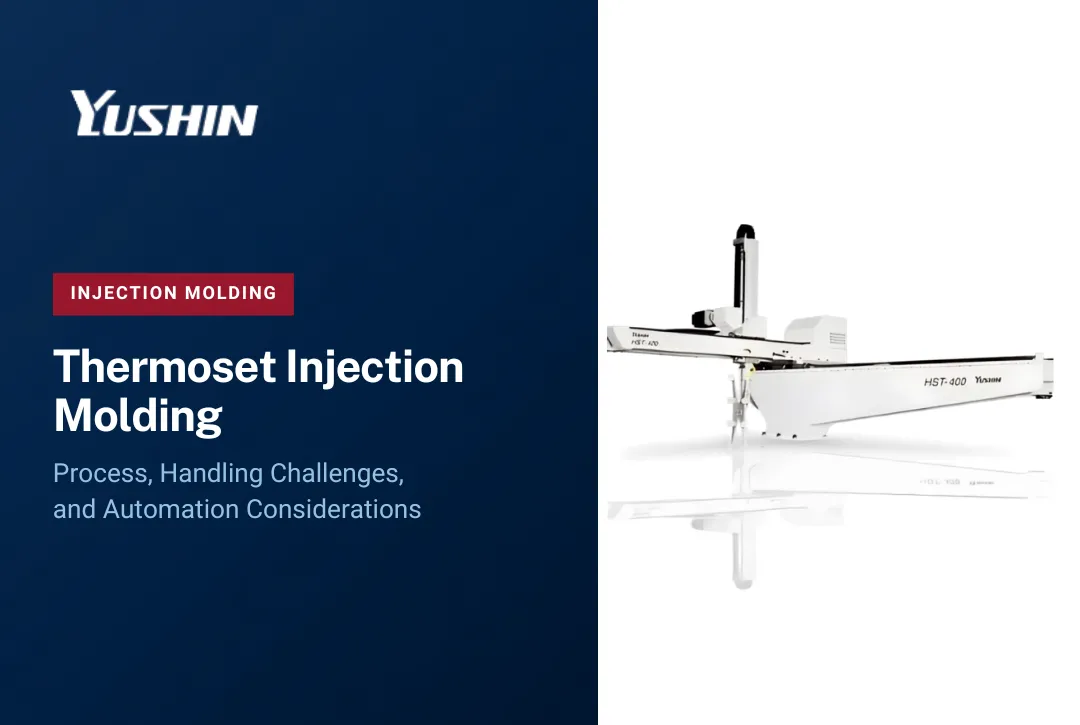
HST-400S/D/DS — High-Speed Take-Out Robot
For larger thin-wall applications on mid-range machines:
- Target IMM clamp capacity: 280–450 tf
- Payload: 10 kg including EOAT
- All-axis servo-driven with vibration control
- Low-posture double-speed mechanism
- 9.2% faster speeds and 25.4% lighter construction vs. prior models
- 98.6% reduced settling time vs. measured prior models
The HST-400 addresses thin-wall and fast-cycle applications on 280–450 tf machines where higher payload is needed for multi-cavity EOAT. (HST-400 source)
RC-SE — High-End High-Speed Take-Out Robot
For advanced molding operations requiring energy efficiency alongside speed:
- Targets IMMs from 30 to 1,300 tf
- Smart ECO Vacuum: up to 78% reduction in air consumption versus conventional vacuum systems
- Long Life Mode: 5% power reduction in Yushin in-house testing
- Vibration control and predictive maintenance positioning
The RC-SE high-end high-speed take-out robot is appropriate for thin-wall and packaging operations where energy cost reduction and predictive maintenance are selection criteria.
TSXA — Side-Entry Robot for High-Speed Applications
For cells where top-entry clearance is limited or where side-entry offers a speed advantage, Yushin's TSXA side-entry robot is available for high-speed molding applications.
Design Considerations That Affect Automation
Thin-wall mold design decisions directly affect automation requirements. Key factors:
- Gate placement and runner layout. Gate location affects where the part is held in the mold at cycle end and influences EOAT approach geometry.
- Ejector pin placement. Ejector pin positions must be compatible with EOAT contact surfaces; conflicting locations require EOAT redesign or timing adjustments.
- Cavitation. Higher cavitation increases EOAT complexity and payload requirements. A 32-cavity mold EOAT may weigh more than the parts it handles.
- Part draft and release. Thin-wall parts with low draft angles may require precise ejection timing coordination between the robot and the IMM to avoid part drag or damage.
- Mold temperature. Higher mold temperatures in some thin-wall processes affect cooling time and part stiffness at ejection—both of which influence EOAT design and grip timing.
Application engineering note: For thin-wall applications with complex EOAT requirements—high cavitation, fragile parts, downstream stacking—discuss EOAT design with Yushin America early in the project. EOAT engineering is the most application-specific part of the automation system.
When Standard Take-Out Robots Are Not the Right Fit for Thin-Wall Molding
Not every robot platform is suitable for thin-wall applications:
- Standard take-out robots without vibration control may settle too slowly for sub-5-second cycles.
- Robots with oversized traverse beams for the IMM size introduce unnecessary inertia and slow retraction.
- EOAT not designed for the specific part geometry will cause part damage, drops, or misplacement regardless of robot speed.
- Very high cavitation molds (32+ cavities) may require EOAT payloads that exceed standard high-speed robot ratings—confirm payload against EOAT weight, not just part weight.
For very low-volume thin-wall production, the capital cost of high-speed automation may not reach payback quickly. A volume and cycle-time analysis is recommended before selecting an automation platform.
Implementation and Support
Yushin America provides installation, EOAT engineering, operator training, field service, and parts support for all Yushin take-out robot systems. For thin-wall and packaging applications, Yushin's engineering team can work through EOAT design, downstream handling, and operator workflow requirements.
- 24/7 phone support: 888-707-6268
- Over $1.3M in spare parts inventory with overnight shipping available
- Yushin University online training: Yushin robot training and programming
For service details, visit Yushin America field service and support.
Frequently Asked Questions
What cycle times are typical in thin wall injection molding? Thin-wall packaging applications commonly run cycle times of 3–8 seconds. High-cavitation thin-wall molds for lids, cups, and containers can run as fast as 3–4 seconds. At these speeds, take-out robot selection must prioritize extraction time and settling time, not just payload.
What robot speed is needed for thin-wall injection molding take-out? The take-out robot must complete entry, grip, retraction, and clearance within the available extraction window—which may be as short as 1–2 seconds in fast-cycle molding. Yushin's HSA series achieves take-out times as fast as 0.27 seconds in live molding. Confirm take-out time requirements against your specific cycle when selecting a robot.
Why does EOAT design matter so much in thin-wall molding? Thin-wall parts are dimensionally unstable immediately after ejection—hot, flexible, and sensitive to grip force and contact geometry. EOAT that is not designed for the specific part, cavitation, and placement requirement will cause part damage, scrap, and cycle interruptions. In high-cavitation molds, EOAT weight also directly affects payload requirements and robot selection.
Can Yushin take-out robots handle multi-cavity thin-wall molds? Yes. Yushin designs EOAT for multi-cavity thin-wall applications. The EOAT must contact all cavities simultaneously with consistent grip, handle the combined part and tooling weight within the robot's rated payload, and release parts in consistent orientation for downstream processing. Confirm cavitation, part geometry, and payload with Yushin America for your specific application.
What is the difference between the HSA and HST series for thin-wall applications? The HSA-150S and HSA-250S target 100–300 tf machines with payloads up to 5 kg—suited for smaller thin-wall packaging molds. The HST-400S/D/DS targets 280–450 tf machines with 10 kg payload—suited for larger thin-wall molds or higher-cavitation EOAT. Both series include vibration control and fast-settling axis design. Confirm IMM clamp force, payload, and cycle time with Yushin America.
Does thin-wall injection molding require special downstream automation? Yes. Fast cycle rates require downstream conveyors, stacking stations, and packaging systems that can match the robot's output rate. A high-speed take-out robot feeding a slow or mismatched downstream station creates a bottleneck. Yushin America can discuss downstream automation requirements alongside robot and EOAT selection.
Conclusion
Thin wall injection molding creates specific and demanding automation requirements: short extraction windows, fragile parts at ejection, high-cavitation EOAT complexity, and downstream systems that must match the cycle rate. Standard take-out robots without speed optimization and vibration control are not the right platform for these applications.
If your plant is running thin-wall packaging, medical, or electronics molding and facing cycle-time pressure, part damage from manual or slow extraction, or downstream handling inconsistency, Yushin America can match the right high-speed take-out robot, EOAT design, and downstream handling to your mold and production requirements. Contact Yushin America to discuss your thin-wall molding application with an automation specialist.