
The Injection Molding Machine (IMM)

The injection molding machine is the core piece of equipment. It heats and injects molten plastic into a closed mold under pressure, cools the part, and opens the mold to release it. IMMs are classified by clamp force--the force that holds the mold closed during injection--expressed in tons (tf). Common classifications:
- Small machines: 30-100 tf -- small parts, medical components, electronics, consumer goods
- Mid-range machines: 100-500 tf -- standard production parts across industries
- Large machines: 500-1,300 tf -- automotive panels, appliance components, large structural parts
- Very large machines: 1,500 tf and above -- large automotive bumpers, industrial enclosures, large appliance panels
IMM clamp force is the primary parameter for matching a take-out robot to the molding machine. The traverse beam span, stroke lengths, and payload requirements of the robot are all driven by the IMM size.
Application engineering note: Yushin America does not sell IMMs. Yushin supports the automation layer--take-out robots, EOAT, downstream systems--that integrates with the molding machine to improve productivity.
The Mold
The mold is the tooling that gives the part its shape. It consists of two halves (cavity side and core side) mounted on the IMM platens. When the mold closes and injection occurs, plastic fills the cavity; when the mold opens, the part (and runner, if applicable) is released.
Mold design directly affects automation requirements:
- Number of cavities: Multi-cavity molds produce multiple parts per cycle. Take-out robot EOAT must handle all cavities simultaneously.
- Runner system: Cold-runner molds produce a runner/sprue that must be removed separately. Hot-runner molds eliminate the runner, simplifying automation.
- Gate location: Gate position affects where the part is held in the mold at cycle end and how the robot accesses it.
- Ejector pin layout: Must be compatible with EOAT contact surfaces.
Take-Out Robots

Take-out robots are Cartesian-axis automation systems that extract molded parts from the mold on every cycle and place them at downstream locations. They are the primary automation interface between the IMM and the downstream handling system.
Yushin America's take-out robot portfolio covers the full range of injection molding applications:
| Application | Yushin solution |
|---|---|
| Standard take-out, 30-1,300 tf | YD/YD2 Series standard take-out robots |
| High-speed take-out with energy efficiency | RC-SE high-end high-speed take-out robot |
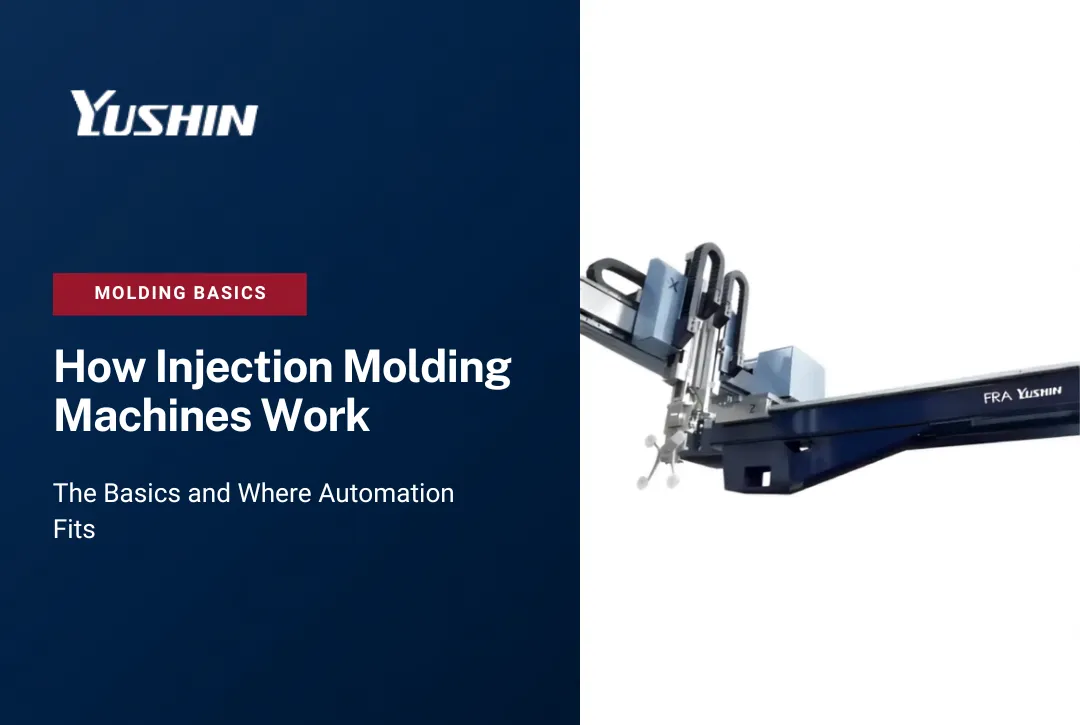
| Safety-certified high-end take-out | FRA Series high-end take-out robots |
| Small IMMs, 30-100 tf, compact cells | YD-0310 compact take-out robot (3 kg payload) |
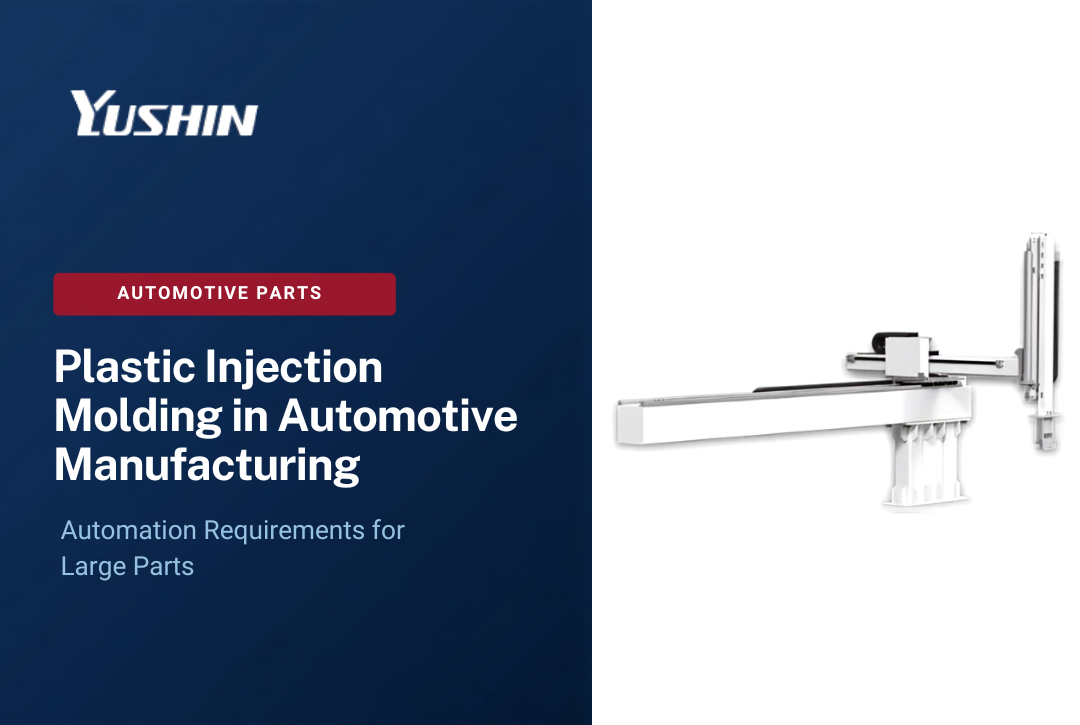
| Large parts, 1,500+ tf | MKA-2000S large full-servo traverse robot |
| Side-entry take-out | SX-41, SXB, SXC-HS, SXC, TSXA |
| Vertical IMM applications | SVR-C50, V-HOP, V-HOP-II |
Take-out robots are mounted on or adjacent to the IMM and do not require floor space within the cell envelope. They integrate with the IMM controller to synchronize robot motion with the mold open/close cycle.
End-of-Arm Tooling (EOAT)
EOAT is the gripper or fixture attached to the end of the robot's vertical arm. It is the direct interface between the robot and the molded part--and is as important as the robot itself for application success.
EOAT design is application-specific:
- Vacuum cups: Used for flat or gently curved surfaces where vacuum can be established
- Mechanical grippers: Used for parts with geometry that supports gripping without surface damage
- Combination tooling: Multi-cavity molds often require EOAT combining vacuum and mechanical elements
- Insert-handling tooling: For insert molding and overmolding, EOAT must handle both the insert and the finished part
EOAT weight is included in the robot's payload calculation. In multi-cavity molds, EOAT weight can exceed part weight--making EOAT engineering a primary driver of robot model selection.
Yushin America designs and builds EOAT as part of complete automation systems, including applications involving insert loading, overmolding, and complex part orientation supported by NC servo wrist units.
Sprue Pickers and Runner Removal
In cold-runner molds, the sprue and runner system must be removed from the mold separately from the molded parts. Sprue pickers are simplified Cartesian robots designed specifically for this task.
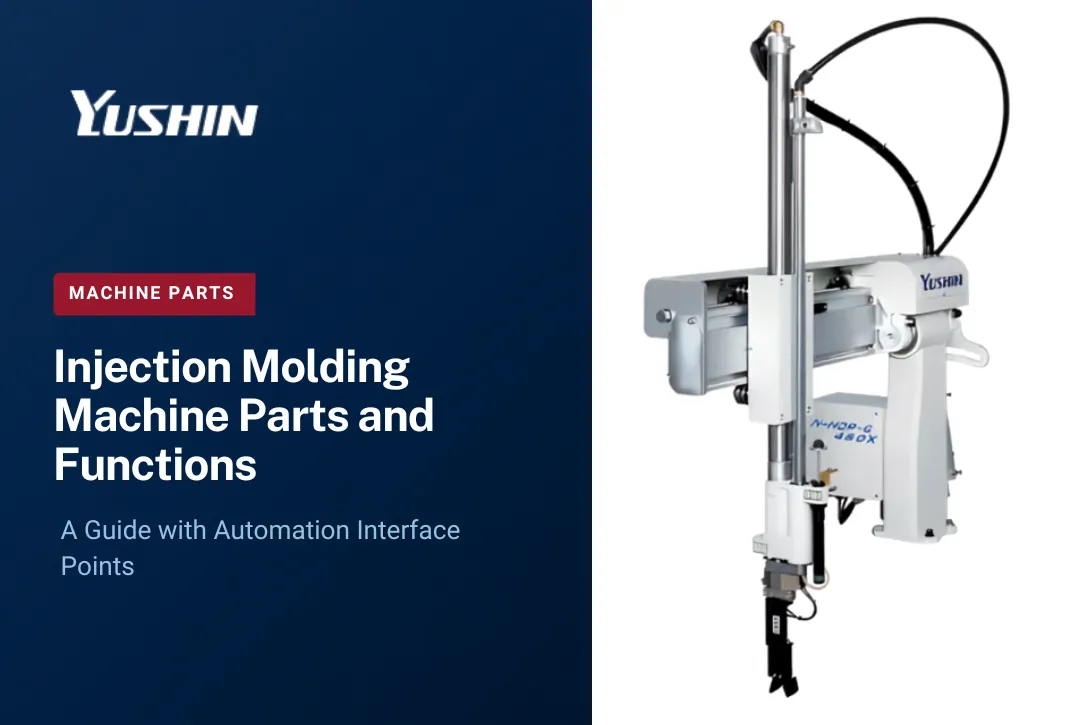
Yushin sprue picker product names include: HOP Five, N-HOP, miniHOP, V-HOP, V-HOP-II.
Sprue pickers are not interchangeable with full take-out robots--they are sized for runner/sprue handling only. In some cells, a full take-out robot handles the parts while a separate sprue picker handles the runner on a coordinated cycle.
Conveyors
Conveyors move parts from the take-out robot's placement position to downstream handling stations. Common conveyor configurations in injection molding cells:
- Belt conveyors: Move parts to cooling, inspection, or packing stations
- Cooling conveyors: Extended belt runs that allow parts to cool before packing
- Sorting conveyors: Separate parts by cavity or quality status
- Exit chutes: For small, robust parts that do not require controlled placement
Conveyor speed must match the molding cell's output rate. A take-out robot placing parts on a conveyor that cannot keep pace creates downstream backlog.
Auxiliary Equipment

A complete injection molding cell also includes:
- Dryers: Condition resin before processing to prevent moisture-related defects. Required for hygroscopic materials.
- Temperature controllers (TCUs): Maintain mold temperature for consistent part quality and cycle time.
- Granulators: Grind runners, sprues, and reject parts for reclaim or disposal.
- Material handling: Vacuum loaders, blenders, and hopper systems for resin delivery and color dosing.
These systems are upstream of the molding cycle. They affect material quality and process consistency but are not Yushin's primary focus area.
Guarding and Safety Systems
Machine guarding protects operators from moving machine parts. Injection molding cells require guarding around the IMM clamping area, mold area, and robot work envelope.
Yushin's FRA Series high-end take-out robots include Safety Category 3 design with redundant safety circuits and speed monitoring, supporting compliance with EN/ISO 10218 and related machine safety standards.
Inspection and Quality Systems
Depending on the application, injection molding cells may include:
- Vision inspection systems: Automated cameras that check parts for defects, dimensions, or completeness
- Weight or force checks: Verify part completeness (e.g., insert presence)
- Leak testing: Medical and fluid-contact parts
Inspection stations are typically positioned downstream of the take-out robot, receiving parts from the conveyor before packing.
Downstream Packaging and Palletizing
At the end of the cell, parts are packed, cased, and palletized. For plants automating the palletizing step, Yushin's PA Series compact palletizing robot handles end-of-line case stacking in a compact Cartesian layout designed for the injection molding plant environment.
- PA-20: 20 kg payload
- PA-40: 40 kg payload including wrist/EOAT; up to 420 boxes/hour
- Automap automatic palletizing pattern calculation; E-touch Compact controller
Avoid the Bundle Blunder
The injection molding machine may be the primary piece of equipment in the cell, but that does not automatically make the IMM supplier the specialist in every surrounding system. Take-out robots, end-of-arm tooling, auxiliary equipment, conveyors, inspection systems, guarding, and downstream automation each require their own application expertise. Purchasing the entire cell as a single bundle may appear convenient, but buyers should still evaluate whether each supplier has the engineering experience, product performance, integration capability, and long-term support required for that part of the system. A successful molding cell should operate as one coordinated system, but each major component should be selected based on the expertise needed to perform its function.
Before accepting a bundled proposal, compare the robot's speed and rigidity, EOAT engineering, controller integration, maintenance access, spare-parts support, training, and downstream automation capabilities. The best IMM supplier is not necessarily the best robot or automation supplier.
Where Yushin America Fits in the Molding Cell

Yushin America provides the automation layer--not the molding machine, not the mold, and not the auxiliary processing equipment. Specifically:
| Cell element | Yushin's role |
|---|---|
| Take-out robot | Design, supply, install, service |
| EOAT | Design and build as part of system |
| Sprue pickers | Design, supply, install, service |
| NC servo wrist units | Design, supply for complex orientation |
| Downstream conveyors | Integration guidance and system support |
| Palletizing | PA Series compact palletizing robots |
| Safety guarding | Supply and integrate as part of cell |
| Controllers | Yushin E-touch controller family |
| Parts | Over $1.3M in spare parts inventory |
| Service | 24/7 support, field service across North America |
| Training | Yushin University online platform |
Implementation and Support
Yushin America supports the full automation layer of the injection molding cell--from take-out robot selection through EOAT engineering, downstream integration, installation, training, and long-term service.
- 24/7 phone support: 888-707-6268
- Parts: Yushin replacement parts -- over $1.3M in inventory with overnight shipping
- Training: Yushin robot training and programming -- Yushin University online platform
- Field service: Yushin America field service and support
Frequently Asked Questions
What is the primary equipment in an injection molding cell? The injection molding machine produces the part. The complete cell includes the mold, take-out robot, EOAT, sprue picker or runner removal, conveyor, auxiliary processing equipment (dryers, temperature controllers), guarding, inspection systems, and downstream packing/palletizing. Each element must be matched to the others for the cell to run efficiently.
Does Yushin America sell injection molding machines? No. Yushin America does not sell injection molding machines. Yushin provides the automation layer: take-out robots, EOAT, sprue pickers, NC servo wrist units, downstream automation, guarding, controllers, parts, service, and training for plastic injection molding operations.
How is a take-out robot selected for a specific injection molding machine? Take-out robot selection starts with the IMM clamp force and platen size, which determine the traverse beam span and required stroke lengths. Part weight plus EOAT weight determines payload requirements. Cycle time determines take-out speed requirements. Downstream placement requirements determine traverse length. Confirm sizing with Yushin America.
What is EOAT and why is it important? EOAT (end-of-arm tooling) is the gripper that contacts and holds the molded part during extraction and placement. It is designed specifically for each part geometry, surface, and downstream placement requirement. EOAT weight is included in the robot's payload rating. In multi-cavity molds, EOAT design is often the most application-specific engineering challenge in the automation system.
What is the difference between a sprue picker and a take-out robot? A take-out robot handles the full molded part--extracting it from the mold and placing it at a downstream location. A sprue picker handles the runner or sprue system in a cold-runner mold, removing it to a disposal or regrind point. Both are Cartesian robots, but they are sized and rated for different tasks and should not be substituted for each other.
What maintenance does injection molding cell automation require? Yushin take-out robots require routine preventative maintenance: axis lubrication, vacuum system inspection, EOAT wear checks, controller backup, and periodic axis calibration. Yushin America provides preventative maintenance services, in-house repairs, and 24/7 phone support. Over $1.3M in spare parts inventory and $2M in pre-assembled robot module inventory support fast repair turnaround.
Should all equipment in an injection molding cell be purchased from the IMM supplier? Not necessarily. An IMM supplier may be able to coordinate a bundled cell, but robots, EOAT, auxiliary equipment, and downstream automation require specialized engineering. Buyers should evaluate the capability and support behind each major component rather than assuming one supplier is the expert in every part of the cell.
Conclusion
An injection molding cell is a system of interdependent equipment. The IMM, mold, robot, EOAT, sprue picker, conveyor, and downstream handling systems all affect part quality, cycle time, and labor efficiency. Yushin America's role is the automation layer--providing take-out robots, EOAT, sprue pickers, palletizing robots, and the service and parts support that keeps the automation running.
If you are evaluating automation for a new molding cell, upgrading an existing cell, or troubleshooting production problems driven by inconsistent part handling, contact Yushin America to discuss the right automation configuration for your IMM, part requirements, and production goals.