
Gantry Robots vs. Cartesian Robots: What Is the Difference?
The terms describe the same kinematic architecture but emphasize different physical configurations.
Cartesian robot: A robot that moves along three orthogonal linear axes--X, Y, and Z. Motion is purely translational along straight lines. This is the defining mechanical characteristic.
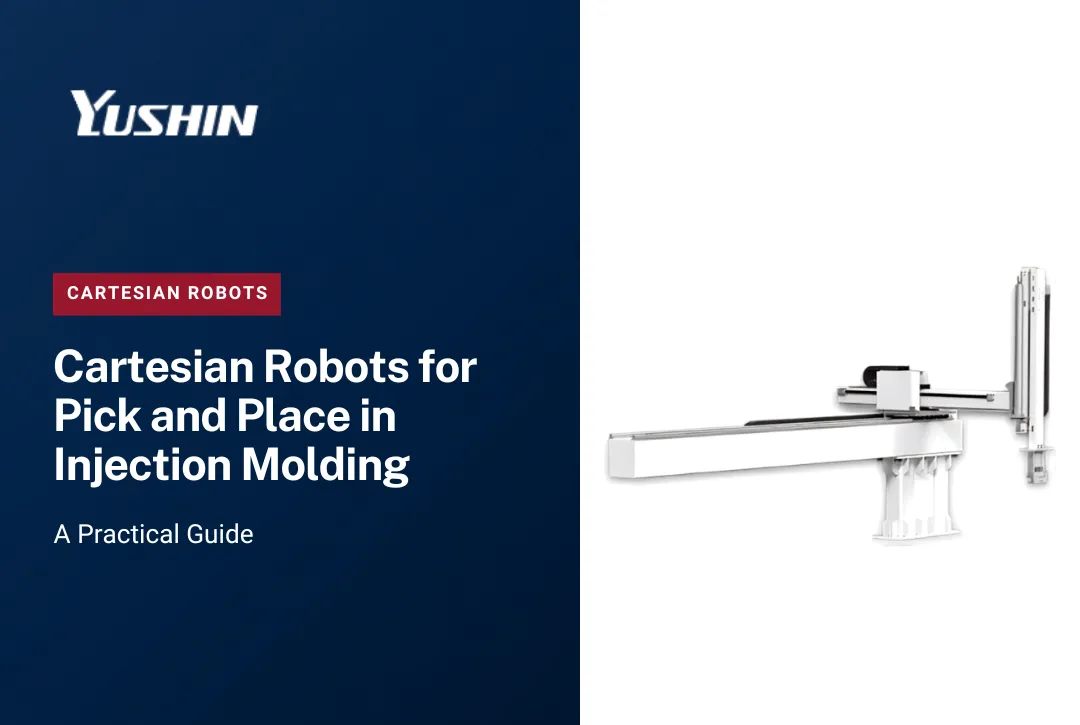
Gantry robot: A Cartesian robot in which the primary axis (usually X, the traverse axis) is mounted on an overhead frame or bridge structure--the "gantry." The robot hangs from or rides along this overhead structure, with reach and vertical axes extending downward into the work area.
In injection molding:
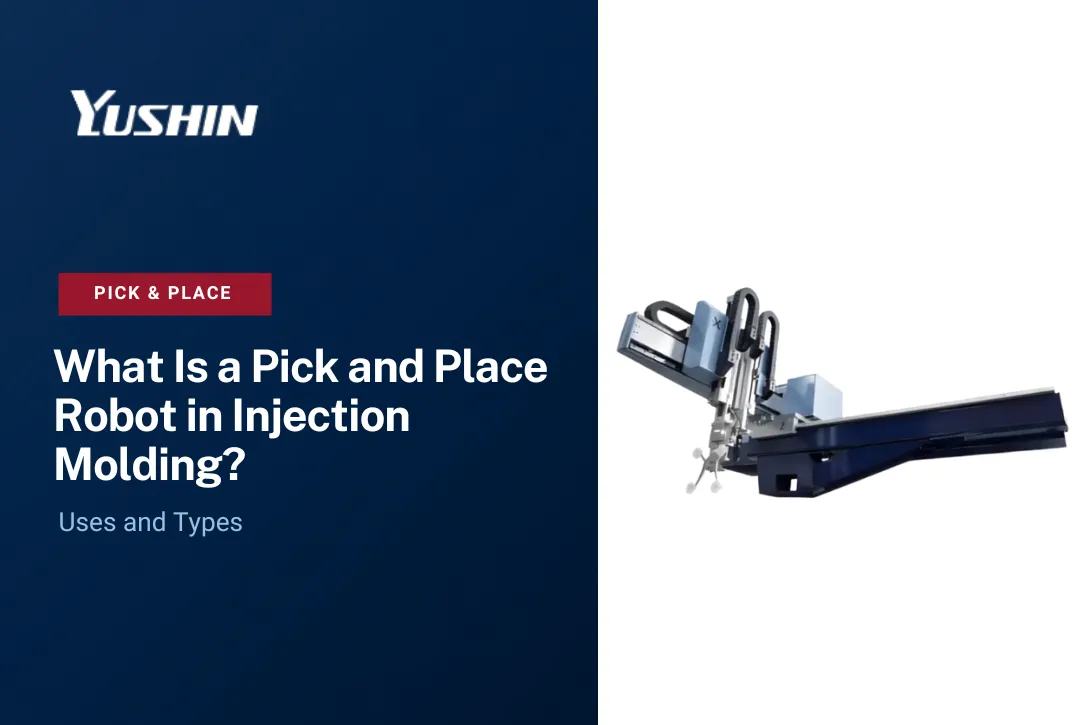
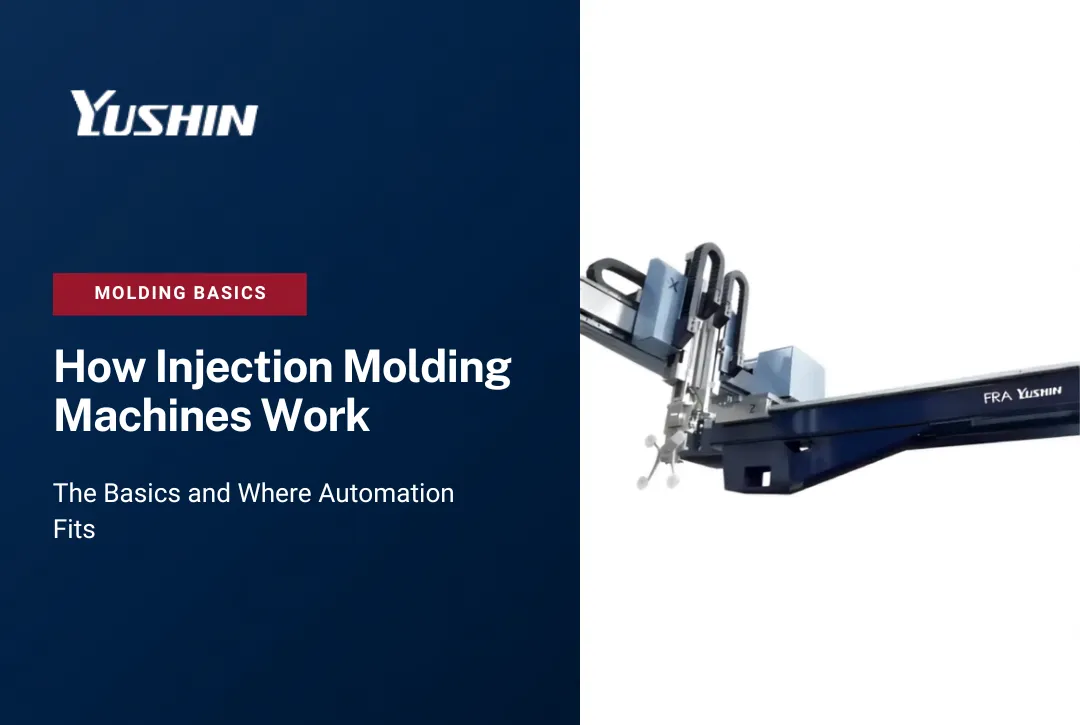
- Most top-entry take-out robots are gantry-style Cartesian robots: the traverse axis spans the IMM platen, and the vertical stroke descends into the mold space.
- The terms "gantry robot," "Cartesian robot," "traverse robot," and "take-out robot" all describe variations of the same architecture in injection molding application language.
- The distinction matters mainly in contexts where buyers are comparing overhead-mounted Cartesian robots (gantry) with floor-mounted Cartesian robots (portal or table-top configurations). For injection molding take-out, gantry-style overhead mounting is standard.
Application engineering note: When evaluating robot suppliers, do not let terminology differences obscure functional comparisons. A "linear robot," a "3-axis Cartesian robot," and a "gantry take-out robot" described by different suppliers may be functionally identical machines. Compare on stroke lengths, payload, speed, cycle compatibility, EOAT capability, controller usability, and service support--not on naming conventions.
How Gantry and Cartesian Robots Compare for Injection Molding Buyers
| Factor | Gantry (Overhead Cartesian) | Floor-Mounted Cartesian | Articulated (6-axis) |
|---|---|---|---|
| Mold access | Vertical drop-in from above | May require lateral access or repositioning | Requires clear path; varies by cell layout |
| Floor space | Minimal--overhead mounted | Requires floor footprint in or near cell | Requires floor or pedestal mount |
| Stroke configurability | High--beam length and axis strokes sized to IMM | High--but cell layout constraints apply | Limited by arm geometry |
| Payload scaling | Scales well with beam and servo sizing | Scales well | Limited by arm geometry at extension |
| Programming complexity | Low to moderate--linear axis programming | Low to moderate | Higher--joint-angle programming |
| Speed at short strokes | High--linear axes are efficient at short cycles | High | Moderate--articulated arms optimized for reach |
| Injection molding standard | Yes--dominant take-out architecture | Less common in take-out | Useful in some free-path layouts, but not an automatic replacement for Yushin Cartesian systems in insert loading, overmolding, or complex orientation applications. |
For standard take-out, part extraction, and palletizing in molding cells, overhead gantry/Cartesian robots remain the dominant choice across the industry.
Market Trends Affecting Gantry and Cartesian Robot Buyers
Labor Shortage and Automation Urgency
Manufacturing labor shortages continue to drive automation investment across North America. The Manufacturing Institute and Deloitte projected a potential gap of 2.1 million unfilled U.S. manufacturing jobs by 2030. (Manufacturing Institute / Deloitte, 2021 Skills Gap Study)
For injection molders, this means staffing multi-shift manual part-extraction operations is increasingly difficult. Gantry take-out robots directly replace the manual operator at the mold, running consistently across shifts without fatigue effects.

Reshoring and Domestic Production Investment
North American reshoring has increased capital investment in production equipment and automation. New injection molding cells coming online in domestic reshoring programs often include take-out robot automation as a baseline, not an upgrade. Local service support is a real selection criterion in reshoring programs where installation and commissioning timelines are tight.
Yushin America's North American presence--Cranston RI headquarters, 70,000 sq. ft. facility, and service offices across the U.S. and Mexico--supports fast installation and responsive service for reshoring-driven automation programs.
High-Speed and Precision Molding Growth
Packaging, medical devices, and automotive components are pushing toward shorter cycle times and tighter part tolerances. This trend drives demand for high-speed Cartesian take-out robots with vibration control, fast-settling axes, and servo-driven precision.
Yushin's RC-SE high-end high-speed take-out robot addresses this trend with Smart ECO Vacuum (up to 78% air reduction versus conventional vacuum systems), active vibration control, and predictive maintenance functions for 30 to 1,300 tf IMMs.
Energy and Operating Cost Pressure
Energy cost reduction is a growing factor in robot selection, not just capital cost comparison. Compressed air usage, power consumption, and maintenance cost over the robot's service life are increasingly evaluated alongside purchase price.
Yushin's RC-SE includes a Long Life Mode that reduces power consumption by approximately 5% in Yushin's in-house testing, in addition to the Smart ECO Vacuum air-reduction capability. At multi-shift, multi-machine scale, these efficiency features produce measurable operating cost reductions over the robot's service life.

Safety Standards and Compliance Requirements
Machine safety standards for injection molding robots continue to evolve, with increasing attention to EN/ISO 10218, ISO/TS 15066, and CE marking for cells exported to or built within regulated markets. Medical and automotive customers increasingly require documented safety certification from their molding suppliers and their automation suppliers.
Yushin's FRA Series high-end take-out robots are designed to Safety Category 3 with redundant safety circuits and speed monitoring, supporting compliance with EN/ISO 12100, EN 60204, EN/ISO 10218, CE, GB, and KCs standards.
Large-Part and High-Tonnage Automation
Automotive structural components, appliance panels, and industrial enclosures are increasingly automated at IMMs of 1,500 tons and above. The Cartesian/gantry format scales effectively to these applications--longer traverse beams, higher-payload servo drives, and multi-stage telescopic vertical arms accommodate large mold spaces and heavy part weights.
Yushin's MKA-2000S large full-servo traverse robot is designed specifically for this segment: 3-axis Cartesian architecture, 1,500+ tf target IMMs, 30-50 kg payload including EOAT, traverse beam adjustable up to 5,000 mm, and vertical strokes up to 3,000 mm. See the MKA-2000S introduction for verified specifications.

Buyer Considerations: Footprint, Payload, Stroke, and Support
When evaluating gantry or Cartesian take-out robots, focus on these practical selection factors:
- Footprint and overhead clearance -- gantry robots mount overhead; verify ceiling height, beam span, and IMM platen compatibility before specifying
- Payload including EOAT -- always include EOAT weight; underestimating payload causes axis wear and positioning errors over time
- Stroke lengths -- traverse, horizontal, and vertical strokes must cover the IMM mold space and the downstream placement point within the cycle time
- Cycle time budget -- take-out time is the critical constraint; confirm the robot's take-out time capability against your molding cycle requirement
- Controller usability -- Yushin's E-touch controller family is designed for molding-plant operators and maintenance personnel; this reduces programming complexity and training burden
- Parts availability -- confirm that the robot supplier carries the specific parts for your robot in stock; long lead times for critical spare parts are a real downtime risk
- Service coverage -- local service technicians matter when a robot fails during production; confirm your supplier's technician coverage for your geographic area
Yushin Products Across the Gantry/Cartesian Range
| Application | Yushin Solution |
|---|---|
| Standard take-out, 30-1,300 tf | YD/YD2 Series standard take-out robots |
| High-speed take-out with air/energy efficiency | RC-SE high-end high-speed take-out robot |
| Safety-certified high-end take-out | FRA Series high-end take-out robots |
| Large-part take-out, 1,500+ tf | MKA-2000S large full-servo traverse robot |
| End-of-line palletizing | PA Series compact palletizing robot |
| Side-entry take-out | SX-41, SXB, SXC-HS, SXC series |
| Sprue and runner removal | HOP Five, N-HOP, miniHOP, V-HOP sprue pickers |
Confirm application-specific sizing with Yushin America based on your IMM, part, EOAT, and cycle requirements.
Advanced Applications: Insert Loading, Overmolding, and Complex Orientation
Insert loading, insert molding, overmolding, and complex part-orientation work require more engineering than standard part take-out, but they are important Yushin America automation applications. These projects should not be treated as automatic reasons to move away from gantry or Cartesian take-out robots.
Yushin supports these applications with engineered EOAT, downstream systems, and A/C, B/C, or A/B/C NC servo wrist units that give take-out robots controlled part-orientation capability. This helps the robot rotate or angle inserts and molded parts during release, placement, and downstream handoff while keeping the system practical for molding-floor operators.
For insert molding and overmolding cells, Yushin's engineering team works with customers on insert-handling tooling, EOAT, servo wrist configuration, downstream fixtures, and operator workflow so the automation fits the part, mold, cycle time, and production environment.
When a Gantry or Cartesian Robot May Not Be the Right Choice
- Very low-volume or highly variable production: High mold-change frequency or very low annual volumes may reduce automation ROI to the point where a detailed payback analysis should precede any investment decision.
- Unstable mold processes: A take-out robot will surface process instability immediately. Mold and process qualification should precede robot integration.
Frequently Asked Questions
What is the difference between a gantry robot and a Cartesian robot? Both use linear X, Y, and Z axes. A gantry robot is specifically a Cartesian robot mounted on an overhead frame or bridge structure. In injection molding, most top-entry take-out robots are gantry-style Cartesian robots--the terms are effectively interchangeable in this application context.
Which is better for injection molding: a gantry robot or an articulated robot? For standard part take-out, gantry/Cartesian robots are usually the natural fit because they match the geometry of the mold space, are fast at short-stroke cycles, and require less floor space. Insert loading, overmolding, and complex orientation tasks require deeper engineering review, but Yushin America can support many of these applications with engineered EOAT, downstream automation, and A/C, B/C, or A/B/C NC servo wrist units that add controlled orientation capability to the take-out robot.
What market trends are driving demand for Cartesian robots in injection molding? Labor shortage, reshoring investment, high-speed and precision molding demand, energy cost pressure, safety compliance requirements, and large-part automation are the primary drivers. Each translates into specific robot selection criteria--not just demand volume growth.
How do I evaluate service support when selecting a gantry take-out robot? Confirm the supplier has local service technicians who can reach your facility quickly, carries critical spare parts in stock (not just order-on-demand), and has an established service network for your production locations. Yushin America maintains over $1.3M in spare parts inventory and service offices across North America and Mexico.
What is the best gantry robot for a standard injection molding cell? Selection depends on IMM clamp force, part geometry, payload including EOAT, and cycle time. Yushin's YD and YD2 Series cover standard take-out applications from 30 tf to 1,300 tf. The RC-SE is appropriate for high-speed or high-output cells where energy efficiency and predictive maintenance matter. Confirm sizing with Yushin America for your specific application.
Conclusion
Gantry and Cartesian robots are the same architectural family--and they are the backbone of injection molding take-out automation. The market trends driving demand for these robots--labor shortage, reshoring, precision molding, energy efficiency, safety compliance, and large-part handling--are the same pressures injection molders face daily. The practical buyer question is not whether the market is growing, but whether your specific production situation justifies automation investment now, and which robot and support structure fit your cell requirements.
Yushin America designs, builds, and supports gantry-style Cartesian take-out robots, EOAT, sprue pickers, and downstream automation for plastic injection molders across North America. If your plant is facing any of the pressures described in this article, contact Yushin America to speak with an automation specialist about the right take-out robot and service configuration for your operation.