
Productivity in an injection molding plant is not just about machine speed. It is the combined result of consistent part extraction, minimal downtime, low scrap, and efficient labor use across every cycle, every shift, every day. Automation affects all four of these factors directly. Yushin America has spent over 35 years building take-out robots, EOAT, and downstream automation systems that improve productivity in plastic injection molding cells—not by replacing the molding process, but by making part extraction and downstream handling consistent, fast, and serviceable over the long term.
What Drives Productivity in an Injection Molding Cell?

Productivity in injection molding is typically measured as good parts produced per hour, per shift, or per machine—not just cycles completed. Four factors determine this number:
- Cycle time: How fast the molding machine and take-out robot can complete a cycle
- Uptime: How much of the available production time the cell is actually running
- Scrap rate: How many parts are rejected due to damage, defects, or handling errors
- Labor efficiency: How much operator time is required per unit of output
Automation affects all four. A robot that extracts parts within the available mold-open window can reduce handling delays and help protect cycle time. A robot that runs reliably across shifts improves uptime. Consistent EOAT grip and placement reduces scrap. And removing manual handling from the extraction cycle reduces labor dependency per unit produced.
How Take-Out Robots Improve Cycle Time and Consistency

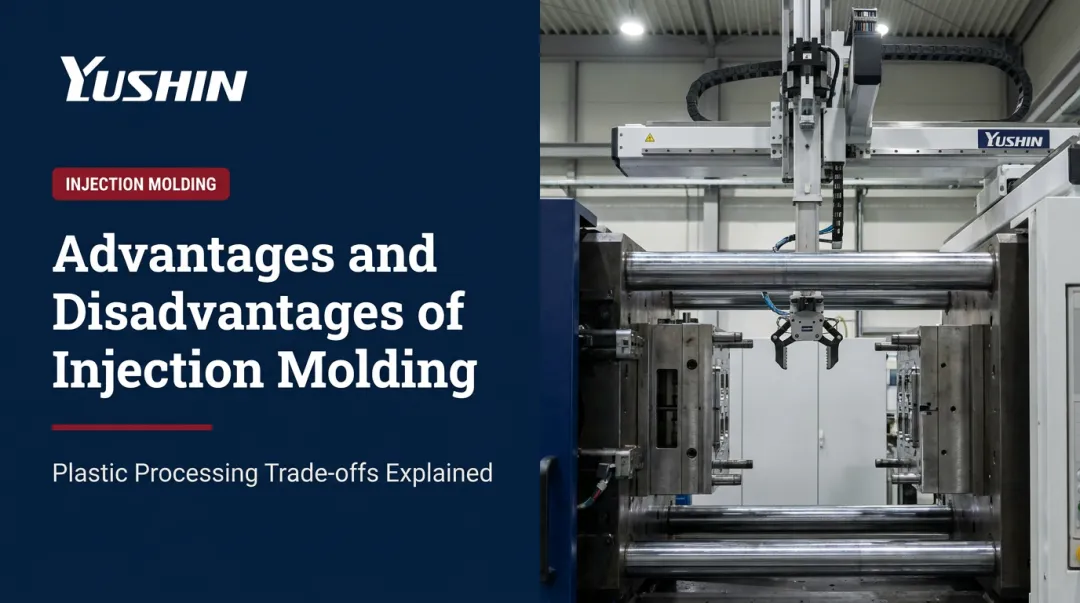
Manual part extraction introduces variability: operator fatigue, inconsistent reach-in timing, and variable grip force all affect cycle-to-cycle consistency. A take-out robot performs the same extraction sequence on every cycle—entry, grip, retraction, and placement—within the time window the molding cycle allows.
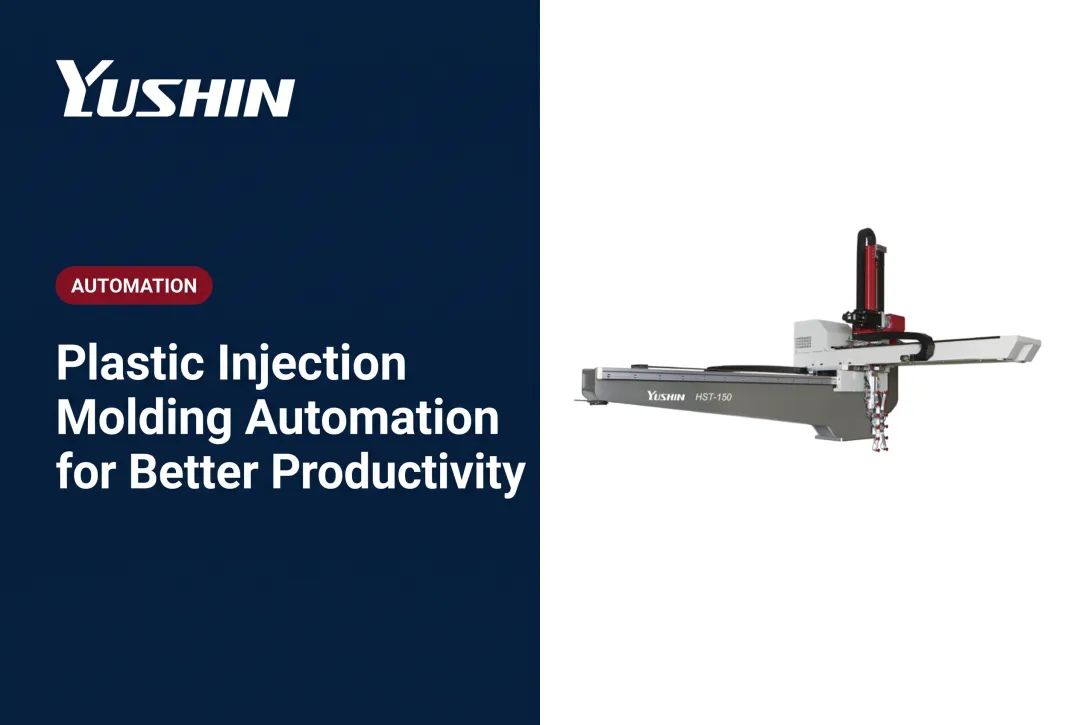
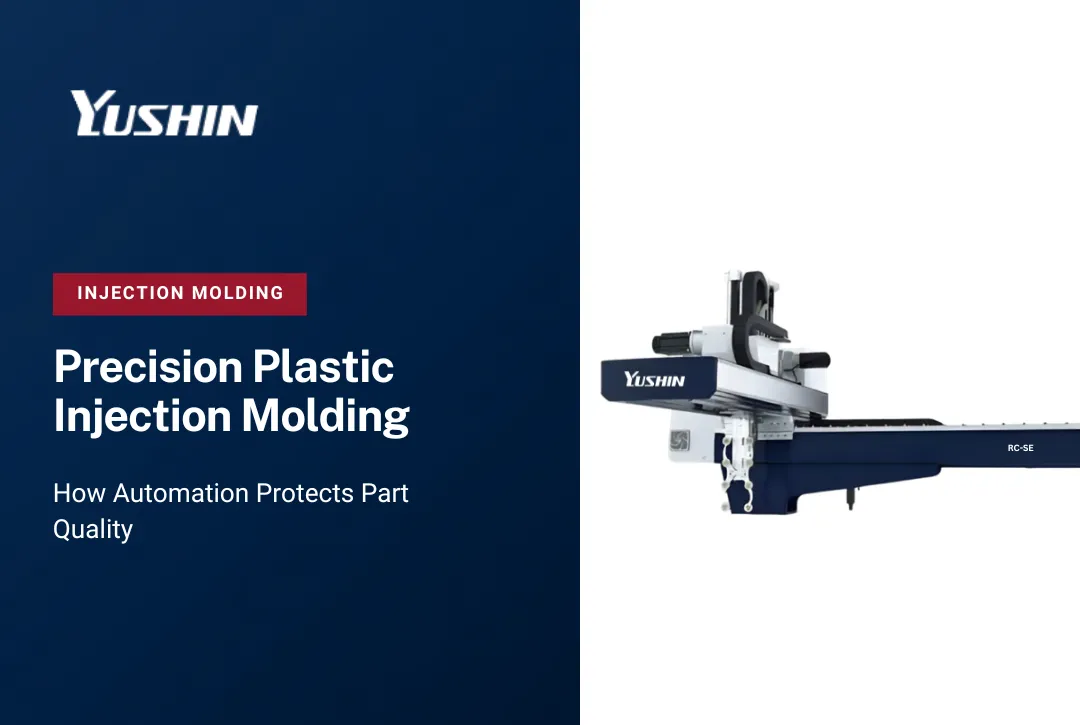
Yushin's YD/YD2 Series standard take-out robots cover 30–1,300 tf IMMs with consistent extraction timing. For applications where cycle speed is a bottleneck, the RC-SE high-end high-speed take-out robot adds vibration control and fast-settling axis design to reduce take-out time without sacrificing positioning accuracy.
Application engineering note: Cycle-time gains from automation are most visible in high-cavitation, short-cycle applications, where even small reductions in take-out time compound into significant annual output gains. Saving a fraction of a second per cycle on a fast-running mold can translate into meaningfully more parts produced per year.
How Automation Improves Uptime
Uptime is lost to unplanned downtime: mold jams, part-stuck-in-mold events, robot faults, and manual handling errors that damage tooling. Automation reduces several of these risks directly:
- Consistent extraction reduces mold damage risk. A robot that reliably clears the part on every cycle prevents the mold-crash events that occur when a part remains in the mold and the next shot begins.
- Predictive maintenance reduces unplanned robot downtime. Yushin's RC-SE and FRA Series include predictive maintenance positioning—monitoring axis performance and cycle data to flag developing issues before they cause a fault. This supports scheduled maintenance instead of emergency repairs.
- Fast service response limits downtime duration when issues do occur. Yushin America provides 24/7 phone support (888-707-6268) and maintains over $1.3M in spare parts inventory with overnight shipping, reducing the time a down robot stays down.
How EOAT and Consistent Handling Reduce Scrap

Scrap from handling—not from the molding process itself—is often underestimated. Parts dropped, dragged across mold surfaces, or gripped with excessive force during manual extraction generate cosmetic defects, dimensional issues, and outright rejects.
EOAT engineered for the specific part geometry addresses this directly:
- Consistent grip force across every cycle, including multi-cavity molds
- Contact points positioned to avoid cosmetic surfaces
- Release timing and orientation matched to downstream placement requirements
Yushin America designs EOAT as part of complete automation system integration—not as a generic accessory. For applications with fragile parts, high cavitation, or complex geometry, EOAT design is often the most application-specific part of the productivity improvement.
How Downstream Automation Extends Productivity Gains
Take-out robot consistency only helps if downstream handling keeps pace. A fast, reliable extraction cycle feeding into a bottlenecked packing or palletizing step does not improve overall plant output—it just moves the bottleneck downstream.
Yushin's PA Series compact palletizing robot extends automation to the end of the line: PA-40 handles up to 40 kg payload including EOAT and can achieve up to 420 boxes per hour, matching output rates for many mid-to-high volume molding cells. Sprue pickers (HOP Five, N-HOP, miniHOP, V-HOP) remove runners on cold-runner molds without interrupting the take-out robot's cycle.
Where Automation Reduces Labor Dependency
Automating part extraction does not eliminate the need for skilled labor—it changes what that labor does. Instead of manually reaching into a mold area every cycle, operators can:
- Monitor multiple cells simultaneously
- Handle quality inspection and process troubleshooting
- Manage material handling and changeovers
- Focus on higher-value production tasks
This shift matters most in labor-constrained plants running multiple shifts, where finding and retaining operators for repetitive manual extraction work is increasingly difficult. According to the Manufacturing Institute and Deloitte, the U.S. manufacturing sector could face a shortfall of 2.1 million unfilled jobs by 2030 if current trends continue. (Manufacturing Institute / Deloitte, 2021 Skills Gap Study)
Yushin Product Fit for Productivity Improvement

| Productivity factor | Yushin solution |
|---|---|
| Cycle time / speed | RC-SE high-end high-speed take-out robot |
| Standard extraction consistency | YD/YD2 Series standard take-out robots |
| Uptime / predictive maintenance | RC-SE and FRA Series high-end take-out robots |
| Scrap reduction / EOAT | Engineered EOAT across all take-out robot models |
| Insert loading, overmolding, complex orientation | NC servo wrist units |
| Large-part handling | MKA-2000S large full-servo traverse robot |
| End-of-line throughput | PA Series compact palletizing robot |
| Runner/sprue handling without cycle interruption | HOP Five, N-HOP, miniHOP, V-HOP sprue pickers |
Advanced Applications: Insert Loading, Overmolding, and Complex Orientation
Insert loading, insert molding, and overmolding applications are common productivity bottlenecks when handled manually—consistent insert placement is difficult to sustain at production rates, and manual insertion exposes operators to the mold area on every cycle. Yushin supports these applications through engineered EOAT, downstream fixtures, and A/C, B/C, or A/B/C NC servo wrist units that add controlled part-orientation capability to the take-out robot. These applications require deeper engineering review, but they are an important part of Yushin America's productivity-improvement capability—not a limitation.
When Automation May Not Improve Productivity
Automation is not automatically a productivity win in every scenario:
- Very low production volume: If annual cycles are too low, the capital and integration cost may not be recovered through productivity gains within a reasonable timeframe.
- Highly variable part geometry with frequent changeovers: If changeover time between molds exceeds the productivity gain from automated extraction, the net benefit may be marginal without additional EOAT investment.
- Already-stable, low-defect manual cells: If a manual cell is already running with low scrap and stable staffing, the marginal productivity gain from automation should be weighed against the investment required.
- Unstable molding processes: If the mold itself produces inconsistent parts, automating extraction will not fix the root cause. Process stabilization should come first.
Implementation and Support
Yushin America provides installation, EOAT engineering, operator training, field service, and parts support across North America to keep automation systems running at their productivity potential.
- 24/7 phone support: 888-707-6268
- Over $1.3M in spare parts inventory with overnight shipping
- Yushin University: Yushin robot training and programming
- Yushin America field service and support
Frequently Asked Questions
How much does a take-out robot improve productivity in injection molding? The productivity impact depends on cycle time, current scrap rate, uptime losses from manual handling errors, and labor cost per shift. Gains typically come from faster, more consistent extraction, reduced scrap from handling damage, and reduced labor dependency. Confirm expected gains for your specific application with Yushin America.
Does automation reduce scrap in injection molding? Yes, when EOAT is properly designed for the part. Consistent grip force, contact placement, and release timing reduce part damage that occurs from manual handling variation. Scrap reduction is one of the more measurable productivity benefits of take-out robot automation.
How does predictive maintenance improve uptime? Predictive maintenance monitors robot axis performance, vibration, and cycle data to flag developing issues before they cause a failure. This allows maintenance to be scheduled proactively rather than performed as emergency repair after a breakdown, reducing unplanned downtime. Yushin's RC-SE and FRA Series include predictive maintenance positioning.
Can automation help with labor shortages in injection molding plants? Yes. Take-out robots remove the need for a dedicated operator at the mold for every extraction cycle, allowing existing staff to cover more cells, handle quality and troubleshooting tasks, or reduce headcount dependency for repetitive manual work. This is particularly relevant for plants running multiple shifts.
Is automation always the right productivity investment? Not always. Very low-volume production, highly variable part geometries with frequent changeovers, or already-efficient manual cells may not see proportional productivity gains from automation investment. A specific ROI analysis based on your cycle time, labor cost, and scrap rate is the right way to evaluate the decision.
What is the fastest way to improve productivity in an existing molding cell? Start with the biggest bottleneck: if scrap from handling damage is high, focus on EOAT design. If cycle time is the constraint, evaluate a high-speed take-out robot. If downtime is the issue, look at predictive maintenance and service response time. Yushin America can help identify where automation investment will have the most impact for your specific cell.
Conclusion
Productivity in injection molding comes from the combination of cycle time, uptime, scrap rate, and labor efficiency—and automation affects all four. Take-out robots deliver consistent extraction, EOAT reduces handling-related scrap, predictive maintenance improves uptime, and downstream automation extends the gains to the end of the line.
If your plant is facing productivity pressure from inconsistent extraction, scrap, downtime, or labor constraints, contact Yushin America to discuss the right take-out robot, EOAT, and downstream automation configuration for your molding cell.