
In general industrial robotics, a "7th axis" typically refers to an added, independently controlled motion axis beyond a robot's base configuration - commonly a linear rail that extends an articulated robot's reach, or an additional rotational axis for orientation control. In injection molding automation, the more useful question is not how many axes a robot has, but whether an added axis actually solves a real handling problem in your specific molding cell. Yushin America's take-out robots address this through NC servo wrist units - added orientation axes that solve specific application problems, not axis count as a marketing number.
What "Extra Axis" Means in General Robotics

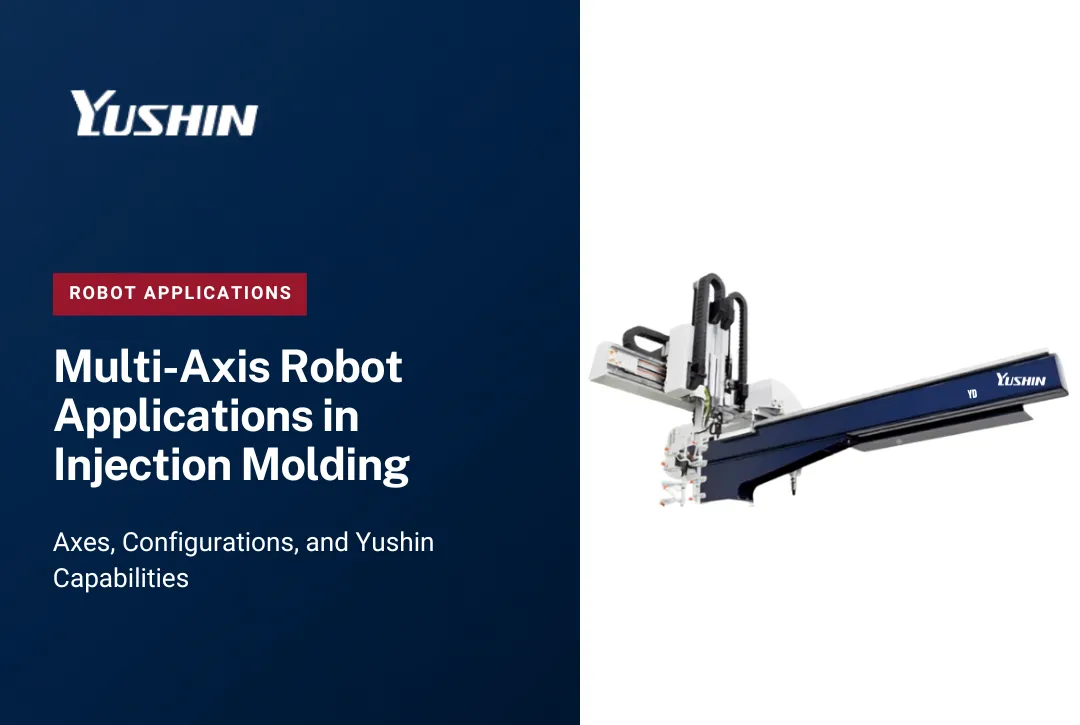
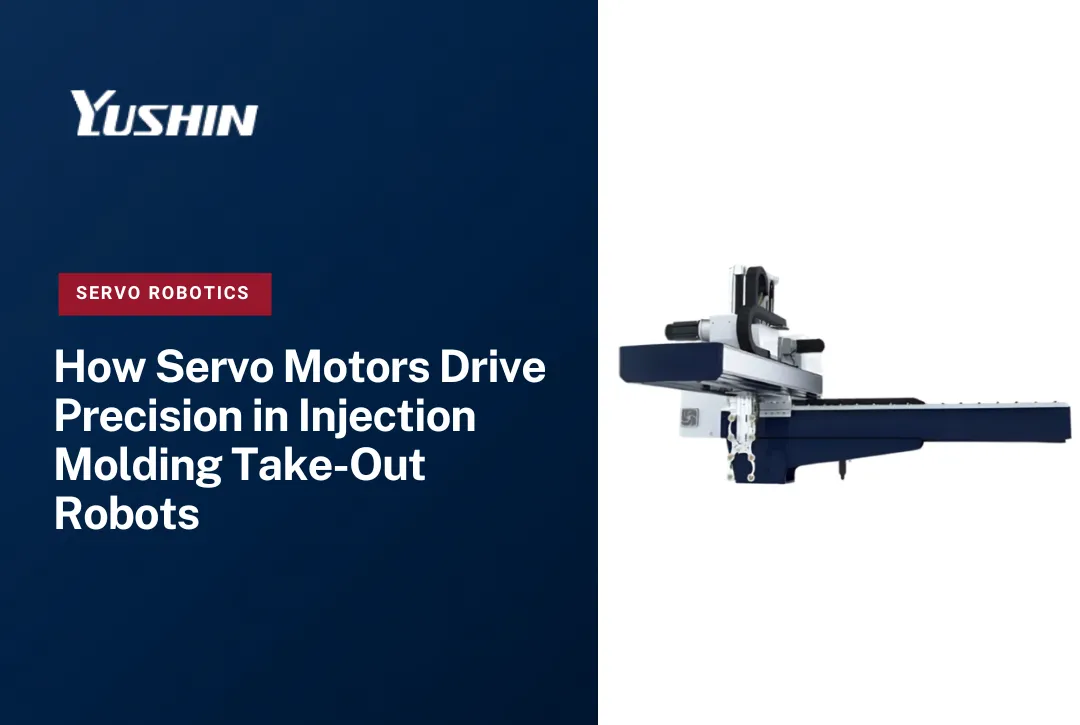
A robot's base axis count defines its basic range of motion. A standard Cartesian take-out robot uses three linear axes - traverse, kick, and vertical stroke. A standard articulated robot typically has six rotational axes. An added axis beyond the base configuration - sometimes called a 7th axis on an articulated robot, or simply an "additional axis" on a Cartesian platform - extends capability in a specific direction: extended linear travel, added rotational orientation, or both.
Application engineering note: The term "7th axis" is most commonly associated with articulated robot rail systems, extending reach along a linear track. This is a different application than the added orientation axes used on injection molding take-out robots, which typically address rotation and orientation control rather than extended linear travel.
What Added-Axis Capability Means in Injection Molding

For injection molding take-out robots, the relevant question is whether the standard linear axes - traverse, kick, vertical stroke - are sufficient for the application, or whether the part or process requires controlled orientation that those axes alone cannot provide.
Common scenarios where an added axis matters:
- Insert loading: An insert must be oriented at a specific angle before being placed into the mold cavity
- Overmolding: A part from a first molding operation must be reoriented before being loaded into a second mold
- Angled placement: Downstream placement requires the part to be positioned at an angle the linear axes cannot achieve alone
- Part inversion: The part must be flipped between take-out orientation and placement orientation
For applications without these requirements, the standard linear axes handle the extraction and placement task completely - an added axis would add cost and complexity without solving an actual problem.
Yushin's Approach: NC Servo Wrist Units, Not Axis Count for Its Own Sake

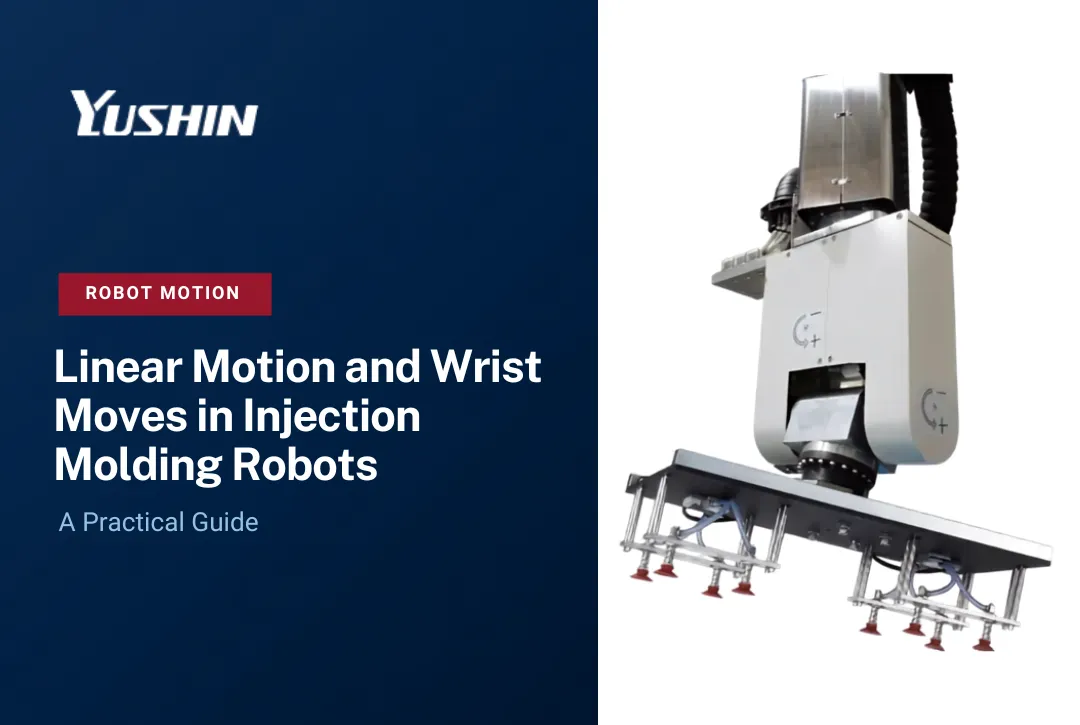
Rather than positioning axis count as a selling point, Yushin America's NC servo wrist units add controlled orientation capability specifically where the application requires it:
- A/C configuration (2-axis): Controls orientation in two rotational axes
- B/C configuration (2-axis): Controls orientation in a different two-axis combination
- A/B/C configuration (3-axis): Full three-axis wrist rotation for complex orientation requirements
These are added to a standard take-out robot platform - the base Cartesian axes handle extraction and traverse; the servo wrist axes handle orientation. This is teach-and-save programmable through the robot controller, supporting repeatable setups without requiring separate programming environments.
Why More Axes Are Not Automatically Better

Adding axes increases capability, but it also increases:
- Capital cost: Each additional servo axis adds hardware and integration cost
- Programming complexity: More axes means more coordinated motion to program and validate
- Maintenance points: Each axis is a mechanical and electrical system requiring its own maintenance attention
- EOAT payload considerations: Wrist axes add weight to the EOAT assembly, which counts against the robot's rated payload
Application engineering note: Specifying an added axis because it sounds like a more capable robot, without a specific handling requirement it solves, typically adds cost and complexity without a corresponding benefit. Axis selection should be driven by the actual orientation requirement in your application - not by matching a competitor's axis count.
When an Added Axis Is the Right Decision

- Confirmed insert orientation requirement: The insert must be placed at a specific angle that linear axes cannot achieve
- Confirmed overmolding reorientation need: The part must be flipped or rotated between molding operations
- Downstream placement requiring angled positioning: A fixture, conveyor, or packaging step requires the part in a specific non-default orientation
- Application review confirms the requirement is real and repeatable: Not a one-off or rare need that could be handled manually instead
Yushin Product Fit for Axis and Orientation Decisions
| Requirement | Yushin solution |
|---|---|
| Standard linear extraction, no orientation need | YD/YD2 Series standard take-out robots |
| Simple part inversion | Flip axis option on many Yushin take-out models |
| Insert loading, overmolding, complex orientation | NC servo wrist units in A/C, B/C, or A/B/C configurations |
| Up to 8 total axes for advanced applications | FRA Series high-end take-out robots |
Selection Criteria for Added-Axis Decisions
- Specific orientation requirement: Define exactly what orientation problem needs solving before specifying an added axis
- Payload impact: Confirm total payload including the added axis hardware weight, plus part and base EOAT weight
- Cycle time impact: Confirm whether the added axis motion can execute simultaneously with traverse motion, or requires dedicated cycle time
- Programming and maintenance capacity: Confirm your team's capacity to program and maintain the added axis over the system's service life
- Application engineering review: For insert loading and overmolding specifically, work through EOAT design and servo wrist configuration with Yushin America before finalizing the robot specification
When Standard Axes Are Sufficient
- Flat conveyor placement with no orientation requirement: Standard linear axes handle the complete cycle
- Sprue/runner removal: Sprue pickers use simple linear paths with no orientation need
- Consistent single-orientation packaging: If parts are placed the same way every cycle, added orientation capability provides no benefit
Implementation and Support
Yushin America provides installation, servo wrist configuration support, EOAT engineering, operator training, field service, and parts support for take-out robot systems across North America.
- 24/7 phone support: 888-707-6268
- Over $1.3M in spare parts inventory with overnight shipping
- Yushin University: Yushin robot training and programming
- Yushin America field service and support
Frequently Asked Questions
What is a 7th axis in robotics? In general industrial robotics, a 7th axis typically refers to an added motion axis beyond a robot's base configuration - often a linear rail extending an articulated robot's reach. In injection molding take-out automation, added axes more commonly refer to orientation-control axes like Yushin's NC servo wrist units, rather than extended linear travel.
Does my take-out robot need an extra axis? Only if your application requires controlled part orientation that the standard linear axes (traverse, kick, vertical stroke) cannot achieve - such as insert loading, overmolding, or angled downstream placement. If the part can be placed consistently in its ejection orientation, standard axes are sufficient.
What is the difference between a flip axis and an NC servo wrist unit? A flip axis provides a single fixed 180-degree rotation for simple part inversion. Yushin's NC servo wrist options support controlled orientation through two-axis and three-axis wrist configurations (A/C, B/C, or A/B/C), while simpler flip-axis options may handle basic part inversion - used for more complex insert loading and overmolding applications.
Does adding an axis always mean more capable automation? Not necessarily more valuable - it means more capability in a specific direction, at the cost of additional hardware, programming, and maintenance complexity. The right decision depends on whether your application has a real orientation requirement, not on matching the highest available axis count.
Can Yushin's take-out robots support insert loading with added axes? Yes. Insert loading and overmolding are supported Yushin America application capabilities through engineered EOAT and NC servo wrist units. These applications require deeper engineering review, but they are not reasons to look outside Yushin's Cartesian take-out robot platforms.
How many axes does the FRA Series support? Yushin's FRA Series high-end take-out robots support configurations with up to 8 total axes (5 primary robot axes plus up to 3 servo wrist axes), for advanced orientation and safety-critical applications. Confirm the right configuration for your application with Yushin America.
Conclusion
An added axis - whether called a 7th axis, a flip axis, or a servo wrist configuration - is only worth the investment when it solves a specific, confirmed orientation problem in your molding cell. Yushin America's NC servo wrist units add this capability where insert loading, overmolding, or angled placement genuinely require it, without forcing added complexity onto applications that do not need it.
If you are evaluating whether your take-out robot needs added orientation capability, contact Yushin America to review your specific part, insert, and placement requirements with an application engineer.