Cobots and the Future of Advanced Robotics in Manufacturing

Introduction

Production demand keeps climbing while the available workforce keeps shrinking. The U.S. Bureau of Labor Statistics consistently flags overexertion and repetitive motion as the leading drivers of musculoskeletal injuries on the plant floor — the exact tasks that legacy automation either can't handle flexibly or requires cost-prohibitive dedicated cells to address.

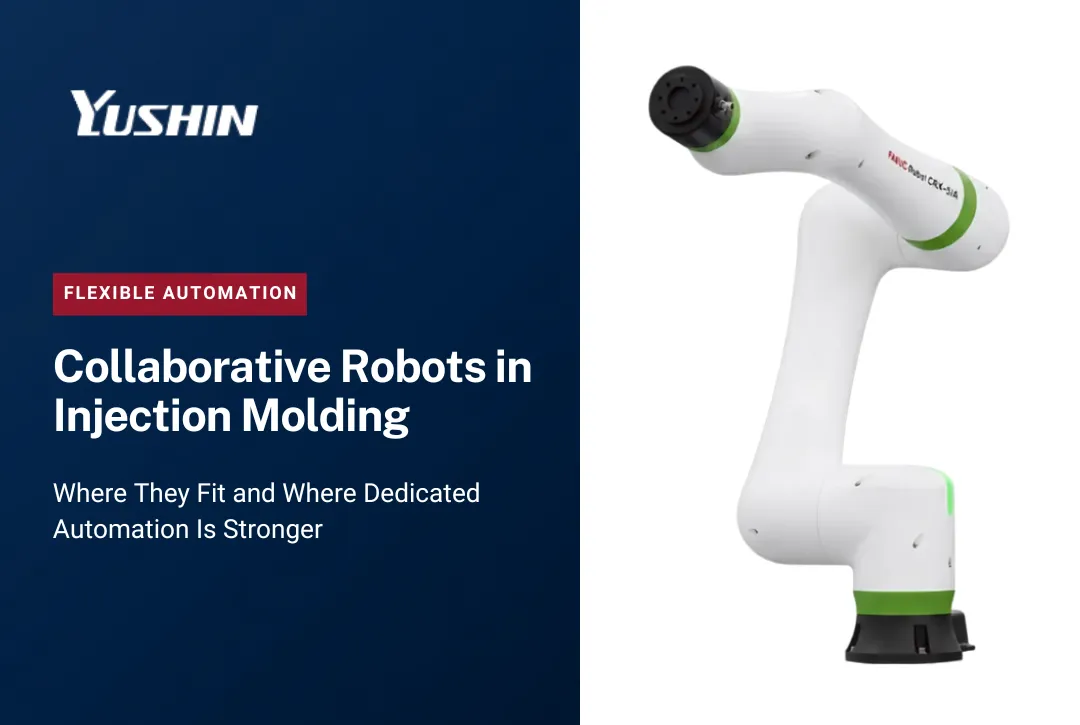
That gap is where collaborative robots, or cobots, come in. Unlike traditional industrial robots that operate behind safety fencing in isolated cells, cobots are designed to share workspace with human operators, monitoring proximity and stopping on contact to work safely alongside people. They're not a replacement for heavy industrial automation — they're the missing piece for flexible, mixed-environment production.

This article covers what separates cobots from traditional robots, why adoption is accelerating, the applications delivering the strongest results, and what plant managers need to evaluate before committing to a deployment.


TL;DR

  • Cobots use force-sensing and collision detection to work safely alongside humans, eliminating the need for safety cages after a proper risk assessment
  • The cobot market is projected to grow from $1.42B in 2025 to $3.38B by 2030 at 18.9% CAGR, per MarketsandMarkets
  • Machine tending, palletizing, assembly, and quality inspection are the highest-ROI cobot applications
  • AI and digital twins are cutting deployment time and improving adaptability in dynamic production environments
  • ROI timelines range from as few as 1,500 running hours to 12–18 months depending on application

Cobots vs. Traditional Industrial Robots: Understanding the Core Differences

Traditional industrial robots (articulated, SCARA, delta, Cartesian) are built for one thing: maximum throughput on a defined, repeating task. They move fast, handle heavy payloads (ABB's IRB 8700 tops out at 800 kg), and run behind engineered safety barriers. What they don't do well is adapt.

Cobots trade some of that raw performance for flexibility and human proximity. FANUC's CR/CRX collaborative series spans 3–50 kg payloads. Universal Robots tops out at 35 kg. ABB's GoFa line (which uses integrated torque sensors in all six joints to detect unexpected contact and stop within milliseconds) maxes out at 14 kg. These aren't numbers for heavy stamping or large-part welding. They're numbers built for the tasks humans currently perform beside machines.

How Cobots Stay Safe Near People

The safety architecture is what fundamentally separates the two robot types. Traditional robots rely on physical barriers — caging, interlocked gates, lockout/tagout procedures. Cobots use:

  • Power and Force Limiting (PFL) — the robot physically cannot exert force beyond a safe threshold
  • Speed and Separation Monitoring — the robot slows or stops as humans enter defined proximity zones
  • Hand Guiding — operators physically move the arm to teach new positions
  • Safety-Rated Monitored Stop — the robot halts when a human enters the collaborative workspace

Four cobot safety mechanisms power force limiting speed monitoring hand guiding stop

This means no dedicated cell layout, no extensive guarding, and no specialist programmer needed for routine reprogramming. FANUC's CRX line uses drag-and-drop programming. ABB's GoFa uses Wizard Easy Programming graphical blocks. An operator who knows the task can often teach the cobot themselves.

Where Traditional Robots Still Win

Cobots are not a universal substitute. For high-volume, single-task, heavy-payload applications — automotive body welding, large-part injection molding extraction, high-speed palletizing above 40 kg — traditional robots remain the right answer. The realistic view is that cobots complement existing automation, not replace it. The IFR reported cobots at just 10.5% of global industrial robot installations in 2023, out of 541,302 total units — they're growing fast, but the two categories coexist by design.

Cobot Safety Standards and What "Fence-Free" Really Means

"Fence-free" is accurate but incomplete. Three standards govern this space:

  • ISO 10218-1:2025 & ISO 10218-2:2025 (published February 2025) — safety requirements for robot design and cell integration
  • ISO/TS 15066:2016 (reviewed and confirmed 2022) — supplemental requirements specifically for collaborative systems and shared workspaces

Fence-free operation is not a plug-and-play exemption. A formal risk assessment of the installed application is still required after deployment. The IFR makes this concrete: a cobot carrying a sharp tool or hazardous material can still be unsafe regardless of its built-in force limits. When the application changes, the assessment must be revisited.


Why Cobots Are Gaining Momentum in Manufacturing Right Now

The cobot market's growth trajectory reflects real operational pressure, not just technology enthusiasm. MarketsandMarkets projects growth from $1.42B in 2025 to $3.38B by 2030 at 18.9% CAGR. Mordor Intelligence puts the figure even higher — $5.72B by 2031 at 20.15% CAGR — with automotive holding 30.35% of the end-user market and assembly applications commanding 25.60% revenue share.

The underlying drivers are consistent across sectors:

  • Labor availability — chronic difficulty attracting and retaining production workers for repetitive, physically demanding tasks
  • Production flexibility — more SKUs, shorter runs, and faster changeovers demand automation that can be reprogrammed in hours, not weeks
  • ROI speed — cobots require far less upfront investment than traditional automation cells and eliminate most safety guarding costs

The Post-COVID Shift

Workforce instability during and after COVID forced a rethinking of automation strategy. Plants that had relied on staffing flexibility found themselves short-staffed on lines that couldn't run efficiently with reduced headcount. Cobots filled gaps where full hard automation wasn't economically feasible or fast enough to deploy — most visibly in mid-volume applications where a human and a cobot working together outperformed either alone.

SMBs Are Driving Adoption

Large OEMs were early adopters, but the stronger growth signal now comes from smaller shops. MarketsandMarkets flags lower upfront cost, easier setup, and redeployability as the factors pulling small and mid-sized manufacturers into the market. A cobot that can move between applications as production needs shift delivers value that a fixed automation cell can't match for a plant running multiple product families.


Where Cobots Are Making the Biggest Impact: Key Applications

Picking, Packing, and Palletizing

Handling was the largest cobot application segment in 2024 per MarketsandMarkets, and palletizing/de-palletizing is growing at 24.55% CAGR according to Mordor Intelligence. End-of-line lifting, sorting, and stacking tasks are physically punishing, prone to inconsistency, and don't require the payload capacity of traditional palletizing robots for most product weights. Flexible gripper systems let the same cobot switch between box sizes or product configurations with minimal changeover.

Machine Tending

Machine tending delivers some of the clearest documented ROI in cobot deployment. Cobots load and unload parts from CNC machines, injection molding presses, and stamping equipment, enabling extended or lights-out production without dedicated automation cells.

Verified case data from Universal Robots' machine tending deployments includes:

  • GFC reaching 22 hours of daily machine time, including 6 hours unmanned
  • EMI adding over 1,200 production hours per machine annually, with 12–18 month ROI

For injection molding specifically, Midgard deployed six UR10e cobots for press tending and secondary operations. Scrap dropped from up to 10% down to 1–2%, sometimes reaching 0%, with ROI achieved in approximately 1,500 running hours. Improved part quality alongside labor reallocation is what makes machine tending the entry point most automation specialists recommend first.

Cobot machine tending ROI statistics GFC EMI Midgard deployment case data comparison

That architecture mirrors what Yushin America has deployed with its OB7 collaborative robot — handling part handoff, packaging prep, and secondary operations alongside Yushin's traditional take-out robots. Pairing a high-speed take-out robot for primary mold extraction with a cobot for downstream tasks is the practical configuration most injection molding facilities end up building.

Quality Inspection

Cobots equipped with machine vision systems perform visual inspections at a consistency level human operators can't sustain across a full shift. Common inspection tasks include:

  • Defect detection on part surfaces
  • Dimensional checks against tolerance specs
  • Surface scanning for cosmetic or structural flaws

For high-mix, short-run production, a vision-guided cobot routine reconfigures faster than a fixed inspection station. Midgard's deployment included quality inspection among its secondary cobot operations, contributing directly to their scrap reduction results.

Assembly and Welding

Assembly tasks — screwdriving, fastening, component insertion — account for 25.60% of cobot market revenue according to Mordor Intelligence, making it the second-largest application segment. The fit is natural: these tasks are precise, repetitive, moderate-force, and need positional flexibility as product variants change.

Collaborative welding cells are growing in automotive and metal fabrication. The typical configuration has the cobot handling torch movement while a human manages fixturing and process oversight. That division of labor improves weld consistency without requiring a fully automated welding cell.

Material Handling and Dispensing

Cobots move parts between workstations and apply adhesives, sealants, or coatings with consistent path and pressure. These tasks are ergonomically problematic for human operators over full shifts, and consistency is hard to maintain manually. A cobot handling dispensing also reduces chemical exposure for workers.


The Future Is Here: AI, Digital Twins, and Next-Gen Cobot Intelligence

AI and Vision-Guided Operation

The most significant capability shift in cobots right now is the move from rigid point-to-point programming to perception-driven operation. Deep learning allows cobots to identify objects, adapt to positional variation within a bin or on a conveyor, and make real-time pick decisions without requiring perfectly presented parts.

For quality inspection, machine learning-powered vision systems now detect defects and adapt to new part types without complete reprogramming.

A 2026 PMC review on machine-learning-powered vision for robotic inspection confirms the technology's maturity in manufacturing environments. The practical implication: cobots in inspection or bin-picking applications are becoming significantly more capable without requiring the rigid fixtures and exact part placement that earlier systems demanded.

Digital Twins and Virtual Commissioning

Siemens defines virtual commissioning as using a digital twin — an interactive virtual representation of the robot system and surrounding production environment — to test system behavior based on actual control software before any physical installation. NVIDIA's Omniverse platform extends this to full industrial facility simulation, accelerating development and deployment of what they call "physical AI" in factory settings.

For brownfield facilities — plants with existing equipment and infrastructure, which describes the majority of injection molding operations — this is particularly relevant. Simulating cobot integration before physical installation means:

  • Workflow conflicts are identified before they cause downtime
  • Offline programming is validated against the actual production environment
  • Integration time is reduced substantially
  • The facility doesn't need to halt production to test a new cell layout

Digital twin virtual commissioning four-step benefits workflow for brownfield manufacturing facilities

Connected Cobots and Predictive Maintenance

Modern cobots transmit continuous operational data — joint torque readings, cycle time deviations, temperature trends. Maintenance teams use this stream to identify developing failures before they cause unplanned downtime. This shifts maintenance from reactive to predictive, directly improving Overall Equipment Effectiveness (OEE) — a standard measure of how efficiently a production line is running.

Yushin America's INTU LINE IoT platform, standard on FRA series robots, puts this into practice — giving operators visibility into cycle times, temperature control, and production status from any device, anywhere. The E-touch Compact controller extends this further with predictive symptom detection, alerting operators to potential issues before they become failures.

Modular and Scalable Deployment

Open-architecture software and hardware modularity have compressed deployment timelines significantly. A well-defined single-task cobot application — bin picking, part transfer, inspection — can move from unboxed to operational in hours. Facilities can scale incrementally — starting with one well-defined application, proving the ROI, then expanding — rather than committing to large-scale automation investments before the use case is validated.


Implementing Cobots in Your Facility: What Plant Managers Should Know

Pre-Deployment Assessment

Before specifying hardware, evaluate the application:

  • Does the task repeat predictably enough for a cobot to handle it consistently?
  • Is this a task causing worker fatigue or repetitive-motion injury?
  • Does product mix or changeover frequency make flexible programming valuable?
  • Can the cobot reach all required positions within the existing line footprint?

Tasks that score well on all four criteria are strong candidates. Tasks with very high payload requirements or single-SKU, high-volume throughput demands may still be better served by traditional automation.

Total Cost of Ownership

Purchase price is the wrong metric. A complete ROI calculation includes:

  • Labor cost reduction and reallocation
  • Reduced defect and scrap rates
  • Improved throughput consistency
  • Lower injury-related costs
  • Avoided guarding and cell engineering expenses (Universal Robots' data suggests fence-free operation after safety assessment can reduce integration costs by as much as 50%)

Payback timelines from verified deployments range from approximately 1,500 running hours to 12–18 months depending on application, throughput volume, and labor cost offset. Application specifics drive the actual result.

Cobot total cost of ownership ROI components and payback timeline comparison infographic

A specialist who understands both robot technology and the production environment helps facilities avoid mis-specifications. Yushin America's 50+ years in plastics processing automation means application-specific guidance — matching the right robot configuration to the actual task rather than defaulting to a general-purpose cobot that underperforms on the floor.

Implementation Readiness Checklist

Before go-live, confirm:

  1. Operators are trained on programming and routine adjustments before go-live — Yushin University offers accessible online courses for teams without a robotics background
  2. A post-installation risk assessment is completed, as required by ISO 10218/ISO/TS 15066 for any collaborative workspace
  3. Communication protocols (EtherNet/IP, EtherCAT, DeviceNet) are verified as compatible with existing PLC and MES control systems
  4. The rollout starts with one well-defined application — measure results before scaling to additional cells

Plants that start with one well-scoped application consistently achieve faster returns and build the internal expertise needed for broader deployment.


Frequently Asked Questions

What is the difference between a cobot and an industrial robot?

Cobots are designed for shared human-robot workspaces, with built-in force-sensing and collision detection that allow them to slow or stop when a person gets too close. Industrial robots operate at higher speeds and payloads in isolated, guarded cells. Cobots are better for flexible, variable tasks; industrial robots are better for high-volume, single-task, heavy-payload operations.

Are cobots safe to use without safety fencing or cages?

Cobots are engineered to allow fence-free operation in many applications, but a formal risk assessment per ISO 10218 and ISO/TS 15066 is still required after installation. The installed application, tooling, part handling, and workspace must all be evaluated — fence-free does not mean risk-free.

What industries benefit most from collaborative robots?

Automotive leads adoption at roughly 30% of end-user revenue, followed by electronics, plastics and injection molding, packaging, food and agriculture, and pharmaceuticals. Any operation with repetitive, ergonomically demanding, or variable-task production is a strong candidate.

How long does it take to program and deploy a cobot?

Straightforward applications using teach pendants or graphical programming can be operational in hours to days, with digital twin commissioning reducing setup time by validating programming before physical deployment. Complex multi-step applications will take longer and typically benefit from specialist support.

What ROI timeline should manufacturers expect from cobots?

Verified case data shows payback ranging from approximately 1,500 running hours to 12–18 months depending on the application. Cobots generally deliver faster ROI than traditional industrial robots due to lower upfront costs and reduced guarding requirements — but the actual result depends heavily on application selection and throughput volume.

How do AI and digital twins enhance cobot performance?

AI enables cobots to adapt to object variation, perform vision-guided inspection, and make real-time decisions without rigid programming. Digital twins let manufacturers simulate and validate cobot integration virtually before physical deployment — together, they shorten setup time and expand cobot capability in dynamic production environments.