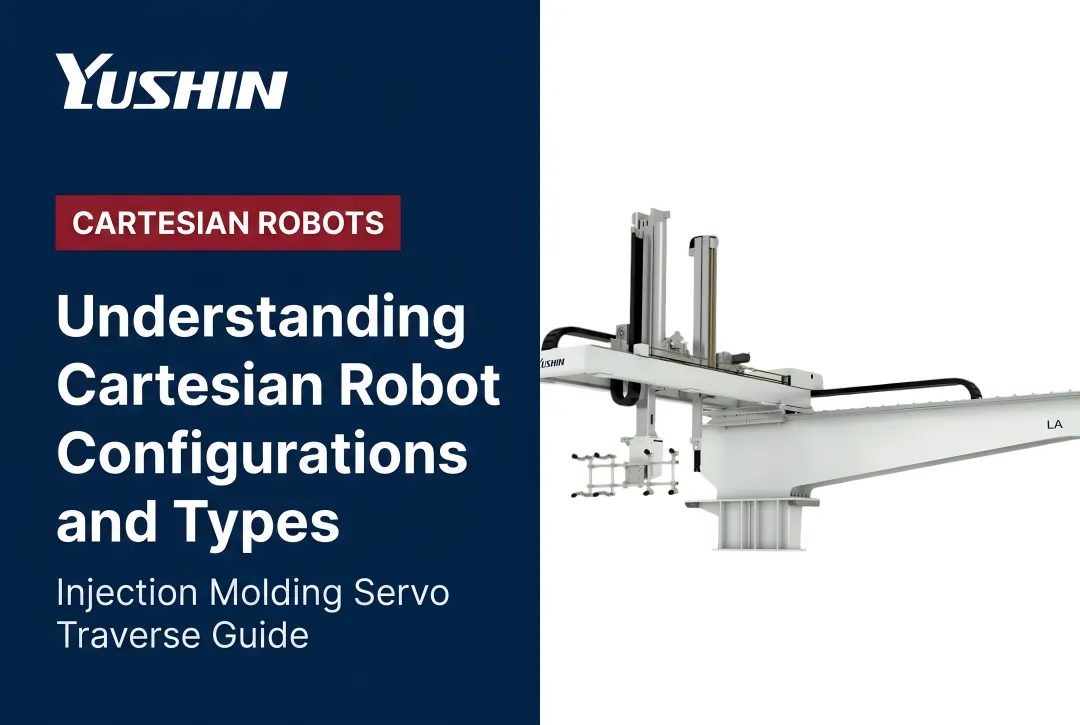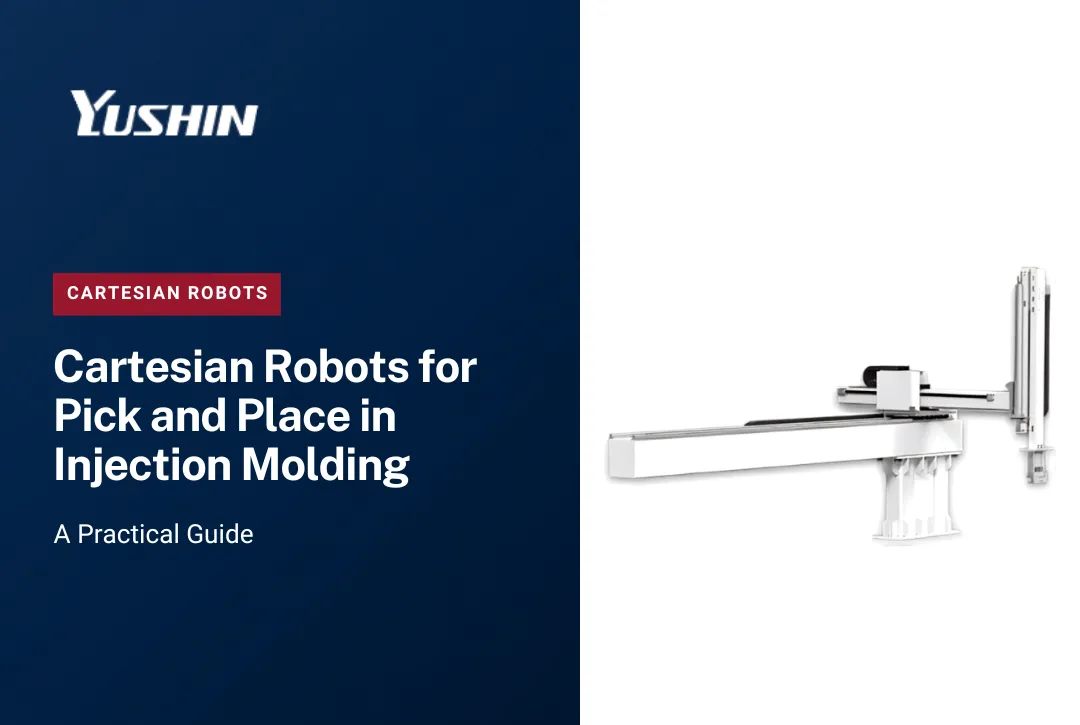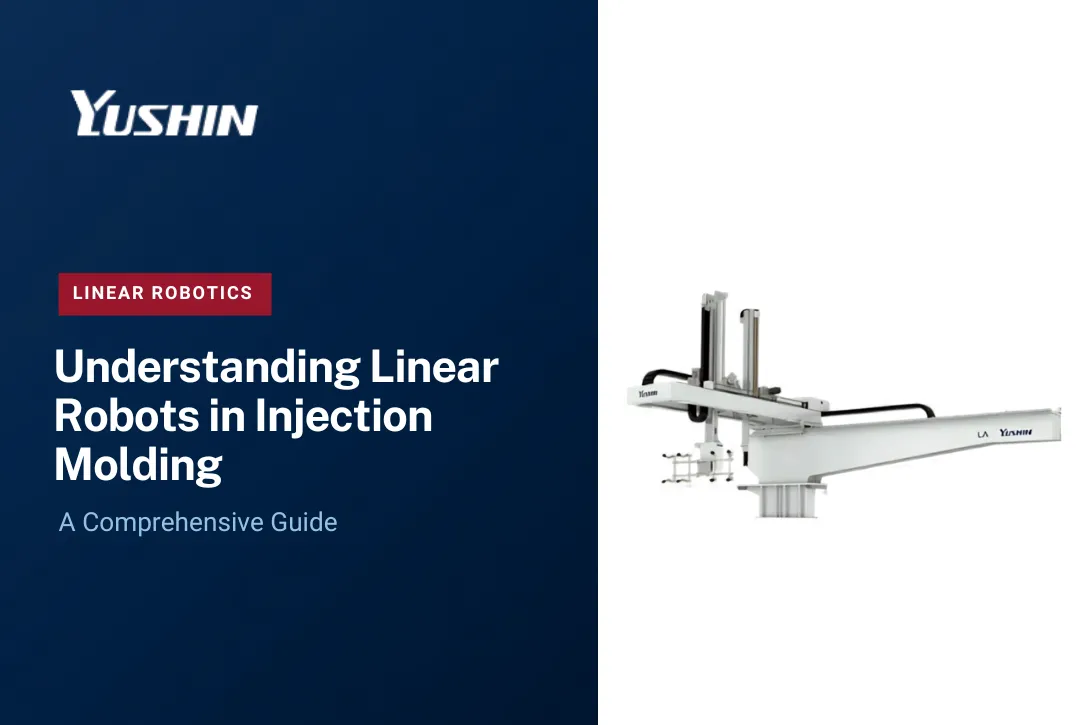

Cartesian coordinate robots are the most widely used robot architecture in plastic injection molding. Their defining characteristic - movement along straight-line X, Y, and Z axes - matches the geometry of injection molding cells precisely. Most take-out robots, the devices that extract molded parts from injection molding machines (IMMs) on every production cycle, are fundamentally Cartesian coordinate robots. Yushin Company of Kyoto, Japan was founded in 1973 and introduced its first take-out robot in 1978. Yushin America was established in 1988 to support the North American market and has since built Cartesian-axis take-out and automation systems for injection molders across North America. Understanding how Cartesian robots work and why they dominate molding automation helps plant managers and automation engineers make better robot selection decisions.
What Is a Cartesian Coordinate Robot?
A Cartesian coordinate robot is a robot that moves along three orthogonal linear axes: X (horizontal traverse), Y (horizontal reach or kick), and Z (vertical stroke). Each axis moves independently along a straight line. The robot's position in three-dimensional space is defined by its X, Y, and Z coordinates - hence "Cartesian," a reference to the Cartesian coordinate system.
Additional axes may be added for part orientation, such as a wrist rotation or flip axis. But the fundamental motion is linear: axes extend and retract along defined strokes rather than rotating through joint angles.
Application engineering note: The terms "Cartesian robot," "gantry robot," "linear robot," and "Cartesian coordinate robot" all describe variants of the same fundamental architecture. In injection molding, "traverse robot" and "take-out robot" describe the same type of machine in application-specific language.

Characteristics That Make Cartesian Robots Effective in Injection Molding
Precise, Repeatable Positioning
Cartesian robots position parts the same way on every cycle. Linear guides and servo-driven axes deliver repeatable positioning that does not degrade with speed or load variations the way manual handling does. For injection molding applications - where part-to-part consistency matters for cosmetic quality, dimensional control, and downstream assembly - this repeatability directly reduces scrap.
Predictable, Configurable Strokes
Each axis of a Cartesian robot has a defined stroke length. In injection molding, this means the vertical stroke (into the mold), horizontal stroke (across the platen), and traverse stroke (along the machine axis) are all sized precisely to the IMM and mold configuration. There is no uncertainty about whether the robot will reach the part or clear the mold - strokes are engineered to the application.
Direct Mold Access
Cartesian robots enter the mold space from above or from the side, depending on configuration (top-entry or side-entry). Top-entry take-out robots descend vertically into the open mold space, grip the part, and retract before the mold closes. This direct vertical access is difficult to replicate efficiently with articulated robot architectures in the tight spaces typical of injection molding cells.
High Speed at Short Strokes
Injection molding cycles are measured in seconds. The take-out robot must enter, grip, retract, and clear the mold within a fraction of the molding cycle time. Cartesian robots with servo-driven linear axes accelerate and decelerate efficiently over short strokes, making them fast enough to stay inside cycle-time budgets even at high speeds.
Scalable Payload and Reach
Cartesian architecture scales well. Longer traverse beams handle larger IMMs. Higher-rated servo drives and structural members support heavier EOAT and part weights. This scalability covers applications from 30 tf small-part molding through 1,500+ tf large structural-part production without changing the fundamental robot architecture.
Low Floor Space Requirement
Cartesian take-out robots mount overhead on the IMM platen or on a freestanding beam structure. They do not require floor space within the cell envelope. This is a practical advantage in molding shops where floor space is constrained.
How Cartesian Take-Out Robots Work in the Molding Cell
The standard injection molding cell cycle with a Cartesian take-out robot follows this sequence:
- IMM cycle completes; mold opens
- Robot traverse axis positions over the mold
- Vertical axis descends; EOAT enters mold space
- EOAT grips molded part (and runner, if applicable)
- Vertical axis retracts; part exits mold space
- Traverse axis moves part to downstream placement position
- EOAT releases part to conveyor, fixture, trim station, or inspection station
- Robot axes return to home position; mold closes; next cycle begins
EOAT (end-of-arm tooling) is the interface between the robot and the part. It must be designed for the specific part geometry - grip points, material, weight, fragility, and downstream placement requirements all drive EOAT design. Payload calculations must include both the part weight and the EOAT weight; underestimating payload reduces axis life and causes positioning errors over time.

Cartesian Robot Variants Used in Injection Molding
Standard Take-Out Robots
Cover the broadest range of IMM sizes and part types. Designed for reliable, repeatable part extraction across standard molding cells.
High-Speed Take-Out Robots
Optimized for short cycle times and fast-cycle molding applications such as packaging, thin-wall parts, and high-cavitation tooling. Reduced weight, optimized axis mechanics, and vibration control are the distinguishing features.
Large Traverse Robots
Extended traverse beams and high-payload servo drives for large-part molding on high-tonnage machines. Movable kick beams and telescopic vertical arms accommodate the geometry of large mold spaces.
Side-Entry Robots
Enter the mold from the side rather than from above. Used in applications where top-entry clearance is limited, or where side-entry allows faster mold access for specific cell layouts.
Palletizing Robots
Cartesian-axis palletizing robots handle end-of-line stacking of packed or boxed molded parts. These are downstream of the take-out robot and operate in the packing/palletizing station rather than at the IMM.
Yushin Cartesian Take-Out Robot Product Fit
| Application | Yushin Solution |
|---|---|
| Standard part take-out, 30-1,300 tf | YD/YD2 Series standard take-out robots |
| High-speed take-out, air and energy reduction | RC-SE high-end high-speed take-out robot |
| Advanced safety-certified take-out | FRA Series high-end take-out robots |
| Large-part take-out, 1,500+ tf | MKA-2000S large full-servo traverse robot |
| End-of-line palletizing | PA Series compact palletizing robot |
| Sprue and runner removal | HOP Five, N-HOP, miniHOP, V-HOP sprue pickers |
| Side-entry take-out | SX-41, SXB, SXC-HS, SXC series |
| Insert loading, overmolding, and complex orientation | Engineered EOAT, downstream systems, and NC servo wrist units |
Confirm application-specific sizing and configuration with Yushin America. Robot selection depends on IMM clamp force, mold dimensions, part geometry, payload, and cycle time.
Advanced Applications: Insert Loading, Overmolding, and Complex Orientation
Insert loading, insert molding, overmolding, and complex part-orientation applications require deeper engineering than standard part take-out, but they are a strong fit for Yushin America's automation capabilities when the system is properly designed.
Yushin can combine Cartesian take-out robots with engineered EOAT, downstream tooling, and A/C, B/C, or A/B/C NC servo wrist units to control insert placement, part orientation, release motion, and downstream handoff. These wrist configurations add controlled orientation capability while keeping the system usable for production teams.
For frequent mold changes, insert handling, overmolding, fragile parts, or complex downstream placement, Yushin's engineering team can design the EOAT, servo wrist configuration, and operator workflow around the actual part, mold, and production requirement.
Selection Criteria for Cartesian Take-Out Robots
When selecting a Cartesian take-out robot for an injection molding cell:
- IMM clamp force and platen size - determines traverse beam span, mold-space access dimensions, and required stroke lengths
- Payload including EOAT - always include EOAT weight in payload calculations; typical range is 3 kg (small parts) to 35+ kg (large parts)
- Cycle time requirement - take-out time must fit within the available window; faster cycles require higher-speed axis configurations
- Part geometry - drives EOAT design, grip-point placement, and placement-path engineering
- Runner/sprue handling - cold-runner molds require sprue removal; determine whether a separate sprue picker or integrated extraction is needed
- Downstream placement requirement - conveyor, fixture, packing, or palletizing; the robot's traverse stroke and placement accuracy must match the downstream process
- Controller usability - Yushin's E-touch controller is designed for operation by molding-plant personnel without advanced robotics programming training
- Service and parts support - confirm that the robot supplier has local service coverage and spare parts inventory to support your production schedule

When Cartesian Take-Out Robots May Not Be the Right Fit
- Very low-volume production: Automation payback is difficult to justify when annual cycles are too low to amortize the investment.
- Frequent mold changes or short runs: These applications require careful EOAT and changeover planning. Yushin can support frequent-changeover environments with engineered EOAT, servo wrist options, and operator-friendly robot programming designed to reduce setup burden. If annual volume is very low, a payback review may still be needed before investing in automation.
- Unstable molding processes: If the molding process itself is not consistent, a take-out robot will surface process instability immediately. Mold and process stabilization should precede robot integration.
Implementation and Support
Yushin America provides installation, EOAT engineering, operator and maintenance training, field service, and parts support across North America. Key support facts:
- 24/7 phone support: 888-707-6268
- Over $1.3M in spare parts inventory with overnight shipping available
- Over $2M in pre-assembled robot module inventory
- Yushin University online training for operators and technicians: self-paced, with refresher access and certificates of completion
For service details, visit Yushin America field service and support. For parts, visit Yushin replacement parts.
Frequently Asked Questions
What is a Cartesian coordinate robot? A Cartesian coordinate robot moves along three straight-line axes - X (traverse), Y (horizontal/kick), and Z (vertical) - to position its end effector in three-dimensional space. In injection molding, Cartesian robots are used as take-out robots that extract molded parts from the mold and place them downstream.
Why are Cartesian robots used for injection molding take-out? Cartesian robots match the geometry of injection molding cells: vertical mold access, defined strokes, fast linear motion over short distances, and predictable part placement paths. They are faster at short-stroke cycles, easier to program for structured tasks, and require less floor space than articulated alternatives.
What axes does a Cartesian take-out robot use? The core axes are X (traverse along the IMM), Y (horizontal kick toward or away from the mold), and Z (vertical drop into the mold space). Additional axes may include a wrist rotation, flip axis, or secondary traverse for downstream placement. Total axis count depends on the application.
What payload capacity does a Cartesian take-out robot need? Payload must include both the molded part weight and the EOAT weight. For small IMMs (30-100 tf), payload requirements are typically 3-5 kg. For large IMMs (1,000-1,300 tf), payload requirements can reach 35 kg or more. Confirm payload requirements with your EOAT designer before selecting a robot.
How fast can a Cartesian take-out robot operate? Take-out time depends on stroke lengths, axis speeds, acceleration profiles, and settling time. Yushin's HSA-150S and HSA-250S super-high-speed robots achieve take-out times as fast as 0.27 seconds in live molding applications. Standard take-out robots operate at longer cycle budgets. Confirm take-out time capability against your molding cycle when selecting a robot.
What is EOAT and why does it matter for Cartesian robots? EOAT (end-of-arm tooling) is the gripper or fixture mounted at the end of the robot's vertical arm. It contacts and holds the molded part during extraction and placement. EOAT design is application-specific - part geometry, material, grip-point location, and downstream placement all drive EOAT engineering. This is why EOAT engineering is a major part of the automation decision: for insert molding, overmolding, fragile parts, or complex downstream placement, Yushin's engineering team can design EOAT and servo wrist configurations around the part, insert-handling requirement, release motion, and operator workflow.
Conclusion
Cartesian coordinate robots are the dominant architecture in injection molding automation because their linear-axis motion is a natural match for the structured, repeatable geometry of molding cells. Understanding the characteristics - stroke-based positioning, payload scaling, direct mold access, and speed at short cycles - helps plant managers and automation engineers evaluate and select the right take-out robot for their application.
Yushin America designs, builds, and supports Cartesian take-out robots, EOAT, sprue pickers, and downstream automation for plastic injection molders across North America. If your plant is facing inconsistent part removal, labor gaps, cycle-time pressure, or part damage from manual handling, contact Yushin America to discuss the right Cartesian robot configuration for your IMM and production requirements.