
Gantry robots--also called overhead Cartesian robots--are a common structural format in industrial automation. In plastic injection molding, the same linear-axis movement that defines a gantry robot is the foundation of take-out robots that extract molded parts from injection molding machines (IMMs) on every production cycle. Yushin America has built Cartesian-style take-out and downstream automation systems for injection molders across North America since 1988, covering applications from small medical parts to large automotive structural components.
What Is a Gantry Robot?

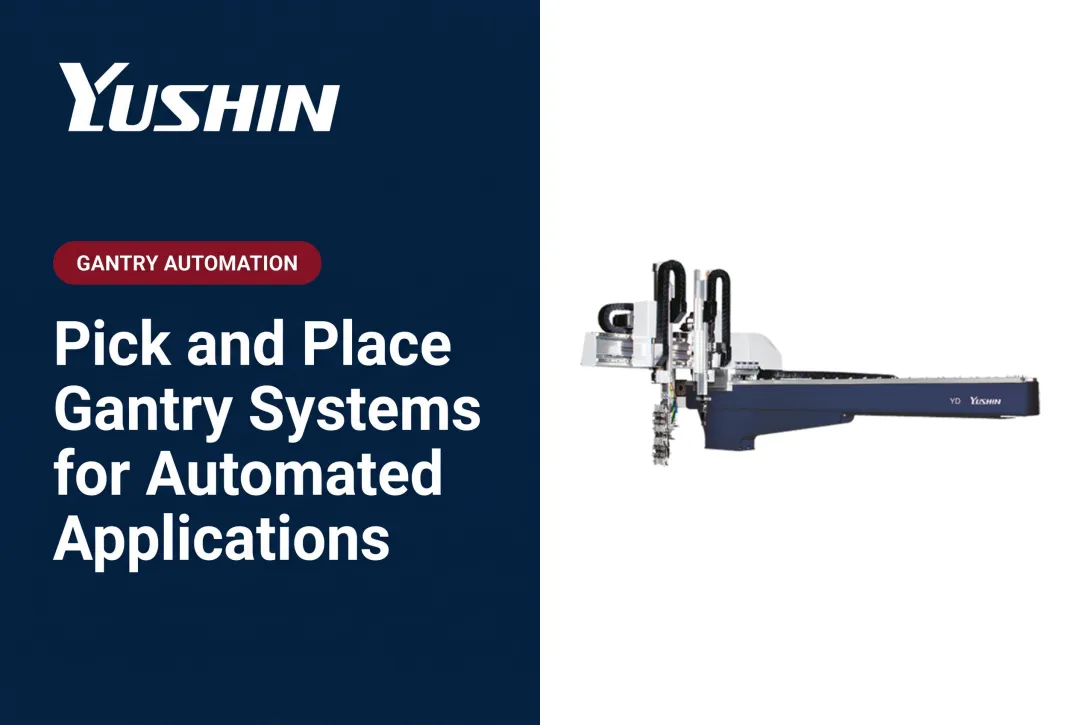
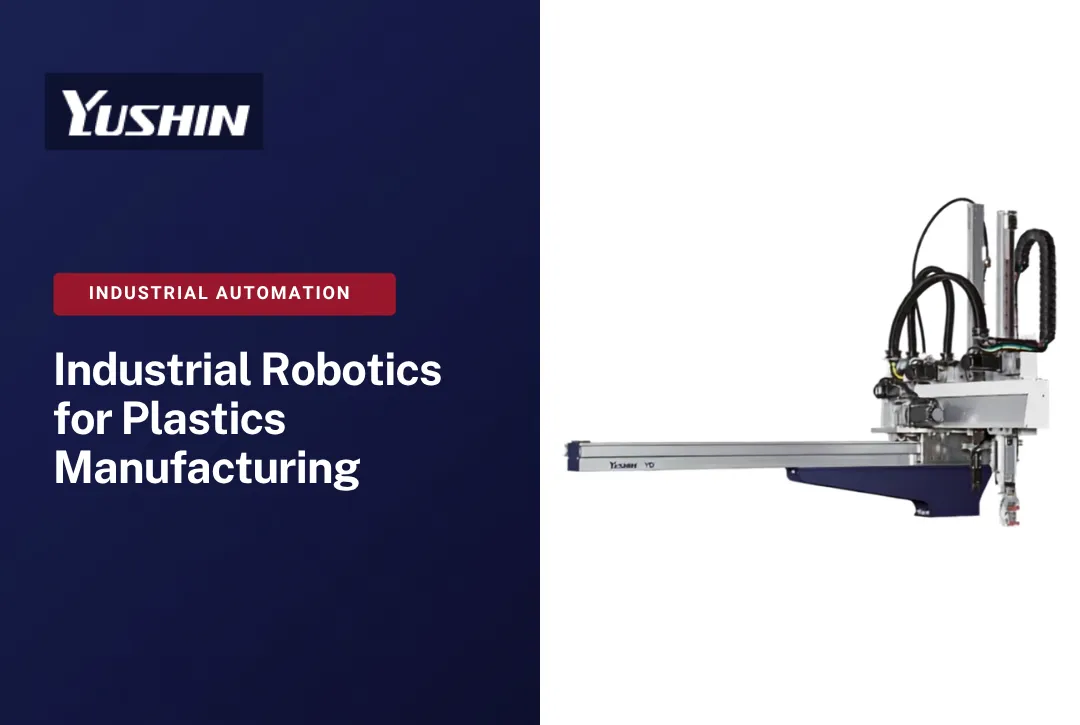
A gantry robot is a robot that moves along fixed linear axes--typically X (traverse), Y (horizontal reach), and Z (vertical stroke)--mounted on an overhead or bridge-style frame. Motion is Cartesian: movements are along straight-line axes rather than rotational joints. This architecture delivers precise, repeatable positioning across defined work envelopes, making it well-suited to structured environments where part placement paths are known and consistent.
In injection molding, the traverse axis spans the molding machine's platen width. The vertical stroke enters the mold space when the mold opens, and the horizontal axis positions the part for placement downstream.## How Gantry Robots Apply to Injection Molding
Part Take-Out
The primary application of gantry/Cartesian robot architecture in injection molding is part take-out: extracting molded parts from the mold when it opens, and placing them at a downstream location. The sequence looks like this:
- Mold opens at end of cycle
- Robot traverse axis moves to mold centerline
- Vertical (kick) axis descends into mold space
- EOAT grips part (and runner, if cold-runner mold)
- Vertical axis retracts, part clears mold
- Traverse axis moves part to placement position
- Part is released to conveyor, cooling fixture, inspection station, trim press, or packaging station
- Robot clears safety gate; mold closes and next cycle begins
The robot's stroke lengths, speed, and EOAT must be matched to the IMM, part geometry, and cycle time. Gantry/Cartesian architecture makes stroke engineering straightforward--axis lengths and speeds are independently configurable.
Sprue and Runner Handling
In cold-runner molds, the sprue or runner system must be removed separately from the molded parts. Gantry-style sprue pickers--including Yushin's HOP Five, N-HOP, miniHOP, and V-HOP series--handle runner removal using a simpler Cartesian motion profile, without requiring a full take-out robot on the same machine. In some cells, a full take-out robot handles the molded parts while a sprue picker handles the runner on a separate cycle axis.
Large Part Removal
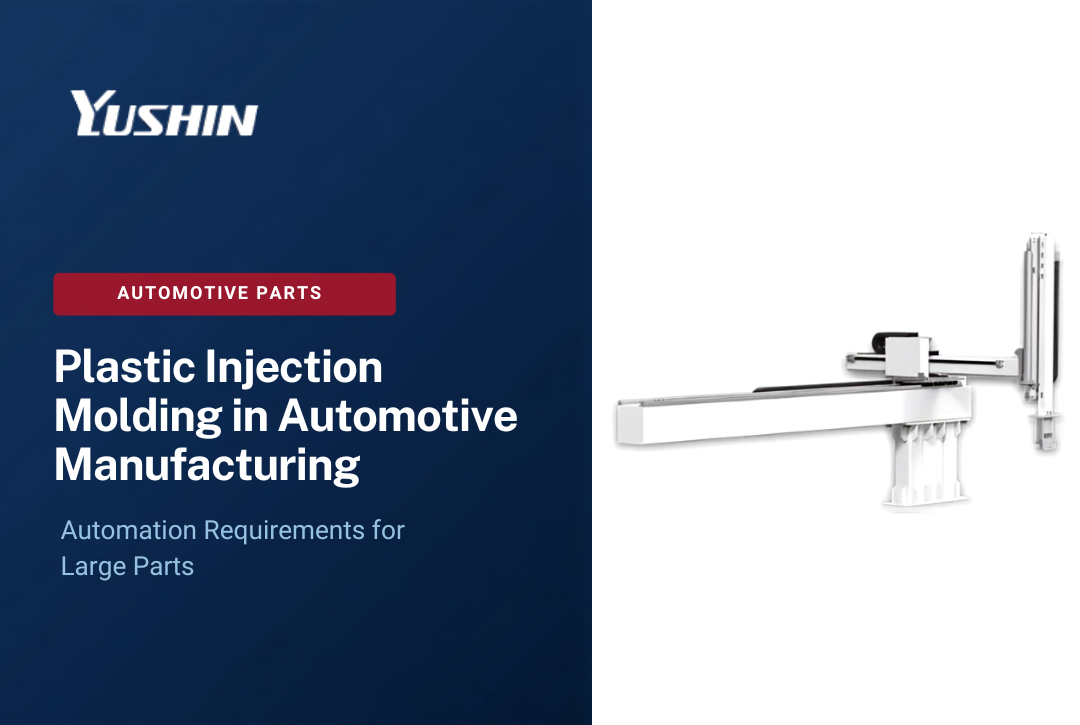
For large molded parts--automotive bumpers, appliance panels, industrial enclosures--the gantry format scales effectively. Long traverse beams, high-payload EOAT, and multi-stage vertical arms accommodate the large strokes and heavy payloads that articulated robots can struggle with in overhead mold-access configurations.
Yushin's MKA-2000S is a 3-axis Cartesian traverse robot designed for IMMs of 1,500 tons or larger. It handles 30-50 kg including EOAT, with a traverse beam adjustable up to 5,000 mm, horizontal reach of 1,800 mm, and vertical strokes up to 3,000 mm. In Yushin's testing, the MKA-2000S achieved 17% shorter take-out times and 10% shorter cycle times versus prior larger counterparts. See the MKA-2000S large robot introduction for details.
Downstream Placement and Palletizing
Gantry robots do not stop at the mold. In complete automation cells, the robot's traverse axis can extend to place parts directly onto conveyors, inspection stations, or packaging fixtures. For end-of-line applications, Yushin's PA Series compact palletizing robot uses Cartesian-style motion to stack boxes, trays, or bags onto pallets after molded parts are packed. The PA-40 supports 40 kg payload including EOAT and can achieve 420 boxes per hour.
Gantry vs. Articulated Robots in Injection Molding

Gantry/Cartesian robots dominate injection molding take-out applications for structural reasons:
| Factor | Gantry / Cartesian | Articulated (6-axis) |
|---|---|---|
| Mold access direction | Vertical drop-in through top of platen | Requires clear lateral or overhead path |
| Programming | Axis-based, straightforward for molding cycles | Joint-angle programming, more complex for simple take-out |
| Speed at short strokes | High--linear axes accelerate/decelerate efficiently | Can be fast but optimized for reach, not short cycles |
| Payload scaling | Scales well--longer beams, heavier EOAT | Limited by arm geometry and joint loading |
| Footprint | Overhead--minimal floor space | Requires floor or pedestal mount, larger cell footprint |
| Repeatability | High--linear guides are mechanically stable | High--but axis stacking introduces more error sources |
Articulated robots have their place in some molding-cell layouts, but insert loading, insert molding, overmolding, assembly support, and complex part-orientation tasks should not be treated as outside Yushin's gantry/Cartesian expertise. Yushin supports many of these applications through engineered EOAT, downstream systems, and A/C, B/C, or A/B/C NC servo wrist units that add controlled orientation while preserving the speed, repeatability, and ease of use of a molding-floor take-out robot.
Yushin Gantry and Cartesian Take-Out Robot Product Fit
| Application | Yushin Solution |
|---|---|
| Standard part take-out, 30-1,300 tf IMMs | YD/YD2 Series standard take-out robots |
| High-speed take-out with air/energy reduction | RC-SE high-end high-speed take-out robot |
| High-end safety-certified take-out | FRA Series high-end take-out robots |
| Large parts, 1,500+ tf IMMs | MKA-2000S large full-servo traverse robot |
| End-of-line palletizing | PA Series compact palletizing robot |
| Sprue and runner removal | HOP Five, N-HOP, miniHOP, V-HOP sprue pickers |
Product selection depends on IMM clamp force, part geometry, payload including EOAT, cycle time, and downstream integration requirements. Confirm sizing with Yushin America for your specific application.
Advanced Applications: Insert Loading, Overmolding, and Servo Wrist Control
Insert loading, insert molding, overmolding, and complex part-orientation applications require more than a standard pick-and-place setup. They require careful engineering around the insert, molded part, EOAT, wrist motion, downstream fixture, and operator workflow.
Yushin America supports these advanced applications with engineered EOAT, downstream automation, and A/C, B/C, or A/B/C NC servo wrist units. These servo wrist configurations give the take-out robot controlled orientation capability, helping the system rotate or angle inserts and molded parts during release, placement, and downstream handoff.
This is a key Yushin engineering strength. Instead of treating insert loading or overmolding as a reason to reject gantry/Cartesian automation, the application should be reviewed with Yushin's engineering team so the EOAT, servo wrist configuration, and operator workflow are designed around the actual molding cell.
Selection Criteria for Gantry Robots in Injection Molding

When evaluating a gantry or Cartesian take-out robot for an injection molding cell, consider:
- IMM clamp force range -- robot must be sized for the machine's platen dimensions and mold space
- Payload including EOAT -- EOAT weight must be included in payload calculations; underestimating payload causes axis fatigue and shortened service life
- Traverse and vertical stroke -- must clear the mold, reach the downstream placement point, and return within the cycle time
- Cycle time -- take-out time is a function of stroke length, axis speed, acceleration, and settling time; faster cycles require optimized axis design
- Part geometry and fragility -- EOAT must grip without marking, distorting, or damaging the part
- Runner/sprue handling -- determine whether a sprue picker or integrated runner extraction is needed
- Floor space and overhead clearance -- gantry robots mount overhead or on the IMM platen; verify ceiling height and beam span requirements
- Controller usability -- Yushin's E-touch controller family supports straightforward robot programming for operators and maintenance teams
- Parts and service availability -- confirm local service coverage and spare parts inventory before selecting any robot platform
When Gantry Take-Out Robots May Not Be the Right Fit
- Very low production volumes: If cycles per year are low, automation ROI may be difficult to justify. A detailed payback analysis is recommended.
- Highly variable part geometry with frequent mold changes: Complex changeovers may require modular EOAT systems or additional engineering investment to make automation practical.
- Prototype or low-confidence tooling: Unstable mold processes should be stabilized before committing to a take-out robot integration.
Implementation and Support
Yushin America provides installation, engineered EOAT, complex downstream system support, operator training, field service, and parts support for Yushin take-out robot systems. For insert molding and overmolding applications, Yushin's engineering team works with customers on EOAT, servo wrist configuration, insert handling, part orientation, downstream fixtures, and ease-of-use requirements so the automation remains practical for production operators.
Service coverage spans North America, with offices in Cranston RI, Corona CA, Columbus OH, San Antonio TX, Downers Grove IL, Plainfield IL, Atlanta GA, and Leon, Guanajuato, Mexico.
- 24/7 phone support: 888-707-6268
- Over $1.3M in spare parts inventory; over $2M in pre-assembled robot module inventory
- Yushin University online training platform for operators and technicians
Visit Yushin America field service and support for service details.
Frequently Asked Questions
What is a gantry robot in injection molding? In injection molding, a gantry robot is a Cartesian-axis robot that moves along X (traverse), Y (horizontal), and Z (vertical) axes to enter the open mold, extract the molded part with EOAT, and place it at a downstream location. Most injection molding take-out robots use this linear-axis architecture.
How is a gantry robot different from an articulated robot? Gantry robots move along straight linear axes; articulated robots use rotational joints. For injection molding take-out--where the robot must drop vertically into the mold space and retract on a defined path--gantry/Cartesian architecture is typically faster, simpler to program, and easier to maintain than articulated alternatives.
What payload capacity do gantry take-out robots need? Payload must include the weight of the EOAT plus the molded part. For standard injection molding take-out, payloads range from 3 kg (small parts, small IMMs) to 35 kg or more (large parts, large IMMs). Yushin's YD2-100130 handles up to 35 kg for 1,000-1,300 tf machines; the MKA-2000S handles 30-50 kg for 1,500+ tf applications.
Can a gantry robot handle palletizing after injection molding? Gantry/Cartesian robots used in palletizing applications--like Yushin's PA Series--handle end-of-line stacking of packed or boxed molded parts. The PA-40 achieves up to 420 boxes per hour. This is downstream of the take-out robot, not part of the extraction cycle.
What controller does Yushin use on its take-out robots? Yushin's E-touch controller family is used across YD, YD2, RC-SE, and PA Series robots. The E-touch Compact 3 is used on smaller machines like the YD-0310. Controllers are designed for usability by molding-plant operators without advanced robotics programming backgrounds.
How do I select the right gantry take-out robot for my injection molding machine? Start with IMM clamp force, mold space dimensions, part weight plus EOAT estimate, and cycle time requirement. Then review downstream placement path and any runner/sprue handling needs. Yushin America's application specialists can help match the robot, EOAT, and controller to your cell configuration.
Conclusion
Gantry and Cartesian robots are the structural backbone of injection molding take-out automation. Their linear-axis architecture matches the geometry of injection molding cells, delivers repeatable part extraction, and scales from small medical components to large automotive structures. If your plant is dealing with inconsistent part removal, operator fatigue, cycle-time pressure, or part damage from manual handling, a Cartesian take-out robot addresses the root cause rather than working around it.
Yushin America designs, builds, and supports gantry-style take-out robots, EOAT, sprue pickers, and downstream automation for plastic injection molding operations across North America. Contact Yushin America to discuss the right robot configuration for your IMM, part, and production requirements.