
Injection molding is the backbone of high-volume plastic part production—but it comes with real trade-offs. For plant managers and automation engineers evaluating whether to invest in process improvements, understanding both the strengths and the limitations of injection molding is the right starting point. More importantly, several of the most common disadvantages of injection molding are directly addressable through take-out robots, end-of-arm tooling (EOAT), and downstream automation. Yushin America has supported plastic injection molders across North America since 1988, helping plants convert fragile manual processes into repeatable, automated production cells.
What Is Injection Molding?
Injection molding is a manufacturing process in which molten plastic material is injected under pressure into a closed mold, cooled, and ejected as a finished or near-finished part. It is the dominant method for producing plastic components at scale—used across automotive, medical, packaging, electronics, appliance, and consumer goods industries.
The process cycle follows a consistent sequence:
- Mold closes
- Molten plastic is injected into the mold cavity
- Plastic cools and solidifies
- Mold opens
- Part (and runner/sprue, if applicable) is ejected or extracted
- Part is placed downstream for inspection, assembly, packaging, or palletizing
Steps 5 and 6 are where take-out robots and downstream automation play a direct role in production consistency, cycle time, and part quality.

Advantages of Injection Molding
High Output Rate and Repeatability
Once a mold is qualified and a process is dialed in, injection molding produces parts at a very consistent rate. Cycle times for many applications range from a few seconds to a few minutes. This makes it well-suited to high-volume, low-variation production where part-to-part consistency is critical.
Complex Part Geometry
Injection molding can produce parts with complex shapes, thin walls, internal features, and tight tolerances that would be difficult or uneconomical to machine. Insert molding and overmolding extend this further, allowing multi-material or multi-component parts to be produced in a single molding cell.
Wide Material Selection
Thermoplastics, thermosets, and elastomers all have injection molding grades available. Material selection can be optimized for strength, flexibility, temperature resistance, regulatory compliance (medical, food contact), or appearance. Over 25,000 engineered plastic materials are available commercially, according to industry estimates.
Low Per-Part Cost at Volume
Tooling costs for injection molds are significant upfront, but at production volumes—typically tens of thousands to millions of parts—the per-part cost of injection molding is low. Material utilization is efficient, especially in hot-runner mold systems.
Minimal Post-Processing at Scale
Parts often exit the mold in near-final form. With properly designed molds and controlled processes, secondary operations such as trimming, finishing, or assembly can be minimized or automated downstream.

Disadvantages of Injection Molding—and Where Automation Helps
High Tooling Cost and Long Lead Time
Mold fabrication is expensive, often ranging from tens of thousands to hundreds of thousands of dollars depending on part complexity, material, and cavitation. Lead times for production-quality tooling typically run 8–16 weeks or more.
Automation relevance: Once the mold investment is made, consistent part extraction is critical to protecting it. A take-out robot reduces the risk of parts remaining in the mold at cycle end—a common cause of mold damage and unplanned downtime.
Labor Dependency and Operator Risk
Manually operated molding cells require an operator to remove parts, handle runners, and manage downstream placement. At volume, this creates ergonomic risk, fatigue-related quality variation, and exposure to hot parts and pinch points.
According to the U.S. Bureau of Labor Statistics, manufacturing accounts for a significant share of repetitive-motion and material-handling injuries annually. (BLS, Injuries, Illnesses, and Fatalities)
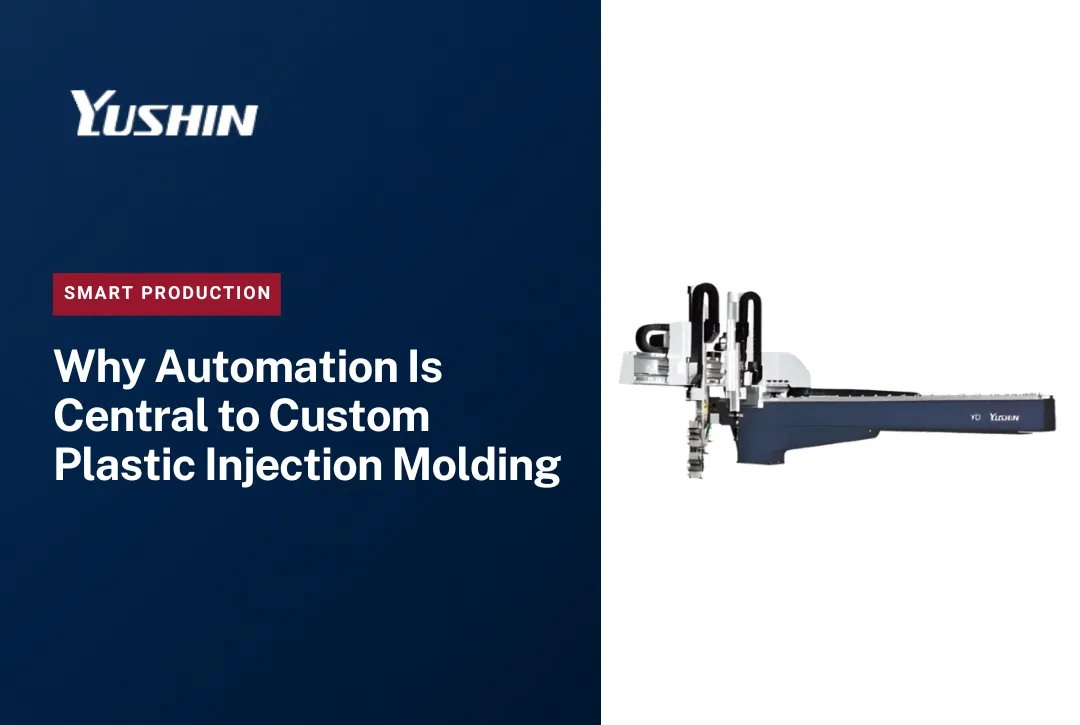
A YD Series standard take-out robot removes the operator from the mold area during part extraction, eliminates manual reach-in cycles, and reduces the ergonomic load on production staff.
Inconsistent Part Handling
Manual part removal introduces variation in how parts are gripped, placed, and oriented downstream. This variation causes cosmetic defects, dimensional variation from improper cooling during handling, and scrap.
Take-out robots with properly designed EOAT grip parts the same way on every cycle. This is especially important for:
- Optical parts that cannot tolerate surface contact variation
- Medical parts with cleanliness or traceability requirements
- Thin-wall parts that distort under uneven grip pressure
- Parts with tight dimensional tolerances
Cycle-Time Pressure
Faster cycle times mean the robot must enter the mold, extract the part, and clear the safety gate before the next cycle begins—all within a tight time window. Manual operators cannot consistently match robot speeds at short cycle times without fatigue effects.
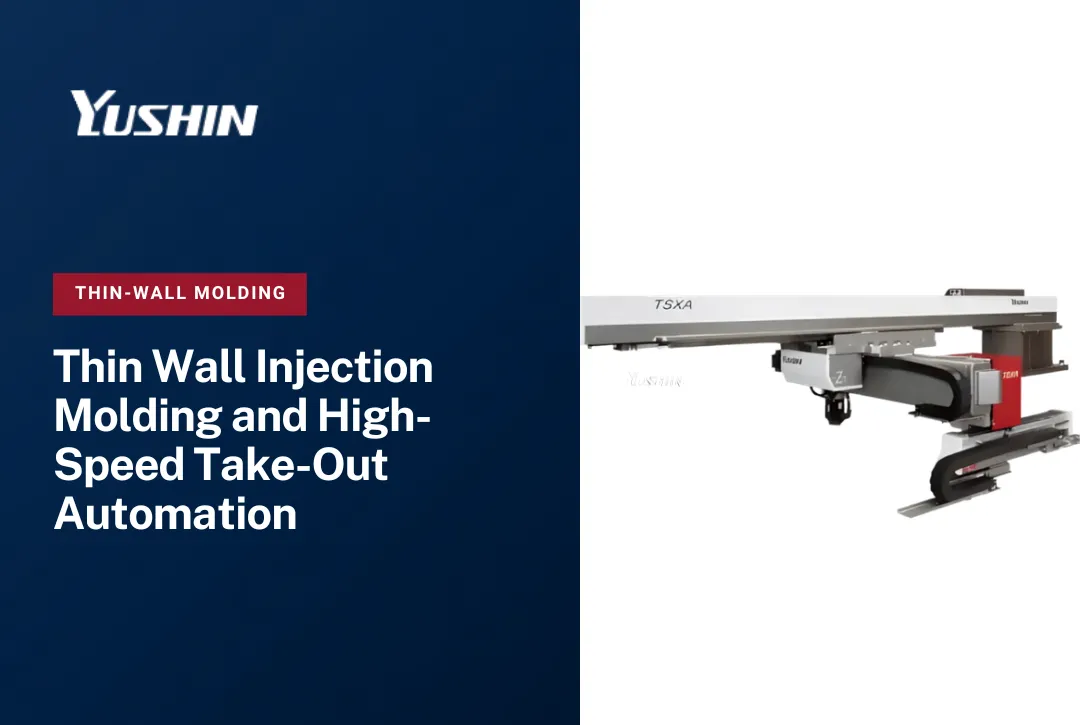
Yushin's RC-SE high-end high-speed take-out robot supports IMMs from 30 to 1,300 tf and includes Smart ECO Vacuum technology that can reduce air consumption by up to 78% compared to conventional vacuum systems—addressing both speed and operating cost.
Scrap and Part Damage
Inadequate part extraction causes parts to drop, drag across mold surfaces, or stack improperly on conveyors. Each of these creates scrap, cosmetic defects, or dimensional failures.
Consistent take-out robot cycles, combined with EOAT engineered for the specific part geometry, dramatically reduce the part-damage and scrap rates associated with manual handling. Yushin America designs and builds EOAT as part of complete automation system integrations.
Downtime from Mold or Equipment Problems
Injection molding cells are vulnerable to unplanned downtime from mold jams, short shots, and equipment faults. When a manual operator is handling parts, diagnosing and responding to these events depends on operator awareness and response time.
Modern Yushin controllers include monitoring functions that can detect anomalies in the extraction cycle and alert operators before a fault causes mold damage—supporting faster response and more structured preventive maintenance.
Safety Risk at the Mold Area
Injection molding machines present crush, pinch, burn, and ergonomic hazards. OSHA's machine guarding standards require that workers be protected from moving machine parts, but manual cell layouts can create gaps in guarding when operators must access the mold area regularly.
Yushin's FRA Series high-end take-out robots are designed to Safety Category 3 standards with redundant safety circuits and speed monitoring—supporting compliance with EN/ISO 10218 and related machine safety standards.

Where Take-Out Robots and Downstream Automation Fit
The standard injection molding cell sequence with automation looks like this:
- Mold opens
- Take-out robot enters the mold area
- EOAT grips the molded part (and runner or sprue, if applicable)
- Robot exits the mold area and clears the safety gate
- Part is placed on a conveyor, cooling fixture, inspection station, trim station, or packaging station
- Downstream automation (conveyor, palletizing robot, vision system) continues the process
- Mold closes and the next cycle begins
Each handoff in this sequence is an opportunity to introduce or reduce variation. Yushin America designs complete automation systems that cover the full extraction-to-palletizing sequence.
Application engineering note: For applications where runners and sprues must be separated from molded parts, Yushin sprue pickers—including the HOP Five, N-HOP, miniHOP, and V-HOP series—handle runner removal independently, freeing the take-out robot to focus on part extraction.
Yushin Product Fit for Injection Molding Automation
| Application | Yushin Solution |
|---|---|
| Standard part take-out, 30–1,300 tf IMMs | YD/YD2 Series standard take-out robots |
| High-speed take-out, energy reduction | RC-SE high-end high-speed take-out robot |
| Advanced molding cells, safety-critical applications | FRA Series high-end take-out robots |
| End-of-line palletizing after packing/boxing | PA Series compact palletizing robot |
| Sprue and runner removal | HOP Five, N-HOP, miniHOP, V-HOP sprue pickers |
Confirm specific product selection with Yushin America based on your IMM clamp force, part geometry, EOAT requirements, and cycle time.
When Injection Molding Automation May Not Be the Right Fit
Automation is not justified in every scenario. Consider these cases carefully:
- Very low production volumes: If annual volumes are low, the capital cost of a take-out robot may not reach payback within an acceptable timeframe. Manual operation may remain cost-effective.
- Extreme product variation with short runs: Cells with frequent mold changes across very different part geometries require more complex EOAT and programming. The changeover burden may offset cycle gains.
- Inconsistent part ejection: If the molding process itself produces inconsistent part release, a robot will surface that problem immediately. Fixing the mold or process first may be required before automating extraction.
- Prototype or development tooling: Early-stage mold trials may not yet have stable enough cycles to justify robot integration. Manual handling during process development is common.
Implementation and Support
Yushin America provides installation, integration support, operator and maintenance training, field service, and parts support across North America. Service offices are located in Cranston RI, Corona CA, Columbus OH, San Antonio TX, Downers Grove IL, Plainfield IL, Atlanta GA, and Leon, Guanajuato, Mexico.
- 24/7 phone support for Yushin equipment: 888-707-6268
- Over $1.3 million in spare parts inventory with overnight shipping available
- Yushin University online training platform for operators and technicians
For more information on available services, visit Yushin America field service and support.
Frequently Asked Questions
What are the main advantages of injection molding? Injection molding offers high output rates, excellent part repeatability, complex geometry capability, wide material selection, and low per-part cost at volume. It is the dominant process for high-volume plastic part production across automotive, medical, packaging, and electronics manufacturing.
What are the main disadvantages of injection molding? High tooling cost, long mold lead times, labor dependency, inconsistent manual part handling, cycle-time pressure, scrap from part damage, and safety risk at the mold area are the primary disadvantages. Several of these are directly addressed through take-out robots and downstream automation.
How does a take-out robot reduce injection molding scrap? A take-out robot with properly designed EOAT grips and places parts the same way on every cycle, eliminating the variation introduced by manual handling. Consistent extraction reduces cosmetic defects, dimensional variation from improper cooling, and part-on-part damage on conveyors.
What injection molding machines are compatible with Yushin take-out robots? Yushin take-out robots are available for injection molding machines ranging from 30 tf to 1,300 tf and beyond. Product selection depends on IMM clamp force, part size, payload including EOAT, stroke requirements, and cycle time. Contact Yushin America for application-specific sizing.
Is automation cost-effective for small injection molding operations? It depends on production volume, cycle time, and labor costs. For cells running multiple shifts at moderate-to-high volumes, take-out robots typically reach payback within one to three years. For very low-volume or highly variable production, a detailed ROI review with Yushin America is recommended before committing to automation.
What is the difference between a take-out robot and a sprue picker? A take-out robot is designed to extract the full molded part from the mold and place it at a downstream location. A sprue picker is a simpler device designed specifically to remove the sprue or runner system. In cold-runner molds, both may be used together—the take-out robot handles the part, and the sprue picker handles the runner.
What does "advantages of injection moulding" mean vs. "injection molding"? "Injection moulding" is the standard British English spelling used in the UK, Australia, and other Commonwealth markets. "Injection molding" is the standard American English spelling used in the United States. Both terms refer to the same manufacturing process. This article uses "injection molding" as the primary spelling but applies to both.
Conclusion
Injection molding delivers genuine production advantages—high output, consistent quality, and low per-part cost at scale. But the process also creates specific challenges: labor dependency, manual handling variation, cycle-time pressure, part damage risk, and safety exposure at the mold area. These are not abstract problems. They show up as scrap, overtime, operator injuries, and unplanned downtime in real molding plants.
Take-out robots, EOAT, sprue pickers, and downstream automation from Yushin America are designed specifically to address these challenges in plastic injection molding cells—not generic warehouse or logistics environments. If your plant is dealing with inconsistent part removal, overtime dependence, or pressure to reduce scrap and cycle time, the right automation system can convert a vulnerable manual cell into a repeatable, defensible production asset.
Contact Yushin America to speak with an automation specialist about the right take-out robot, EOAT configuration, and downstream automation for your injection molding application.