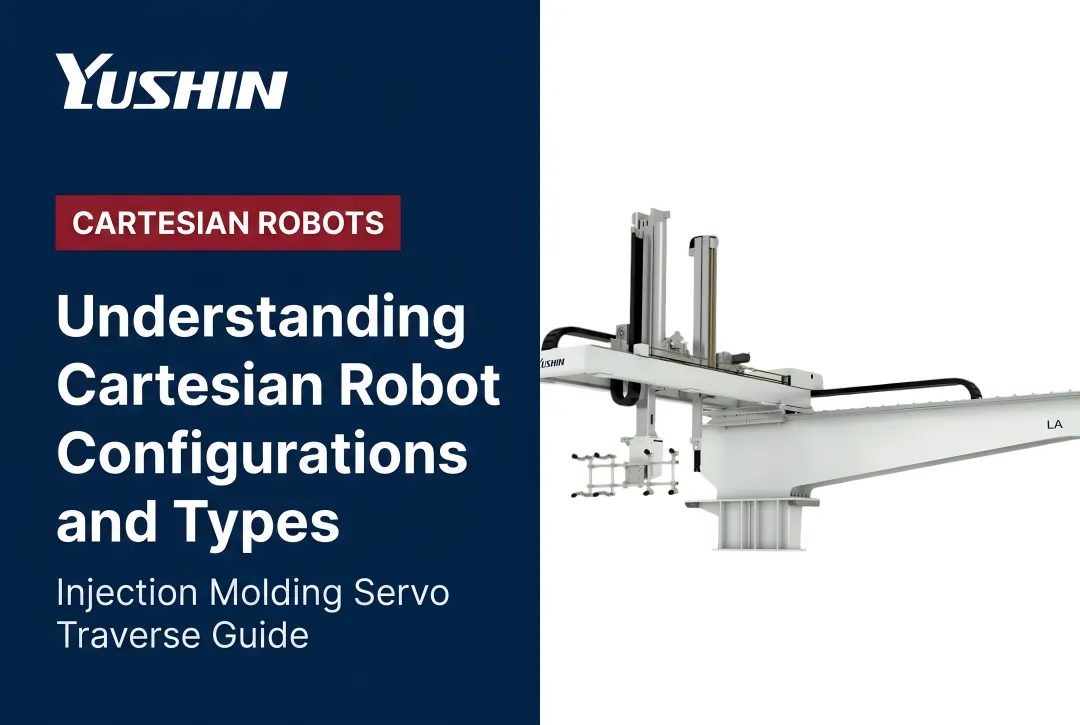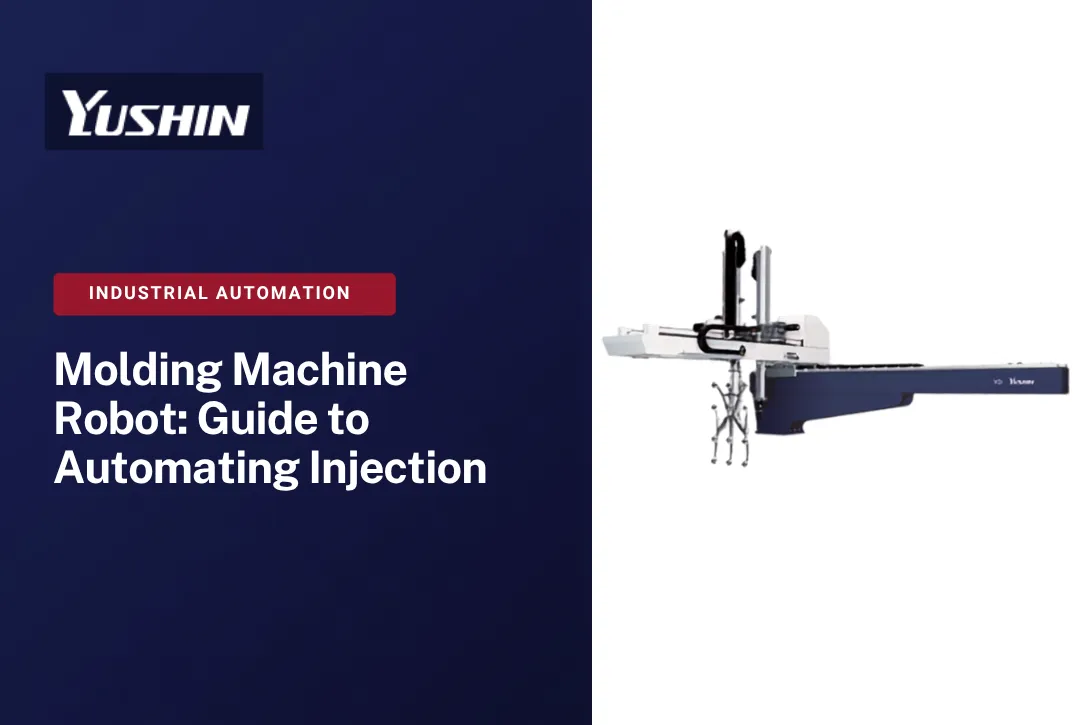

Injection molding automation is not a single robot category—it is a range of robot types, each matched to a specific role in the molding cell. Standard top-entry take-out robots handle most applications, but high-speed molding, side-entry access, runner removal, vertical machines, large parts, and end-of-line palletizing each require a different robot configuration. Yushin America builds robots across this full range, purpose-built for plastic injection molding operations rather than adapted from general industrial robotics.
Top-Entry Take-Out Robots

The most common robot type in injection molding, top-entry take-out robots use Cartesian linear axes—traverse, kick, vertical stroke—to enter the mold space from above, extract the molded part, and place it downstream.
Best fit: Standard part take-out across most IMM sizes and applications.
Yushin solutions:
- YD/YD2 Series standard take-out robots — covers 30–1,300 tf IMMs
- YD-0310 compact take-out robot — for 30–100 tf machines, small parts, medical and electronics applications, 3 kg payload
High-Speed Take-Out Robots

For applications with short cycle times—thin-wall molding, packaging, high-cavitation tooling—standard take-out speed is not sufficient. High-speed take-out robots use optimized axis design, reduced weight, and vibration control to complete extraction within tighter time windows.
Best fit: Thin-wall molding, packaging, fast-cycle production, applications where take-out time is the cycle-time constraint.
Yushin solutions:
- RC-SE high-end high-speed take-out robot — 30 to 1,300 tf, Smart ECO Vacuum (up to 78% air reduction), Long Life Mode, predictive maintenance positioning
- HST-150S/HST-250S super-high-speed take-out robots — 100–300 tf, take-out times as fast as 0.27 sec proven during live molding
- HST-400S/D/DS high-speed take-out robot — 280–450 tf, all-axis servo-driven with vibration control
Yushin's HST high-speed take-out robot is designed as a purpose-built high-speed automation platform for injection molding, not simply a standard robot fitted with larger motors. Its robust structural design helps increase rigidity, supporting stable motion and repeatable performance in fast-cycle molding applications. This matters in high-speed molding, where rigidity and stable motion are just as important as motor output.
Large Traverse Robots
Large molded parts—automotive structural components, appliance panels, industrial enclosures—require robots with extended reach, higher payload, and larger structural capacity than standard take-out platforms provide.
Best fit: Large IMMs (1,500+ tf), large or heavy molded parts.
Yushin solution: MKA-2000S large full-servo traverse robot — 3-axis Cartesian traverse robot for 1,500+ tf machines, handles 30–50 kg including EOAT, traverse beam adjustable up to 5,000 mm, vertical strokes up to 3,000 mm. See the MKA-2000S introduction.
Side-Entry Robots

Side-entry robots access the mold from the side rather than from above. This configuration is used where overhead clearance is limited or where side-entry access offers a speed advantage for high-speed molded-part removal.
Best fit: Applications with restricted overhead clearance, high-speed side-access molding cells.
Yushin solutions: SX-41, SXB, SXC-HSY, SXC-HS, SXC, TSXA.
Sprue Pickers
Sprue pickers are simplified robots designed specifically to remove the sprue or runner system from cold-runner molds. They are not designed or rated for full molded-part take-out.
Best fit: Cold-runner molds where runner removal must be handled separately from part extraction, often coordinated with a separate take-out robot on the same cell.
Yushin solutions: HOP Five, N-HOP, miniHOP, V-HOP, V-HOP-II.
Robots for Vertical Injection Molding Machines
Vertical IMMs have a vertical clamping axis, opening the mold vertically rather than horizontally. This geometry requires a different robot entry configuration than standard horizontal-machine take-out robots—commonly used for insert molding and rotary-table applications.
Best fit: Vertical clamp injection molding machines, insert molding applications with top-loaded inserts, rotary table and shuttle-platen configurations.
Yushin solutions: SVR-C50, V-HOP, V-HOP-II.
Safety-Focused and High-End Take-Out Robots
For advanced molding plants, complex molded products, small-lot/high-variety production, and applications requiring formal safety certification, a higher-end robot platform with additional safety and configuration flexibility may be warranted.
Best fit: Safety-critical applications (medical, automotive), high-variety production requiring frequent reconfiguration, plants standardizing on Safety Category 3 automation.
Yushin solution: FRA Series high-end take-out robots — Safety Category 3 design, redundant safety circuits, speed monitoring, supports up to 8 axes (5 robot + 3 wrist), standards include EN/ISO 12100, EN 60204, EN/ISO 10218, CE, GB, KCs.
NC Servo Wrist Units: Adding Orientation Capability

For applications requiring more than linear extraction—insert loading, overmolding, angled placement—NC servo wrist units add controlled orientation axes to Yushin take-out robots. Available in A/C, B/C (2-axis), and A/B/C (3-axis) configurations, these units are teach-and-save programmable through the robot controller and support repeatable setups for insert molding and complex part orientation.
Insert loading, overmolding, and complex orientation are important Yushin America application capabilities—not exceptions requiring a different robot category. NC servo wrist units extend Yushin's standard take-out robot platforms to handle these applications.
Palletizing Robots
Palletizing robots operate downstream of the take-out robot, handling end-of-line case, tray, or bag stacking after molded parts are packed. This is a distinct robot category from mold-area take-out.
Best fit: End-of-line palletizing after injection molding, packing, boxing, or bagging.
Yushin solution: PA Series compact palletizing robot — PA-20 (20 kg payload), PA-40 (40 kg including EOAT, up to 420 boxes/hour), compact cantilever Cartesian layout, Automap pattern software, E-touch Compact controller.
Robot Type Selection Summary
| Application need | Robot category |
|---|---|
| Standard part take-out | Top-entry take-out robots (YD/YD2, YD-0310) |
| Fast cycle times, thin-wall, packaging | High-speed take-out robots (RC-SE, HST) |
| Large parts, 1,500+ tf | Large traverse robots (MKA-2000S) |
| Limited overhead clearance | Side-entry robots (SX, SXC, TSXA) |
| Runner/sprue removal | Sprue pickers (HOP Five, N-HOP, miniHOP, V-HOP) |
| Vertical IMMs | Robots for vertical machines (SVR-C50, V-HOP) |
| Safety-critical, high-variety | FRA Series high-end take-out robots |
| Insert loading, overmolding, orientation | NC servo wrist units (most standard take-out platforms) |
| End-of-line palletizing | PA Series compact palletizing robot |
Selection Criteria Across Robot Types

- IMM clamp force and platen size: Narrows the robot category and specific model range
- Cycle time: Determines whether standard or high-speed take-out is needed
- Part weight and EOAT weight: Payload calculation always includes both
- Mold access geometry: Top-entry vs. side-entry vs. vertical-IMM configuration
- Runner system: Cold-runner molds may need a separate sprue picker
- Orientation requirements: Determines whether NC servo wrist units are needed
- Downstream requirements: Determines whether palletizing automation should be included in the automation plan
- Safety and certification requirements: May point toward FRA Series for formal Safety Category 3 compliance
When a Standard Take-Out Robot Is the Right Choice (and When It Is Not)
Most injection molding applications are well served by a standard top-entry take-out robot. Consider a different category when:
- Cycle time is under pressure and a standard robot cannot keep up (move to high-speed take-out)
- Overhead clearance is limited (move to side-entry)
- The part or IMM exceeds standard payload/tonnage range (move to large traverse)
- Insert loading or overmolding is required (add NC servo wrist units)
- End-of-line palletizing is part of the automation scope (add PA Series)
Standard take-out robots are not the right fit for cold-runner sprue removal (use a sprue picker) or vertical IMM applications (use a vertical-IMM-specific robot).
Implementation and Support
Yushin America provides installation, EOAT engineering, operator training, field service, and parts support across all robot categories.
- 24/7 phone support: 888-707-6268
- Over $1.3M in spare parts inventory; over $2M in pre-assembled robot module inventory
- Yushin University: Yushin robot training and programming
- Yushin America field service and support
Frequently Asked Questions
What types of robots are used in injection molding automation? The main categories are top-entry take-out robots (standard applications), high-speed take-out robots (fast cycles, thin-wall), large traverse robots (large parts), side-entry robots (limited clearance), sprue pickers (runner removal), robots for vertical IMMs, and palletizing robots (end-of-line). NC servo wrist units add orientation capability across most of these categories.
What is the difference between a take-out robot and a sprue picker? A take-out robot extracts the full molded part and places it downstream. A sprue picker removes only the runner or sprue system from a cold-runner mold. They are not interchangeable—sprue pickers are sized for runner handling only.
When should I use a high-speed take-out robot instead of a standard one? When cycle time is short enough that a standard robot's extraction time becomes the cycle-time bottleneck—commonly in thin-wall packaging, high-cavitation molding, or fast-cycle applications. Yushin's RC-SE and HST series are designed for these speed requirements.
Do all injection molding robots support insert loading? Insert loading requires engineered EOAT and typically A/C, B/C, or A/B/C NC servo wrist units for controlled orientation. These can be added to most Yushin standard take-out robot platforms rather than requiring an entirely different robot category.
What robot is used for large automotive parts? Yushin's MKA-2000S large full-servo traverse robot is designed for large parts on 1,500+ tf machines, handling 30–50 kg including EOAT with extended traverse beam and vertical stroke.
Is a palletizing robot the same as a take-out robot? No. A take-out robot extracts parts from the mold. A palletizing robot, like Yushin's PA Series, operates downstream at the end of the line, stacking packed or boxed parts onto pallets. Both may be used in the same production line but serve different functions.
Conclusion
Injection molding automation spans a range of robot types, each matched to a specific role: standard take-out, high-speed extraction, large-part handling, side-entry access, runner removal, vertical IMM applications, and end-of-line palletizing. Selecting the right category—and adding NC servo wrist capability where insert loading or orientation is needed—is the foundation of a well-matched automation system.
If you are evaluating robot options for your molding cell, contact Yushin America to discuss which robot category and configuration fits your IMM, part, and production requirements.