
Linear Motion in Injection Molding Take-Out Robots

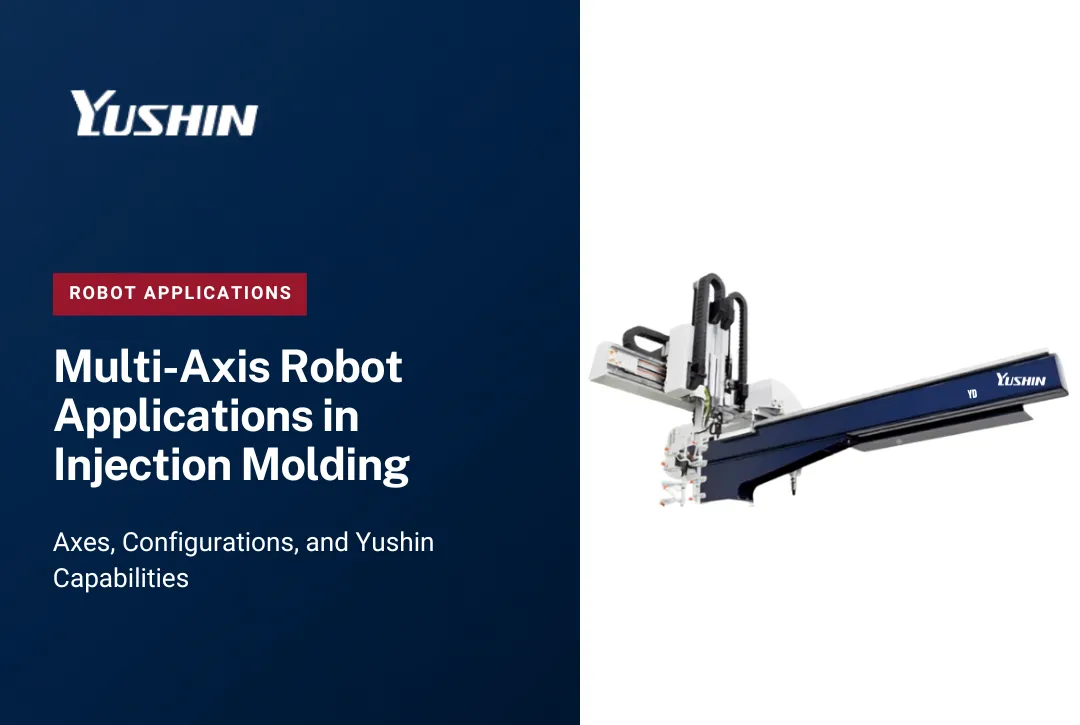
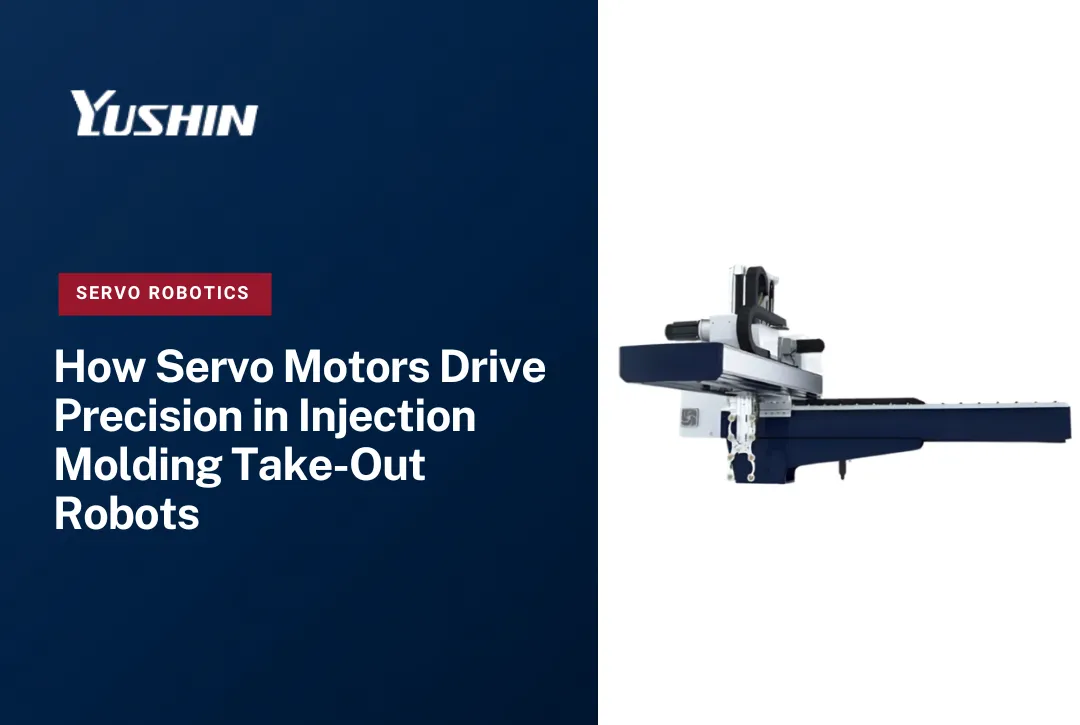
Linear motion means the robot's axis moves in a straight line from one position to another. In Cartesian take-out robots, all primary axes are linear:
- X axis (traverse): Moves the robot horizontally along the length of the IMM
- Y axis (kick/horizontal): Moves the robot horizontally toward or away from the mold space
- Z axis (vertical stroke): Moves the robot vertically into and out of the mold
Each axis moves independently. The robot's position at any point is defined by its X, Y, and Z coordinates. The path between positions on any single axis is a straight line.
Why linear motion is the right fit for standard take-out: Injection molding take-out is a structured, repeatable task. The mold opens at a known position. The part is at a predictable location. The downstream placement point is fixed. Linear motion matches this structure precisely-axes move defined strokes, at defined speeds, to defined positions. There are no kinematic uncertainties, no singularities, and no need for joint-angle interpolation.
Application engineering note: The efficiency of Cartesian linear motion over short, repeatable strokes is one of the primary reasons Cartesian take-out robots dominate injection molding cells over articulated alternatives. The motion is mechanically direct-energy, speed, and repeatability are not compromised by joint stacking.
Wrist Motion: What It Is and When It Matters

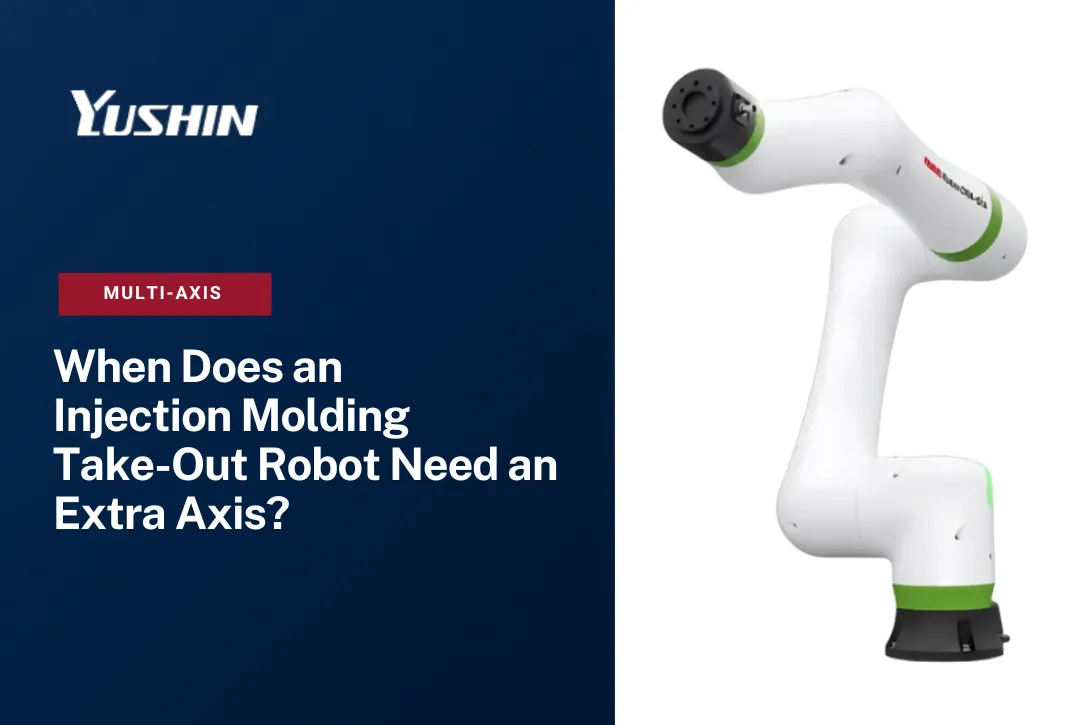
Wrist or joint motion adds rotational capability at the end of the robot's linear arm-the point where EOAT is attached. While the primary traverse, kick, and vertical axes handle gross positioning, wrist axes control the orientation of the part or EOAT at the point of grip, release, or placement.
In injection molding, wrist motion becomes important in these scenarios:
- Angled part release: Parts must be placed at an angle relative to the mold exit path-on a conveyor at a specific orientation, into a fixture with a defined entry angle, or onto a pallet in a specific pattern.
- Insert loading: An insert must be rotated or oriented before being placed into the mold cavity. The robot's linear axes position the insert at the mold; the wrist controls the final orientation.
- Overmolding: Parts from a first molding operation must be reoriented before being loaded into the second mold.
- Flip axis (180 degree rotation): A flip axis is a specific wrist configuration that rotates the EOAT 180 degrees-often used to flip a part from ejection orientation to placement orientation. This is common on robots with separate take-out and placement axes.
- Downstream stacking and orientation: Parts must be placed in defined orientations for downstream assembly, inspection, or packaging.
Linear motion handles where. Wrist motion handles how the part is oriented when it gets there.
Yushin NC Servo Wrist Units: Controlled Orientation for Complex Applications

Yushin's NC servo wrist units are the primary tool for adding controlled orientation capability to Yushin take-out robots. They are available in A/C, B/C, and A/B/C configurations-2-axis and 3-axis wrist arrangements that provide precise rotational control at the EOAT.
Yushin's compact servo-wrist design can help reduce the mold-open space required for part extraction and orientation. Its fast, accurate servo-controlled movement allows the robot to present a molded part at the required angle before it reaches downstream equipment. A single robot can position the part for multiple cutting locations or rotate it through several visual-inspection points, reducing the need for separate mechanical repositioning equipment and simplifying the downstream process. Where the application permits, wrist orientation can occur during the robot's traverse movement to minimize additional cycle time.
Key capabilities:
- Rotate or angle molded parts, inserts, or EOAT assemblies during release, placement, and downstream handoff
- Teach-and-save programmable through the robot controller-no separate programming environment needed
- Support repeatable setups and fast mold changes by saving wrist positions as part of the robot program
- Add orientation flexibility without significantly impacting cycle time
- Keep the system practical for molding-floor operators
Where NC servo wrist units fit in the molding cell:
For a standard take-out cycle with no orientation requirement, the NC servo wrist unit sits at the base wrist position throughout the cycle-it does not affect cycle time.
For a cycle that requires part rotation:
- Robot enters mold; EOAT grips part at take-out orientation
- Robot retracts; part exits mold
- Servo wrist rotates to placement orientation during traverse (typically simultaneous with traverse motion, consuming no extra time)
- Robot places part at downstream location in correct orientation
- Servo wrist returns to take-out position during return traverse
When wrist rotation is executed simultaneously with an axis traverse, it can add little or no net cycle time, depending on the rotation angle, required precision, and application setup. When it requires a dedicated move, the time impact depends on the rotation angle and required precision.
Insert Loading, Overmolding, and Complex Orientation
Insert loading and overmolding are advanced applications where linear motion alone is not sufficient. The robot must position an insert at the mold cavity (linear) and then orient it precisely before placement (wrist/joint). Overmolding requires that the part from the first operation be picked, reoriented, and placed into a second mold in a specific position.
These applications require:
- Engineered EOAT designed for the specific insert or part geometry
- A/C, B/C, or A/B/C NC servo wrist configuration to control final orientation
- Robot program that coordinates linear axes and wrist axes in the correct sequence
- Downstream fixtures or placement stations that accept the part in the correct orientation
Insert loading and overmolding are important Yushin America automation applications. They require deeper engineering review than standard part take-out, but they are not reasons to reject a Cartesian take-out robot approach. Yushin's engineering team works with customers on EOAT design, servo wrist configuration, insert-handling tooling, and operator workflow for these applications.
Comparing Linear Moves and Wrist Moves in Injection Molding

| Motion type | Function | When needed in molding | Yushin solution |
|---|---|---|---|
| Linear (traverse) | Move robot along machine axis | Every cycle | Standard traverse axis on all take-out robots |
| Linear (vertical/Z) | Enter and exit mold space | Every cycle | Vertical stroke on all take-out robots |
| Linear (kick/Y) | Position EOAT at part | Every cycle | Kick axis on all take-out robots |
| Flip axis | Rotate EOAT 180 degrees (part inversion) | Part inversion for placement | Flip axis option on many Yushin models |
| Wrist rotation (A/C, B/C) | Controlled part orientation | Angled release, insert loading, overmolding | NC servo wrist units (2-axis) |
| Wrist rotation (A/B/C) | Full 3-axis orientation control | Complex insert/overmolding, precise placement | NC servo wrist units (3-axis) |
Yushin Take-Out Robot Product Fit for Motion Requirements
| Application | Yushin solution |
|---|---|
| Standard linear take-out, 30-1,300 tf | YD/YD2 Series standard take-out robots |
| High-speed linear take-out | RC-SE high-end high-speed take-out robot |
| Safety-certified take-out with advanced motion | FRA Series high-end take-out robots |
| Complex orientation, insert loading, overmolding | NC servo wrist units - A/C, B/C, A/B/C configurations |
| Large parts, 1,500+ tf | MKA-2000S large full-servo traverse robot |
When Wrist Motion May Not Be Needed

Not every molding application requires a servo wrist or complex orientation capability:
- Standard part take-out with flat conveyor placement: Linear traverse, vertical, and kick axes handle the entire cycle. A wrist axis adds cost and complexity without benefit.
- Sprue/runner removal: Sprue pickers operate on simple linear paths to a disposal or regrind point. No wrist motion is needed.
- High-speed packaging with consistent placement: If parts are placed consistently in one orientation on a conveyor or cooling station, a flip axis or simple fixed wrist may be sufficient.
Review wrist requirements as part of EOAT design-not as an afterthought. Adding a servo wrist after the fact to an under-specified EOAT assembly is more expensive and complex than designing it in from the start.
Implementation and Support
Yushin America provides installation, NC servo wrist configuration support, EOAT engineering, operator training, field service, and parts support for all Yushin take-out robot systems.
- 24/7 phone support: 888-707-6268
- Over $1.3M in spare parts inventory with overnight shipping
- Yushin University for operator and technician training: Yushin robot training and programming
- Yushin America field service and support
Frequently Asked Questions
What is linear motion in an injection molding take-out robot? Linear motion means the robot axis moves in a straight line from one point to another. In take-out robots, the traverse (X), kick/horizontal (Y), and vertical stroke (Z) are all linear axes. They position the EOAT at the part location and move it to the downstream placement point along defined straight-line paths.
What is wrist or joint motion in a take-out robot? Wrist or joint motion is rotational movement at the end of the robot arm-at the point where EOAT is attached. It controls the orientation of the part or EOAT rather than its position. In Yushin take-out robots, wrist motion is provided by optional NC servo wrist units in A/C, B/C, or A/B/C configurations.
When do I need a servo wrist on a take-out robot? You need a servo wrist when the application requires controlled part orientation that cannot be achieved through linear axes alone. Common cases: angled part release onto a conveyor or into a fixture, insert loading where the insert must be rotated before placement, overmolding where the part must be reoriented between operations, and precise downstream stacking or assembly placement.
Do servo wrist moves add cycle time? Not necessarily. When servo wrist rotation is executed simultaneously with a traverse or return-axis move, it can add little or no net cycle time. When a dedicated wrist move is required, the time impact depends on rotation angle, required precision, and servo wrist speed. For most molding-cell applications, wrist rotation should be reviewed during EOAT and cycle-time planning so it can be timed to overlap with other robot motion wherever possible.
Can Yushin take-out robots handle insert loading and overmolding? Yes. Insert loading, insert molding, and overmolding are important Yushin America application capabilities. These applications require engineered EOAT and typically A/C, B/C, or A/B/C NC servo wrist units. Yushin's engineering team works with customers on EOAT design, servo wrist configuration, and downstream requirements for these applications.
What is the difference between a flip axis and an NC servo wrist? A flip axis rotates the EOAT 180 degrees (part inversion) between take-out and placement-a fixed rotation for inverting parts. An NC servo wrist provides programmable, teach-and-save rotational control over one, two, or three axes-allowing the robot to orient parts at any angle within the wrist's range of motion. NC servo wrist units are used for applications requiring more than simple inversion.
Conclusion
Linear motion is the foundation of injection molding take-out automation-every standard extraction cycle uses traverse, vertical, and kick axes to position the EOAT and move parts. Wrist and joint motion become important when the application requires controlled part orientation: angled release, insert loading, overmolding, or precise downstream placement.
Yushin America's NC servo wrist units add A/C, B/C, and A/B/C orientation capability to Yushin take-out robots, with teach-and-save programming designed for production-floor operators. If your application involves complex part orientation, insert handling, or overmolding, contact Yushin America to discuss the right robot, wrist configuration, and EOAT engineering for your molding cell.