
In injection molding, "multi-axis" does not automatically mean a 6-axis articulated arm. It means the robot has enough controlled axes to accomplish the extraction, orientation, and placement task the application requires. A standard take-out robot uses three primary linear axes—traverse, kick, and vertical—plus optional wrist or flip axes for orientation. Advanced applications add servo wrist axes for insert loading, overmolding, and precise downstream placement. Understanding what each axis contributes helps automation engineers and plant managers specify the right robot configuration without over-engineering or under-specifying. Yushin America has built and supported multi-axis injection molding automation systems for over 35 years.
What "Multi-Axis" Means in Injection Molding Take-Out

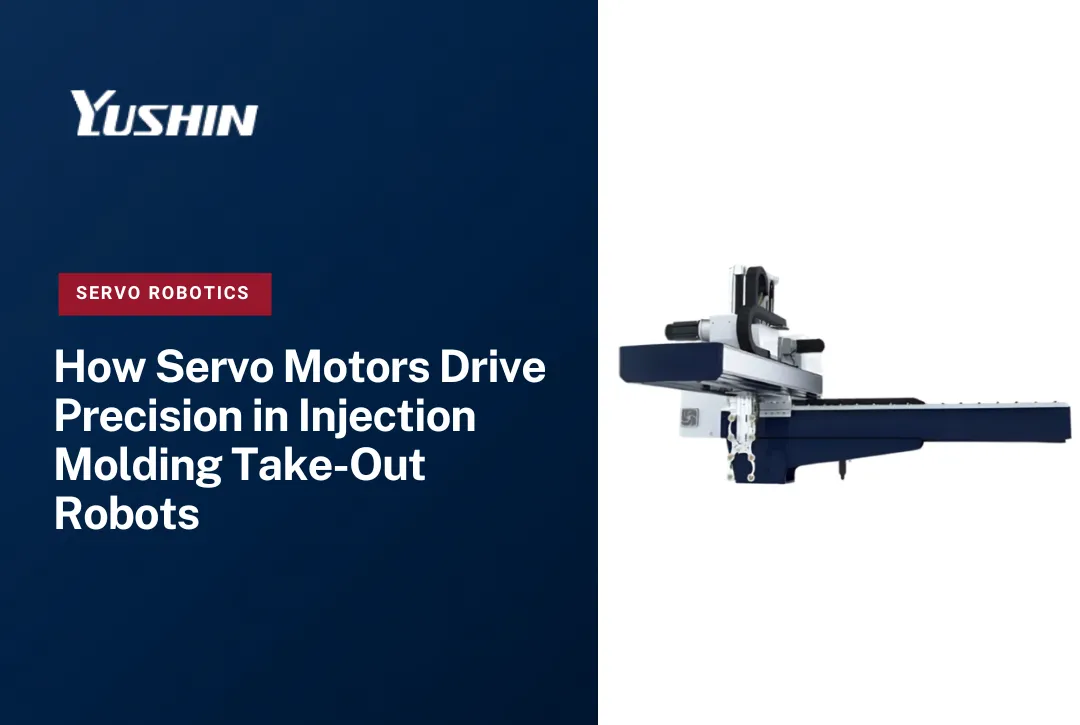
Multi-axis simply means the robot controls more than one independent direction of movement. In Cartesian take-out robots, axes are linear—each axis moves in a straight line along a defined path. The combination of axes determines what the robot can do:
| Axis | Direction | Function in molding cell |
|---|---|---|
| X (traverse) | Horizontal along IMM | Moves robot to mold position and to placement position |
| Y (kick/horizontal) | Horizontal into/out of mold | Positions EOAT at the part depth within the mold |
| Z (vertical stroke) | Vertical into/out of mold | Descends into mold space; retracts part out of mold |
| Flip axis | 180° rotation | Inverts part between take-out and placement orientations |
| A/C wrist | 2-axis servo rotation | Controlled part orientation for angled release, insert placement |
| B/C wrist | 2-axis servo rotation | Controlled orientation in a different plane |
| A/B/C wrist | 3-axis servo rotation | Full controlled orientation for complex insert/overmolding applications |
The three primary axes (X, Y, Z) handle most standard take-out applications. Flip axes and servo wrist axes are added when the application requires controlled part orientation beyond simple linear positioning.
Application engineering note: More axes are not always better. Each additional axis adds cost, programming complexity, and potential maintenance points. Add axes when the application requires them—not to match a specification sheet.
The Standard 3-Axis Cartesian Take-Out Cycle
For most standard injection molding applications, three linear axes handle the complete extraction cycle:
- Mold completes cycle; IMM signals robot
- Traverse axis (X) moves robot carriage to mold position
- Kick axis (Y) extends arm into mold space depth
- Vertical axis (Z) lowers EOAT onto the molded part
- EOAT activates (vacuum, gripper, or combination)
- Vertical axis retracts; part exits mold space
- Kick axis retracts; arm clears mold zone
- Traverse axis moves part to downstream placement position
- EOAT releases part to conveyor, cooling fixture, or packaging station
- Robot returns to standby; mold closes; next cycle begins
This 3-axis sequence is repeatable, fast, and mechanically straightforward. Cartesian linear axes accelerate and decelerate efficiently over short strokes, making them naturally suited to the short, structured path of a take-out cycle.
Why 3-axis Cartesian dominates injection molding over 6-axis articulated:
- Linear servo motion is faster than articulated joint sequencing at short strokes
- Cartesian geometry maintains positional accuracy without cumulative joint tolerances
- Fewer axes means lower cost, simpler programming, and fewer maintenance points
- Overhead mounting minimizes floor space requirements in the cell
Adding Axes: Flip, Wrist, and Servo Wrist Configurations

Flip Axis
A flip axis rotates the EOAT 180° between take-out orientation and placement orientation. It is the simplest orientation axis—on or off, 0° or 180°. Common in cells where the part must be inverted between ejection and downstream placement.
NC Servo Wrist Units: A/C, B/C, and A/B/C Configurations
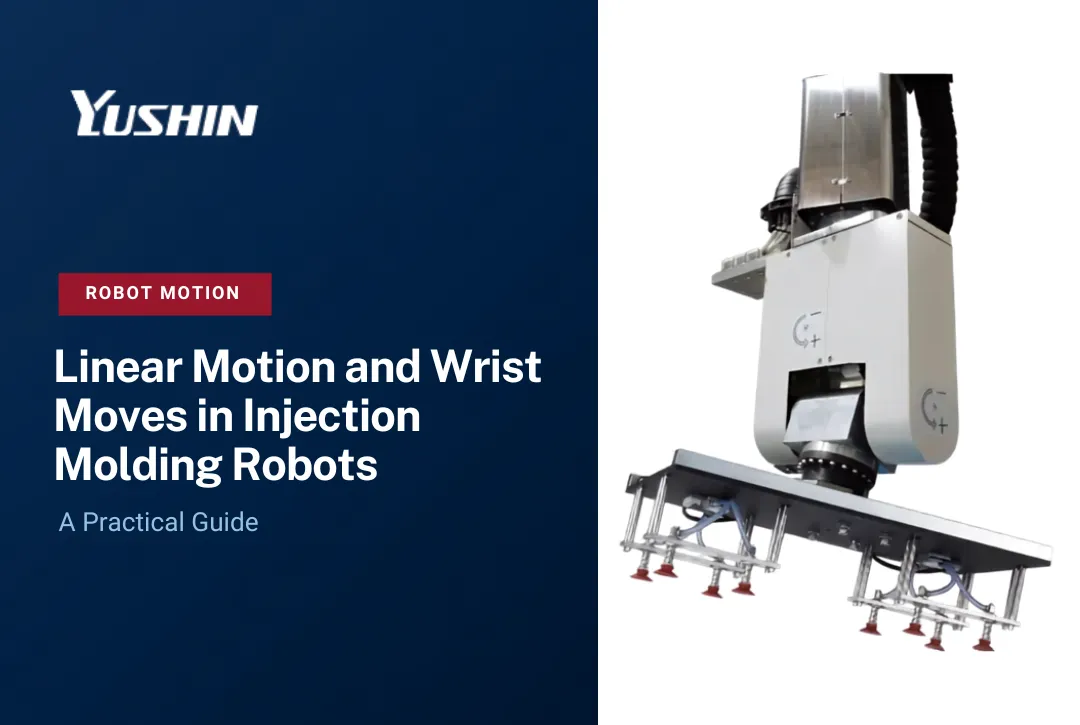
For applications requiring controlled orientation beyond simple inversion, Yushin's NC servo wrist units add programmable rotational axes to the end of the robot arm.
- A/C configuration (2-axis): Controls orientation in two rotational axes
- B/C configuration (2-axis): Controls orientation in a different two-axis combination
- A/B/C configuration (3-axis): Full three-axis wrist rotation for complex orientation requirements
NC servo wrist units are teach-and-save programmable through the robot controller. Wrist positions are saved as part of the robot program, supporting repeatable setups and fast mold changes without re-teaching. When wrist rotation is executed simultaneously with traverse motion, it can add little or no net cycle time, depending on the rotation angle, required precision, and application setup.
FRA Series: Up to 8 Controlled Axes

Yushin's FRA Series high-end take-out robots support configurations with up to 8 axes (5 primary robot axes plus A/B/C servo wrist axes). This makes the FRA Series the appropriate platform for the most demanding multi-axis injection molding applications: large structural parts requiring complex reorientation, advanced insert molding, and high-variety production cells with frequent mold changes.
FRA Series specifications:
- Safety Category 3 design
- Redundant safety circuits and speed monitoring
- Standards: EN/ISO 12100, EN 60204, EN/ISO 10218, CE, GB, KCs references
Advanced Multi-Axis Applications in Injection Molding
Insert Loading and Insert Molding
Insert loading requires the robot to pick an insert (metal, pre-formed plastic, or other material), orient it precisely, and place it into the mold cavity before the mold closes. The linear axes position the robot at the insertion point; the servo wrist controls the final orientation of the insert at the moment of placement.
Insert molding is an important Yushin America application capability. It requires:
- Engineered EOAT designed for the specific insert geometry and grip requirements
- A/C, B/C, or A/B/C NC servo wrist configuration to control insert orientation
- Robot programming that coordinates linear and wrist axes in the correct sequence
- Downstream fixtures or trays that accept the finished insert-molded part in the correct orientation
Yushin's engineering team works with customers on EOAT design, servo wrist configuration, insert-handling tooling, and operator workflow for insert molding applications.
Overmolding
Overmolding requires picking a finished part from a first mold operation, reorienting it, and loading it into a second mold for the overmold shot. The robot must handle the part from both operations and manage the orientation transition between them.
Like insert molding, overmolding is an advanced Yushin America application that requires engineered EOAT, servo wrist configuration, and application-specific engineering support.
Large-Part Multi-Axis Take-Out
Large automotive structural components, appliance panels, and industrial enclosures require both extended reach and precise placement. The MKA-2000S large full-servo traverse robot handles 30–50 kg including EOAT at traverse beams up to 5,000 mm, with vertical strokes up to 3,000 mm—for 1,500+ tf injection molding machines. See the MKA-2000S introduction.
End-of-Line Palletizing
After injection molded parts are packed, boxed, bagged, or trayed, end-of-line palletizing robots stack them onto pallets. Yushin's PA Series compact palletizing robot uses Cartesian-axis motion in a compact cantilever layout designed for the injection molding plant environment.
- PA-20: 20 kg payload
- PA-40: 40 kg payload including wrist/EOAT; up to 420 boxes/hour
- Automap automatic palletizing pattern calculation
- 7.5-inch touchscreen; E-touch Compact controller; predictive maintenance
Yushin Multi-Axis Product Fit
| Application | Axis requirements | Yushin solution |
|---|---|---|
| Standard part take-out, 30–1,300 tf | 3 primary axes | YD/YD2 Series |
| High-speed take-out, energy reduction | 3 primary axes + speed/vacuum optimization | RC-SE |
| Complex orientation, insert loading, overmolding | 3 primary + A/C, B/C, or A/B/C wrist | NC servo wrist units on YD/YD2, FRA |
| High-end safety + up to 8 axes | 5 robot + up to 3 wrist axes | FRA Series |
| Large parts, 1,500+ tf | 3 primary axes, extended stroke/payload | MKA-2000S |
| End-of-line palletizing | Cartesian cantilever axes | PA Series |
| Side-entry take-out | Linear side-entry axes | SX-41, SXB, SXC-HS, SXC, TSXA |
| Sprue/runner removal | Simplified linear axes | HOP Five, N-HOP, miniHOP, V-HOP |
When Fewer Axes Are the Right Choice
Adding axes adds cost and complexity. Before specifying a multi-wrist robot:
- Confirm that orientation is actually required. If the part can be placed on a flat conveyor in ejection orientation, no wrist is needed.
- Check whether a fixed wrist angle solves the problem. Some placement requirements can be met with a fixed EOAT orientation—no programmable wrist needed.
- Evaluate whether a flip axis is sufficient. If the only requirement is part inversion, a flip axis is simpler and less expensive than a servo wrist.
- Confirm payload against the full EOAT assembly. Each wrist axis adds weight to the EOAT assembly, which counts against the robot's rated payload.
The goal is to match axis count to the application requirement—not to maximize axis count.
Implementation and Support
Yushin America provides installation, multi-axis configuration support, EOAT engineering, operator training, field service, and parts support for all Yushin take-out robot systems.
- 24/7 phone support: 888-707-6268
- Over $1.3M in spare parts inventory with overnight shipping
- Yushin University online training: Yushin robot training and programming
- Yushin America field service and support
Frequently Asked Questions
How many axes does a standard injection molding take-out robot have? Standard take-out robots use three primary linear axes: traverse (X), kick/horizontal (Y), and vertical (Z). Optional axes include a flip axis for part inversion and A/C, B/C, or A/B/C NC servo wrist axes for controlled orientation in insert loading, overmolding, or complex placement applications. Yushin's FRA Series can support configurations with up to 8 axes.
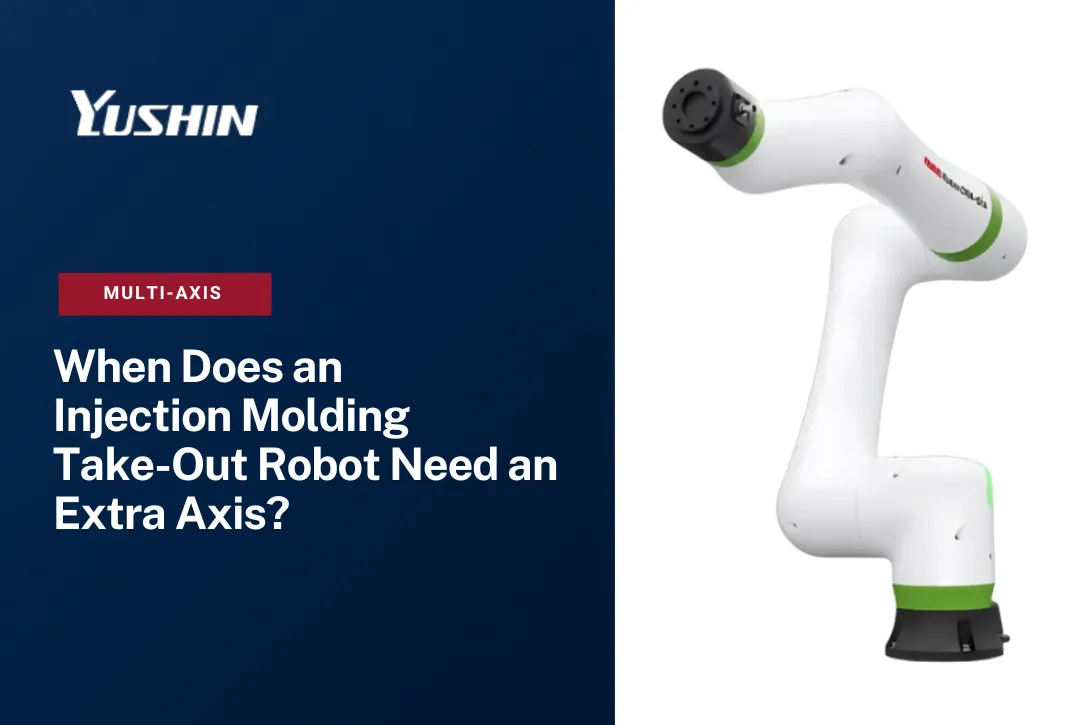
What is the difference between a 3-axis and a 6-axis robot in injection molding? A 3-axis Cartesian take-out robot moves along three linear axes and handles the large majority of standard part take-out applications. A 6-axis articulated robot uses three rotational joint axes (shoulder, elbow, wrist) and is typically used for assembly, welding, or applications requiring non-linear approach paths. In injection molding, 3-axis Cartesian robots dominate take-out because their linear motion is faster, simpler, and more cost-effective for structured extraction cycles.
Can Yushin robots handle insert loading and overmolding? Yes. Insert loading, insert molding, and overmolding are important Yushin America application capabilities. These applications require engineered EOAT and A/C, B/C, or A/B/C NC servo wrist units to add controlled orientation capability. Yushin's engineering team works with customers on EOAT, wrist configuration, insert-handling tooling, and operator workflow for these applications.
What are NC servo wrist units and when are they needed? NC servo wrist units are add-on wrist axes that give Yushin take-out robots controlled orientation capability at the EOAT. They are needed when the application requires the part or insert to be rotated or angled beyond what linear axes can achieve—for example, angled release into a fixture, insert orientation before mold placement, or overmolding reorientation. They are available in 2-axis (A/C or B/C) and 3-axis (A/B/C) configurations.
What is the FRA Series and when does it apply? The FRA Series is Yushin America's high-end take-out robot platform, supporting up to 8 axes in Safety Category 3 design. It applies to advanced molding cells with complex reorientation requirements, safety-critical applications (medical, automotive), and high-variety production environments where an 8-axis configuration and redundant safety circuits are justified.
Does adding servo wrist axes increase cycle time? Not necessarily. When servo wrist rotation is executed simultaneously with traverse or return-axis moves, it can add little or no net cycle time. When a dedicated wrist move is required, the time impact depends on the rotation angle, required precision, and application setup. For most molding-cell applications, wrist motion should be planned with EOAT design and cycle-time analysis so it can overlap with other robot movement wherever possible.
Conclusion
Multi-axis capability in injection molding automation means adding the axes the application actually requires—not chasing a higher axis count. Three linear Cartesian axes handle most standard take-out applications efficiently. When insert loading, overmolding, complex orientation, or precise downstream placement is needed, servo wrist axes add controlled orientation capability while preserving the speed and repeatability of a Cartesian take-out robot.
Yushin America designs, builds, and supports multi-axis take-out robots from standard 3-axis configurations through FRA Series platforms with up to 8 axes. If your application involves complex orientation, insert handling, or overmolding, contact Yushin America to discuss the right axis configuration, EOAT engineering, and servo wrist setup for your molding cell.