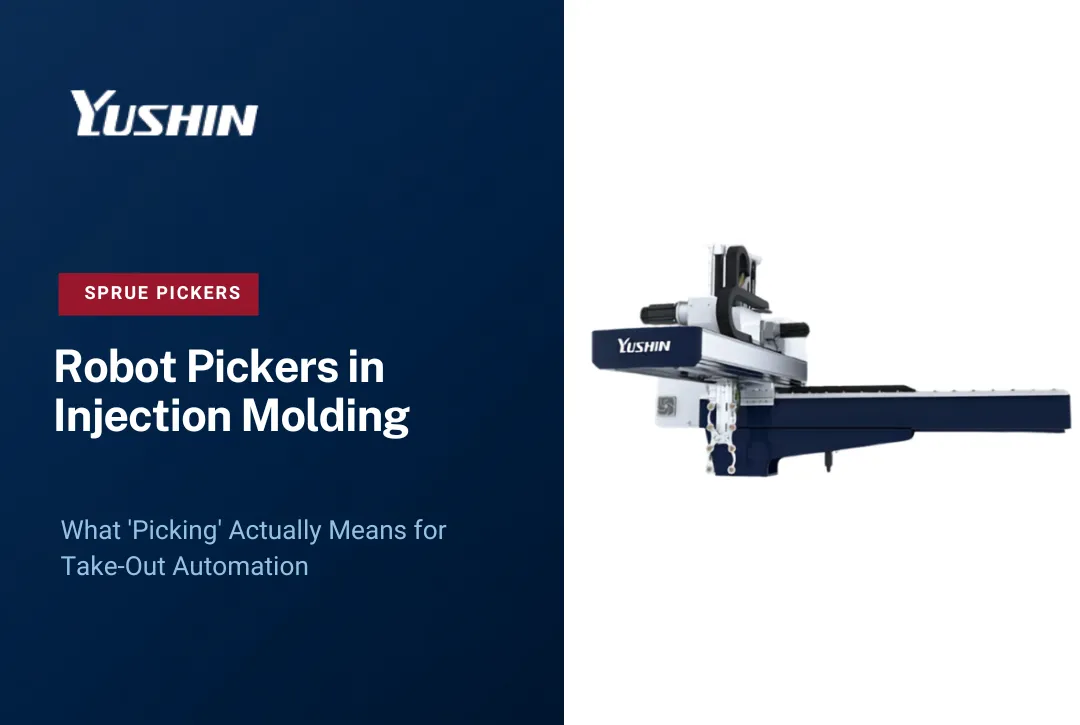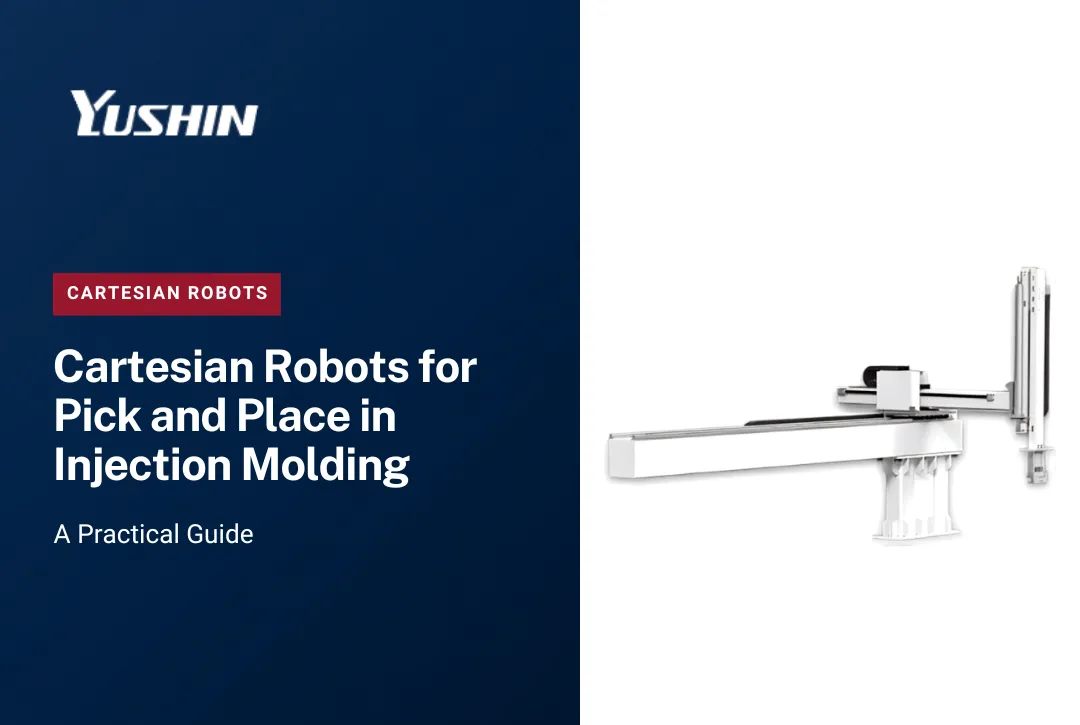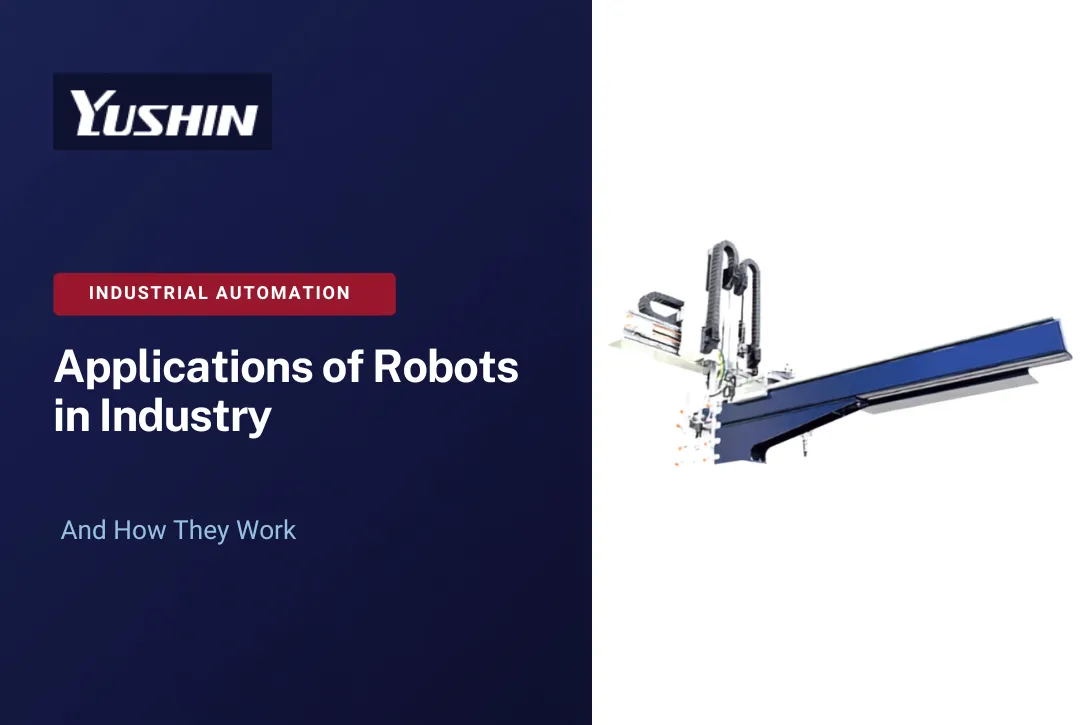

A pick and place robot performs exactly what the name describes: it picks up an object and places it somewhere else. In injection molding, this simple description covers one of the most critical automation tasks in the plant - extracting a molded part from the mold and placing it at a downstream location, on every single production cycle. Yushin America builds pick and place robots specifically for this application, not for warehouse fulfillment or generic material handling.
What Does a Pick and Place Robot Do in Injection Molding?

In injection molding, a pick and place robot (commonly called a take-out robot in this context) performs a specific sequence:
- Pick: The robot enters the mold space when it opens and grips the molded part using end-of-arm tooling (EOAT)
- Place: The robot moves the part to a downstream location - a conveyor, cooling fixture, inspection station, trim station, packaging area, or palletizing system
This happens on every molding cycle, which can range from a few seconds to a minute depending on the application. The robot's speed, accuracy, and reliability directly affect the molding cell's output, part quality, and labor requirements.
How Pick and Place Robots Work in the Molding Cell

- Mold completes its cycle and opens
- Robot's traverse axis positions it over the mold
- Vertical axis descends into the mold space
- EOAT grips the part (the "pick")
- Robot retracts, clearing the mold space
- Traverse axis moves the part to the downstream position
- EOAT releases the part (the "place")
- Robot returns to standby; mold closes for the next cycle
Types of Pick and Place Robots Used in Injection Molding

Linear (Cartesian) Take-Out Robots
The dominant type in injection molding. These robots move along straight-line X, Y, and Z axes to enter the mold space, extract the part, and place it downstream. Linear motion matches the fixed, repeatable geometry of the extraction task efficiently.
Yushin solutions: YD/YD2 Series standard take-out robots, RC-SE high-end high-speed take-out robot, FRA Series high-end take-out robots.
High-Speed Take-Out Robots
A specialized category of linear pick and place robots optimized for fast-cycle applications like thin-wall packaging molding, where the pick-and-place sequence must complete within a very short window.
Yushin solutions: HSA-150S/HSA-250S super-high-speed take-out robots, HST-400S/D/DS high-speed take-out robot.
Side-Entry Robots
Access the mold from the side rather than from above, used where overhead clearance is limited.
Yushin solutions: SX-41, SXB, SXC-HS, SXC, TSXA.
Large Traverse Robots
For large molded parts, using extended traverse beams and higher-payload servo drives.
Yushin solution: MKA-2000S large full-servo traverse robot.
Palletizing Robots
A downstream pick and place application: after parts are packed and boxed, a palletizing robot picks the boxes and places them onto a pallet in a defined pattern.
Yushin solution: PA Series compact palletizing robot - PA-40 achieves up to 420 boxes/hour.
What Pick and Place Robots Are Not, in This Context
It's worth clarifying what "pick and place robot" does not mean in an injection molding context, since the term is used broadly across other industries:
- Not a warehouse order-picking robot: Warehouse pick and place systems handle mixed-SKU fulfillment and case retrieval - a different application entirely from mold-to-downstream part handling.
- Not an autonomous mobile robot (AMR): AMRs navigate a facility to transport goods between locations; injection molding take-out robots are fixed-position automation tied to a specific IMM.
- Not necessarily a 6-axis articulated robot: While articulated pick and place robots exist in some industries, injection molding take-out overwhelmingly uses linear/Cartesian architecture because of how well it matches the fixed mold-to-downstream geometry.
Selection Criteria for Pick and Place Robots in Injection Molding
- IMM clamp force and platen size: Determines robot model range and required stroke lengths
- Part weight plus EOAT weight: Total payload calculation - always include both
- Cycle time: Determines whether standard or high-speed take-out is needed
- Part geometry: Drives EOAT contact point and grip method
- Downstream placement requirements: Determines traverse stroke and placement accuracy needed
- Orientation requirements: Determines whether NC servo wrist units are needed for angled placement
Advanced Applications: Insert Loading, Overmolding, and Orientation Control
Some pick and place applications in injection molding require more than simple linear extraction and placement. Insert loading requires the robot to pick an insert, orient it, and place it into the mold before closing. Overmolding requires picking a part from one operation and placing it into a second mold with controlled orientation.
Yushin supports these applications through engineered EOAT and NC servo wrist units - A/C, B/C, or A/B/C configurations that add controlled orientation capability to the pick and place cycle. These applications require deeper engineering review, but they are important Yushin America capabilities, not exceptions requiring a different robot type.
When a Standard Pick and Place Robot May Not Be the Right Fit
- Very low production volume: Automation payback may not be reached at low annual cycle counts.
- Highly variable part geometry with frequent mold changes: May require modular EOAT investment to keep changeover manageable.
- Cold-runner molds needing separate runner removal: A standard take-out robot handles the part; a separate sprue picker (HOP Five, N-HOP, miniHOP, V-HOP) handles the runner.
Implementation and Support
Yushin America provides installation, EOAT engineering, operator training, field service, and parts support for pick and place robot systems across North America.
- 24/7 phone support: 888-707-6268
- Over $1.3M in spare parts inventory with overnight shipping
- Yushin University: Yushin robot training and programming
- Yushin America field service and support
Frequently Asked Questions
What is a pick and place robot in injection molding called? In injection molding, a pick and place robot is commonly called a "take-out robot" because its primary function is extracting (taking out) the molded part from the mold and placing it downstream.
What type of robot is most commonly used for pick and place in injection molding? Linear (Cartesian) robots are the dominant type, because their straight-line X, Y, Z motion matches the fixed, repeatable geometry of mold extraction and downstream placement more efficiently than articulated alternatives.
Is a palletizing robot a type of pick and place robot? Yes. A palletizing robot performs a pick and place function downstream of the take-out robot - picking packed boxes or cases and placing them onto a pallet in a defined pattern. Yushin's PA Series is designed specifically for this application in injection molding plants.
Can pick and place robots handle insert loading in injection molding? Yes, with the right EOAT and orientation capability. Insert loading requires picking an insert, orienting it, and placing it into the mold - supported through engineered EOAT and NC servo wrist units on Yushin take-out robot platforms.
What is the difference between a pick and place robot and a warehouse picking robot? They serve very different applications. An injection molding pick and place (take-out) robot performs a fixed, repeatable extraction and placement cycle tied to a specific molding machine. A warehouse picking robot handles variable, mixed-SKU order fulfillment across a much larger and less structured environment.
How fast can a pick and place robot complete its cycle in injection molding? This depends on the robot model and application. Yushin's HSA series achieves take-out times as fast as 0.27 seconds in live molding for high-speed applications. Standard take-out robots operate at speeds matched to their specific application's cycle time requirement.
Conclusion
A pick and place robot in injection molding - more commonly called a take-out robot - performs the specific task of extracting molded parts from the mold and placing them at the correct downstream location, cycle after cycle. Getting this right requires matching the robot type, EOAT, and orientation capability to the specific IMM, part, and production requirements.
If you are evaluating pick and place automation for your molding cell, contact Yushin America to discuss which take-out robot configuration fits your application.