
End-of-line palletizing is the last manual step many injection molding plants still have not automated. After parts are molded, packed, and boxed, someone has to stack those boxes onto pallets—consistently, at the rate the line produces them, shift after shift. Modular palletizing automation systems solve this without requiring a full production line redesign. Yushin America's PA Series compact palletizing robot is built specifically for this application in injection molding plants—not for warehouse or logistics fulfillment.
What Is Modular Palletizing Automation?

Modular palletizing automation means the palletizing system is built from defined, integratable components rather than a single custom-engineered installation. In practical terms, this means:
- The palletizing robot can be added to an existing packing line without redesigning the entire line
- Infeed conveyors connect the existing packing/boxing process to the palletizer
- The controller and pattern software can be reconfigured for different box sizes and pallet patterns without a new system
- The system can be scaled or relocated as production needs change
For injection molding plants, this matters because palletizing is typically the last automation gap after take-out robots and packing processes are already established. A modular palletizing system fits into that existing workflow rather than replacing it.
Where Palletizing Fits in the Injection Molding Cell

Palletizing is the final step in the molding-to-shipping sequence:
- Take-out robot extracts molded parts from the IMM
- Parts move through downstream handling—cooling, inspection, trimming
- Parts are packed into bags, trays, or boxes
- Boxes are sealed and labeled
- Boxes are conveyed to the palletizing station
- Palletizing robot picks boxes and builds the pallet pattern
- Completed pallet is stretch-wrapped and moved to shipping
Modular palletizing systems automate step 6—and integrate with the conveyor infrastructure from step 5 without requiring changes to the upstream take-out and packing process.
Core Components of a Modular Palletizing System

Infeed Conveyor
Moves sealed boxes from the packing area to the palletizing robot's pick point. Infeed conveyor speed and spacing must be coordinated with the robot's cycle time to avoid box backup or starved cycles.
Palletizing Robot and EOAT
The robot picks boxes from the infeed point and places them onto the pallet in the programmed pattern. EOAT for palletizing typically uses vacuum or clamp-style grippers sized for the box range the plant handles.
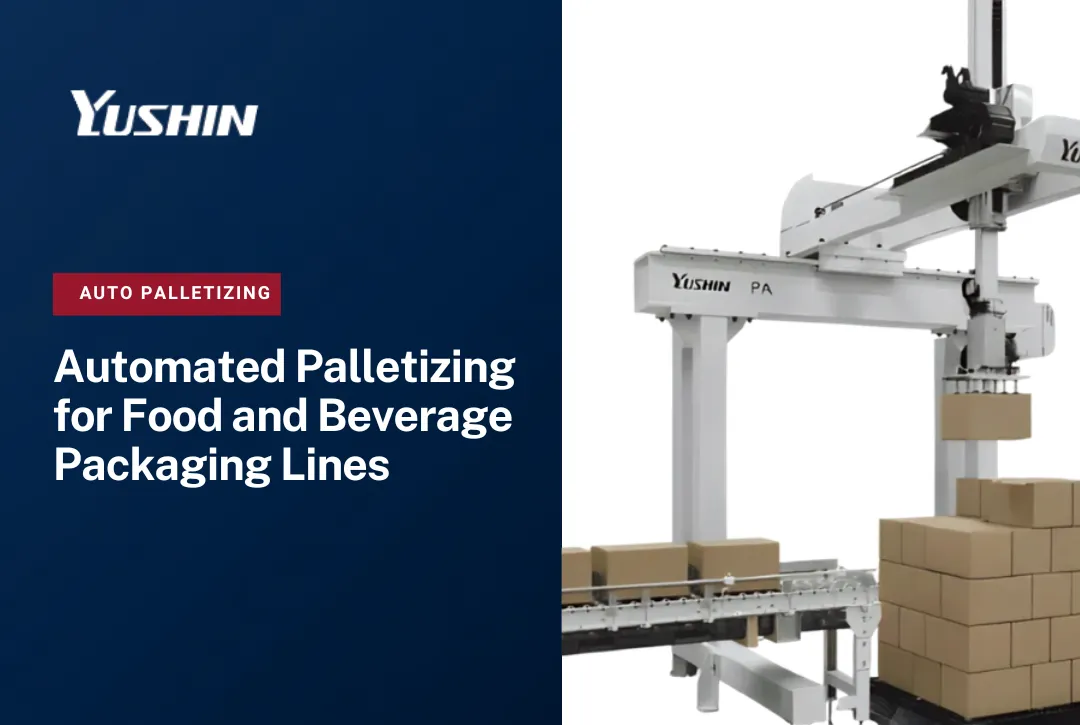
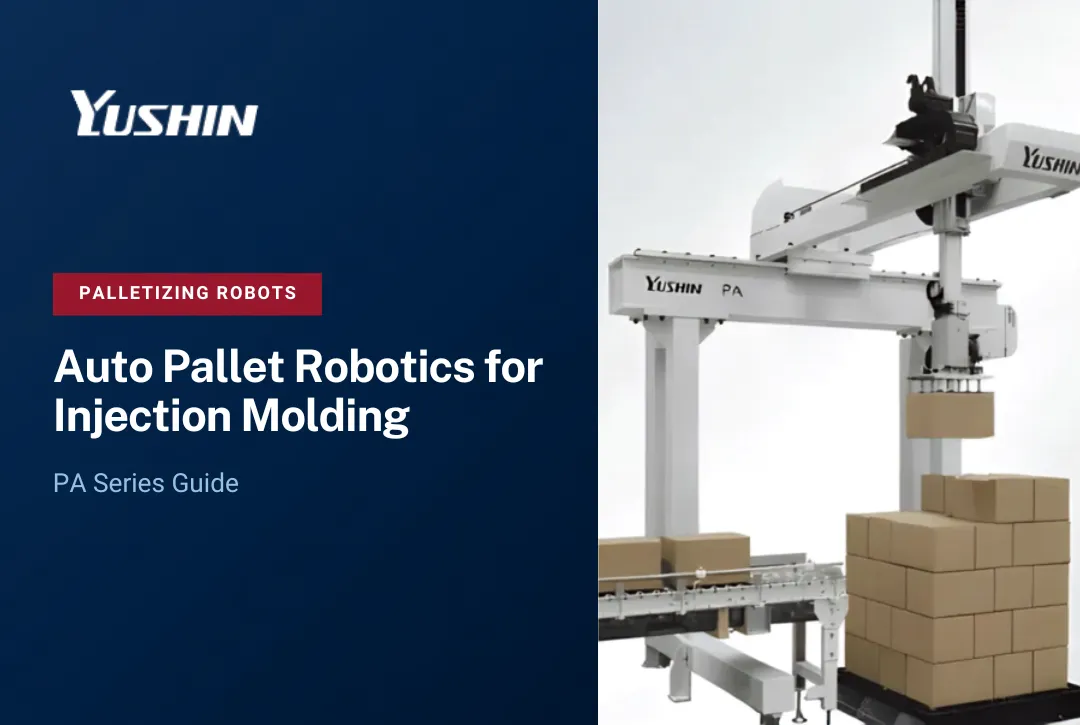
Yushin's PA Series is a Cartesian-axis compact palletizing robot purpose-built for this task:
- PA-20: 20 kg payload
- PA-40: 40 kg payload including wrist/EOAT; up to 420 boxes/hour
- Compact cantilever Cartesian layout—smaller footprint than large articulated palletizing systems
- 7.5-inch full-color touchscreen
- E-touch Compact controller
Pattern Software
Automap, Yushin's automatic palletizing pattern calculation feature, determines box placement patterns based on box dimensions and pallet size—reducing the manual programming required when box sizes change.
Pallet Dispensing and Exchange
Empty pallets must be staged and exchanged as completed pallets move to stretch wrapping and shipping. This can be manual (operator swaps pallets) or automated (pallet dispenser and conveyor exchange), depending on system scope.
Guarding
Palletizing robots require guarding around the robot work envelope per standard machine safety practice, consistent with the safety requirements applied to take-out robots elsewhere in the plant.
Controller Integration
The PA Series E-touch Compact controller can be configured to coordinate with upstream conveyor signals, allowing the palletizing system to communicate with the broader line rather than operating as an isolated station.
Why "Modular" Matters for Injection Molding Plants
Injection molding plants typically add palletizing automation after take-out robots and packing processes are already in place. A modular approach offers practical advantages:
- Retrofit into existing lines: The palletizer connects to the existing packing conveyor without requiring a full line redesign.
- Pattern flexibility: Automap pattern software adapts to different box sizes without a new system for each SKU.
- Scalable to future lines: If the plant adds production capacity, a modular palletizing approach can be replicated for additional lines using the same equipment and programming approach.
- Smaller footprint: The PA Series compact cantilever layout fits into existing floor space more easily than large-format articulated palletizing cells designed for warehouse-scale operations.
Yushin PA Series Product Fit
| Application | PA Series fit |
|---|---|
| End-of-line palletizing after molding/packing | PA-20 (20 kg) or PA-40 (40 kg including EOAT) |
| High-throughput packing lines | PA-40, up to 420 boxes/hour |
| Multiple box sizes / SKUs | Automap pattern software |
| Retrofitting an existing packing line | Compact cantilever Cartesian layout |
| Predictive maintenance for palletizing uptime | Built-in predictive maintenance feature |
Confirm case format, payload including EOAT, pallet pattern, and line speed with Yushin America for application-specific sizing.
Selection Criteria for Modular Palletizing Systems
- Box/case weight and dimensions: Determines payload rating and EOAT design
- Line throughput: Determines whether PA-20 or PA-40 fits the required boxes-per-hour rate
- Pallet pattern complexity: More complex patterns may require additional programming time even with pattern software
- Available floor space: Compact cantilever layouts fit smaller footprints than large articulated systems
- Integration with existing conveyor: Confirm conveyor speed and infeed spacing match the robot's cycle capability
- SKU variability: Frequent box size changes benefit from pattern software flexibility
- Service and parts support: Confirm local service coverage before committing to a palletizing automation investment
When Modular Palletizing May Not Be the Right Fit
- Very low box volume: If pallet-building volume is low, the automation investment may not reach payback quickly. Manual palletizing may remain cost-effective at low throughput.
- Extremely variable box formats: If box sizes and weights vary constantly with little repeat pattern, EOAT and programming complexity may reduce the efficiency gains.
- Palletizing robots are not warehouse picking systems: A PA Series robot is designed for consistent case palletizing after packing—not for order picking, mixed-SKU fulfillment, or warehouse case retrieval tasks.
Implementation and Support
Yushin America provides installation, EOAT and pattern configuration, operator training, field service, and parts support for PA Series palletizing systems across North America.
- 24/7 phone support: 888-707-6268
- Over $1.3M in spare parts inventory with overnight shipping
- Yushin University: Yushin robot training and programming
- Yushin America field service and support
Frequently Asked Questions
What makes a palletizing system "modular"? A modular palletizing system is built from components—infeed conveyor, robot, EOAT, pattern software, controller—that can be integrated into an existing packing line without a full redesign. It can also be adapted for different box sizes and scaled to additional lines using the same approach.
How is the PA Series different from a warehouse palletizing robot? The PA Series is designed specifically for injection molding and manufacturing plant environments—compact footprint, integration with existing packing lines, and throughput matched to molding cell output rates. It is not designed for warehouse order fulfillment, mixed-SKU picking, or logistics distribution center operations.
How many boxes per hour can the PA Series handle? The PA-40 can achieve up to 420 boxes per hour and handles payloads up to 40 kg including end-of-arm tooling. PA-20 throughput should be confirmed with Yushin America based on the specific application. Final sizing depends on case format, payload including EOAT, pallet pattern, and required line speed.
Can a modular palletizing system be added to an existing packing line? Yes. That is the core advantage of a modular approach—the palletizing robot and infeed conveyor integrate with the existing packing process rather than requiring the packing line to be redesigned around the palletizer.
Does Automap eliminate the need for programming when box sizes change? Automap calculates the palletizing pattern automatically based on box dimensions and pallet size, reducing manual programming time. Some configuration may still be needed depending on the specific pattern requirements and pallet constraints. Confirm with Yushin America for your specific SKU mix.
Is palletizing automation worth it for a lower-volume molding plant? It depends on box volume, labor cost, and injury risk from manual case stacking. Lower-volume operations should calculate payback based on actual case volume and labor cost rather than assuming automation is or is not justified by default. Discuss your specific volume and line configuration with Yushin America.
Conclusion
Modular palletizing automation closes the last manual gap in many injection molding plants—the end-of-line case stacking that happens after parts are molded, packed, and boxed. A modular approach lets plants add this automation to an existing packing line without a full redesign, and scale or reconfigure it as production needs change.
Yushin America's PA Series compact palletizing robot is built for this specific application in the injection molding plant environment. If your plant is dealing with manual case stacking, labor coverage gaps, or injury risk from repetitive palletizing, contact Yushin America to discuss the right PA Series configuration for your packing line.