
For decades, robot maintenance in injection molding plants followed one of two models: fix it when it breaks, or service it on a fixed calendar schedule regardless of actual condition. Both approaches leave money on the table. A new approach—using monitored performance data to anticipate developing issues before they cause a failure—is changing how plants think about take-out robot uptime. This is not a robotics theory shift; it is a practical change in how maintenance decisions get made on the production floor. Yushin America builds predictive maintenance positioning into select take-out robot platforms as part of this shift.
The Old Model: Reactive and Calendar-Based Maintenance
Most maintenance programs historically fall into two categories:
- Reactive maintenance: Fix the robot after it fails. This is the lowest-cost approach until a failure happens during production, at which point downtime cost, expedited parts shipping, and emergency service response drive up total cost significantly.
- Preventive maintenance: Service the robot on a fixed schedule (weekly, monthly, annual) regardless of actual wear. This reduces unplanned failures compared to reactive maintenance, but it often replaces parts before they need it and misses developing issues that occur between scheduled service intervals.
Both models react to time or failure—not to the actual condition of the equipment.
The New Approach: Condition-Based, Data-Driven Maintenance

Predictive maintenance uses monitored data from the robot itself to identify developing problems before they cause a failure. Instead of asking "has enough time passed to justify a service visit," predictive maintenance asks "does the current performance data indicate a developing issue."
In take-out robot automation, this shift depends on the robot generating usable data:
- Axis performance data: Servo motor load, positioning accuracy, and settling time can reveal developing mechanical wear well before it causes a fault.
- Vibration signatures: Abnormal vibration patterns often precede bearing wear, loose mounting, or structural fatigue by a meaningful margin.
- Cycle timing trends: Gradual drift in cycle time—even small increases—can indicate developing resistance, controller lag, or mechanical degradation.
- Vacuum and pneumatic performance: Declining vacuum performance or increasing air consumption often signals seal or valve wear before a pick failure occurs.
- Controller alarm patterns: Frequent minor alarms that clear on reset are often early indicators of a developing issue, distinct from a single major failure event.
Why This Approach Matters More for Robots Than for Other Equipment

Take-out robots run every single cycle a molding cell completes—there is no idle time built into most production schedules. This makes robot downtime immediately visible in output, unlike equipment with built-in redundancy or buffer capacity.
Application engineering note: In a molding cell running 20-second cycles across three shifts, a robot fault during production stops output completely until the robot is repaired—there is no manual fallback that matches production rate. This is why predictive monitoring on the robot side of the cell has a direct, measurable uptime impact.
How Yushin Builds Predictive Positioning Into Take-Out Robots
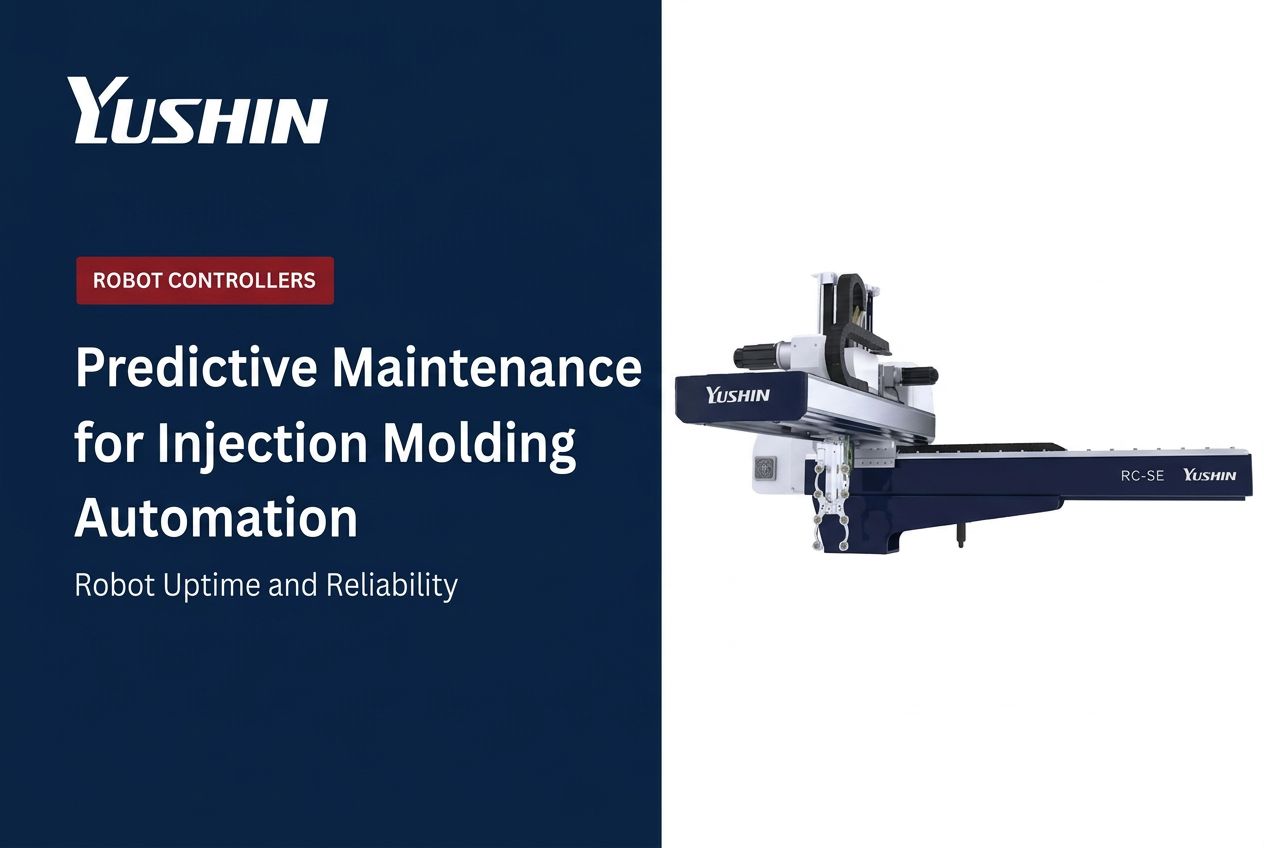
Yushin's RC-SE high-end high-speed take-out robot includes predictive maintenance positioning alongside vibration control designed for high-speed operation. Yushin's FRA Series high-end take-out robots similarly incorporate monitoring positioning appropriate for safety-critical, high-variety production environments.
These features support the "new approach" model: rather than relying purely on fixed-interval preventive service, plants running these robot platforms can incorporate monitored performance data into their maintenance planning.
What This Means for Maintenance Planning

Shifting to a predictive approach does not mean abandoning preventive maintenance entirely. A practical maintenance program for take-out robots typically combines both:
| Maintenance type | Role |
|---|---|
| Preventive | Fixed-interval tasks: lubrication, visual inspection, filter/seal replacement on schedule |
| Predictive | Condition-based flags: axis performance, vibration, cycle timing trends that trigger investigation before failure |
| Reactive | Fallback for unmonitored components or unexpected failures; minimized but not eliminated by predictive/preventive programs |
The goal is not to eliminate scheduled maintenance—it is to catch the failures that a fixed schedule would miss, while avoiding unnecessary part replacement on components that are still performing well.
Advanced Applications: Monitoring EOAT and Servo Wrist Performance

For applications involving insert loading, overmolding, or complex orientation—supported through Yushin's engineered EOAT and NC servo wrist units—monitoring extends beyond the primary axes. Servo wrist performance data (rotation accuracy, cycle timing at the wrist axis) and EOAT wear indicators (grip force consistency, vacuum performance) are part of a complete predictive maintenance approach for these advanced automation configurations. Insert loading and overmolding applications benefit from this monitoring because consistent orientation control is critical to part quality in these use cases.
Yushin Product Fit for Predictive Maintenance

| Requirement | Yushin solution |
|---|---|
| High-speed applications with predictive monitoring | RC-SE high-end high-speed take-out robot |
| Safety-critical, advanced monitoring needs | FRA Series high-end take-out robots |
| Standard take-out with scheduled preventive maintenance | YD/YD2 Series standard take-out robots |
| Fast parts replacement when issues are caught early | Over $1.3M spare parts inventory; $2M pre-assembled module inventory |
When a Predictive Approach May Not Be Necessary
- Low-criticality applications with buffer capacity: If short robot downtime does not directly impact output (redundant capacity, low-volume runs), standard preventive maintenance may be sufficient without additional monitoring investment.
- Very new equipment: Robots with low cumulative cycle counts may not yet show the wear patterns predictive monitoring is designed to catch.
- Applications without meaningful cycle-time or vibration data available: Older robot platforms without built-in monitoring capability may require retrofit instrumentation to support a predictive approach—weigh this cost against the expected downtime savings.
Implementation and Support
Yushin America provides preventive maintenance services, field service, parts support, and training to support a data-driven approach to take-out robot maintenance across North America.
- 24/7 phone support: 888-707-6268
- Over $1.3M in spare parts inventory with overnight shipping
- Yushin University: Yushin robot training and programming
- Yushin America field service and support
Frequently Asked Questions
What is the difference between predictive and preventive maintenance for take-out robots? Preventive maintenance services the robot on a fixed schedule regardless of actual condition. Predictive maintenance uses monitored performance data—axis performance, vibration, cycle timing—to flag developing issues based on actual equipment condition, allowing maintenance to be scheduled proactively rather than purely on a calendar.
Do all Yushin take-out robots include predictive maintenance features? Predictive maintenance positioning is included on select platforms, including the RC-SE and FRA Series. Confirm specific monitoring capability by robot model with Yushin America.
What data does a take-out robot generate that supports predictive maintenance? Axis performance (servo load, positioning accuracy, settling time), vibration signatures, cycle timing trends, vacuum/pneumatic system performance, and controller alarm patterns are the primary data sources used to identify developing maintenance issues before failure.
Does predictive maintenance replace the need for preventive maintenance? No. A practical maintenance program typically combines both: preventive maintenance handles fixed-interval tasks like lubrication and inspection, while predictive maintenance catches condition-based issues that a fixed schedule would miss.
How does predictive maintenance apply to EOAT and servo wrist components? For applications with engineered EOAT and NC servo wrist units, monitoring extends to grip force consistency, vacuum performance, and wrist rotation accuracy. This is particularly relevant for insert loading and overmolding applications where consistent orientation control affects part quality.
Is predictive maintenance worth implementing for every molding cell? Not necessarily. High-criticality, high-volume applications where robot downtime directly affects output typically see the most value. Low-criticality or buffered applications may not justify the investment beyond standard preventive maintenance. Evaluate based on your specific production impact from unplanned robot downtime.
Conclusion
The shift from reactive and calendar-based maintenance to condition-based, data-driven maintenance is a practical change in how injection molding plants manage take-out robot uptime—not a theoretical robotics concept. Monitoring axis performance, vibration, cycle timing, and EOAT wear allows maintenance to be scheduled around actual equipment condition rather than guesswork or fixed intervals.
If your plant is managing take-out robot maintenance reactively or on a fixed schedule that is not catching developing issues, contact Yushin America to discuss robot platforms with predictive maintenance positioning and the service support to act on that data.