
Real-time production monitoring in an injection molding plant means having visibility into what is actually happening in the cell right now—not what happened last shift, but what is happening this cycle. When cycle time drifts, a robot fault occurs, or scrap starts climbing, the value of monitoring is catching it immediately rather than discovering it in an end-of-shift report. Yushin America's take-out robot controllers provide diagnostic data that supports this kind of production visibility on the automation side of the molding cell.
What Should Be Monitored in an Injection Molding Cell?

Real-time monitoring in a molding cell should cover both the molding process and the automation layer around it:
- Cycle time: The total time per molding cycle, including injection, cooling, and take-out. Deviation from the target cycle time is often the first sign of a developing problem.
- Take-out robot time: How long the robot's extraction sequence takes within the overall cycle. Increasing take-out time can signal developing axis wear, EOAT issues, or vacuum degradation.
- Robot faults and alarms: Controller-reported faults, from minor recoverable alarms to major stops, indicate developing or acute automation issues.
- Part removal consistency: Whether parts are being extracted and placed consistently cycle to cycle, which affects downstream quality.
- Downtime events: Unplanned stops, their duration, and their cause—mold-related, robot-related, or process-related.
- Scrap and reject rate: Real-time scrap tracking helps identify whether a developing issue is producing defective parts before a large batch is affected.
- Vacuum and pneumatic system performance: Air consumption and vacuum level trends can indicate developing EOAT or robot pneumatic system issues.
- Downstream bottlenecks: Whether packing, inspection, or palletizing stations are keeping pace with the molding cell's output rate.
Why Real-Time Visibility Matters More Than End-of-Shift Reports
A cycle time that drifts 5% over several hours is easy to miss in a daily summary report but very visible in real-time monitoring—and catching it early prevents a full shift of reduced output. Similarly, a developing robot fault pattern (recurring minor alarms) is a leading indicator that end-of-shift scrap or downtime totals only reveal after the fact.
Application engineering note: The value of real-time monitoring is not the data itself—it is the ability to act on a developing problem during the shift it occurs, rather than analyzing it after the fact. A monitoring system that only produces historical reports has diagnostic value but limited operational value for preventing the next few hours of lost output.
Where Robot Controller Diagnostics Fit Into Cell Monitoring

The take-out robot's controller is a direct source of cycle-level data for the automation side of the cell. Yushin's E-touch controller family provides diagnostic information including cycle timing, fault logs, and axis status that can be monitored to support real-time production visibility.
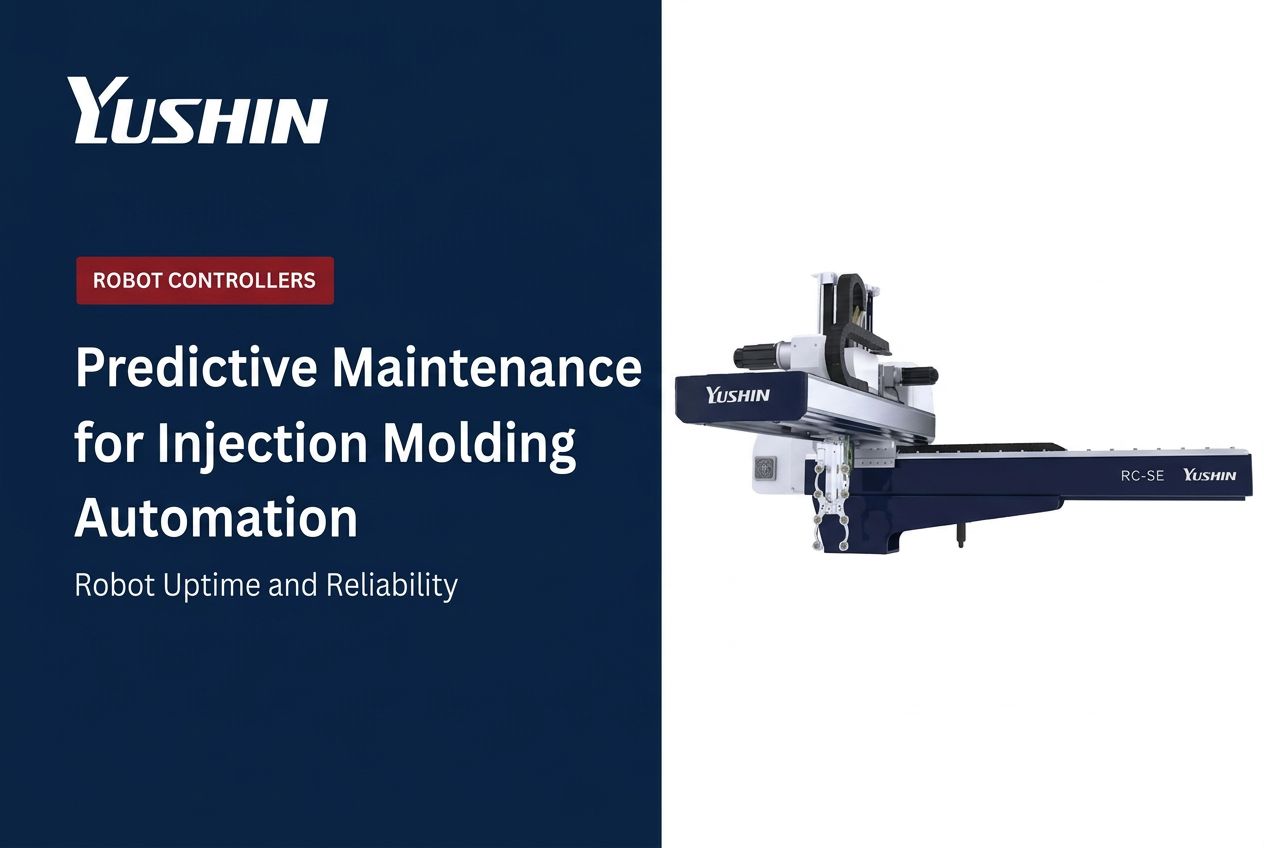
For applications requiring predictive maintenance positioning, Yushin's RC-SE high-end high-speed take-out robot and FRA Series high-end take-out robots incorporate monitoring capability that extends beyond basic cycle logging into performance trend tracking—supporting the kind of proactive visibility that catches developing issues before they cause downtime.
What Real-Time Monitoring Reveals About Robot Performance

Monitoring the robot side of the cell in real time can surface:
- Take-out time drift: Gradual increases in extraction time, often an early sign of mechanical wear or EOAT degradation
- Fault frequency patterns: An increase in minor recoverable faults, which often precedes a more significant failure
- Cycle-to-cycle placement variation: Inconsistency in where parts land on the downstream conveyor or fixture, which can indicate axis positioning drift
- Vacuum/air performance trends: Declining vacuum hold or increasing air consumption, both indicators of EOAT or pneumatic system wear
Connecting Robot Monitoring to Downstream Bottleneck Detection

A take-out robot that is performing consistently can still be limited by downstream constraints. Real-time monitoring that includes downstream station status—packing line speed, palletizer cycle rate, inspection station throughput—helps identify whether the actual production constraint is the molding cell, the robot, or a downstream station.
For plants running Yushin's PA Series compact palletizing robot at the end of the line, palletizer cycle rate and predictive maintenance status are part of the same monitoring picture as the take-out robot upstream.
Advanced Applications: Monitoring Insert Loading and Servo Wrist Performance
For applications involving insert loading, overmolding, or complex orientation—supported through engineered EOAT and NC servo wrist units—real-time monitoring extends to wrist axis performance and insert placement consistency. These advanced applications benefit from close monitoring because orientation accuracy directly affects part quality, and catching a developing wrist-axis issue early avoids a batch of misoriented parts.
Selection Criteria for Production Monitoring on the Automation Side
- Controller diagnostic depth: Confirm what data the robot controller reports—cycle timing, fault logs, axis status—and whether it can be accessed for monitoring purposes
- Fault alerting: Does the controller flag developing issues (recurring minor faults) or only report acute failures?
- Integration with existing plant systems: Confirm whether robot controller data can feed into existing plant monitoring infrastructure, or whether it operates as a standalone diagnostic source
- Service response tied to monitoring: Confirm how monitored data translates into actionable service response—alerting is only useful if it leads to timely action
When Advanced Monitoring May Not Be Necessary

- Low-criticality applications: If a molding cell has buffer capacity or low production impact from short stops, basic controller diagnostics may be sufficient without additional monitoring investment.
- Very stable, well-established processes: Cells with a long track record of consistent performance and minimal fault history may not need the same level of monitoring investment as newer or higher-variability applications.
- Applications where downstream capacity already exceeds cell output: If downstream stations are never the constraint, monitoring effort should focus upstream on the molding cell and robot rather than downstream bottleneck detection.
Implementation and Support
Yushin America provides controller diagnostics, field service, parts support, and training to support production monitoring on the automation side of injection molding cells.
- 24/7 phone support: 888-707-6268
- Over $1.3M in spare parts inventory with overnight shipping
- Yushin University: Yushin robot training and programming
- Yushin America field service and support
Frequently Asked Questions
What should be monitored in real time in an injection molding cell?
Cycle time, take-out robot performance, robot faults and alarms, part removal consistency, downtime events, scrap rate, vacuum/pneumatic performance, and downstream bottlenecks are the primary factors worth monitoring in real time. Together they provide visibility into both the molding process and the automation layer around it.
How does robot controller data support production monitoring?
Yushin's E-touch controller family provides cycle timing, fault logs, and axis status diagnostics that can be monitored to track take-out robot performance in real time. This data helps identify developing issues—cycle time drift, fault patterns—before they cause significant downtime.
Why does take-out time matter for production monitoring?
Take-out time is the robot's contribution to overall cycle time. Gradual increases in take-out time often indicate developing mechanical wear, EOAT degradation, or vacuum system issues—catching this trend early prevents a bigger downtime event later.
Can real-time monitoring identify downstream bottlenecks?
Yes, when monitoring includes downstream station data alongside robot and molding cell data. Comparing take-out robot cycle rate to packing, inspection, or palletizing station throughput helps identify where the actual production constraint is located.
Does Yushin America provide a production monitoring software platform?
Yushin's take-out robot controllers, including the E-touch family, provide diagnostic data (cycle timing, fault logs, axis status) that supports production monitoring. Confirm specific integration and platform capabilities with Yushin America for your monitoring requirements.
Is real-time monitoring necessary for every molding cell?
Not necessarily. High-criticality, high-volume cells where downtime directly affects output benefit most from real-time monitoring investment. Low-criticality or well-established stable processes may not require the same level of monitoring. Evaluate based on your specific production impact from unplanned events.
Conclusion
Real-time production monitoring in an injection molding cell means having visibility into cycle time, take-out robot performance, faults, scrap, and downstream bottlenecks as they happen—not after the shift ends. Yushin's take-out robot controllers provide the diagnostic data needed to monitor the automation side of this picture.
If your plant needs better visibility into take-out robot performance, developing maintenance issues, or downstream bottlenecks, contact Yushin America to discuss the controller diagnostics and service support available for your automation systems.