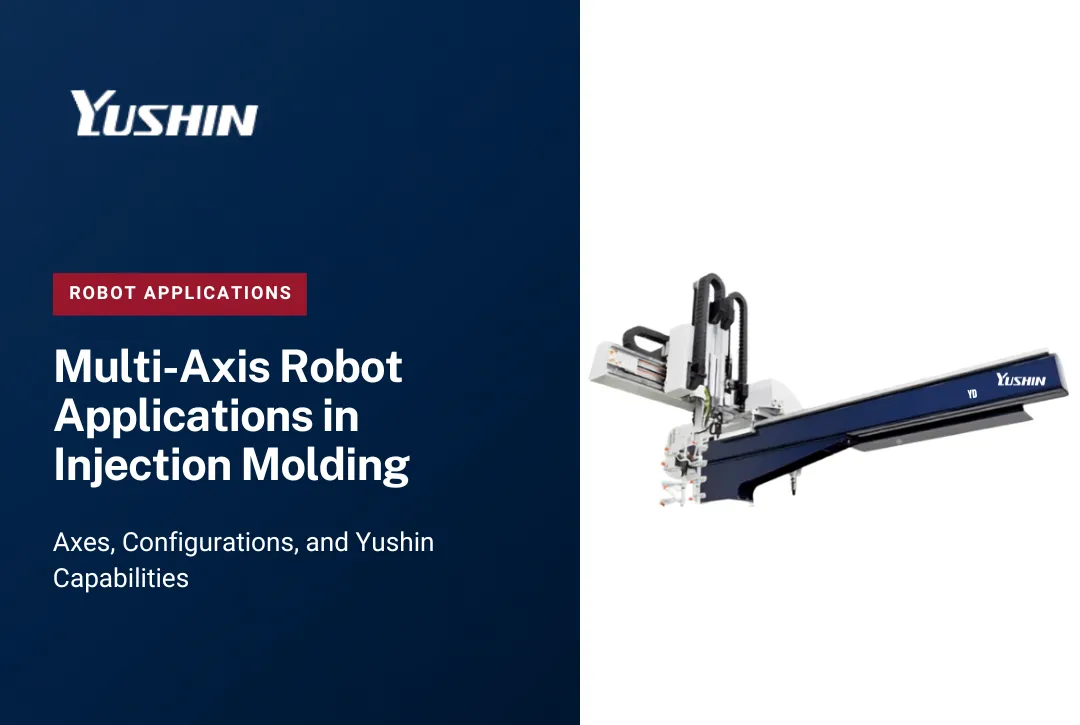

Every take-out robot cycle in an injection molding cell depends on precise, repeatable motion - the robot must enter the mold space, grip the part, retract, and place it downstream at the same speed and position on every cycle, hundreds or thousands of times per shift. Servo motors are the technology that makes this repeatability possible. Understanding the basics of how servo motors work helps explain why Yushin America builds its take-out robots around all-servo drive systems rather than simpler motion technologies.
What Is a Servo Motor?

A servo motor is a motor paired with a feedback system - typically an encoder - that reports the motor's actual position, speed, or torque back to a controller in real time. The controller compares this feedback against the commanded position and continuously adjusts the motor to close the gap between where the axis is and where it should be.
This closed-loop feedback is the key difference from simpler motor systems: a servo motor does not just run at a commanded speed and hope it arrives at the right position - it actively corrects its motion based on real-time position data.
Application engineering note: The practical benefit of closed-loop feedback is repeatability. A servo-driven axis returns to the same position within a very small tolerance, cycle after cycle - which is exactly what a take-out robot needs when extracting parts from the same mold location thousands of times.
Why Servo Control Matters for Take-Out Robot Axes

Traverse, Kick, and Vertical Stroke Axes
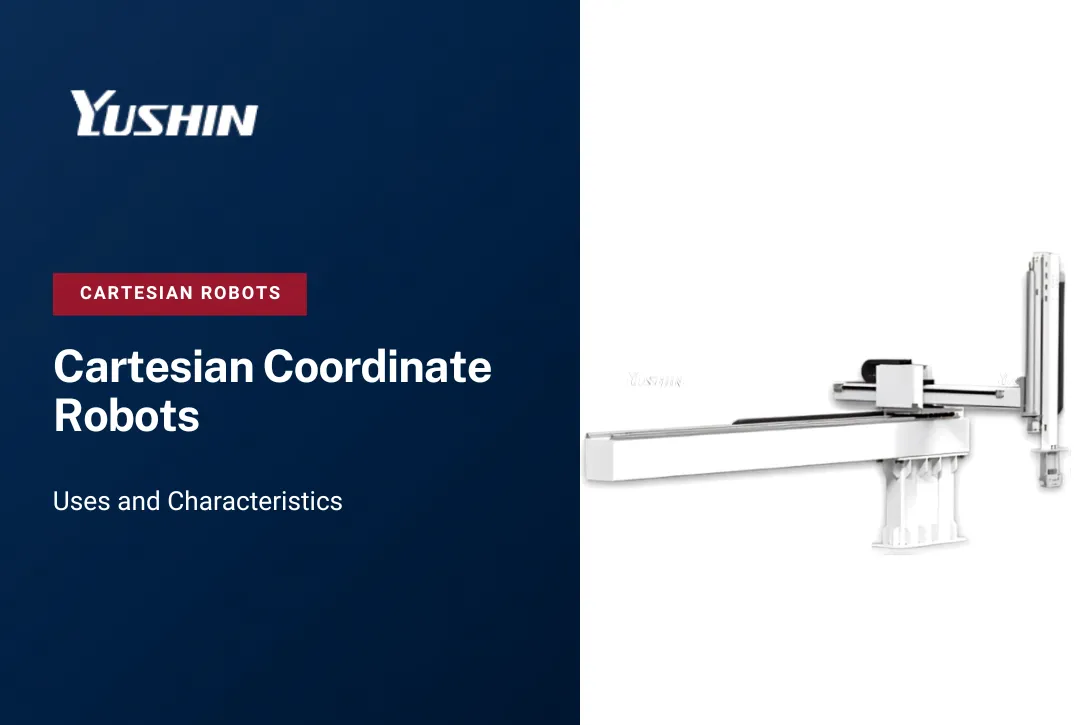
The three primary linear axes of a Cartesian take-out robot - traverse, horizontal kick, and vertical stroke - all rely on servo motors to achieve precise, repeatable positioning at each point in the extraction cycle: entering the mold space, gripping the part, retracting, and moving to the downstream placement point.
Acceleration and Deceleration Control
Servo motors allow precise control over acceleration and deceleration profiles, not just final position. This matters for cycle time - a servo axis can accelerate quickly at the start of a stroke and decelerate smoothly before reaching the target position, minimizing settling time (the brief pause needed for the axis to stop vibrating before the next action can occur).
Vibration Control at High Speed
At high take-out speeds, uncontrolled vibration causes positioning errors and inconsistent part placement. Servo-driven axes with vibration control algorithms actively manage this, allowing faster motion while maintaining positional accuracy - a key feature in Yushin's high-speed take-out robot platforms.
Wrist and Orientation Axes
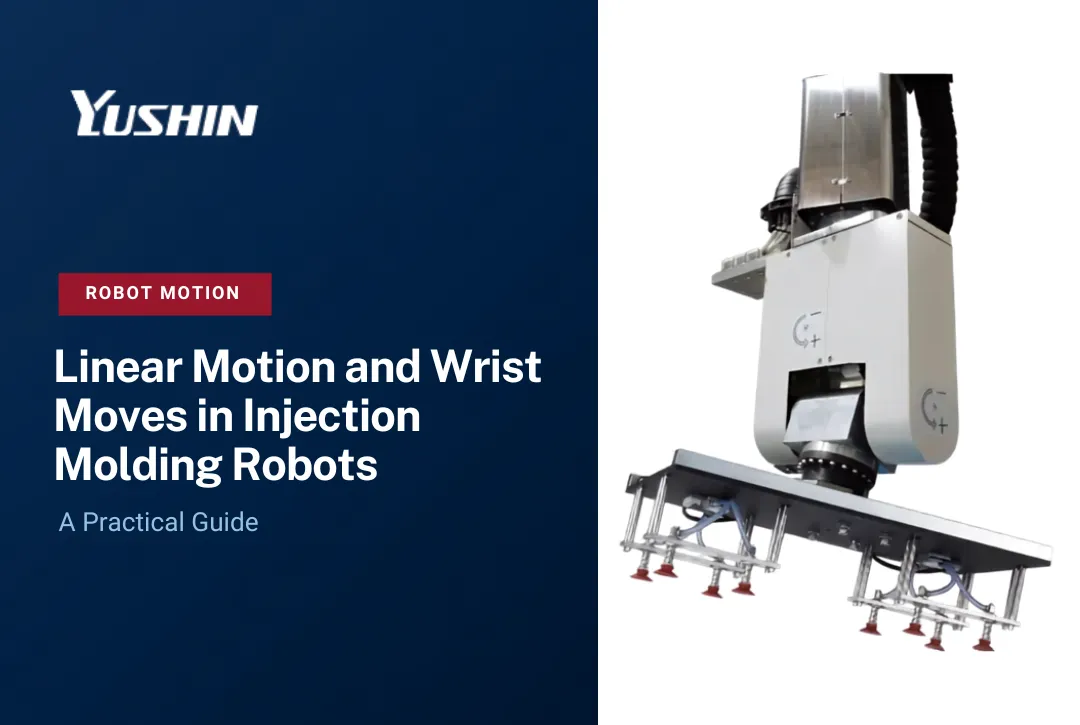
For applications requiring controlled part orientation - insert loading, overmolding, angled placement - servo-driven wrist axes provide the same precise, repeatable positioning as the primary linear axes, but for rotational motion. Yushin's NC servo wrist units use this same servo technology to add controlled orientation capability.
How Servo Motors Affect Cycle Time and Part Protection
Cycle Time
The speed at which a servo axis can accelerate, move, and settle directly determines how much of the available molding cycle time the take-out sequence consumes. Faster, more precisely controlled servo axes allow the robot to complete extraction within a shorter window - relevant for thin-wall, high-cavitation, and other fast-cycle applications.
Part Protection
Precise servo control means the robot's EOAT arrives at the pick point consistently, with the same approach speed and position every cycle. This reduces the risk of the EOAT contacting the part incorrectly, dragging across mold surfaces, or applying inconsistent grip force - all of which can cause part damage.
Downstream Handoff Accuracy
Servo-controlled placement means parts arrive at the downstream conveyor, fixture, or inspection station in the same position and orientation every cycle - important for consistent packaging, automated inspection, or precise fixture loading.
Yushin's All-Servo Take-Out Robot Platforms

Many Yushin take-out robot platforms use servo-driven axes for precise, repeatable motion, with model-specific configurations depending on IMM size, cycle time, payload, and application requirements:
| Application | Yushin solution | Servo relevance |
|---|---|---|
| Standard take-out, 30-1,300 tf | YD/YD2 Series standard take-out robots | Digital servo drive across primary axes |
| Compact applications, 30-100 tf | YD-0310 compact take-out robot | Digital servo motor, 3 kg payload including EOAT |
| High-speed take-out with efficiency features | RC-SE high-end high-speed take-out robot | Servo-driven with vibration control |
| Medium-range high-speed molding | HST-400 series | All-axis servo-driven with vibration control |
| Complex orientation control | NC servo wrist units | Servo-driven wrist axes, A/C, B/C, A/B/C configurations |
Selection Criteria Where Servo Performance Matters
- Cycle time requirement: Faster cycles require servo axes with higher acceleration and shorter settling time
- Part fragility: Precise, consistent approach and grip timing protects fragile or cosmetically sensitive parts
- Payload including EOAT: Servo motor sizing must account for the full payload, not just the part weight
- Orientation requirements: Determines whether servo wrist axes are needed in addition to the primary linear axes
- Multi-cavity consistency: Servo-controlled positioning helps maintain consistent EOAT contact across all cavities in a multi-cavity mold
Implementation and Support
Yushin America provides installation, EOAT engineering, operator training, field service, and parts support for all-servo take-out robot systems across North America.
- 24/7 phone support: 888-707-6268
- Over $1.3M in spare parts inventory with overnight shipping
- Yushin University: Yushin robot training and programming
- Yushin America field service and support
Frequently Asked Questions
What is a servo motor and why does it matter for take-out robots? A servo motor is a motor with closed-loop feedback - typically an encoder - that reports actual position back to the controller, which continuously corrects the motion to match the commanded position. This feedback loop is what gives take-out robots their repeatable, precise motion cycle after cycle.
Does Yushin America sell servo motors as standalone components? No. Yushin America builds complete take-out robot systems using servo-driven axes as part of the robot design. Yushin does not sell servo motors as standalone components separate from its robot platforms.
How do servo motors affect take-out robot cycle time? Servo motor acceleration, deceleration, and settling time determine how quickly a robot axis can move and stop precisely. Faster, better-controlled servo axes allow the take-out sequence to complete within a shorter portion of the available molding cycle.
Why do high-speed take-out robots need vibration control? At high speeds, servo axes can generate vibration that causes positioning errors at the pick point and inconsistent part placement. Vibration control algorithms manage this actively, allowing faster motion while maintaining positional accuracy - a feature built into Yushin's high-speed platforms.
Are NC servo wrist units also servo-driven? Yes. Yushin's NC servo wrist units use the same servo motor and feedback technology as the primary linear axes, applied to rotational motion for controlled part orientation in insert loading, overmolding, and angled placement applications.
Do all Yushin take-out robots use servo motors? Yushin's take-out robot lineup includes servo-driven platforms across compact, standard, high-speed, and high-end applications. Confirm the exact drive configuration by model with Yushin America.
Conclusion
Servo motors provide the closed-loop position, speed, and torque control that makes repeatable, precise take-out robot motion possible - directly affecting cycle time, part protection, and downstream placement accuracy. Yushin America builds its take-out robot platforms around all-servo drive systems, extending this precision to wrist and orientation axes through NC servo wrist units.
If your molding cell needs faster, more consistent part extraction, contact Yushin America to discuss the right servo-driven take-out robot configuration for your IMM, part, and cycle time requirements.