
What Is End-of-Line Packaging in Injection Molding?

End-of-line packaging covers the downstream handling steps that follow part extraction from the injection molding machine. The specific steps vary by part type and industry:
- Part cooling and orientation
- Visual inspection or automated vision inspection
- Trimming or degating (if not done in-mold)
- Counting, grouping, or batch assembly
- Placement into bags, trays, boxes, or cases
- Case filling and closing
- Pallet building and stretch wrapping
In high-volume injection molding—packaging, automotive, consumer goods, medical—these steps can involve significant manual labor, repetitive handling, and ergonomic risk. Automating them consistently requires matching the right equipment to each step.
What Cobots Are and Where They Apply
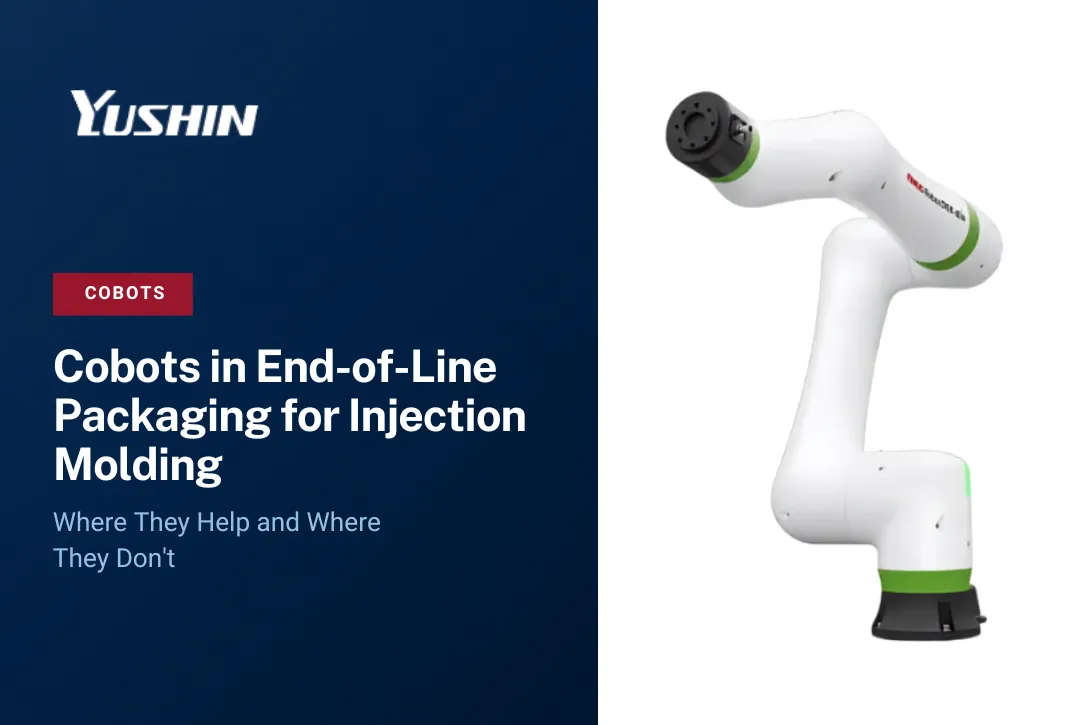
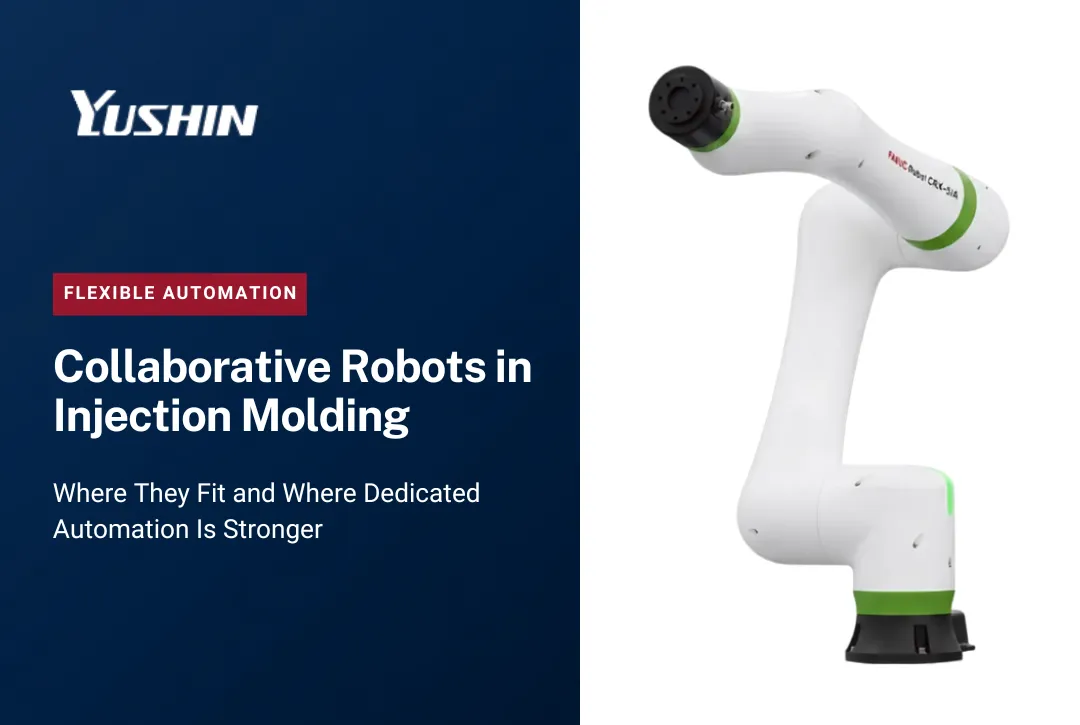
A collaborative robot (cobot) is designed to work in close proximity to human operators, with speed and force limits that allow direct human-robot interaction without hard guarding. They are generally used for light-duty, variable, or operator-assist tasks where full automation is not justified or practical.
In an injection molding end-of-line context, cobots can be useful for:
- Light packing assistance: Placing cooled parts into bags, clamshells, or trays alongside an operator
- Inspection support: Holding or presenting parts for operator visual check or simple vision system scan
- Counting and grouping: Stacking or organizing low-weight parts into defined quantities before packing
- Labeling and taping assistance: Supporting repetitive light-force downstream tasks
- Flexible short-run handling: Tasks where volumes are too low or changeovers too frequent to justify hard automation
Cobots generally work best for lower-payload, light-duty tasks that vary frequently or benefit from keeping an operator actively in the loop. Confirm payload limits by cobot model, EOAT weight, part weight, and required cycle speed.
Where Cobots Are Not the Right Fit for Injection Molding
Cobots have real limitations in injection molding end-of-line environments:
- Cycle-rate mismatch: Injection molding cells—especially high-cavitation or thin-wall applications—can output parts faster than a cobot can reliably handle. A cobot's collaborative speed limits make it unsuitable for keeping pace with fast molding cycles without creating downstream backlog.
- Payload: Heavy packaged cases, full trays, or large boxes may exceed typical cobot payload ratings. Palletizing applications involving 20–40+ kg loads require dedicated palletizing equipment.
- Durability in harsh environments: Molding floors with heat, flash, resin dust, and repetitive handling can be demanding on cobot systems not designed for that environment.
- Guarding and cell layout complexity: Collaborative speed limits only apply when humans are actually present. If operators are not consistently in the cobot's workspace, hard guarding may be required anyway—eliminating the collaborative advantage.
- ROI at volume: For high-volume, consistent packing tasks, a purpose-built palletizing or downstream automation system typically delivers better throughput, more predictable payback, and lower per-cycle cost than a cobot.
Application engineering note: Do not assume cobot = simple to install. Programming a cobot for reliable, repeatable packaging performance in a production environment still requires EOAT engineering, integration work, and process validation.
Yushin's Core End-of-Line Automation Approach

Yushin America's primary end-of-line automation strengths are not cobots—they are:
Take-Out Robots and EOAT
The first step in protecting parts downstream is consistent extraction from the mold. Yushin's YD/YD2 Series standard take-out robots remove parts with consistent grip, placement force, and release orientation on every cycle. Parts that are extracted consistently arrive at downstream packaging stations in better condition—reducing scrap, rejects, and downstream handling variation before packaging even begins.
PA Series Compact Palletizing Robots
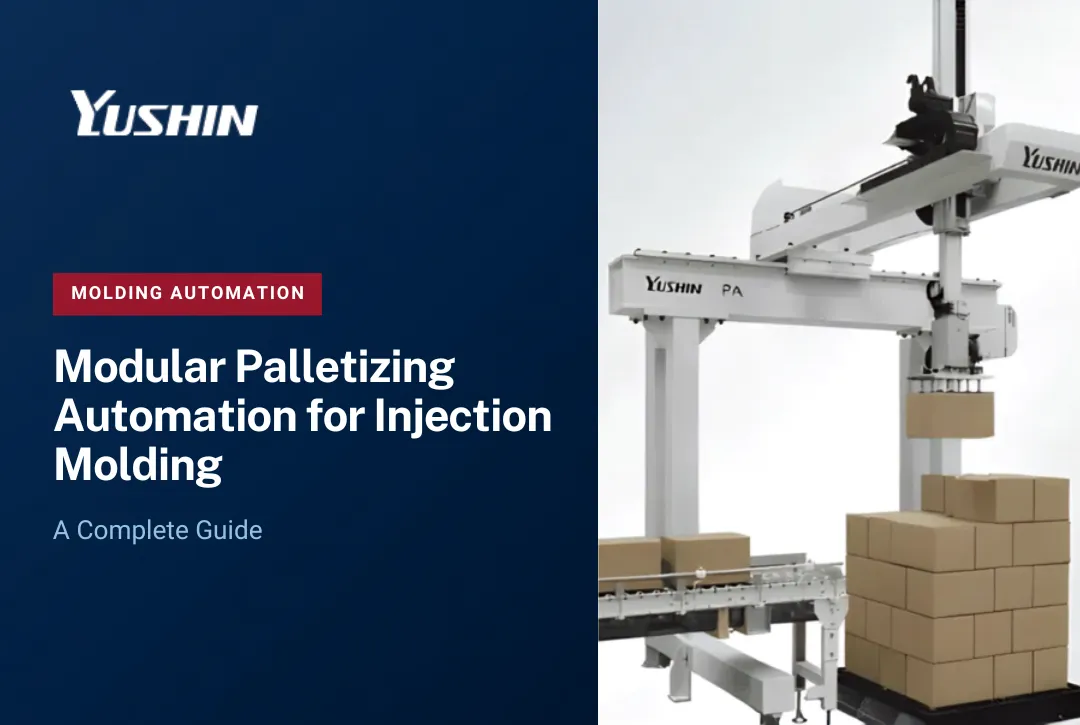
For end-of-line palletizing of boxed, bagged, or cased injection molded parts, Yushin's PA Series compact palletizing robot is purpose-built for the injection molding plant environment—not warehouse logistics.
- PA-20: 20 kg payload
- PA-40: 40 kg payload including wrist/EOAT; up to 420 boxes/hour
- Compact cantilever Cartesian layout
- Automap automatic palletizing pattern calculation
- 7.5-inch touchscreen; E-touch Compact controller; predictive maintenance
The PA Series is designed for plants that need to automate the last manual step in a molding cell—case stacking onto pallets—without the complexity or cost of a large articulated palletizing system.
Downstream Conveyors and Handling Systems
Between the take-out robot and the palletizer, the part travels through a handling sequence—cooling conveyors, vision inspection, counting, packing, case filling—that must match the molding cell's output rate. Yushin America provides guidance on how these downstream systems integrate with take-out robot timing, controller signals, and packing station layouts.
When Cobots and Yushin Automation Coexist

Some end-of-line operations combine automated palletizing with operator-assist tasks for variable or light-duty steps. In these mixed cells:
- A Yushin take-out robot handles part extraction from the IMM
- A downstream conveyor moves parts to the packing area
- An operator or cobot assists with packing into bags or trays for variable SKUs
- A PA Series robot handles the consistent palletizing step at the end of the line
This approach concentrates automation where the volume and consistency justify it (take-out and palletizing) while allowing flexibility in the packing step.
When to Discuss Cobot Options

Consider cobots for end-of-line operations when:
- The task is light (under 10 kg total handling weight)
- The task is highly variable, with frequent SKU or pack-pattern changes
- Volumes are too low for hard automation to reach payback
- The specific task benefits from keeping an operator actively present
- The task is a bridge solution during production growth before full automation is justified
For consistent, higher-volume packing and palletizing tasks in injection molding, a dedicated Yushin automation system will typically outperform a cobot on throughput, durability, and long-term cost.
Implementation and Support
Yushin America provides installation, EOAT engineering, operator training, field service, and parts support for take-out and palletizing automation across North America.
- 24/7 phone support: 888-707-6268
- Over $1.3M in spare parts inventory with overnight shipping
- Yushin University online training: Yushin robot training and programming
- Yushin America field service and support
Frequently Asked Questions
Can cobots replace take-out robots in injection molding cells?
No. Take-out robots and cobots serve different functions. A take-out robot operates inside the mold space at cycle speed—it must complete part extraction within a tight time window and operates in an environment where guarding is required regardless. Cobots are designed for downstream, human-proximate tasks like light packing assistance, not mold-area extraction.
Where do cobots genuinely help in injection molding end-of-line operations?
Cobots can support light packing, inspection assistance, counting, labeling, and flexible short-run handling tasks where volumes are low, tasks change frequently, or an operator needs to remain in the workflow. They are most useful for variable, light-duty downstream tasks—not for high-speed, high-payload, or consistent-volume applications.
What is the difference between a cobot and the Yushin PA Series for end-of-line work?
The PA Series is a purpose-built Cartesian palletizing robot for stacking boxed or cased injection molded parts onto pallets at up to 420 boxes/hour (PA-40). It is not collaborative—it is a high-throughput, durability-focused palletizing system for the injection molding plant environment. A cobot would not be appropriate for consistent, high-volume palletizing at those rates.
How does take-out robot consistency affect downstream packaging quality?
Parts extracted consistently by a take-out robot arrive at downstream packing stations in more uniform orientation, temperature, and condition. This reduces rejects, cosmetic defects from part-on-part contact, and variation in downstream placement. Improving extraction consistency is often the first step in improving packaging line performance.
Do I need a cobot to automate end-of-line packaging?
Not necessarily. For consistent, higher-volume packing and palletizing applications, a Yushin PA Series robot and properly integrated downstream conveyor typically deliver better results than a cobot. For variable, low-volume, or operator-assist packing tasks, a cobot may be worth evaluating. Discuss your specific end-of-line configuration with Yushin America to identify where automation investment has the best return.
Conclusion
Cobots have a place in injection molding end-of-line operations—but that place is specific and limited. They work well for light, variable, operator-assist downstream tasks where volumes and consistency do not justify dedicated automation. For the tasks that drive real throughput, consistency, and ROI in a molding plant—consistent part extraction, case stacking, and palletizing—Yushin America's take-out robots, PA Series palletizing systems, and downstream automation are the more reliable approach.
If your end-of-line operations are limited by inconsistent packing, manual case stacking, or labor-dependent palletizing, contact Yushin America to discuss the right combination of take-out automation and end-of-line palletizing for your injection molding cell.