
Choosing the wrong Cartesian robot configuration for an injection molding cell is a practical problem, not a theoretical one. A robot with a traverse beam too short for the mold space forces workarounds. An axis payload too low for the EOAT and part weight causes premature wear. A side-entry robot installed where a top-entry unit should have been creates clearance conflicts. Yushin America has designed, built, and supported Cartesian take-out robots for injection molding cells since 1988. This guide explains the major configuration types, when each applies, and how to match the configuration to the IMM, part, EOAT, cycle time, and downstream requirements.
What Are Cartesian Robot Configurations?

Cartesian robots move along straight-line X, Y, and Z axes--traverse, horizontal reach/kick, and vertical stroke. "Configuration" describes how those axes are physically arranged, mounted, and supported relative to the injection molding machine.
In injection molding, the robot configuration determines:
- How the robot accesses the mold space (from above or the side)
- What stroke lengths are available relative to the mold and downstream placement
- How much payload capacity is achievable without axis wear
- What floor space and overhead clearance the robot requires
- Whether the robot fits the specific IMM model and platen dimensions
The same Cartesian kinematics--X, Y, Z linear motion--can be realized in several distinct configurations, each suited to different IMM sizes, part geometries, production volumes, and cell layouts.
Top-Entry Traverse Robot (Standard Configuration)
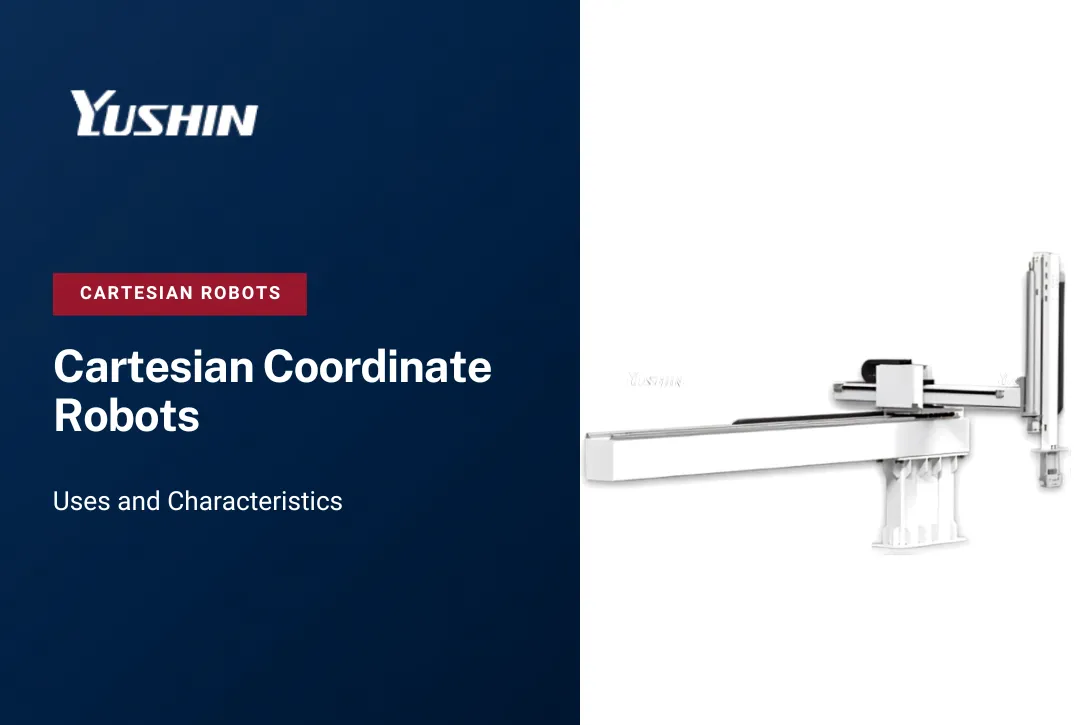
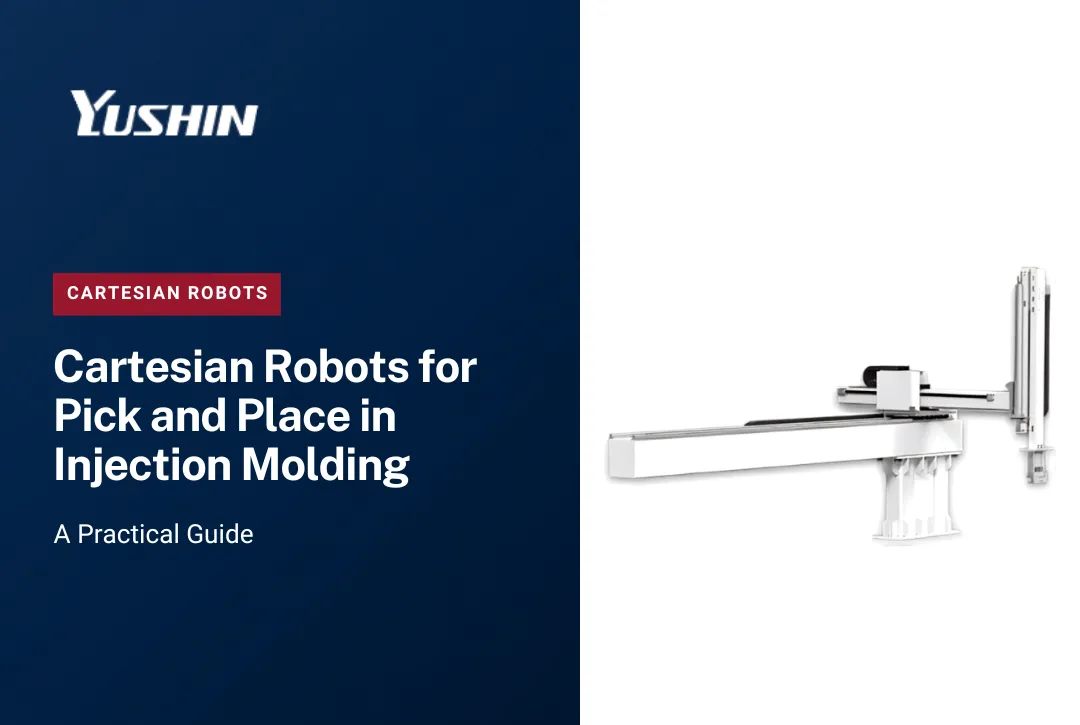
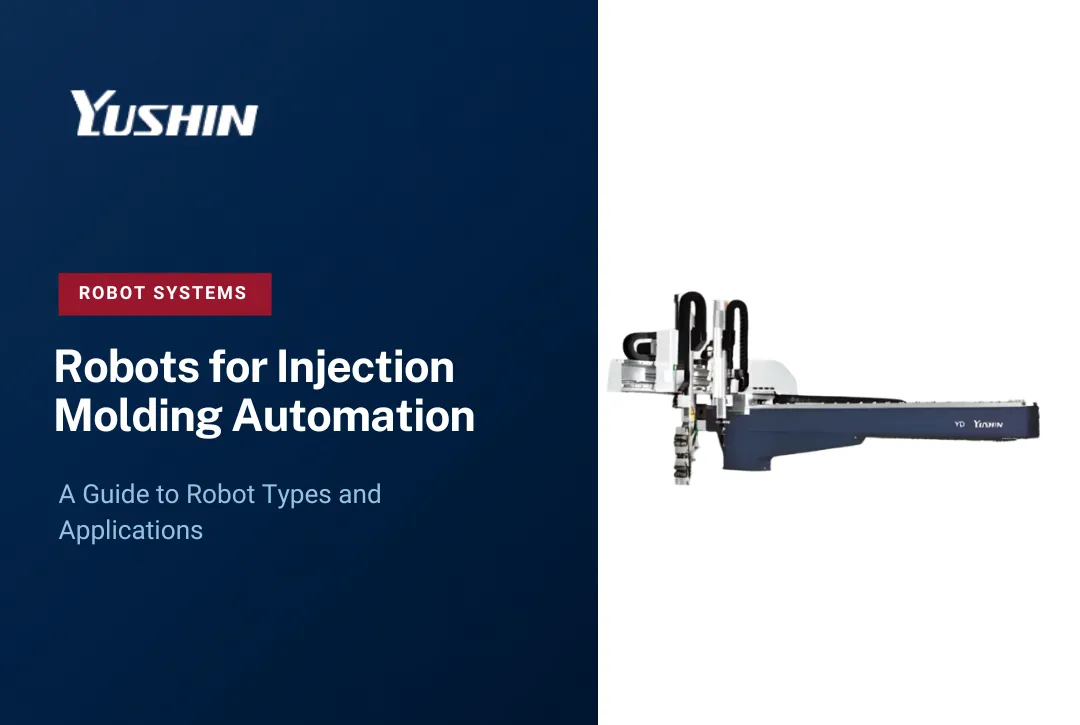
The top-entry traverse robot is the most common configuration in injection molding. The traverse axis spans the IMM platen horizontally. The vertical stroke descends into the open mold space, and the horizontal (kick) axis positions the EOAT at the part location within the mold.
When to use:
- Standard part take-out on horizontal injection molding machines
- Applications where mold access from above is clear
- Cells where downstream placement is in line with the machine traverse axis
Payload range: Depends on IMM size and robot model. Standard configurations cover 3 kg (small IMMs) through 35+ kg (large IMMs). Always include EOAT weight in payload calculations.
Yushin solutions for top-entry traverse:
- YD/YD2 Series standard take-out robots -- standard top-entry traverse for 30-1,300 tf IMMs
- RC-SE high-end high-speed take-out robot -- high-speed top-entry with Smart ECO Vacuum and predictive maintenance
- FRA Series high-end take-out robots -- Safety Category 3 design for advanced and safety-critical cells
- HSA-150S / HSA-250S -- super-high-speed top-entry for 100-300 tf thin-wall and packaging applications
- HST-400S/D/DS -- high-speed top-entry for 280-450 tf medium-range molding
Side-Entry Robots
Side-entry robots access the mold from the operator side or non-operator side of the machine rather than from above. The traverse axis and entry direction are horizontal rather than vertical.
When to use:
- Applications where overhead clearance is limited
- High-speed molding cells where a side-entry approach allows faster mold access than top-entry
- Cells where top-of-machine clearance is restricted by building constraints or equipment above the IMM
Yushin side-entry robot product names include: SX-41, SXB, SXC-HSY, SXC-HS, SXC, TSXA.
Side-entry robots use the same Cartesian linear-axis architecture as top-entry robots; the difference is the orientation of the entry axis and the direction from which the EOAT approaches the mold.
Large Full-Servo Traverse Robots

For large injection molding machines--1,500 tons and above--standard top-entry traverse configurations are not sufficient. Large-part applications require extended traverse beams, high-payload servo drives, and multi-stage vertical arms to access large mold spaces and handle heavy parts and EOAT assemblies.
When to use:
- Large IMMs, 1,500 tf and above
- Large molded parts: automotive structural components, appliance panels, industrial enclosures
- Payloads of 30-50 kg including EOAT
Yushin solution: The MKA-2000S large full-servo traverse robot is a 3-axis Cartesian robot designed for 1,500+ tf machines.
- Handles 30-50 kg including EOAT
- Traverse beam adjustable up to 5,000 mm
- Horizontal reach of 1,800 mm
- Vertical strokes up to 3,000 mm
- Two-stage telescopic vertical arm with movable kick beam
- 17% shorter take-out times and 10% shorter cycle times versus prior larger counterparts
See the MKA-2000S large robot introduction for details.
Sprue Pickers
Sprue pickers are simplified Cartesian robots designed specifically for runner and sprue removal in cold-runner molds. They use a reduced-axis configuration optimized for the simple path from the sprue location to the disposal or regrind point--not for full part take-out.
When to use:
- Cold-runner molds where the sprue/runner must be removed separately from molded parts
- Cells where a full take-out robot handles the molded parts and a separate sprue picker handles the runner
- High-speed cells where runner removal must not interrupt the take-out cycle
Yushin sprue picker product names include: HOP Five, N-HOP, miniHOP, V-HOP, V-HOP-II.
Sprue pickers are not interchangeable with full part take-out robots. They are sized and rated for runner/sprue handling only--do not attempt to use a sprue picker for full part take-out.
Robots for Vertical Injection Molding Machines

Vertical injection molding machines (vertical IMMs) have a vertical clamping axis--the mold opens vertically rather than horizontally. Take-out robots for vertical IMMs require a different entry geometry than standard horizontal-machine traverse robots.
When to use:
- Vertical clamp injection molding machines
- Insert molding applications where inserts are loaded from above into the open mold
- Rotary table machines and shuttle-platen configurations
Yushin solutions for vertical IMMs: SVR-C50, V-HOP, V-HOP-II.
Palletizing Robots (End-of-Line Cartesian Configuration)
Palletizing robots operate downstream of the take-out robot, handling end-of-line stacking of packed, boxed, bagged, or trayed molded parts onto pallets. Yushin's PA Series uses a Cartesian cantilever layout specifically designed for the molding plant environment--not for warehouse or e-commerce picking.
When to use:
- End-of-line palletizing after injection molding, packing, boxing, or bagging
- Applications where consistent pallet patterns and high throughput are needed
- Plants automating the final manual step after parts exit the molding cell
Yushin solution: PA Series compact palletizing robot
- PA-20: 20 kg payload
- PA-40: 40 kg payload including wrist/EOAT; up to 420 boxes/hour
- Automap automatic palletizing pattern calculation
- 7.5-inch touchscreen; E-touch Compact controller; predictive maintenance
Configuration Selection: Key Decision Factors
| Factor | What to determine |
|---|---|
| IMM clamp force and platen size | Robot model range; traverse beam span required |
| IMM orientation | Horizontal = top-entry or side-entry; Vertical = vertical IMM robot |
| Part size and weight | Payload calculation starting point (add EOAT weight) |
| EOAT weight | Added to part weight for total payload; often the larger number |
| Cycle time | Determines required take-out speed and settling time |
| Mold space access | Clearance above mold determines top-entry vs. side-entry |
| Runner/sprue handling | Cold runner = sprue picker needed; hot runner = typically not |
| Downstream placement | Stroke length must reach placement position within cycle |
| IMM tonnage (large) | 1,500+ tf = MKA-2000S or large traverse required |
| End-of-line palletizing | PA Series after packing/boxing, not at the IMM |
Advanced Applications: Insert Loading, Overmolding, and Servo Wrist Configurations

Some injection molding applications require more than a standard linear take-out cycle. Insert loading, insert molding, overmolding, and complex part-orientation placement require controlled wrist motion in addition to the linear traverse, kick, and vertical axes.
Yushin's NC servo wrist units add A/C, B/C, or A/B/C wrist axis configurations to Yushin take-out robots. These servo wrist configurations give the robot controlled orientation capability--helping rotate or angle parts and inserts during release, placement, and downstream handoff. They support repeatable setups through teach-and-save programming and maintain production-floor ease of use.
Insert loading, overmolding, and complex orientation work require deeper engineering review, but they are important Yushin America application capabilities. Yushin's engineering team works with customers on EOAT design, servo wrist configuration, insert-handling tooling, downstream fixtures, and operator workflow.
When Configuration Selection Requires Additional Review
- Mold changeover frequency: High-frequency mold changes require EOAT that is quick to swap. Yushin offers modular EOAT and servo wrist options to reduce changeover burden.
- Very low production volume: If annual cycles are low, automation payback may be difficult to justify regardless of configuration.
- Non-standard IMM layouts: Stack molds, rotary platen machines, and multi-material IMMs may require configuration review beyond standard top-entry or side-entry options.
- Unstable mold process: If the mold process is not stable (consistent shot, consistent ejection), configuration selection is premature--stabilize the process first.
Implementation and Support
Yushin America provides installation, application engineering, EOAT design, operator training, field service, and parts support across North America.
- 24/7 phone support: 888-707-6268
- Over $1.3M in spare parts inventory with overnight shipping
- Yushin University: Yushin robot training and programming
- Yushin America field service and support
Frequently Asked Questions
What is the most common Cartesian robot configuration for injection molding? Top-entry traverse robots are the dominant configuration for horizontal injection molding machines. The traverse axis spans the IMM platen; the vertical stroke enters the mold; the horizontal kick axis positions the EOAT at the part location. This configuration fits the large majority of standard injection molding take-out applications.
When should I use a side-entry robot instead of a top-entry robot? Use a side-entry robot when overhead clearance above the IMM is limited, when building constraints prevent top-entry installation, or when a side-entry approach offers a speed advantage for a specific cell layout. Yushin's SX, SXC, and TSXA series are the side-entry options.
What is the difference between a take-out robot and a sprue picker? A take-out robot handles the full molded part--gripping, extracting, and placing it at a downstream location. A sprue picker handles only the runner or sprue system in a cold-runner mold, removing it to a disposal or regrind point. In cold-runner cells, both may be used together.
What payload rating do I need for my injection molding take-out robot? Payload must include the weight of the EOAT plus the molded part (or all parts in a multi-cavity pull). EOAT weight is often larger than the part weight, especially in multi-cavity applications. Confirm payload requirements against the actual EOAT design before specifying a robot.
Can Yushin take-out robots support insert loading and overmolding? Yes. Insert loading, insert molding, and overmolding applications require additional engineering--specifically engineered EOAT, downstream fixtures, and often A/C, B/C, or A/B/C NC servo wrist units that add controlled orientation capability to the take-out robot. Yushin's engineering team works with customers on these applications.
How do I select between the YD Series and the RC-SE for standard take-out? Both cover a wide range of IMMs (30-1,300 tf). The YD/YD2 Series is the standard take-out platform. The RC-SE adds high-speed capability, Smart ECO Vacuum (up to 78% air reduction), Long Life Mode, and predictive maintenance. For high-output, multi-shift operations where energy cost and uptime are priorities, the RC-SE is the upgrade path. Confirm with Yushin America based on your specific application.
Conclusion
Cartesian robot configuration selection for injection molding is an application-specific decision, not a catalog choice. The IMM size, mold layout, part geometry, EOAT payload, cycle time, and downstream requirements all drive which configuration--top-entry, side-entry, large traverse, sprue picker, or palletizing--fits the cell.
Yushin America can help you work through configuration selection, EOAT requirements, servo wrist options, and downstream handling for your specific injection molding cell. Contact Yushin America to speak with an automation specialist about the right robot configuration for your application.