
Take-out robot cost for injection molding is not a single number you can look up. It depends on the IMM size, part payload including EOAT, cycle time requirements, EOAT complexity, and how much downstream integration the application requires. Yushin America prices take-out robot systems on a quote basis because the cost drivers vary significantly by application—there is no accurate way to give a single price without knowing the specifics of your molding cell. This article explains what actually drives take-out robot cost so you can prepare for a meaningful conversation with an automation supplier.
Why Take-Out Robot Pricing Is Application-Specific
Unlike a catalog item with a fixed price, a take-out robot system cost depends on several variables that differ from one molding cell to the next:
- The robot model required for the IMM size and payload
- Whether standard EOAT or custom-engineered EOAT is needed
- Whether servo wrist axes are required for orientation control
- How much downstream integration (conveyors, controls coordination) is included
- Installation, training, and commissioning scope
Two plants with similar IMM tonnage can have very different automation costs if one requires simple flat-part extraction and the other requires multi-cavity EOAT with insert loading and servo wrist orientation.
Primary Cost Driver: Robot Model and IMM Size

The base robot model is selected around the IMM clamp force and required payload. Larger machines and higher payloads generally require larger, more capable robot platforms:
| IMM range | Typical Yushin robot category |
|---|---|
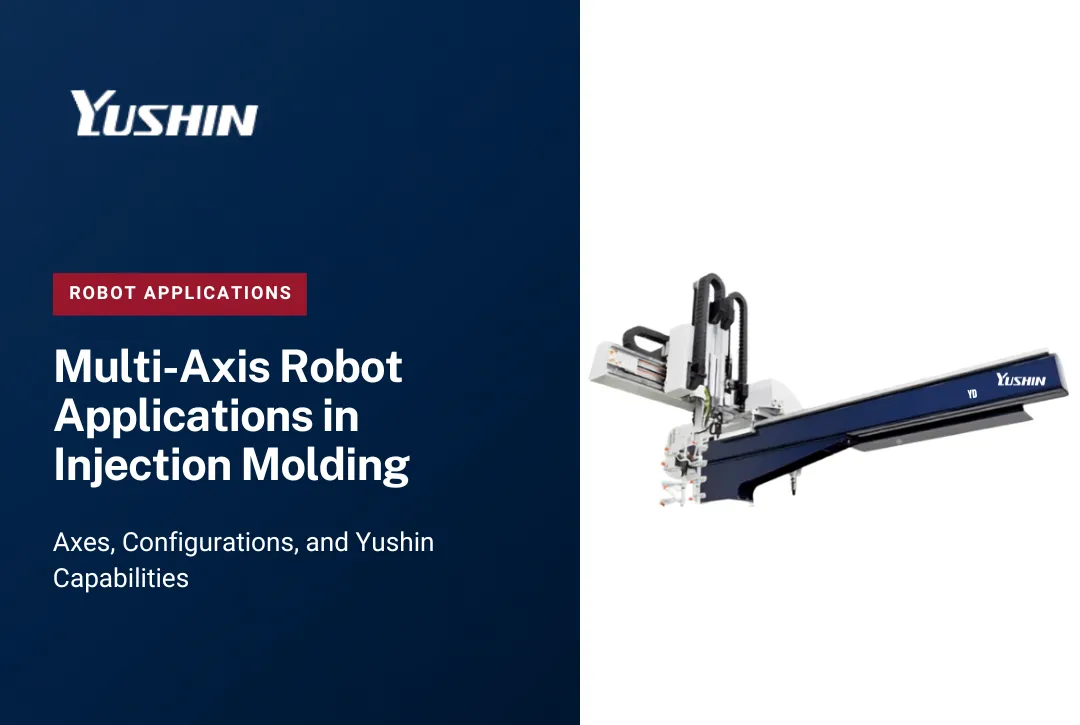
| 30–100 tf | YD-0310 compact take-out robot |
| 30–1,300 tf (standard) | YD/YD2 Series standard take-out robots |
| 30–1,300 tf (high-speed) | RC-SE high-end high-speed take-out robot |
| 30–1,300 tf (safety-focused, advanced) | FRA Series high-end take-out robots |
| 1,500+ tf | MKA-2000S large full-servo traverse robot |
Robot model selection is the starting point for cost, but it is not the only factor—EOAT and integration scope often represent a significant portion of total system cost.
Cost Driver: Payload Including EOAT
Payload requirements affect which robot model and configuration are needed. Payload always includes both the part weight and the EOAT weight—not just the part. Multi-cavity molds, where the EOAT must grip several parts simultaneously, often push payload requirements—and therefore robot selection—higher than the part weight alone would suggest.
Cost Driver: EOAT Complexity

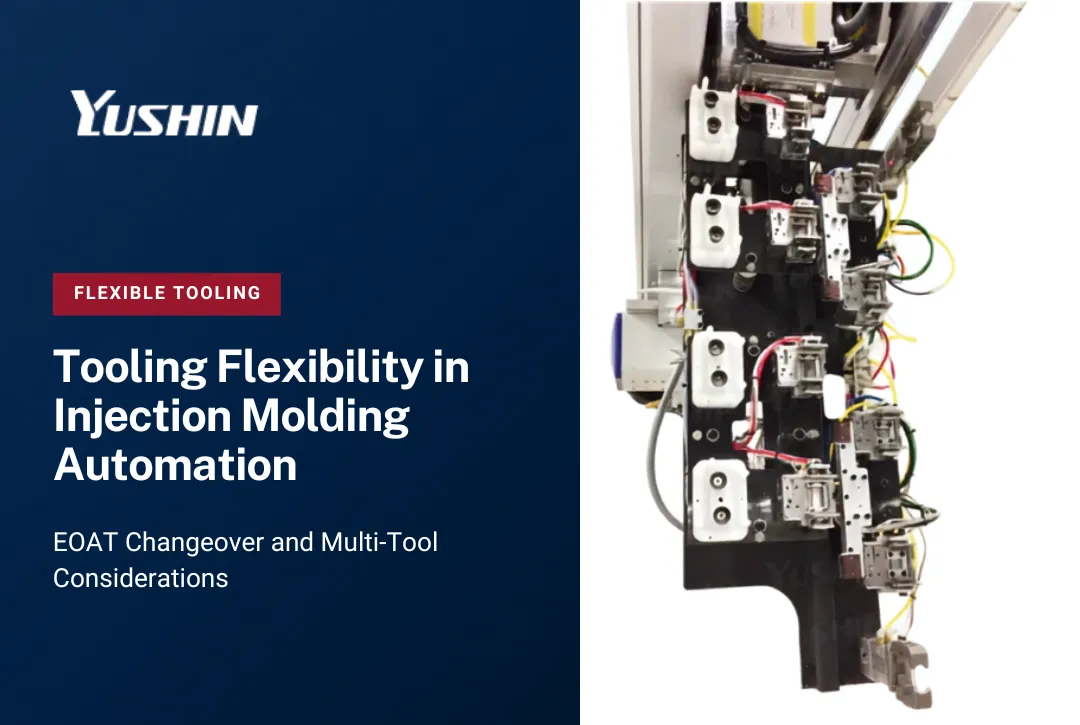
EOAT is frequently underestimated as a cost factor. Simple, single-cavity flat-part EOAT is relatively straightforward. Cost increases with:
- Number of cavities the EOAT must handle simultaneously
- Part geometry complexity (curved, flexible, or fragile parts requiring specialized grip design)
- Multi-point grip systems for large or irregular parts
- Combination tooling (vacuum plus mechanical grip)
- Insert-handling tooling for insert molding applications
Application engineering note: For applications with complex EOAT requirements, EOAT design and fabrication can represent a substantial share of total automation system cost—sometimes comparable to the robot itself. Discuss EOAT requirements early in any cost conversation.
Cost Driver: Servo Wrist and Orientation Requirements

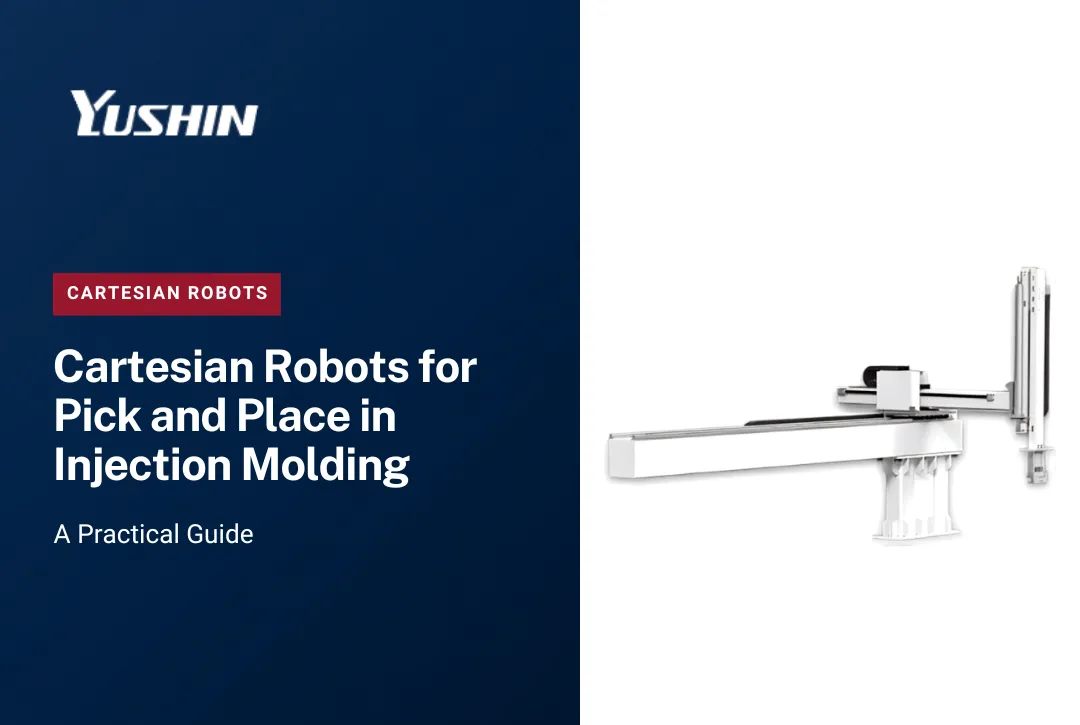
Standard linear take-out—traverse, kick, vertical axes only—is the baseline configuration. Adding orientation capability increases system cost:
- A flip axis (fixed 180° rotation) adds modest cost for simple part inversion
- NC servo wrist units in A/C or B/C (2-axis) configurations add cost for controlled orientation in insert loading, angled placement, or overmolding applications
- A/B/C (3-axis) servo wrist configurations represent the most capable and highest-cost orientation option, used for the most complex insert loading and overmolding applications
Insert loading, overmolding, and complex orientation are important Yushin America application capabilities. They require additional engineering and typically increase system cost relative to standard take-out—but they are supported applications, not exceptions.
Cost Driver: Downstream Integration
The take-out robot itself is one part of the system cost. Additional scope that affects total project cost:
- Conveyor integration and controls coordination
- Vision or inspection system integration
- Palletizing automation (Yushin's PA Series for end-of-line case stacking)
- Safety guarding around the robot work envelope
- Controller integration with existing plant systems
A quote that covers only the robot without downstream integration will understate the full automation project cost if conveyors, guarding, or palletizing are also needed.
Cost Driver: Installation, Training, and Commissioning
Beyond equipment cost, budget for:
- Installation and commissioning at your facility
- Initial operator and maintenance training (Yushin University supplements in-person training with self-paced online courses)
- Startup support and process validation
These costs are typically included in a complete automation project quote rather than billed separately, but they should be confirmed as part of scope when comparing quotes.
What General Market Cost Ranges Look Like
Published industry sources indicate that industrial robot systems—including EOAT, integration, and installation—commonly range from tens of thousands of dollars for simple, low-payload systems to well over $100,000 for complex, high-payload, or highly integrated systems, according to general automation industry reporting. (HowToRobot, industrial robot cost overview)
These figures are general market references for industrial robot automation broadly—not Yushin-specific pricing. Yushin America's take-out robot systems are quoted individually based on the cost drivers described above. Contact Yushin America for application-specific pricing.
How to Prepare for an Accurate Quote
To get an accurate cost estimate for your application, be ready to discuss:
- IMM clamp force and platen dimensions
- Part weight and any known EOAT weight estimate
- Number of cavities
- Required cycle time / take-out time window
- Part geometry and any fragility or cosmetic sensitivity concerns
- Whether insert loading, overmolding, or complex orientation is involved
- Downstream requirements (conveyor, packaging, palletizing)
- Facility service and maintenance considerations
The more of this information you can provide upfront, the more accurate the initial quote will be.
Implementation and Support
Yushin America provides installation, EOAT engineering, operator training, field service, and parts support as part of complete automation system quotes.
- 24/7 phone support: 888-707-6268
- Over $1.3M in spare parts inventory with overnight shipping
- Yushin University: Yushin robot training and programming
- Yushin America field service and support
Frequently Asked Questions
How much does a take-out robot cost for injection molding? Cost depends on the robot model required for your IMM size and payload, EOAT complexity, whether servo wrist orientation is needed, and downstream integration scope. There is no fixed price—Yushin America quotes take-out robot systems based on application-specific requirements. Contact Yushin America for a quote.
What is the biggest cost driver in a take-out robot system? Robot model selection (driven by IMM size and payload) is the starting point, but EOAT complexity is often underestimated. For multi-cavity, fragile, or insert-loading applications, EOAT design and fabrication can represent a substantial share of total system cost.
Does adding a servo wrist increase robot cost? Yes. Standard linear take-out (traverse, kick, vertical axes) is the baseline configuration. Adding NC servo wrist units for controlled orientation—needed for insert loading, overmolding, or angled placement—increases cost relative to standard configurations, with 3-axis (A/B/C) configurations representing the most capable and highest-cost option.
Is downstream integration included in take-out robot pricing? Not necessarily. Confirm whether a quote includes conveyor integration, guarding, vision systems, or palletizing automation, or whether these are scoped separately. A robot-only quote will understate total project cost if additional downstream automation is needed.
How can I get an accurate cost estimate from Yushin America? Provide your IMM clamp force, part weight, cavitation count, required cycle time, part geometry, and any insert loading or downstream integration requirements. The more detail provided upfront, the more accurate the initial quote will be.
Are published industrial robot price ranges accurate for Yushin systems? General market price ranges reflect industrial robot automation broadly and are not specific to Yushin America's product line or pricing. Use them as general context only. For accurate, application-specific pricing on Yushin take-out robots, contact Yushin America directly.
Conclusion

Take-out robot cost for injection molding is driven by IMM size, payload including EOAT, EOAT complexity, servo wrist requirements, and downstream integration scope—not a single catalog price. Understanding these factors helps you prepare for a more productive conversation with an automation supplier and avoid comparing incomplete quotes.
If you are evaluating take-out robot automation for your molding cell, contact Yushin America to discuss your application and receive a quote based on your specific IMM, part, and production requirements.