
Task flexibility is a real automation goal - a single robot handling multiple jobs with different tooling requirements is more capital-efficient than a dedicated robot per task. Cobots with multiple end-of-arm tools (EOAT) are one approach to this problem, using automatic tool changers to swap grippers, vacuum cups, or other tooling between tasks. But every tool change introduces complexity: payload shifts, grip force differences, cycle timing impact, and safety validation requirements. In injection molding specifically, Yushin America's stronger approach to tooling flexibility is engineered, modular EOAT and NC servo wrist units built into the take-out robot platform - not a general-purpose cobot with interchangeable tools.

What Multi-Tool Flexibility Actually Requires

A robot equipped with multiple interchangeable EOAT tools needs several things to work reliably:
- Automatic tool changer: A mechanical interface allowing the robot to disconnect one tool and connect another without manual intervention
- Consistent payload management: Each tool adds different weight, and the robot's payload budget must account for the heaviest tool plus the heaviest workpiece it will handle
- Grip force recalibration per tool: Different tools require different force settings - a setting appropriate for one tool can damage a part if applied with a different tool
- Programming for each tool configuration: Each tool change typically requires a corresponding change in the robot's program, including approach path, grip sequence, and release timing
- Safety validation for each configuration: Changing tooling can change the robot's effective reach, speed profile, or contact risk, requiring safety review for each configuration
The Tradeoffs of Multi-Tool Flexibility
Cycle Time Impact
Tool changes take time - the robot must move to the tool docking station, disconnect the current tool, connect the new one, and verify the connection before resuming work. In a high-cycle-rate application like injection molding take-out, this changeover time can be incompatible with the available cycle window.
Maintenance Complexity
More tools mean more components to inspect, clean, and maintain. A worn tool-changer connector or a damaged tool can cause failures that are harder to diagnose than a single fixed-EOAT system.
Payload Budget Constraints
The robot must be rated for its heaviest tool-plus-part combination across all configurations it uses, even if most tasks require less. This can force selection of a larger, more expensive robot than a single-task system would need.
Programming and Changeover Overhead
Each tool configuration requires its own validated program. More tool combinations mean more programs to maintain, test, and keep synchronized with production changes.
Why Injection Molding Take-Out Favors Engineered, Fixed or Modular EOAT
For mold-area part extraction, the cycle-time and reliability requirements generally favor a different approach than multi-tool cobot flexibility:
Cycle Time Cannot Absorb Tool-Change Overhead
Take-out robots operate within a fixed extraction window defined by the molding cycle. Tool-change time that a cobot could absorb in a flexible downstream task is often not available in a mold-area extraction cycle.
Modular EOAT Addresses Flexibility Differently
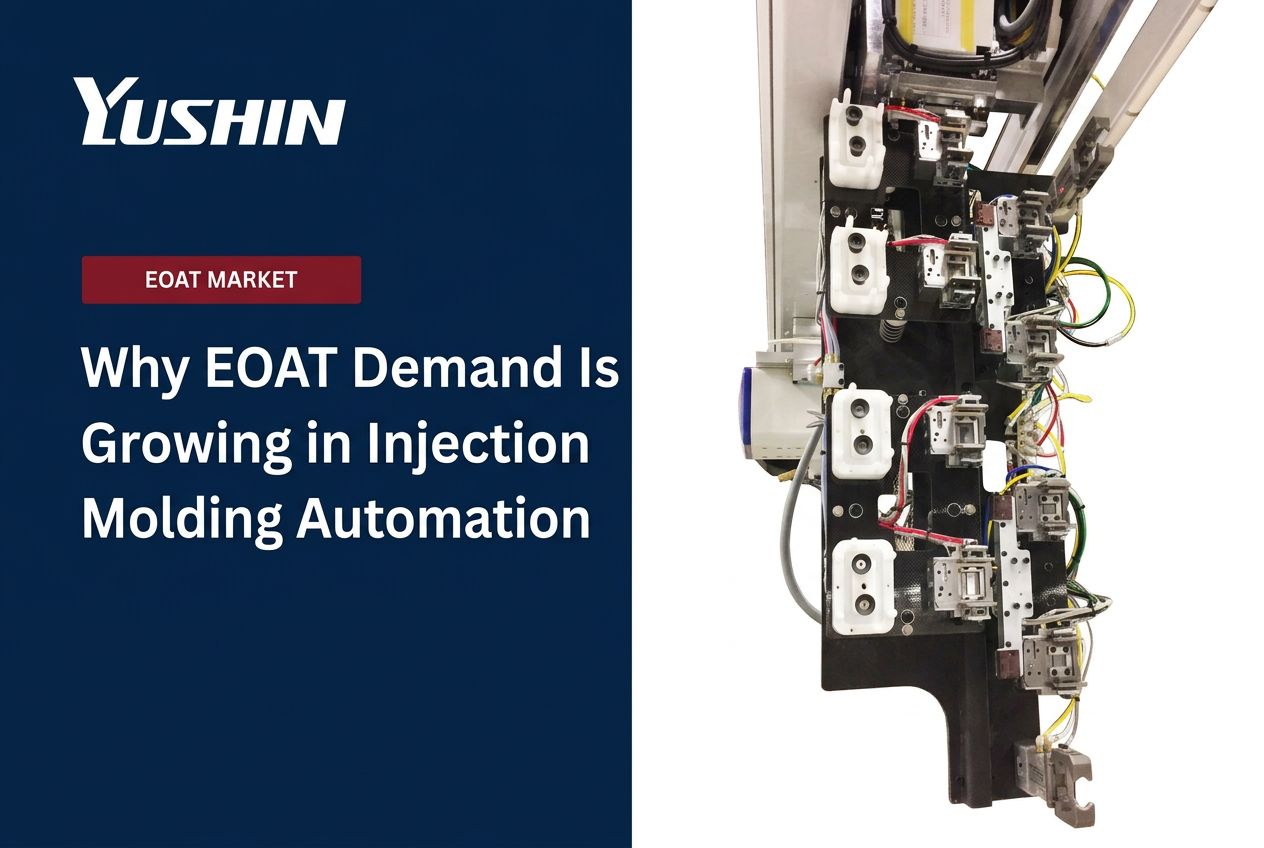
Rather than a robot that swaps between many general-purpose tools, Yushin's approach to job-to-job flexibility is modular EOAT design - engineered tooling that can be reconfigured or swapped between molding programs during a changeover, not mid-cycle during production. This matches how injection molding actually changes tasks: at mold changes, not part-to-part.
NC Servo Wrist Units Add Orientation Without Tool Changes
For applications requiring different part orientations - insert loading, overmolding, angled placement - Yushin's NC servo wrist units add controlled rotation capability to a single EOAT configuration, rather than requiring a tool change to achieve a different orientation. This avoids the cycle-time penalty of a tool swap entirely.
Engineered EOAT for the Specific Application
Yushin designs EOAT as part of complete automation system integration - engineered for the specific part geometry, grip requirements, and cycle time of each molding program, rather than relying on generic interchangeable tooling designed for broad applicability across many unrelated tasks.
Where Multi-Tool Flexibility Does Make Sense
Multi-tool cobot configurations can be a reasonable approach for:
- Downstream, non-cycle-critical tasks: Packing, inspection assistance, or sorting tasks where tool-change time does not compete with a fixed molding cycle window
- Low-volume, highly variable work: Applications where task variety is high enough that dedicated tooling for each task would be impractical
- Human-proximate operator-assist roles: Where a cobot supports a variety of light tasks alongside an operator
Selection Criteria: Multi-Tool Cobot vs. Engineered EOAT for Injection Molding
| Factor | Favors multi-tool cobot | Favors engineered/modular Yushin EOAT |
|---|---|---|
| Task timing | Flexible, non-cycle-critical | Fixed molding cycle window |
| Task variety | High variety, low volume per task | Consistent extraction task per mold |
| Payload requirement | Lower, tool-dependent | Application-specific, often higher including EOAT |
| Changeover frequency | Mid-shift, task-to-task | At mold changes, not mid-cycle |
| Orientation needs | Tool change per orientation | NC servo wrist for orientation without tool change |
Yushin Product Fit for Tooling Flexibility Needs
| Application need | Yushin solution |
|---|---|
| Standard take-out with modular EOAT | YD/YD2 Series standard take-out robots |
| Insert loading, overmolding, orientation control | NC servo wrist units |
| Safety-critical, high-variety production | FRA Series high-end take-out robots |
| End-of-line palletizing | PA Series compact palletizing robot |
Implementation and Support
Yushin America provides installation, EOAT engineering, operator training, field service, and parts support for take-out robot systems.
- 24/7 phone support: 888-707-6268
- Over $1.3M in spare parts inventory with overnight shipping
- Yushin University: Yushin robot training and programming
- Yushin America field service and support
Frequently Asked Questions
Can a cobot with multiple EOAT tools replace a dedicated take-out robot in injection molding? Generally not for mold-area extraction. Tool-change time is typically incompatible with the fixed extraction window in a molding cycle. Multi-tool cobots are better suited to downstream, non-cycle-critical tasks.
What is the difference between multi-tool cobot flexibility and Yushin's modular EOAT approach? Multi-tool cobots swap tooling within a shift or task sequence, often mid-cycle. Yushin's modular EOAT approach reconfigures tooling at mold changes, matching how injection molding programs actually change tasks - not part-to-part.
Do NC servo wrist units eliminate the need for tool changes in insert loading applications? NC servo wrist units can reduce or avoid some orientation-driven tool changes by adding controlled rotation to the robot, but EOAT requirements still depend on the specific insert, part geometry, and cycle sequence.
What safety considerations apply to multi-tool robot configurations? Each tool configuration can change the robot's effective reach, speed profile, or contact risk, requiring safety validation for each configuration used - not just an initial risk assessment for the base robot.
Why does payload budgeting matter for multi-tool robots? The robot must be rated for its heaviest tool-plus-workpiece combination across every configuration it uses, which can force selection of a larger, more capable (and more expensive) robot than a single-task system would require.
Is multi-tool flexibility ever a good fit for injection molding automation? It can work for downstream, non-cycle-critical tasks like packing or inspection support, where tool-change time does not compete with a fixed molding cycle. For mold-area extraction, engineered EOAT and NC servo wrist units are generally the better fit.
Conclusion
Multi-tool flexibility is a real automation strategy, but it comes with tradeoffs in cycle time, payload budgeting, programming complexity, and safety validation that matter more in cycle-critical applications like injection molding take-out. Yushin America's engineered, modular EOAT and NC servo wrist units address the same flexibility need differently - matched to how molding programs actually change, without the tool-change penalty inside the production cycle.
If your molding cell needs tooling flexibility across job changes or complex orientation requirements, contact Yushin America to discuss the right EOAT and servo wrist configuration for your take-out robot.