
As labor availability, cycle-time pressure, and quality requirements continue to challenge plastics processors, automated part removal has become a practical way to improve consistency on the molding floor. A properly specified take-out robot can help reduce manual handling, support repeatable part placement, and keep production moving with fewer interruptions.
This guide covers how take-out robots work, the main types used in injection molding, the benefits they can deliver, and what to consider when selecting the right system for your facility.
Key Takeaways
- Take-out robots remove molded parts, runners, or sprues from injection molding machines after each cycle — a task that is repetitive, time-sensitive, and important for safe operation.
- Servo or pneumatic robot axes work with end-of-arm tooling to grip and transfer parts to conveyors, cooling stations, inspection systems, palletizers, or other downstream equipment.
- Automating part removal can help reduce manual handling, improve consistency, lower scrap risk, and support unattended or reduced-attendance production when the full molding cell is properly configured.
- The right robot depends on press size, part weight, cycle-time target, EOAT requirements, downstream handling needs, and available floor space.
- Choose an automation partner with application engineering, local service, parts support, and integration experience to reduce deployment and downtime risk.
What Are Take-Out Robots in Manufacturing?
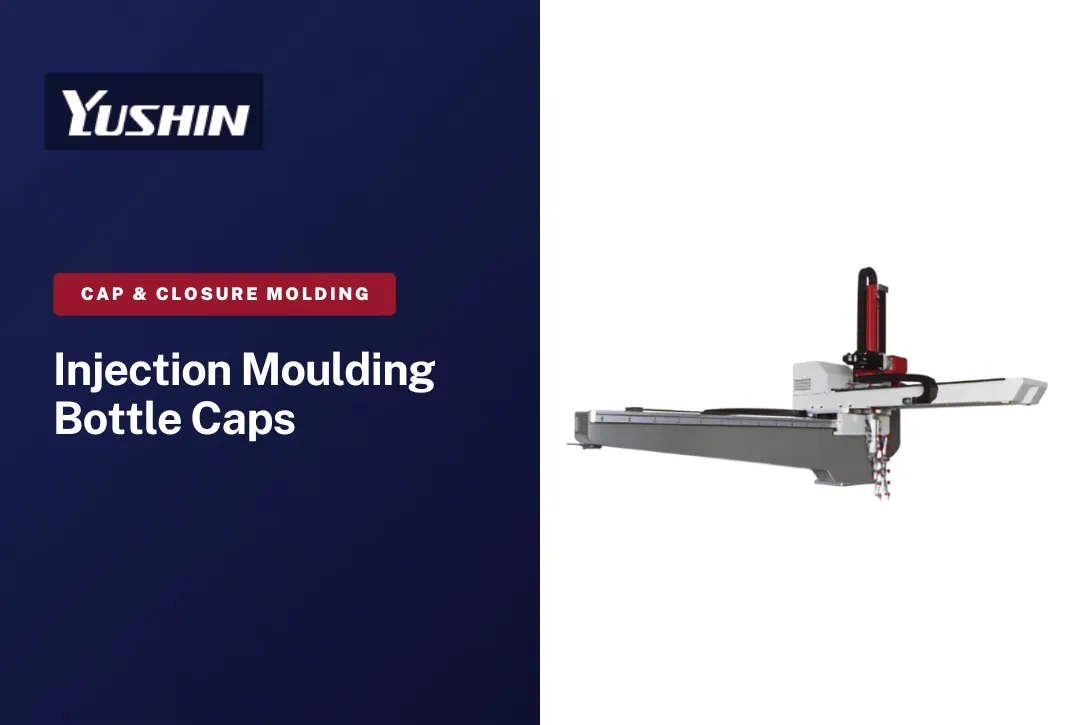
An industrial take-out robot is an automation device used with an injection molding machine to remove molded parts, runners, or sprues after each molding cycle. Depending on the application, this may be a simple sprue picker, a top-entry take-out robot, a side-entry robot, or a more advanced part-removal system integrated with downstream equipment.
After the mold opens, the robot enters the mold area, uses end-of-arm tooling to grip the part or runner, exits the mold area, and transfers the part to a conveyor, cooling fixture, inspection station, or secondary process. In this guide, “take-out robot” refers specifically to part-removal automation for plastics manufacturing.
A Brief History
Before take-out robots became common in injection molding, operators often removed hot or sharp plastic parts manually from open molds. This created safety risks, handling inconsistency, and cycle-time variation, especially in high-volume production environments.
Take-out automation developed as molders looked for a safer and more repeatable way to remove parts from the molding area. Yushin has been part of this category for decades, advancing from early take-out robot designs to modern servo-driven robots with touchscreen controls, diagnostic functions, and automation features designed for today’s plastics production floors.
Why Take-Out Robots Differ from General Industrial Arms
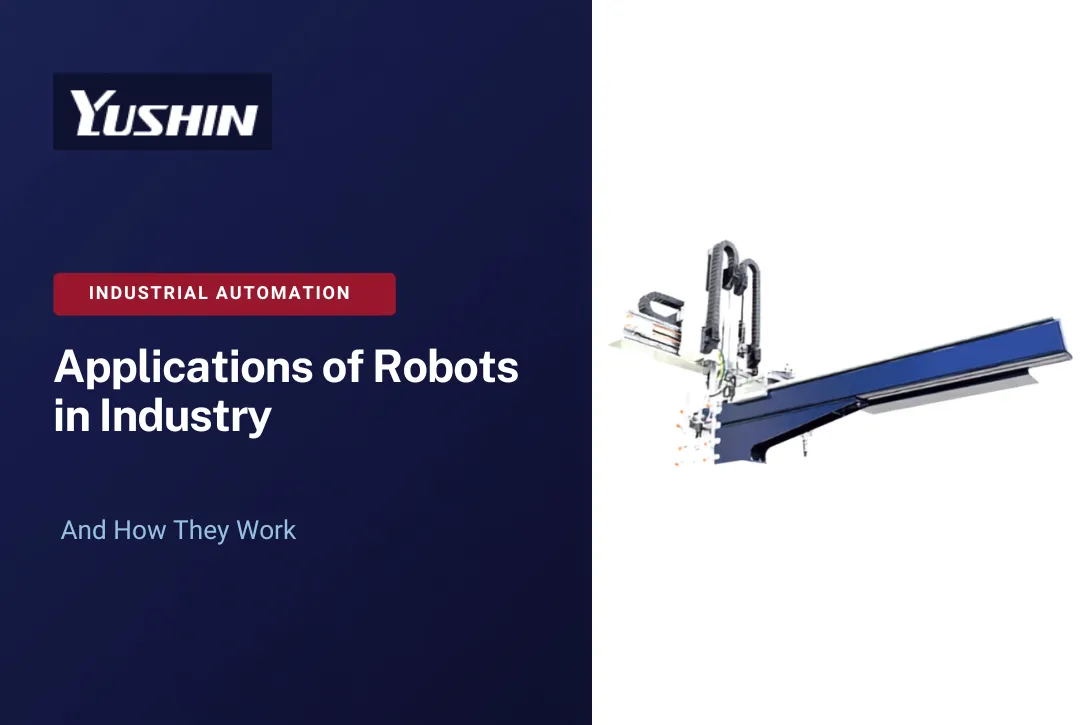
Take-out robots are different from general six-axis articulated robots. Most are purpose-built Cartesian, or linear-axis, systems designed around the physical requirements of injection molding machines.
They are optimized for three main needs:
- Fast extraction: removing the part within the mold-open portion of the cycle.
- Repeatable motion: following a consistent path to help protect parts, molds, and cycle stability.
- Machine fit: working within the space, guarding, and mounting requirements of the molding cell.
For many plastics processors, this makes a take-out robot the more practical choice for part removal than a general-purpose industrial arm. The right configuration depends on the press size, part geometry, cycle-time target, end-of-arm tooling, and downstream handling requirements.
The broader injection molding machine market those robots serve is growing: valued at $11.98 billion in 2024 and projected to reach $14.78 billion by 2030, it's a market where take-out robots have moved from optional add-on to standard equipment.
How Do Take-Out Robots Work?
The Operating Cycle
A take-out robot works in coordination with the injection molding machine, mold, ejector system, end-of-arm tooling, and downstream equipment. The exact sequence depends on the robot model, mold design, EOAT, and application, but a typical take-out cycle includes the following steps:
- The molding cycle finishes and the mold opens. The injection molding machine completes the shot and provides a mold-open condition for robot access.
- The robot enters the mold area. Once the machine interface confirms that access is permitted, the robot moves into the mold area.
- The EOAT moves to the take-out position. The robot positions the end-of-arm tooling near the molded part, runner, or sprue.
- The ejector and robot take-out motion are coordinated. Depending on the mold, robot program, and EOAT design, ejector timing may be coordinated with the robot’s take-out position so the part can be released cleanly.
- The part, runner, or sprue is gripped. Vacuum cups, mechanical grippers, or custom EOAT secure the part during removal. In many applications, part presence can also be confirmed through vacuum sensing, part sensors, or other detection methods.
- The robot retracts from the mold area. After take-out, the robot exits the mold area with the part, runner, or sprue.
- The molding machine receives clearance to continue. Once the robot is safely clear of the mold area, the machine can continue into the next cycle.
- The part is transferred downstream. The robot places the part on a conveyor, cooling fixture, inspection station, box-loading system, palletizing system, or other downstream automation.

That robot-to-machine coordination is critical. The press, robot, EOAT, sensors, guarding, and downstream equipment must be validated during installation so the cell runs safely and consistently.
Servo vs. Pneumatic Drives
| Drive Type | Strengths | Trade-offs |
|---|---|---|
| Pneumatic | Low cost, simple, fast for short strokes | Fixed motion profiles, less flexible |
| Servo | Programmable speed and position, handles complex geometries | Higher upfront cost |
Take-out robots may use pneumatic motion, servo motion, or a combination of both depending on the application. Pneumatic systems can be a practical choice for simple sprue or runner removal where the motion is short and repeatable. Servo-driven robots provide more programmable control over position, speed, acceleration, and placement, which is especially useful for complex parts, tighter cycle targets, multi-cavity molds, and downstream integration.
Modern take-out robot systems increasingly use servo-driven axes because they give plastics processors more control over motion profiles and part placement. For example, Yushin’s YD/YD2 Series standard take-out robots include take-out diagnosis, vacuum monitoring, and predictive maintenance features designed to help operators identify take-out issues and reduce unplanned downtime.
End-of-Arm Tooling (EOAT)
EOAT is the robot’s “hand” and one of the most application-specific parts of the automation system. The robot provides the motion, but the EOAT determines how the part is gripped, supported, detected, and transferred.
Common EOAT options include:
- Vacuum cups for flat, smooth, or lightweight molded parts.
- Mechanical grippers or fingers for complex geometries, heavier parts, or parts that cannot be handled by vacuum alone.
- Custom EOAT for insert molding, in-mold labeling, multi-cavity removal, part detection, orientation control, or downstream placement.
Lightweight EOAT design matters because excess tooling mass can slow robot motion, increase vibration, and affect cycle stability. Yushin America’s End-of-Arm Tooling team designs custom EOAT for injection molding applications, including insert molding, in-mold labeling, and special downstream automation needs.
Safety Architecture
Take-out robot safety depends on the full cell design, not only the robot itself. The injection molding machine, robot, EOAT, guarding, conveyor, downstream equipment, emergency stops, and operator access points all need to work together as one controlled system.
A properly commissioned cell should confirm that:
- the robot enters only when mold-area access is permitted;
- the press does not continue until the robot is clear of the mold area;
- part detection, vacuum sensing, or grip confirmation functions as required by the application;
- emergency stops, guarding, light curtains, and access doors are validated;
- operators and maintenance teams understand the approved operating sequence.
For this reason, robot selection should include not only payload and speed, but also integration support, startup assistance, training, parts availability, and service coverage. Yushin America supports customers with robot systems, custom EOAT, downstream automation systems, field service, and technical support through its service team.
OSHA notes that crushing injuries or amputations can occur on injection molding machines when hands or limbs enter the mold area or other hazardous areas while the machine cycles. ANSI/PLASTICS B151.27-2021 covers safety requirements for robot / injection molding machine systems, including robot systems that operate within the guarded mold-area volume of an injection molding machine.
Types of Take-Out Robots for Injection Molding
Sprue Pickers — Entry-Level Automation
Sprue pickers are often the starting point for injection molding automation. They are designed to remove sprues or runners from the mold area, helping reduce one of the most repetitive manual handling tasks in a molding facility.
Yushin’s sprue picker lineup includes:
- HOP Five — a standard swing-type runner take-out robot designed for reliable sprue and runner removal with a compact body and operator-friendly setup.
- N-HOP — a single-axis servo swing-type runner take-out robot with a servo-driven kick axis, allowing kick-stroke adjustments from the controller.
- YD-0310S/D — a compact all-axis servo driven take-out robot for small molding machines. The YD-0310S/D is designed for 30–100 tf clamping-force machines, with the S type equipped with a main arm only and the D type equipped with a main arm and sub arm.
For molders that need more programmability, part placement control, and downstream flexibility than a basic sprue picker can provide, the YD-0310S/D can serve as an upgrade path from simple runner removal to more capable part take-out automation.
Top-Entry Traverse Robots — The Workhorse Category
Top-entry traverse robots are one of the most common configurations for injection molding automation. They enter the mold area from above the platen and are used across a wide range of press sizes, part geometries, and production environments.
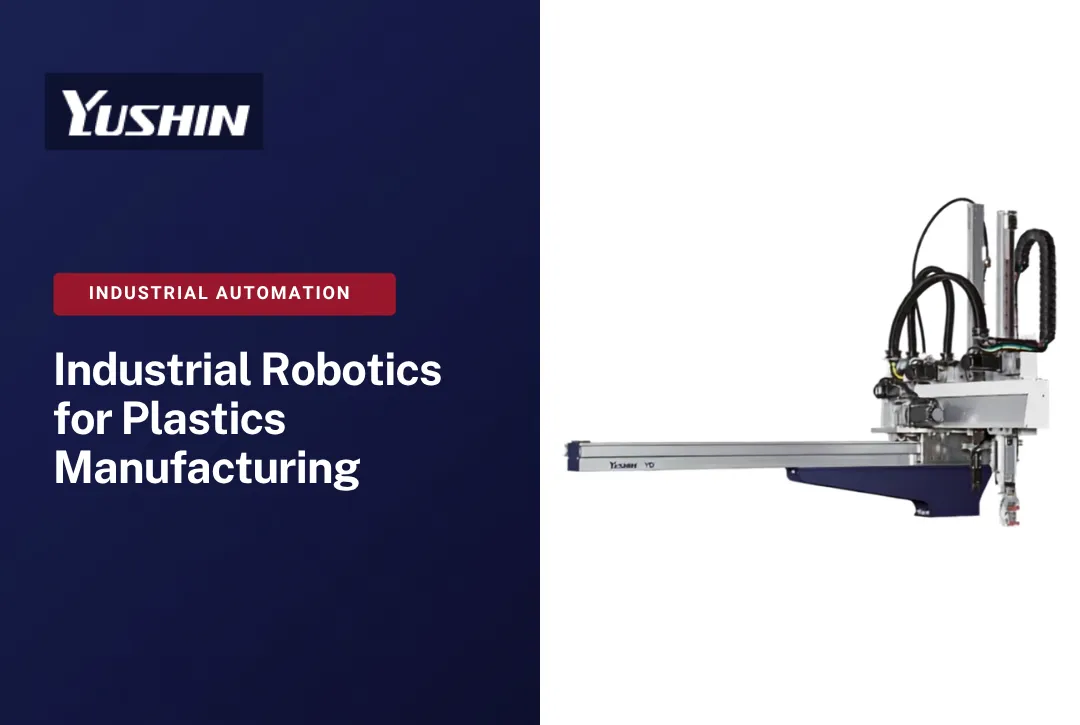
Yushin’s YD/YD2 Series standard take-out robots are built for standard part-removal applications where repeatability, teaching efficiency, and downtime prevention matter. The series includes features such as vibration control, take-out diagnosis, vacuum monitoring, and predictive maintenance functions to help processors stabilize take-out performance and reduce unplanned interruptions.
For faster or more demanding applications, Yushin also offers specialized robot families, including:
- HST high-speed take-out robots for applications that require high-speed operation and vibration control.
- HSA high-speed take-out robots for fast-cycle production and packaging applications.
- RC-SE high-end high-speed take-out robots for advanced high-speed take-out applications, including configurations that may require specialized EOAT or in-mold labeling support.
- FRA high-end take-out robots for complex automation cells where motion control, downstream integration, and advanced functions are important.
- Clamp-end traverse robots for molding cells where layout, ceiling height, or machine configuration limits standard top-entry access.
- Large take-out robots for larger presses and heavier molded parts.
The main point for buyers is not to select by robot name alone. The right top-entry robot depends on press size, part weight, mold layout, cycle-time target, EOAT design, and downstream handling requirements.

Side-Entry Robots — IML, Cleanroom, and Specialty Applications
Side-entry take-out robots access the mold area from the side rather than from above. This configuration is often used for fast-cycle packaging, in-mold labeling, micromolding, cleanroom molding, and applications where a top-entry robot is not the best fit for the mold or cell layout.
Yushin’s side-entry lineup includes options for both packaging and precision molding applications:
- SXB side-entry take-out robots — low overall-height side-entry robots suited for clean environments and facilities where low ceilings or mold-area layout make side-entry access useful.
- TSXA super-high-speed side-entry take-out robots — side-entry robots designed for high-speed operation, integrated control, and applications that require fast mold access.
- SXC-HSY / SXC-HS / SXC side-entry robots — side-entry robots suited for high-speed, high-precision molding of small parts, including micromolding applications.
- SX-41 high-speed side-entry robot — a side-entry robot designed for cleanroom and micro-molding applications, including optical parts, medical equipment, food containers, and electronic parts.
Side-entry robots are especially valuable when cycle time, cleanroom performance, mold access, or part-handling precision makes overhead take-out less practical.
Vertical Press Robots — Insert Molding and Overmolding
Vertical-clamp injection molding machines require a different automation approach because the mold opens and presents the part differently from a horizontal press. These machines are common in insert molding and overmolding, where components may be loaded into the mold before the next shot.
Yushin’s robots for vertical injection molding machines include options for runner removal, part take-out, and automation support around vertical molding cells.
Examples include:
- V-HOP / V-HOP-II — vertical sprue pickers for runner removal on vertical-clamp presses.
- SVR-C50 — a vertical-press take-out robot for part extraction and automation tasks around vertical injection molding machines.
For insert molding and overmolding applications, robot selection should account for insert loading, part orientation, EOAT clearance, operator access, and downstream handling requirements.
Downstream Integration
Extracting the part is only the first step. A complete automation cell may also include end-of-arm tooling, conveyors, cooling stations, degating, inspection, box loading, palletizing, safety guarding, and other downstream automation systems.
For end-of-line handling, Yushin’s PA Series compact palletizing robot can support palletizing applications where finished parts, boxes, or totes need to move beyond the press area. In fully integrated cells, take-out robots, conveyors, EOAT, inspection equipment, and palletizing systems can work together to reduce manual handling and support unattended or reduced-attendance production when the full process is properly designed and validated.
For high-mix or lower-volume production, collaborative robots may also be considered for certain downstream handling tasks. However, cobot use still requires an application-specific safety assessment, proper guarding or risk-reduction measures where needed, and validation of the complete cell.
Key Benefits of Automating with Take-Out Robots

Cycle Time and Productivity
A take-out robot removes parts during the mold-open portion of the injection molding cycle, helping the press run with less variation from cycle to cycle. Manual removal can introduce inconsistency because operator timing, fatigue, and handling methods may vary by shift.
Servo-driven take-out robots can help improve cycle stability by repeating the same programmed motion, controlling acceleration and deceleration, and reducing unnecessary movement in the mold area. Advanced systems such as Yushin’s FRA Series high-end take-out robots are designed with features such as active vibration control and production monitoring to support high-speed, high-precision take-out applications.
Consistency and Quality
Speed gains are only valuable if part quality is maintained. Take-out robots help standardize how molded parts are gripped, removed, and placed after each cycle.
This can help processors reduce:
- part damage caused by inconsistent manual handling;
- mis-drops or unstable part placement;
- scrap risk from poor handling or missed take-out;
- downstream variation before cooling, inspection, packaging, or palletizing.
The right end-of-arm tooling is especially important here. EOAT determines how the part is held, supported, detected, and transferred, so it should be designed around the part geometry, mold layout, and downstream process.
Worker Safety
Automating part removal can help reduce how often operators need to reach near the mold area for repetitive take-out tasks. According to the U.S. Bureau of Labor Statistics, manufacturing recorded a total recordable injury and illness rate of 2.7 cases per 100 full-time workers in 2024, underscoring the importance of safety-focused process design on the production floor.
OSHA also notes that crushing injuries or amputations can occur on injection molding machines when hands or limbs enter the mold area or other hazardous areas while the machine cycles.
A properly integrated take-out robot helps keep the operator outside the mold area during normal production. It also supports a more controlled process where the robot, press, guarding, emergency stops, sensors, and downstream equipment are validated as one complete cell.
In many facilities, automation also allows operators to focus more on higher-value tasks such as quality checks, material handling, mold setup, process monitoring, and maintenance support.
Lights-Out Production
A take-out robot can support unattended or reduced-attendance production when the full molding cell is designed for it. The robot alone is not enough. The process also needs stable molding conditions, reliable EOAT, part detection, downstream handling, fault response, and a way to alert the right team when something goes wrong.
Features that can support this type of operation include:
- Take-out and part-detection functions that help identify missed parts, failed grips, or release problems.
- Fault-response logic that determines what the robot and molding machine should do when an error occurs.
- Remote alerts, such as Yushin’s YC Email Notification Module, which can send email notifications for programmable robot or cell errors during lights-out operation.
- Production monitoring, such as INTU LINE, which allows users to check production status, cycle times, alarms, and molding operation data from a mobile device or PC after installation on supported FRA take-out robots.
When take-out, conveying, inspection, packaging, and palletizing are integrated correctly, a molding cell can reduce manual touchpoints and support more consistent off-shift production.
How to Choose the Right Take-Out Robot for Your Facility
Technical Matching Criteria
Before selecting a take-out robot, define the application requirements around the molding machine, part, mold, and downstream process. The right robot is not just the fastest model or the largest payload rating. It is the robot that fits the production cell and can repeat the required motion reliably.
Key specifications to confirm include:
- Platen size and tie-bar spacing — helps determine robot mounting requirements, available access, and traverse beam size.
- Part weight and geometry — affects payload rating, gripping method, and end-of-arm tooling design.
- Runner or sprue requirements — determines whether a basic sprue picker is enough or a more capable take-out robot is needed.
- Cycle-time target — helps determine whether pneumatic, servo, high-speed, or advanced motion control is required.
- Downstream handling — confirms whether the part will be placed on a conveyor, cooling fixture, inspection station, box-loading system, palletizer, or other downstream automation.
- Available floor space and cell layout — affects whether top-entry, side-entry, clamp-end, or vertical-press automation is the best fit.
- Service and maintenance needs — helps evaluate parts availability, technician support, training, and long-term uptime risk.
For reference, Yushin's lineup maps directly to press size and payload demand:
| Series | Press Range | Payload | Best Fit |
|---|---|---|---|
| YD/YD2 | 30–1,300 tf, model-dependent | Model-dependent; for example, YD2-3550S/D supports 10 kg standard, 15 kg with increased payload option | Standard take-out applications where molders need reliable part removal, stable motion, vacuum monitoring, take-out diagnosis, and easier teaching |
| FRA | 50–600 tf across FRA-0515, FRA-1530, and FRA-3060 models | 5–10 kg standard, with increased payload options up to 11–13 kg, depending on model | High-end take-out applications, high-mix production, complex EOAT motion, downstream equipment integration, and advanced cell control |
| MKA-2000S | 1,500 tf or larger | Up to 50 kg, including EOAT | Large, heavy molded parts such as automotive parts, appliance housings, and industrial equipment components |
Total Cost of Ownership vs. Purchase Price
Upfront robot price is only one part of the automation decision. A lower-cost robot can become expensive if it cannot meet the cycle target, requires frequent intervention, is difficult to reprogram, or lacks reliable service and parts support.
When building the business case, consider the full cost of ownership:
- labor reduction or operator redeployment opportunities;
- cycle-time improvement potential;
- scrap reduction and part-handling consistency;
- mold protection and missed-take-out prevention;
- EOAT design, guarding, conveyors, and integration work;
- energy and compressed-air usage;
- preventive maintenance and spare parts;
- training and ease of reprogramming;
- supplier service response and technical support.
Yushin America’s ROI Calculator can help estimate automation payback using production-specific inputs such as labor rates, machine hours, productivity, cavitation, scrap, mold damage, and lost production.
Integration and Support
Robot performance depends on more than the robot itself. The molding machine interface, EOAT, part detection, safety guarding, conveyor layout, downstream process, and operator training all affect how well the cell performs after installation.
This is where supplier support becomes a major part of the buying decision. Yushin America supports customers with individual robots, fully integrated factory automation, end-of-arm tooling, conveyors, safety guarding, parts inventory, regional service, and 24/7 phone support.
For connected production environments, Yushin’s INTU LINE IoT Solution can help users monitor production status, operating data, alarms, and cycle information from supported systems. This can make troubleshooting and production visibility easier, especially when combined with proper service support and preventive maintenance.
When comparing suppliers, ask:
- Who designs and supports the EOAT?
- Who validates the robot-to-machine interface?
- Who supports downstream equipment integration?
- How quickly are spare parts available?
- Is local or regional service available?
- What training is provided for operators and maintenance teams?
- What happens if the robot alarms during off-shift production?
The best take-out robot choice is the one that fits the application technically and is backed by the engineering, integration, and service support needed to keep the molding cell running.
Frequently Asked Questions
How much do take-out robots cost?
Yushin, like many injection molding robot manufacturers, does not publish standard list prices because each project depends on the molding machine, robot model, end-of-arm tooling, safety requirements, downstream equipment, installation, and commissioning scope.
As a general rule, a simple sprue picker will typically cost less than a full servo take-out robot, while advanced systems with custom EOAT, conveyors, inspection, palletizing, or other downstream automation will require a larger project budget. When comparing options, evaluate the full automation scope rather than the robot price alone.
How do take-out robots work?
A take-out robot works with the injection molding machine, mold, ejector system, and end-of-arm tooling to remove molded parts, runners, or sprues after each cycle.
Once the mold opens and the machine interface allows robot access, the robot moves into the mold area, positions the EOAT, grips the part or runner, retracts from the mold area, and signals that the machine can continue. The robot then transfers the part to a conveyor, cooling fixture, inspection station, palletizing system, or other downstream process.
The exact sequence depends on the robot model, mold design, EOAT, and production cell layout.
What is the difference between a take-out robot and a six-axis industrial robot?
Most take-out robots are Cartesian, or linear-axis, systems designed specifically for injection molding machines. They are built for fast, repeatable part removal within the space and timing requirements of the molding cell.
Six-axis industrial robots offer more rotational freedom and can be useful for complex downstream handling, assembly, or secondary operations. However, for the core task of removing parts from the mold area, a purpose-built take-out robot is often the more practical choice because it is designed around the press, mold-open window, EOAT, and part-removal sequence.
Can take-out robots run lights-out operations?
Take-out robots can support unattended or reduced-attendance production, but the robot alone does not make a cell lights-out ready. The full process must be stable and properly integrated.
A lights-out or reduced-attendance molding cell may require reliable EOAT, part detection, fault response, conveyors, inspection, packaging, palletizing, and remote alerts. Tools such as Yushin’s YC Email Notification Module and INTU LINE IoT Solution can support production visibility and error notification when used with compatible systems.
What information should I prepare before requesting a take-out robot quote?
Before requesting a quote, prepare the molding machine size, platen and tie-bar details, part weight, runner or sprue information, mold layout, cycle-time target, discharge direction, EOAT requirements, and downstream handling needs.
It also helps to share whether the part will go to a conveyor, cooling fixture, inspection station, box-loading system, palletizer, or another automation process. This allows the automation team to recommend the right robot, EOAT, and integration approach.
What industries use take-out robots besides plastics?
Take-out robots are most closely associated with plastic injection molding, where they are used to remove molded parts, runners, or sprues from the mold area. Similar part-removal automation may also be used in related molding or casting processes, but plastics injection molding remains the primary application for this type of robot.