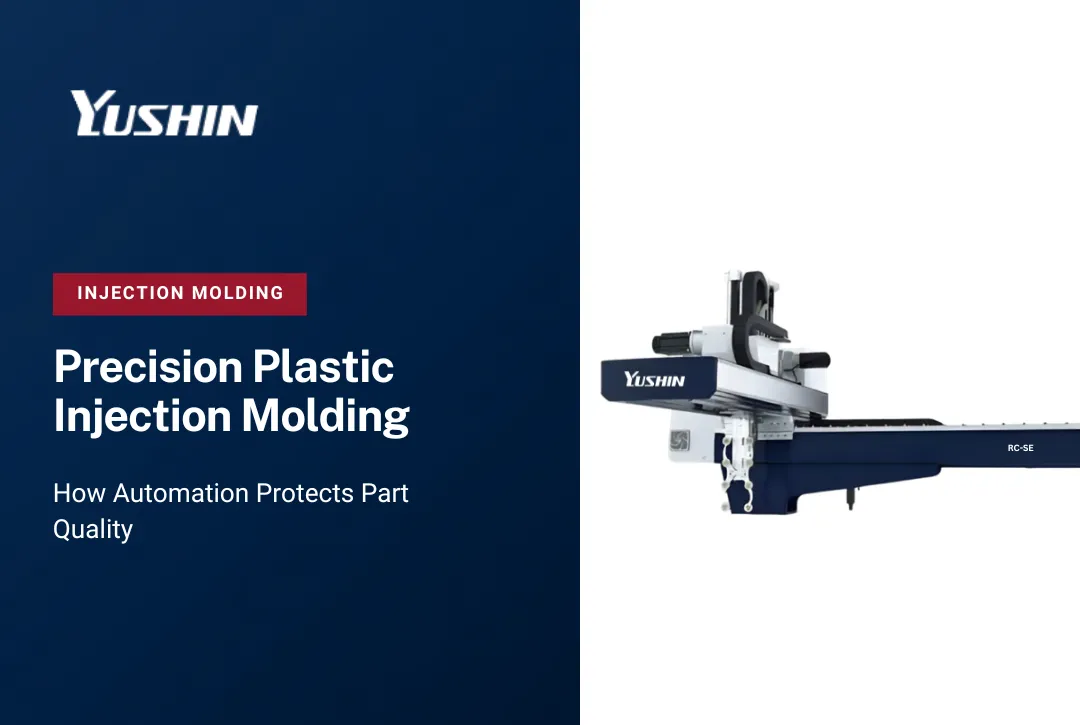

Micro injection molding produces parts often measured in fractions of a gram, with tolerances tighter than most standard molding applications require. These parts are frequently too small and too delicate for the handling approaches used on larger components - a grip force or contact point that works fine on a standard part can crush or damage a micro part instantly. Yushin America supports micro molding applications through compact take-out robots and EOAT engineered specifically for small, delicate part handling.
What Is Micro Injection Molding?

Micro injection molding is a specialized process for producing very small plastic parts, often weighing less than a gram and measuring only a few millimeters in critical dimensions. It typically runs on smaller injection molding machines with reduced shot sizes and precise injection control, since standard-size machines are often not capable of the metering precision micro parts require.
Common characteristics of micro molding:
- Part weights often under 1 gram, sometimes in the milligram range
- Tight dimensional tolerances relative to part size
- High-cavitation tooling to achieve reasonable output per cycle given the small part size
- Frequent use in medical devices, electronics connectors, and precision consumer components
Why Molders Use Micro Injection Molding
- Miniaturization requirements: Medical devices, electronics, and connector components increasingly require smaller parts to fit space-constrained assemblies.
- Material efficiency: Very small parts use minimal material per shot, which matters for high-value engineering resins.
- Precision applications: Micro components often serve as precision mechanical or electrical elements where tight tolerances are functionally necessary, not just cosmetic.
- High-volume production of small components: Applications like electronic connectors or medical device components often require high shot counts, making automation particularly valuable per-part.
Handling Challenges Unique to Micro Molded Parts
Standard take-out and EOAT approaches often do not translate directly to micro parts:
- Grip force sensitivity: Force levels that are appropriate for standard parts can crush, deform, or damage micro parts. EOAT grip force must be calibrated specifically for the part's mass and material.
- Static and contamination control: Small electronics and medical components are often sensitive to static discharge or contamination - EOAT design and material selection must account for this.
- Visibility and placement accuracy: Micro parts can be difficult to place accurately at a small scale, making consistent robot positioning and EOAT design more important than on larger parts where placement tolerance is more forgiving.
- Multi-cavity consistency at scale: Micro molds are often high-cavitation to achieve reasonable output, meaning EOAT must apply consistent (and very light) grip force across many small cavities simultaneously.
- Part identification and orientation: Because micro parts are difficult to distinguish visually at a glance, consistent robot placement and orientation become the primary means of maintaining traceability and downstream handling accuracy.
Where Automation Fits in Micro Molding Cells
The extraction sequence for micro molded parts follows the same general logic as standard take-out, adapted for the part scale:
- Mold opens after the (often short) cycle completes
- Compact take-out robot enters the mold space
- EOAT engages the part or parts with carefully calibrated, low grip force
- Robot retracts; parts exit the mold space
- Parts are placed at a downstream station - often inspection, counting, or precision packaging given the value and small size of the parts
- Robot returns to home position; mold closes for the next cycle
Given the fast cycle times common in micro molding and the small, sometimes fragile parts involved, take-out timing and EOAT precision matter more than they do in many standard-part applications.
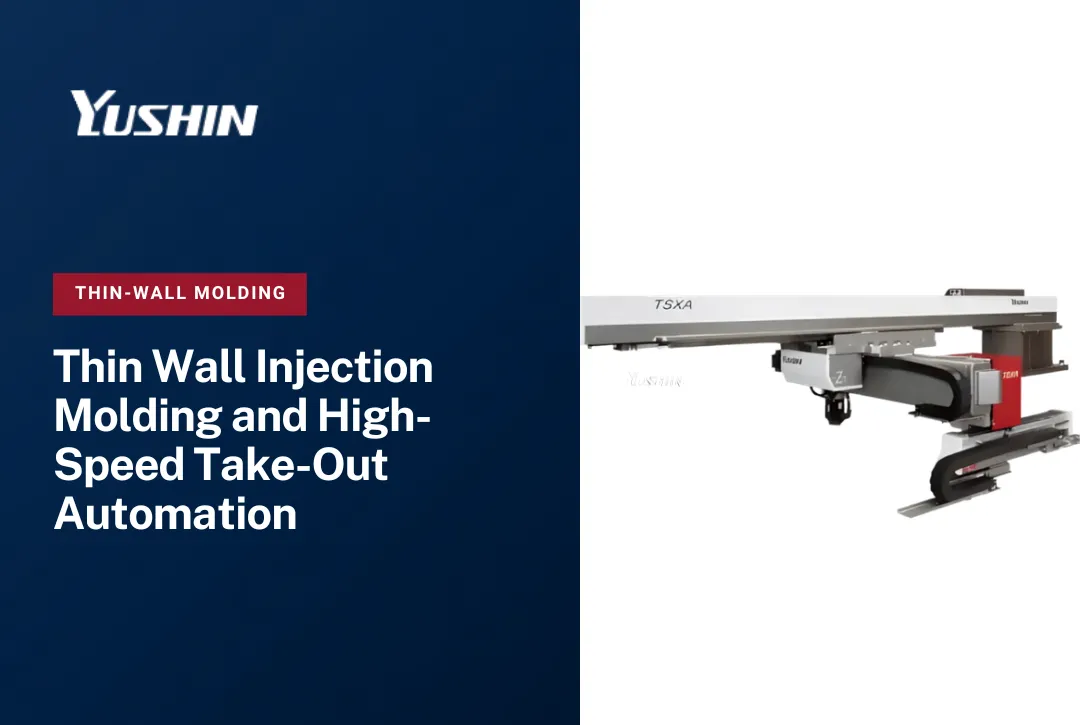
For micro-molding applications that benefit from side-entry automation, Yushin also offers super-high-speed side-entry take-out robots for micromolding.
Yushin Compact Take-Out Robot Solutions for Micro Molding

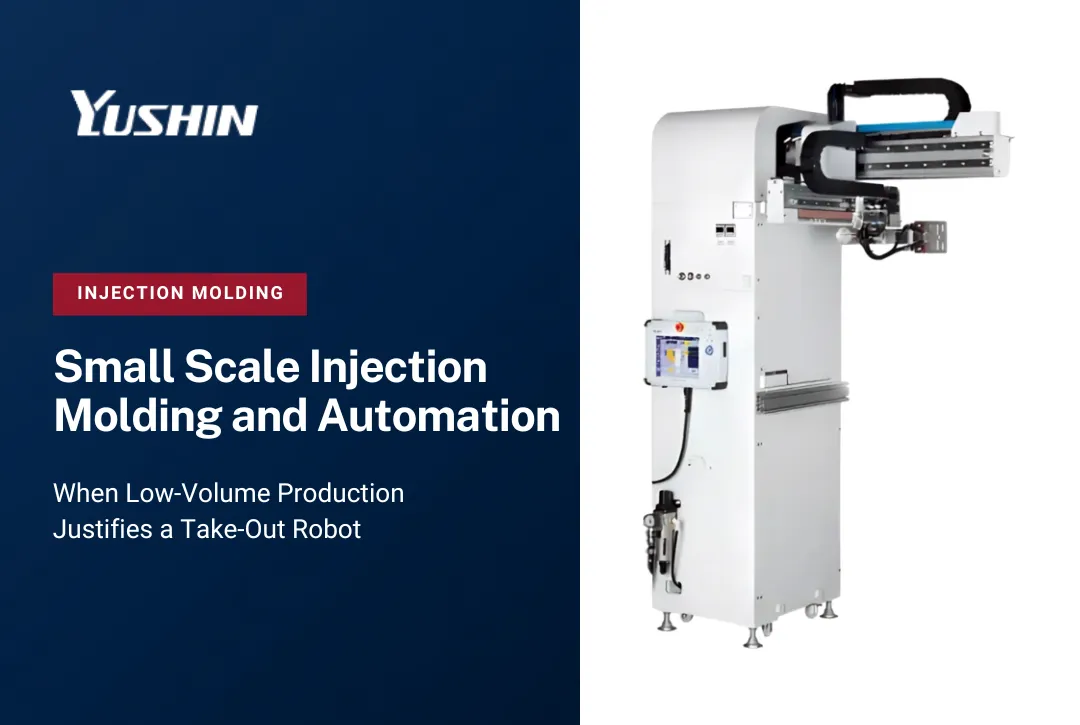
YD-0310 Compact Take-Out Robot
Designed for small injection molding machines and small parts:
- Target IMM clamp force: 30–100 tf
- Digital servo motor
- E-touch Compact 3 controller
- Working air pressure: 0.49 MPa
- 90° flip angle
- Standard payload: 3 kg including EOAT
The YD-0310 is commonly used for compact molding cells, small parts, medical components, electronics, and consumer parts where the IMM is in the 30–100 tf range. (YD-0310 source)
For micro molding specifically, the robot's speed and precision are important, but EOAT design - grip force calibration, contact material selection, and multi-cavity consistency - is often the deciding factor in whether the automation system handles micro parts successfully.
For micro injection molding applications, automation selection should reflect the small part size, tight process windows, and handling sensitivity involved. Yushin's compact take-out robot platforms, including models covered in the YD-01/03 and YD-20/310 product literature, can support small-part molding environments.
EOAT Design Considerations for Micro Parts
Yushin America designs EOAT as part of complete automation system integration, with particular attention to the requirements micro parts introduce:
- Precisely calibrated vacuum or mechanical grip: Sized and tuned for gram-scale or sub-gram part weights
- Contact material selection: Chosen to avoid marking, static buildup, or contamination on sensitive parts
- Multi-cavity distribution: Consistent, light-force contact across potentially dozens of cavities in a high-cavitation micro mold
- Fine positioning accuracy: Precise placement matters more at small scale, where placement tolerance is proportionally tighter
Selection Criteria for Micro Molding Automation
- Part weight and material: Drives EOAT grip force calibration and contact method
- Cavitation: High-cavitation micro molds require EOAT that applies consistent, light force across all cavities
- Cycle time: Micro molding cycles can be very short; confirm the take-out robot's extraction time fits the available window
- Static/contamination sensitivity: Relevant for electronics and some medical applications
- Downstream requirements: Inspection, counting, or precision packaging stations may require specific placement accuracy from the robot
When Micro Molding Automation May Need Additional Engineering Review
- Extremely fragile parts: May require highly specialized EOAT with distributed, minimal-force contact points and extended process validation before production release.
- Very low-volume specialty runs: As with any low-volume application, evaluate automation payback against actual production volume.
- Parts requiring vision-guided placement: Some micro applications may benefit from vision system integration for placement verification beyond what standard robot positioning alone provides - discuss this scope with Yushin America.
Implementation and Support
Yushin America provides installation, EOAT engineering for delicate part handling, operator training, field service, and parts support for micro molding automation applications.
- 24/7 phone support: 888-707-6268
- Over $1.3M in spare parts inventory with overnight shipping
- Yushin University: Yushin robot training and programming
- Yushin America field service and support
Frequently Asked Questions
What size parts qualify as micro injection molding? Micro molded parts are often under 1 gram, sometimes in the milligram range, with tolerances tighter than most standard molding applications. There is no single universal size threshold - it depends on the specific application and industry.
Does Yushin America manufacture micro molds or micro molded parts? No. Yushin America does not design molds or manufacture parts. Yushin's role is take-out robots, EOAT, and automation systems that handle micro parts after they are molded.
What take-out robot is appropriate for micro molding? Yushin's YD-0310 compact take-out robot, designed for 30–100 tf machines with a 3 kg payload including EOAT, is commonly used for small parts including many micro molding applications. EOAT design specific to the part is often the deciding factor in application success.
Why does grip force matter so much for micro parts? Grip force appropriate for standard-size parts can crush, deform, or damage micro parts almost instantly. EOAT grip force must be precisely calibrated to the part's small mass and material properties - this is one of the most important EOAT engineering considerations for micro molding.
Can micro molded parts be handled in high-cavitation molds? Yes, and this is common in micro molding to achieve reasonable output given the small part size. EOAT must apply consistent, light grip force across all cavities simultaneously - inconsistency between cavities causes part damage or drops in some cavities while others handle correctly.
Is automation always necessary for micro injection molding? Not automatically, but manual handling of gram-scale or sub-gram parts is difficult to do consistently at production rates and introduces real risk of part damage or loss. Automation is frequently justified for micro molding specifically because manual handling precision is harder to sustain than with larger parts.
Conclusion
Micro injection molding produces parts small enough that standard take-out and EOAT approaches often do not translate directly - grip force, contact material, and multi-cavity consistency all require specific engineering attention at this scale. Yushin America's compact take-out robots and application-specific EOAT design address these requirements.
If your micro molding application is facing part damage from handling, inconsistent multi-cavity extraction, or precision placement challenges, contact Yushin America to discuss the right compact robot and EOAT configuration for your small parts.