
Injection molding machine manufacturers periodically introduce larger and larger machines, driven by demand for bigger single-shot parts - automotive structural components, large appliance housings, industrial containers, and similar large-format products. Some of the largest injection molding machines in operation today exceed 3,000 tons of clamping force, capable of producing parts that would be impractical to produce any other way. In March 2026, industry reporting covered a new injection molding machine with 110,000 kN of clamping force, described by its manufacturer as the world's largest. The development illustrates how far injection molding capacity has expanded for extremely large single-shot parts. What gets less attention is what these large machines mean for the automation layer around them - specifically, the take-out robot that has to extract an increasingly large, heavy part from an increasingly large mold space. Yushin America builds large-format take-out robots and EOAT specifically for this challenge, not the molding machines themselves.
Why Large-Format Molding Increases Automation Difficulty

As injection molding machines scale up in tonnage and mold size, several automation challenges scale up with them:
Traverse Distance and Stroke Requirements
Larger machines have larger platens, meaning the take-out robot's traverse beam must span a greater distance, and vertical/horizontal strokes must reach further into a larger mold space. This is not simply a matter of building a bigger version of a standard robot - traverse beam rigidity, deflection under load, and settling time all become more significant engineering considerations at scale.
Heavier Parts, Heavier EOAT
Large molded parts weigh more, and the EOAT required to grip large, sometimes flexible panels must distribute contact force across multiple points to avoid deformation. Combined part-plus-EOAT weight at this scale can represent a substantial payload requirement - a very different sizing problem than a small-part application.
Part Deflection and Structural Support
Large flat or panel-shaped parts can flex or sag under their own weight during extraction if not adequately supported by the EOAT. This risk increases with part size, requiring EOAT designs with distributed support points rather than simple single-point grip.
Cosmetic Protection at Scale
Large parts - automotive exterior panels, appliance housings - often carry the same cosmetic sensitivity as smaller parts, but with a much larger surface area exposed to potential contact damage during extraction and placement. A single contact mark on a large panel is just as visible, and just as costly, as on a smaller part.
Cycle Time and Cooling Time Interaction

Large parts often have longer cooling times due to greater material mass, which can create a larger available extraction window - but this does not eliminate the need for careful timing, since large-part EOAT movements themselves take longer to execute due to the strokes and masses involved.
Where Yushin's Role Fits Around Large-Format Machines

Yushin America does not manufacture injection molding machines - regardless of machine size. Yushin's role is the take-out robot, EOAT, and downstream automation layer that operates around large-format IMMs, addressing the specific challenges described above.
Yushin Large-Part Take-Out Solutions

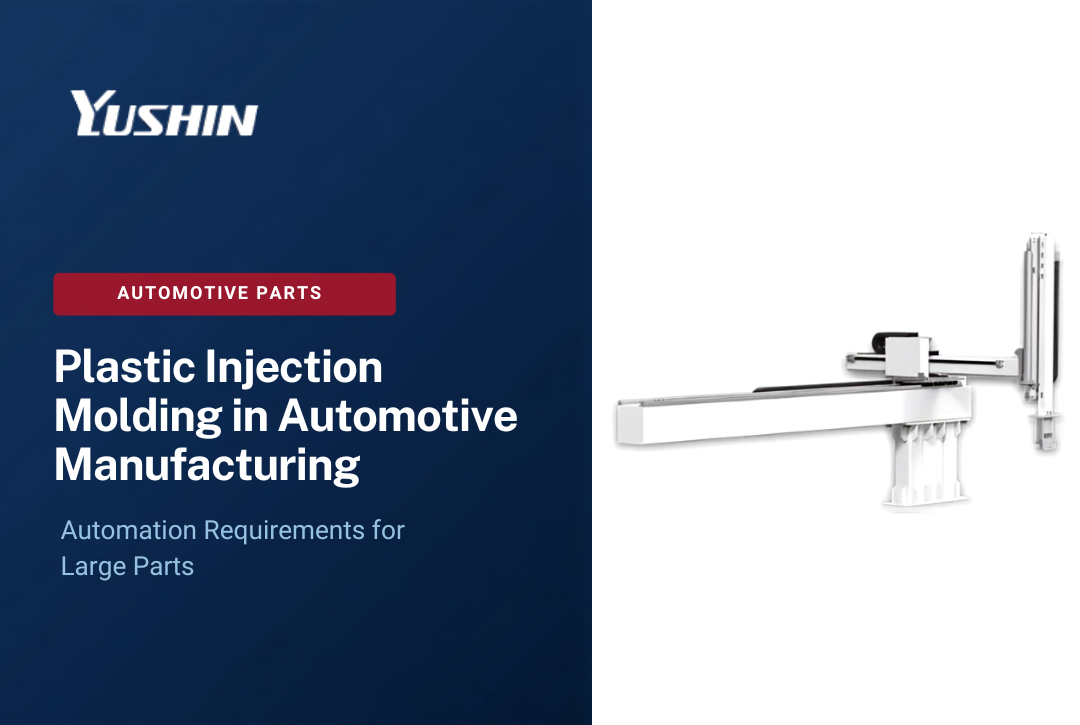
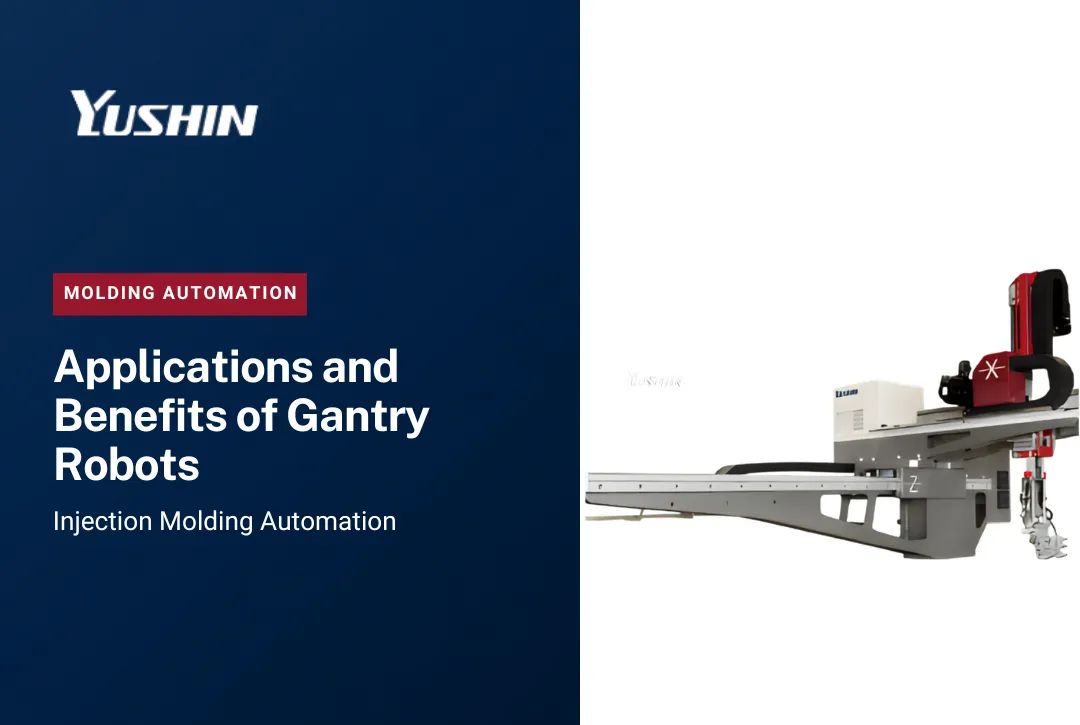
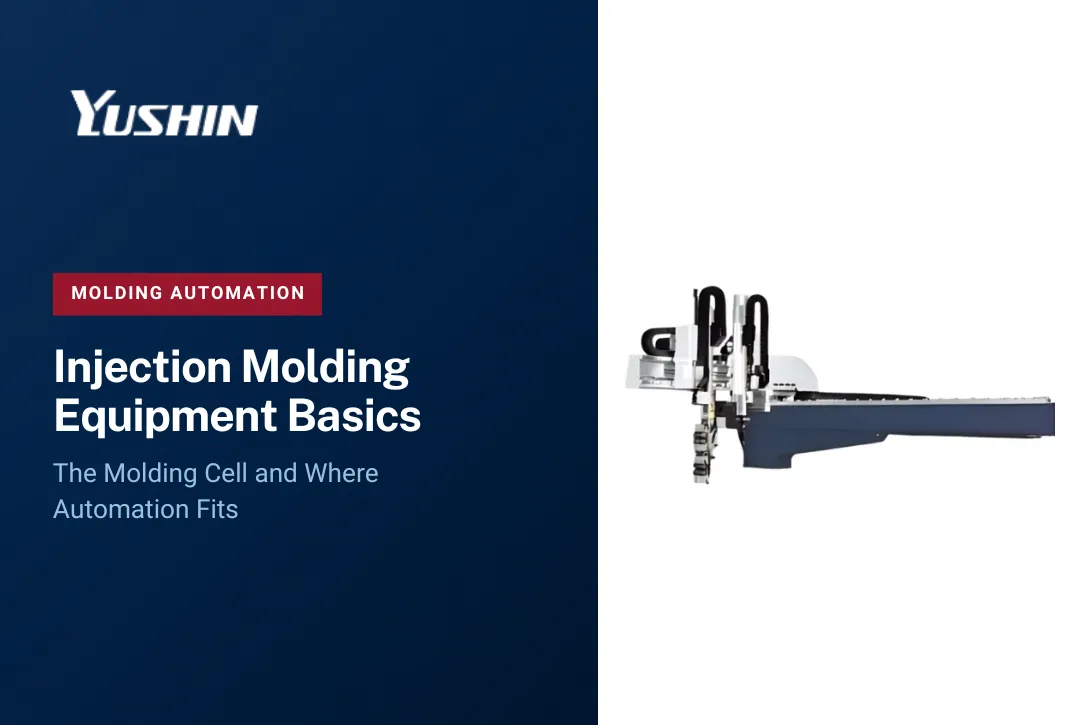
For large-format molding applications, Yushin's MKA-2000S large full-servo traverse robot is designed for this segment:
- For molding machines of 1,500 tons or larger
- Handles 30-50 kg including EOAT
- 3-axis Cartesian traverse robot with movable kick beam
- Two-stage telescopic vertical arm
- Traverse beam adjustable up to 5,000 mm; horizontal reach of 1,800 mm; vertical strokes up to 3,000 mm
- 17% shorter take-out times and 10% shorter cycle times versus prior larger counterparts, per Yushin testing
See the MKA-2000S large robot introduction for verified specifications. Confirm sizing for machines beyond this range with Yushin America directly - specific payload and stroke requirements should always be verified for the exact machine and part before finalizing a robot configuration.
For mid-large applications, the YD2-100130S/D large take-out robot covers 1,000-1,300 tf IMMs with 35 kg payload including EOAT.
EOAT Engineering for Large-Format Parts

EOAT for large parts requires specific engineering attention:
- Multi-point support: Distributing grip and support force across large panels to prevent flexing or sagging during extraction
- Weight-to-stiffness balance: EOAT structures must be rigid enough to control the part without adding excessive weight that reduces effective robot payload capacity
- Non-marking contact for cosmetic surfaces: Especially important on exterior automotive and appliance panels
- Structural analysis for the specific part: Large, custom EOAT designs often require engineering review specific to the part's geometry and material properties
Yushin America designs EOAT as part of complete automation system integration for large-format applications, working through grip point layout, contact surface selection, and structural support specific to each large-part program.
Advanced Applications: Insert Loading and Complex Orientation at Large-Part Scale
Some large-format molding applications involve insert molding or overmolding - structural inserts in automotive parts, for example. These applications require engineered EOAT and typically A/C, B/C, or A/B/C NC servo wrist units for controlled insert orientation, scaled to the payload and reach requirements of large-part robots. Insert loading and overmolding at this scale require deeper engineering review, but they are supported Yushin America application capabilities.
Selection Criteria for Large-Format Automation
- IMM tonnage and platen size: Determines required traverse beam length and stroke
- Part weight plus EOAT weight: The combined payload, which can be substantial for large panels
- Part flexibility and support requirements: Determines EOAT contact point distribution
- Cosmetic sensitivity: Drives EOAT contact surface selection
- Cooling time vs. extraction window: Confirm actual available time for the extraction sequence given large-part EOAT movement times
When Large-Format Automation May Require Additional Engineering Review
- Extremely large or unusually shaped parts: May require custom EOAT engineering beyond standard configurations.
- New program launches with unverified mold stability: Process and mold qualification should be stabilized before finalizing automation and EOAT design for large-format applications.
- Very low production volume on large machines: Even at large scale, automation payback should be evaluated against actual production volume and program duration.
Implementation and Support
Yushin America provides installation, EOAT engineering, operator training, field service, and parts support for large-format automation systems across North America.
- 24/7 phone support: 888-707-6268
- Over $1.3M in spare parts inventory; over $2M in pre-assembled robot module inventory
- Yushin University: Yushin robot training and programming
- Yushin America field service and support
Frequently Asked Questions
Does Yushin America manufacture injection molding machines? No. Yushin America does not manufacture or sell injection molding machines, including large-format machines. Yushin's role is the take-out robot, EOAT, and automation layer that operates around the IMM, regardless of machine size.
Why does part extraction get harder as injection molding machines get larger? Larger machines require longer robot traverse and stroke distances, heavier combined part-and-EOAT payloads, and EOAT designs that can support large panels without flexing or sagging. Cosmetic protection also becomes more demanding simply due to the larger surface area exposed to potential contact damage.
What robot does Yushin recommend for large-format injection molding? The MKA-2000S large full-servo traverse robot is designed for machines of 1,500 tons or larger, handling 30-50 kg including EOAT. Confirm sizing for your specific machine and part with Yushin America.
How does EOAT design change for very large molded parts? Large-part EOAT requires multi-point support to prevent part flexing, a weight-to-stiffness balance to preserve effective payload capacity, and non-marking contact surfaces for cosmetic applications. Custom structural EOAT engineering is often required for large or unusually shaped parts.
Can Yushin support insert loading on large-format molding machines? Yes. Insert loading and overmolding on large parts are supported Yushin America capabilities, using engineered EOAT and NC servo wrist units scaled to the payload and reach requirements of large-part take-out robots. This requires application-specific engineering review.
Is a bigger injection molding machine always harder to automate? Generally yes, in the sense that larger machines require more capable automation - longer strokes, higher payload, more careful EOAT design. But cooling time on large parts can also create a longer extraction window, which partially offsets the added complexity of larger, slower EOAT movements.
Conclusion
As injection molding machines scale up to produce larger single-shot parts, the automation challenge scales up with them - longer traverse distances, heavier combined payloads, part deflection risk, and cosmetic protection at a larger surface area. Yushin America's MKA-2000S and engineered EOAT are built specifically to address these large-format automation requirements.
If your plant is running or planning large-format injection molding and facing part damage, cosmetic rejects, or extraction consistency challenges, contact Yushin America to discuss the right large take-out robot and EOAT configuration for your machine and part.