
Precision plastic injection molding produces parts with tight dimensional tolerances, controlled cosmetic surfaces, and consistent repeatability across production runs—common in medical devices, electronics, automotive components, and other high-tolerance applications. Achieving precision starts with mold design and process control, but it does not end there. How a part is extracted from the mold and handled afterward directly affects whether that precision survives to the finished, packaged product. Yushin America has supported precision molding applications with take-out robots and engineered EOAT designed to protect part quality through the extraction and handling process.
What Makes Injection Molding "Precision"?

Precision injection molding refers to production of parts with tight dimensional tolerances, controlled surface finish, and high repeatability from part to part and shot to shot. Common characteristics:
- Tight dimensional tolerances, often measured in thousandths of an inch or fractions of a millimeter
- Controlled cosmetic surface requirements—no marking, scuffing, or visible defects
- High shot-to-shot repeatability across long production runs
- Often small or intricate part geometry, especially in medical and electronics applications
- Strict quality documentation and traceability requirements
Precision is established by mold design, material selection, and process control (injection speed, pressure, cooling, temperature). Automation's role is protecting that precision through extraction, handling, and placement—not replacing the molding process itself.
How Part Handling Affects Precision After Molding

A precisely molded part can still fail quality requirements if it is handled inconsistently after ejection. Common handling-related precision risks:
- Dimensional distortion from grip force: Excessive or uneven EOAT grip pressure can deform a part immediately after ejection, while it is still warm and dimensionally less stable.
- Cosmetic damage from contact or drag: Parts dragged across mold surfaces or gripped at cosmetic contact points introduce marks and scuffs that fail visual inspection.
- Placement variation: Inconsistent placement orientation on downstream conveyors or fixtures can cause misalignment in subsequent assembly or inspection steps.
- Cooling distortion from inconsistent timing: Parts removed at inconsistent points in the cooling cycle may cool unevenly, affecting final dimensional accuracy.
Manual handling introduces variability in all of these areas—grip force, contact point, timing, and placement orientation all vary operator to operator and cycle to cycle. This is precisely where automation adds the most value in precision molding applications.
How Take-Out Robots Protect Precision

A take-out robot performs the same extraction sequence on every cycle: same entry path, same grip point, same retraction timing, same placement position. This consistency is the core value automation provides for precision applications:
- Consistent grip force: Servo-controlled EOAT applies the same grip force on every cycle, eliminating the variability of manual handling.
- Consistent contact points: EOAT is engineered to contact the part at defined, non-cosmetic locations every time.
- Consistent timing: The robot extracts the part at the same point in the cycle every time, supporting consistent cooling and dimensional stability.
- Consistent placement: Parts arrive at downstream inspection or assembly stations in the same orientation every cycle, supporting automated inspection and reducing placement-related defects.
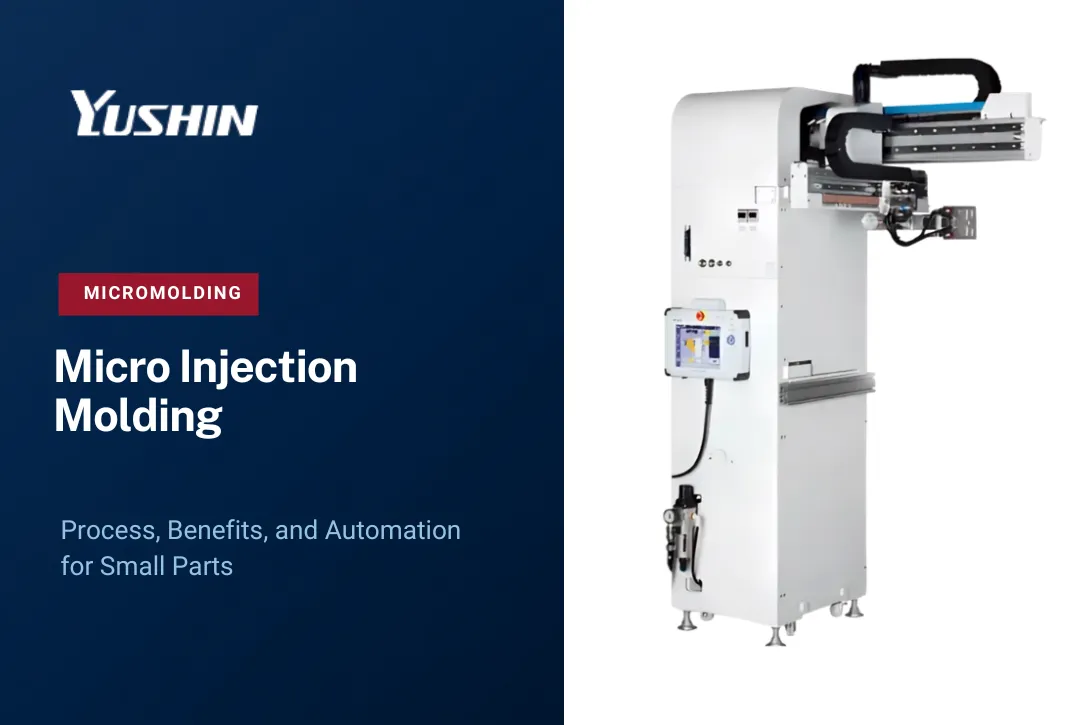
Yushin's YD-0310 compact take-out robot is commonly used in precision applications on small IMMs (30–100 tf)—medical components, electronics parts, and small consumer parts where consistent handling matters as much as consistent molding.
EOAT Design for Precision Applications

EOAT is the direct interface between the robot and the part, and its design is often the deciding factor in whether precision survives the extraction process:
- Contact point selection: EOAT must contact the part at locations that do not affect critical dimensions or cosmetic surfaces.
- Grip force control: Servo-driven or precisely regulated pneumatic grip systems apply consistent, appropriately calibrated force for the specific part material and geometry.
- Multi-cavity consistency: In multi-cavity precision molds, EOAT must apply the same grip force and timing across every cavity—inconsistency between cavities creates part-to-part variation within the same shot.
- Vacuum cup sizing and placement: For vacuum-based EOAT, cup size and placement must be matched to the part surface to avoid deformation, particularly on thin-wall precision parts.
Yushin America designs EOAT as part of complete automation system integration, working through contact point, grip force, and placement requirements specific to each precision application.
Insert Loading and Complex Orientation in Precision Applications
Many precision molding applications—medical device components, electronics connectors, automotive sensors—involve insert molding, where a component must be placed precisely into the mold before each cycle. Precision insert placement is difficult to sustain manually at production rates and introduces risk of insert misplacement or operator exposure to the mold area.
Yushin supports precision insert loading applications through:
- Engineered EOAT designed for the specific insert geometry
- A/C, B/C, or A/B/C NC servo wrist units for controlled, repeatable insert orientation
- Coordinated programming between extraction and orientation axes
Insert molding is an important Yushin America capability in precision applications. It requires deeper engineering review than standard extraction, but the same precision principles apply: consistent, repeatable, servo-controlled motion protects part quality better than manual insertion.
Yushin Product Fit for Precision Molding Applications
| Application | Yushin solution |
|---|---|
| Small precision parts, 30–100 tf | YD-0310 compact take-out robot |
| Standard precision take-out, 30–1,300 tf | YD/YD2 Series standard take-out robots |
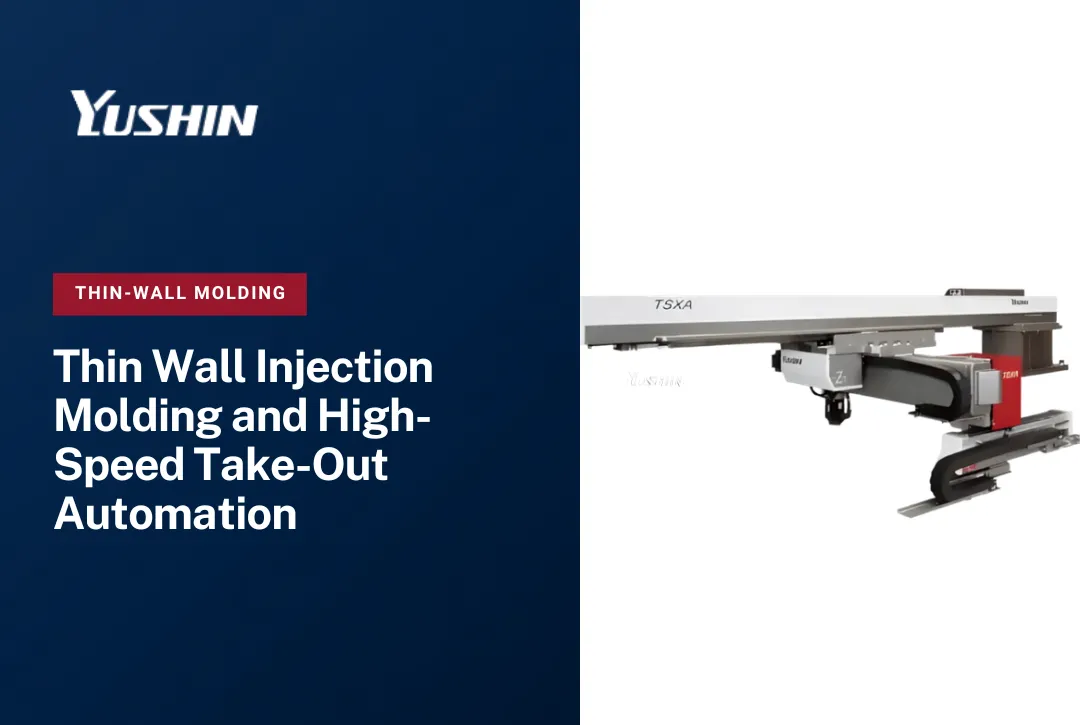
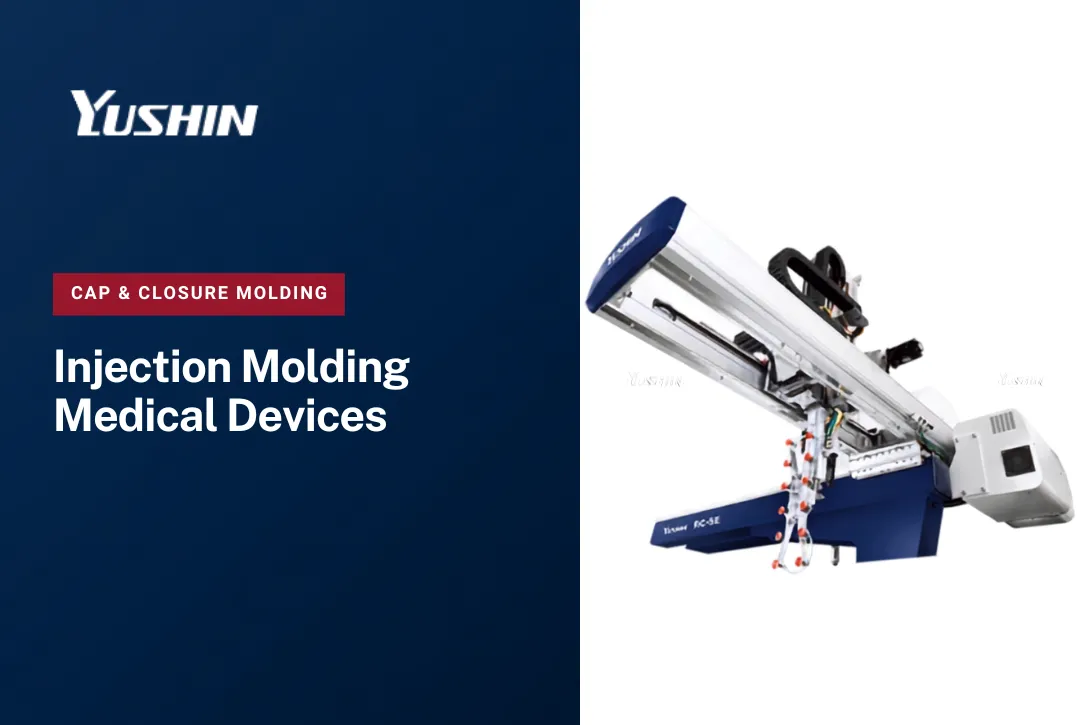
| High-speed precision applications | RC-SE high-end high-speed take-out robot |
| Safety-certified precision cells (medical, electronics) | FRA Series high-end take-out robots |
| Insert loading, complex orientation | NC servo wrist units |
Confirm part tolerance requirements, EOAT design, and cycle time with Yushin America for application-specific configuration.
Selection Criteria for Precision Molding Automation
- Part tolerance and cosmetic requirements: Drives EOAT contact point and grip force specification
- Payload including EOAT: Precision parts are often small, but EOAT for multi-cavity or delicate handling can still be a meaningful portion of total payload
- Cycle time: Precision applications often run at moderate-to-high speed; confirm take-out time fits the available window
- Cavitation: Multi-cavity precision molds require EOAT that applies consistent force across all cavities
- Downstream inspection integration: If parts move to automated vision inspection, placement consistency and orientation must match inspection station requirements
- Insert or overmolding requirements: Determines whether servo wrist configuration is needed
- Documentation and traceability: Confirm whether your quality system requires cycle data logging that ties to specific parts or lots
When Precision Requirements May Need Additional Engineering Review
- Extremely fragile or thin-wall parts: May require specialized EOAT with distributed contact points or reduced grip force, adding engineering time.
- Very tight cosmetic zero-defect requirements: May require EOAT redesign iterations and process validation before production release.
- High-mix precision production: Frequent part changeovers across different precision geometries may require modular EOAT investment to maintain consistency across changeovers.
Implementation and Support
Yushin America provides installation, EOAT engineering, operator training, field service, and parts support for precision molding automation applications across North America.
- 24/7 phone support: 888-707-6268
- Over $1.3M in spare parts inventory with overnight shipping
- Yushin University: Yushin robot training and programming
- Yushin America field service and support
Frequently Asked Questions
How does automation improve precision in injection molding? Automation improves precision by making part extraction, handling, and placement consistent from cycle to cycle. A take-out robot applies the same grip force, contacts the same points, and places parts in the same orientation every time—eliminating the variability that manual handling introduces after the part leaves the mold.
Can automation fix precision problems caused by the molding process itself? No. If dimensional variation is caused by the mold, material, or process parameters, automating extraction will not fix it—it will only ensure consistent handling of parts that already vary. Process and mold issues should be addressed first; automation then protects the precision the process achieves.
What EOAT design considerations matter most for precision parts? Contact point selection (avoiding cosmetic and critical-dimension surfaces), grip force calibration for the specific material and geometry, and multi-cavity consistency are the primary considerations. For thin-wall or fragile precision parts, EOAT design often requires iteration and validation before production release.
Is a small take-out robot sufficient for precision medical or electronics parts? Often yes. Yushin's YD-0310 is designed for 30–100 tf machines with a 3 kg payload, commonly used for small precision parts in medical and electronics applications. The right robot size depends on part weight, EOAT weight, and cycle time—confirm with Yushin America for your specific application.
Does insert molding complicate precision automation? It adds engineering complexity but is a well-supported Yushin capability. Insert loading requires consistent, repeatable placement—which servo-controlled robots and NC servo wrist units are well suited to deliver, arguably more consistently than manual insertion for precision applications.
How do I know if my precision application needs custom EOAT? If your part has tight cosmetic requirements, unusual geometry, multi-cavity handling needs, or fragile wall sections, custom EOAT is likely needed. Standard EOAT works for straightforward, robust part geometries. Discuss your specific part with Yushin America's engineering team to determine EOAT requirements.
Conclusion
Precision in injection molding is established by the mold and process—but it survives or fails based on how consistently the part is handled after ejection. Take-out robots and properly engineered EOAT protect that precision through consistent grip force, contact points, timing, and placement.
If your precision molding application is facing cosmetic rejects, dimensional variation from handling, or insert placement challenges, contact Yushin America to discuss the right take-out robot and EOAT configuration to protect your part quality through extraction and downstream handling.