
High speed injection molding pushes cycle times down through faster injection speeds, optimized cooling, and higher cavitation - and every second saved in the molding cycle puts more pressure on the take-out robot to keep pace. A high-speed molding process is only as fast as its slowest step, and if the take-out robot cannot extract parts within the available window, the process improvements upstream do not translate into actual output gains. Yushin America builds high-speed take-out robots specifically for this constraint.
What Defines High Speed Injection Molding?

High speed injection molding refers to processes optimized for short cycle times, typically through:
- Faster injection speeds: Higher fill rates to reduce the injection phase of the cycle
- Optimized cooling design: Reduced wall thickness and improved mold cooling channel design to shorten the cooling phase
- Higher cavitation: More cavities per shot to increase parts-per-cycle output
- Thin-wall part design: Wall thicknesses often under 1.5mm, common in packaging, medical, and electronics applications
Cycle times for high-speed applications can run from under 5 seconds for thin-wall packaging to the 10-15 second range for standard high-output parts, compared to 20-30+ seconds for many standard molding applications.
Why Take-Out Speed Becomes the Constraint

In a standard molding cell, the take-out robot has a comfortable time window relative to the overall cycle. As cycle times compress, that window shrinks - and at some point, the robot's extraction, retraction, and clearance sequence becomes the limiting factor on how fast the cell can actually run.
Application engineering note: A common mistake is optimizing injection speed, cooling, and cavitation without evaluating whether the existing take-out robot can keep pace. If the robot's take-out sequence exceeds the available window, the mold has to wait for the robot - meaning all the process-side speed improvements produce no net cycle time gain.
What High-Speed Take-Out Requires

A take-out robot suited for high-speed molding needs several characteristics beyond a standard platform:
- Fast axis acceleration and deceleration: Servo-driven axes optimized for quick starts and stops over short strokes
- Vibration control: High-speed motion without vibration control causes positioning errors and part-placement inconsistency
- Reduced weight, high rigidity: Lighter robot structures reduce inertia, allowing faster motion without sacrificing positional accuracy
- Fast-settling EOAT: EOAT that grips and releases quickly and consistently, without the settling time that slower tooling requires
- Coordinated timing with the IMM: The robot's cycle must be synchronized precisely with mold-open and part-ejection timing - even small timing misalignment compounds at high cycle rates
Yushin High-Speed Take-Out Robot Solutions
HST-150 / HST-250 — Super-High-Speed Take-Out Robots
Purpose-built for the fastest cycle applications:
- Target clamping force range: 100–300 tf
- 3-axis, dual-support, reduced-height configuration
- Take-out times as fast as 0.27 sec proven during live molding
- 13% lighter and 25% faster than previous models
- HST-150 payload: 3 kg; HST-250 payload: 5 kg
Appropriate for thin-wall packaging, medical, and other applications where cycle times run under 10 seconds. (HST-150/250 source)
HST-400S/D/DS — High-Speed Take-Out Robot
For medium-tonnage high-speed applications:
- Target IMM clamp capacity: 280–450 tf
- Payload: 10 kg
- All-axis servo-driven with vibration control
- Low-posture double-speed mechanism
- 9.2% faster speeds and 25.4% lighter construction vs. prior models
- 98.6% reduced settling time vs. measured prior models
Appropriate for higher-payload high-speed applications where a larger EOAT or higher cavitation requires more capacity than the HST-150/250 series provides. (HST-400 source)
For high-speed injection molding applications, Yushin's HST platform should be positioned as a purpose-built high-speed take-out robot. Its robust structural design helps increase rigidity and maintain stable, repeatable motion under fast-cycle operating conditions. This is not simply a stock robot with larger motors, but a platform engineered specifically for high-speed molding performance.
RC-SE — High-End High-Speed Take-Out Robot
For high-speed applications across a broader IMM range where energy efficiency and predictive maintenance also matter:
- Targets IMMs from 30 to 1,300 tf
- Smart ECO Vacuum: up to 78% reduction in air consumption
- Long Life Mode: 5% power reduction in Yushin in-house testing
- Vibration control and predictive maintenance positioning
The RC-SE high-end high-speed take-out robot fits applications where speed requirements are significant but not at the extreme end HST-150/250 is designed for, and where operating cost reduction is also a priority.
TSXA — Side-Entry Robot for High-Speed Applications
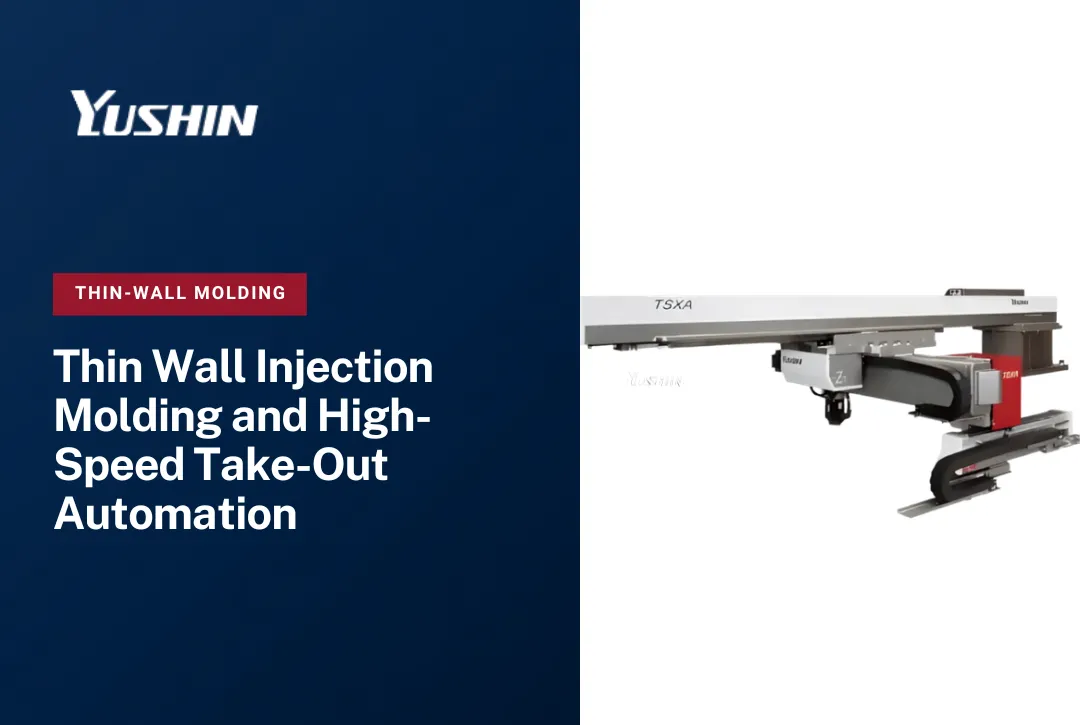
Where top-entry clearance is limited or side-entry offers a faster mold-access path for a specific cell layout, Yushin's TSXA side-entry robot is available for high-speed molding applications.
Selecting the Right High-Speed Take-Out Robot
| Factor | What it determines |
|---|---|
| Cycle time / available extraction window | Whether HST-150/250, HST-400, or RC-SE fits the speed requirement |
| IMM clamp force | Narrows the robot model range |
| Part weight + EOAT weight | Payload requirement, affecting which model has sufficient capacity |
| Cavitation | Higher cavitation increases EOAT complexity and often payload |
| Energy/operating cost priorities | Points toward RC-SE if air/power efficiency matters alongside speed |
| Mold access geometry | Top-entry vs. side-entry (TSXA) based on cell layout |
Downstream Automation Must Match Take-Out Speed

A fast take-out robot feeding a slower downstream process just relocates the bottleneck. For high-speed applications with significant output volume, end-of-line automation should be sized to match:
Yushin's PA Series compact palletizing robot - with the PA-40 achieving up to 420 boxes per hour - is designed to keep pace with high-output molding cells at the packaging and palletizing stage.
Orientation Requirements in High-Speed Applications
Applications requiring insert loading, overmolding, or complex part orientation need separate engineering review. Servo-wrist capability should not automatically be specified for an HST or another HS Series high-speed robot, because additional wrist mass and movement requirements may affect the speed, rigidity, settling behavior, and cycle-time priorities of the application.
The appropriate orientation method depends on the molded part, EOAT design, required take-out time, mold-access sequence, and downstream placement requirements. Yushin America should evaluate these factors before recommending a robot, EOAT, or orientation configuration for a high-speed molding cell.
When High-Speed Take-Out May Not Be Necessary
- Cycle times already within standard robot capability: If your process cycle time provides comfortable margin for a standard take-out robot, investing in a high-speed platform adds cost without proportional benefit.
- Low-volume, infrequent runs: The premium for high-speed capability is best justified by high-volume, sustained production - not occasional short runs.
- Downstream bottlenecks that limit actual throughput regardless of take-out speed: If packaging or inspection stations cannot keep pace, upgrading only the take-out robot will not increase actual output.
Implementation and Support
Yushin America provides installation, EOAT engineering for high-speed applications, operator training, field service, and parts support across North America.
- 24/7 phone support: 888-707-6268
- Over $1.3M in spare parts inventory with overnight shipping
- Yushin University: Yushin robot training and programming
- Yushin America field service and support
Frequently Asked Questions
What cycle times qualify as "high speed" in injection molding? High-speed applications commonly run cycle times from under 5 seconds (thin-wall packaging) to 10-15 seconds (standard high-output parts), compared to 20-30+ seconds for many standard applications. The specific threshold depends on part size, wall thickness, and cavitation.
How fast can a take-out robot extract a part? Yushin's HST-150/250 series achieves take-out times as fast as 0.27 seconds in live molding. The required take-out speed depends on your specific cycle time and the portion of that cycle available for extraction - confirm with Yushin America for your application.
Why does vibration control matter for high-speed take-out robots? Vibration control matters because the robot must settle quickly after high-speed acceleration and deceleration before the EOAT can engage, extract, or place the part with the positional accuracy needed for reliable part handling. The HST Series was engineered specifically around this challenge. Yushin uses Optimum Design to reduce moving mass, a CFRP arm with enhanced vibration-damping characteristics, and additional anti-vibration measures to suppress oscillation quickly after motion. Yushin reports a 98.6% reduction in settling time for the HST design, allowing robot-step timers to be shortened while maintaining stable high-speed part takeout.
Can insert loading work in a high-speed molding cell? Insert loading or overmolding may be possible in a high-speed molding cell, but the application requires detailed engineering review. A servo wrist should not automatically be specified for an HST or HS Series robot, since additional wrist mass and movement may affect rigidity, take-out speed, settling behavior, and total cycle time. Yushin America should evaluate the part, EOAT, orientation requirements, mold-access sequence, and available extraction window before recommending the final configuration.
Does a faster take-out robot always improve overall cycle time? Only if take-out time was actually the constraint. If a downstream station - packaging, inspection, or palletizing - is the actual bottleneck, upgrading the take-out robot alone will not increase overall output. Evaluate the full cell before investing in a high-speed platform.
What is the difference between the HST-150/250 and RC-SE for high-speed applications? The HST-150/250 series is optimized for the fastest possible take-out times on 100-300 tf machines. The RC-SE covers a broader IMM range (30-1,300 tf) and adds energy efficiency features (Smart ECO Vacuum, Long Life Mode) and predictive maintenance positioning alongside high-speed capability. Confirm which fits your specific tonnage and priority with Yushin America.
Conclusion
High speed injection molding techniques reduce cycle time on the process side, but those gains only translate into real output improvements if the take-out robot can keep pace. Yushin America's HST-150/250, HST-400, and RC-SE platforms are built specifically for the extraction speed, vibration control, and EOAT timing that high-speed molding cells require.
If your high-speed molding cell is limited by take-out time, inconsistent placement at speed, or a downstream bottleneck, contact Yushin America to discuss the right high-speed take-out robot and automation configuration for your production requirements.