
The Cartesian robots market is growing, but market growth numbers alone do not help a plant manager decide whether to automate a molding cell. The more useful question is: what is driving demand, and what does it mean for injection molders evaluating take-out robot investments right now? Yushin America has supported plastic injection molding automation in North America since 1988, and the trends shaping the Cartesian robot market are the same pressures Yushin's customers are navigating on the production floor.
What Is Driving Cartesian Robot Market Growth?
Multiple independent forces are increasing demand for Cartesian and linear-axis robots in manufacturing. For injection molders, these forces are not abstract—they show up as daily production decisions.
Labor Shortage and Operator Coverage
Manufacturing labor shortages are a persistent driver of automation investment. According to the Manufacturing Institute and Deloitte, the U.S. manufacturing sector could face a shortfall of 2.1 million unfilled jobs by 2030 if current trends continue. (Manufacturing Institute / Deloitte, 2021 Skills Gap Study)
For injection molding plants, this translates to difficulty staffing multiple-shift operations, covering operator absences, and maintaining consistent output during peak periods. A take-out robot does not call in sick, does not fatigue across a 12-hour shift, and does not vary its grip force between parts. Cartesian take-out robots directly address the coverage and consistency problems created by labor shortages.

Reshoring and Domestic Manufacturing Investment
North American manufacturing reshoring has accelerated investment in automation-ready production capacity. Plants adding new injection molding machines—or bringing production back from offshore—need automation systems that can be installed, commissioned, and supported locally. Domestic automation suppliers with local service infrastructure have a practical advantage in these programs.
Yushin America operates from a 70,000 sq. ft. facility in Cranston, Rhode Island, with service offices across North America and Mexico. When reshoring timelines require fast robot commissioning and responsive local support, that infrastructure matters.
High-Speed and High-Precision Molding Demand
End markets—packaging, medical devices, automotive components, and electronics—continue to push for shorter cycle times and tighter part tolerances. Thin-wall packaging applications run cycles under 5 seconds. Medical part production requires part-to-part dimensional and cleanliness consistency that manual handling cannot reliably provide.
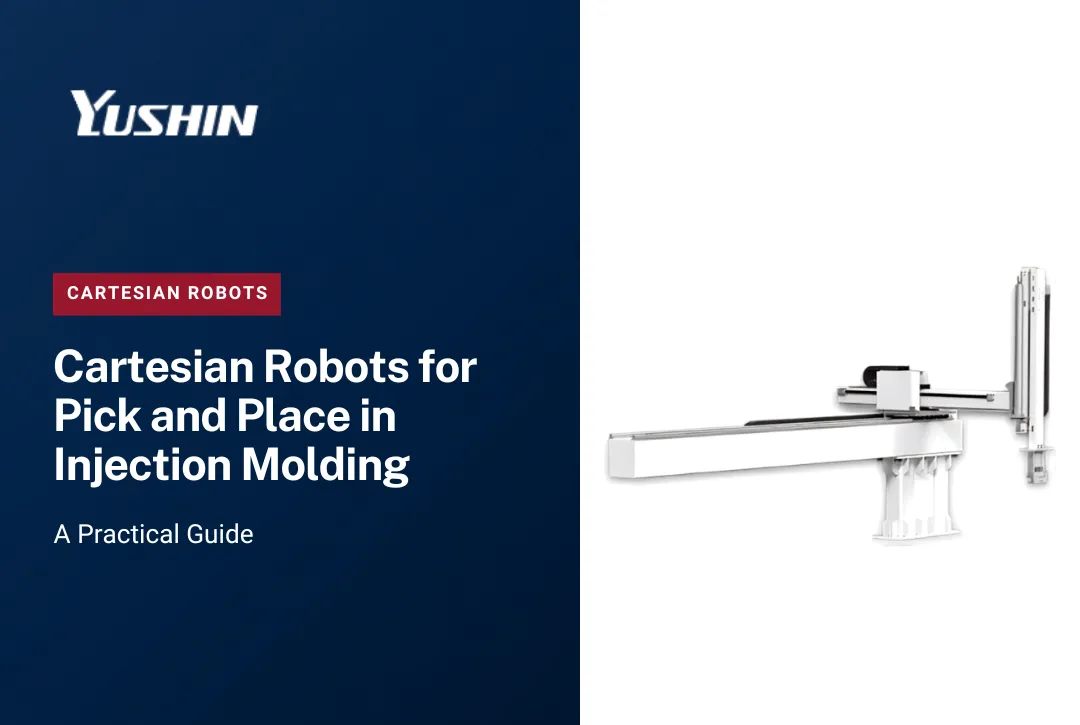
Cartesian robots move along linear X, Y, and Z axes, allowing direct point-to-point motion between programmed positions. In injection molding takeout, that direct movement can reduce unnecessary travel compared with the arcing motion of a six-axis articulated robot, helping the robot enter and clear the mold area quickly and supporting shorter takeout times.
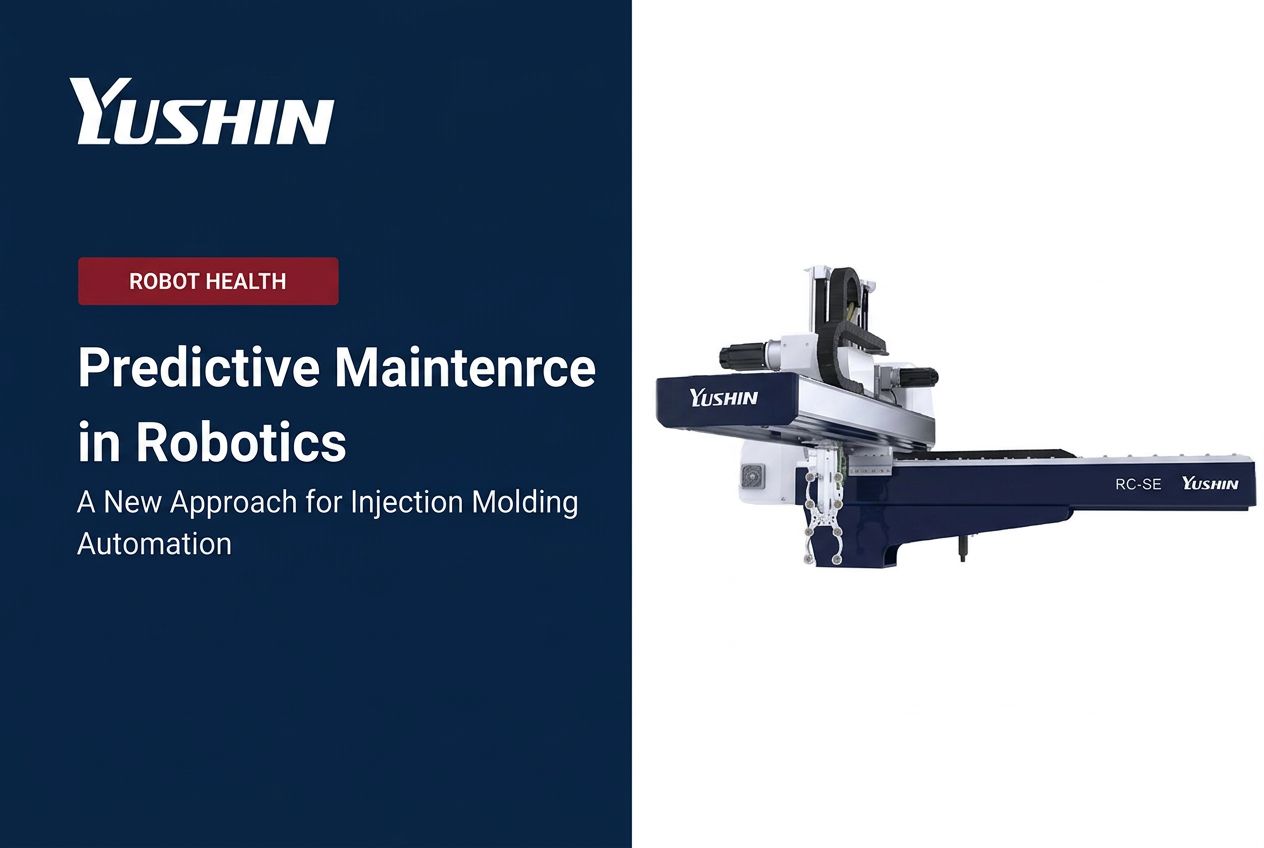
This precision and speed demand favors Cartesian take-out robots with vibration-controlled axes, high settling speed, and servo-driven accuracy. Yushin's RC-SE high-end high-speed take-out robot targets IMMs from 30 to 1,300 tf and includes active vibration control and predictive maintenance features designed for demanding, high-output molding environments.
Energy and Air Efficiency
Energy cost pressure is increasing across manufacturing. Compressed air is one of the most expensive utilities in a molding plant—and conventional robot vacuum circuits consume air continuously during the take-out cycle.
The RC-SE's Smart ECO Vacuum technology reduces air consumption by up to 78% compared to conventional vacuum systems, based on Yushin in-house testing. At scale—across multiple machines running multiple shifts—this reduction has meaningful operating cost impact. The RC-SE's Long Life Mode also reduces power consumption by approximately 5% in Yushin testing. These efficiency features are becoming selection criteria rather than nice-to-have options for plants managing energy costs.
Predictive Maintenance and Uptime Management
Unplanned downtime is the most expensive event in a molding plant. A mold jam, a stuck part, or a robot fault that is not caught early can cause mold damage, scrap, and extended production delays. Modern Cartesian take-out robots increasingly include monitoring functions that track axis performance, vibration signatures, and cycle anomalies—alerting operators to developing issues before they cause failures.
Yushin's RC-SE and FRA Series robots include predictive maintenance positioning. This capability—trend monitoring of robot performance data—supports proactive maintenance scheduling rather than reactive emergency service. For plants running 24/7 or near-continuous production, predictive maintenance is a tangible downtime-reduction tool.

Automation of Large-Part and High-Tonnage Applications
Large injection molded parts—automotive structural components, appliance panels, industrial enclosures—present handling challenges that manual labor cannot address safely or consistently at production rates. The market for Cartesian traverse robots capable of handling 30 kg or more at IMMs of 1,500 tons and above is growing as automotive and appliance molding investment increases.
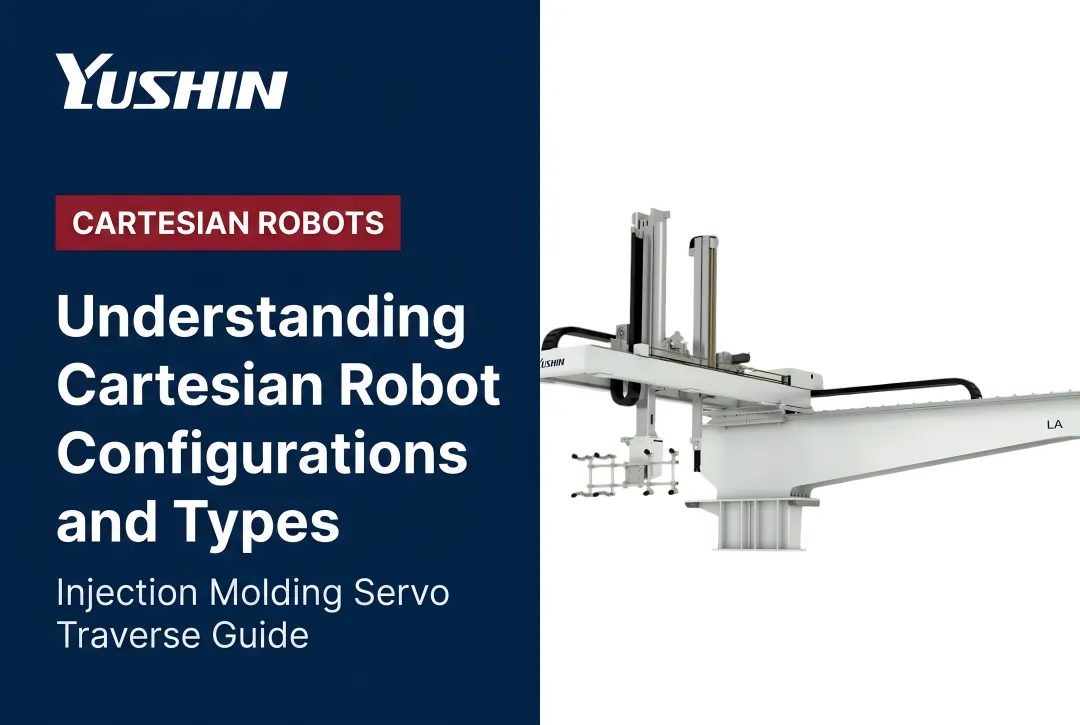
Yushin's MKA-2000S is a 3-axis Cartesian traverse robot designed specifically for this segment. It handles 30–50 kg including EOAT, with a traverse beam adjustable up to 5,000 mm and vertical strokes up to 3,000 mm. Yushin testing showed 17% shorter take-out times and 10% shorter cycle times versus prior large-robot counterparts. See the MKA-2000S introduction for details.

What Injection Molders Should Take From These Trends
Automation Investment Is Accelerating—Waiting Costs More
Plants that delay automation investments to avoid capital spending are increasingly finding that the cost of labor coverage, scrap, and downtime exceeds the cost of the robot. A Cartesian take-out robot on a standard molding cell typically reaches payback in one to three years, depending on shift count, labor cost, and cycle time. That payback window is shortening as labor costs increase.
Service Capability and Parts Availability Are as Important as Robot Specs
A robot that cannot be serviced quickly when it fails is a downtime risk, not a productivity asset. As automation demand grows, the difference between suppliers with deep parts inventory and local technician coverage—and those without—becomes visible the first time a robot needs emergency service.
Yushin America maintains over $1.3M in spare parts inventory and over $2M in pre-assembled robot module inventory, with overnight shipping available. Service offices span Cranston RI, Corona CA, Columbus OH, San Antonio TX, Downers Grove IL, Plainfield IL, Atlanta GA, and León, Guanajuato, Mexico. Yushin replacement parts and field service support the full product line.
Training and Operator Readiness Are Automation Bottlenecks
Installing a robot is not the same as running it well. Operator and maintenance training are frequently the difference between a robot that operates efficiently and one that causes more downtime than it prevents. Yushin University, Yushin America's online training platform, provides self-paced operator and technician training with refresher access and certificates of completion. Yushin robot training and programming provides details.
Not Every Trend Applies to Every Plant
Market trend articles are written at the industry level. Not every trend applies to every plant. Low-volume molding operations, highly variable product mixes, and plants with adequate labor supply may not face the same automation urgency as high-volume, labor-constrained, multi-shift operations. A honest ROI analysis based on your specific production data is a better guide to automation timing than market forecast numbers.
Yushin Products Aligned With Market Trends
| Trend | Yushin Product / Capability |
|---|---|
| Labor shortage / coverage | YD/YD2 Series standard take-out robots — consistent, unattended operation |
| High-speed / precision molding | RC-SE high-end high-speed take-out robot — vibration control, predictive maintenance |
| Energy / air efficiency | RC-SE Smart ECO Vacuum — up to 78% air reduction |
| Safety-certified automation | FRA Series high-end take-out robots — Safety Category 3, EN/ISO 10218 |
| Large-part / high-tonnage applications | MKA-2000S — 1,500+ tf, 30–50 kg payload |
| End-of-line palletizing | PA Series compact palletizing robot — 420 boxes/hr, PA-40 at 40 kg payload |
Frequently Asked Questions
Is the Cartesian robots market growing? Yes. Demand for Cartesian and linear-axis robots is growing across manufacturing sectors, driven by labor shortage, precision requirements, energy efficiency mandates, and reshoring investment. For injection molding specifically, take-out robot adoption is increasing as plants automate manual part-extraction operations. Confirm market-size data with authoritative industry research sources.
What is driving injection molding automation investment? The primary drivers are labor shortage and coverage gaps, cycle-time pressure, part-quality consistency requirements, energy cost reduction, and uptime improvement through predictive maintenance. ROI for take-out robot automation typically falls within one to three years in moderate- to high-volume production environments.
How does energy efficiency affect Cartesian robot selection for injection molding? Compressed air consumption is a significant operating cost in molding plants. Take-out robots that use conventional vacuum circuits consume air continuously during extraction. Robots with smart vacuum control—like Yushin's RC-SE with Smart ECO Vacuum—reduce air consumption by up to 78%, lowering operating costs over the robot's service life.
What role does predictive maintenance play in Cartesian robot selection? Predictive maintenance functions monitor robot axis performance, vibration, and cycle data to identify developing issues before they cause failures. For plants running high-volume, multi-shift production, this capability reduces unplanned downtime and supports proactive maintenance scheduling. Yushin's RC-SE and FRA Series robots include predictive maintenance positioning.
How do I evaluate automation ROI for a Cartesian take-out robot? Start with labor cost per shift, number of shifts, scrap rate from manual handling, and downtime frequency. Compare against robot amortization cost, EOAT cost, installation cost, and ongoing parts/service cost. For a specific payback analysis, contact Yushin America to review your production data.
Conclusion
Cartesian robot market growth reflects real production-floor pressures: labor shortages, precision requirements, energy costs, and the need for uptime-reliable automation. For injection molders, these trends translate directly into decisions about when to automate, which robot to select, and which supplier can support the system over its service life.
Yushin America designs, builds, and supports Cartesian take-out robots and downstream automation for plastic injection molders across North America. If your plant is facing the pressures driving automation market growth—labor gaps, cycle-time pressure, scrap from manual handling, or energy cost reduction goals—contact Yushin America to discuss the right take-out robot configuration and service support for your operation.