
What Is Predictive Maintenance in an Injection Molding Cell?

Predictive maintenance uses monitored equipment data—vibration, cycle timing, temperature, sensor readings—to detect developing problems before they cause a failure. It differs from reactive maintenance (fixing equipment after it breaks) and preventive maintenance (servicing on a fixed schedule regardless of actual condition).
In a molding cell, predictive maintenance can apply to:
- The injection molding machine (hydraulic system, screw/barrel wear, clamp mechanism)
- The take-out robot (axis performance, vibration signatures, cycle timing anomalies)
- The controller and safety systems
- Downstream automation (conveyors, palletizing systems)
Each piece of equipment has different failure modes and different monitoring approaches. This article focuses primarily on the robot and automation layer, where Yushin America's expertise applies directly.
Why IMM Maintenance Matters as Context
The injection molding machine is subject to significant mechanical and thermal stress—repeated clamping cycles, hydraulic or electric drive wear, screw and barrel wear from material processing, and heater band degradation. IMM manufacturers and their service networks typically provide maintenance guidance, monitoring systems, and service support for the machine itself.
Yushin America does not sell or service injection molding machines. If your plant needs IMM-specific predictive maintenance support, that should come from your IMM manufacturer or their authorized service network. Yushin's role is the automation layer that surrounds the IMM—not the machine itself.
Predictive Maintenance for Take-Out Robots

Take-out robots run every cycle, all day, across every shift the molding cell operates. Robot downtime stops the cell just as effectively as IMM downtime. Predictive maintenance for the robot side of the cell focuses on:
- Axis performance monitoring: Tracking servo motor load, positioning accuracy, and settling time to identify developing mechanical wear before it causes a fault
- Vibration monitoring: Detecting abnormal vibration signatures that indicate bearing wear, loose mounting, or structural fatigue
- Cycle timing anomalies: Flagging cycles that deviate from normal timing patterns, which can indicate developing mechanical issues, EOAT wear, or vacuum system degradation
- Vacuum and pneumatic system monitoring: Tracking air consumption and vacuum performance to identify leaks or degrading seals before they cause a failed pick
Yushin RC-SE Predictive Maintenance Features
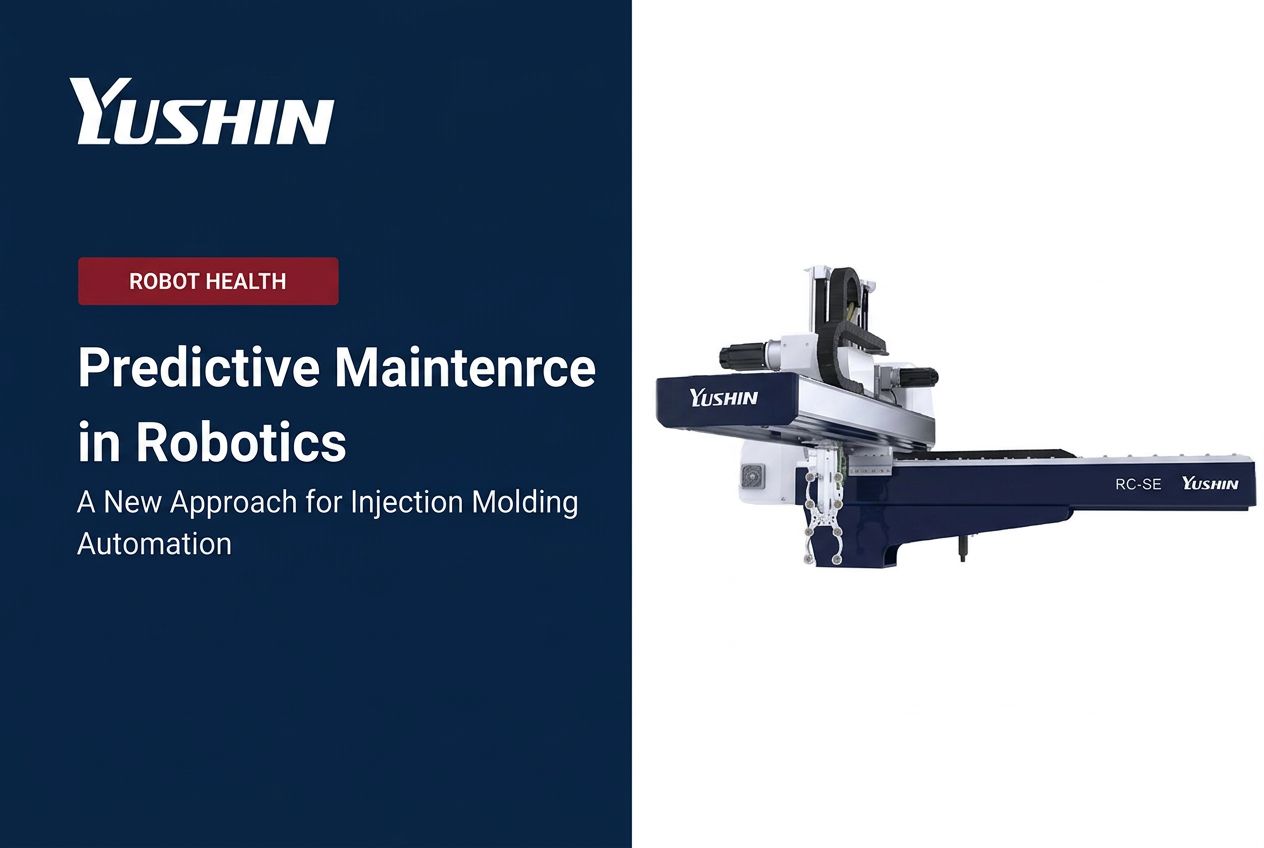
Yushin's RC-SE high-end high-speed take-out robot includes predictive maintenance positioning as part of its feature set, alongside vibration control for high-speed operation. For plants running high-cycle-count applications where robot downtime has significant production impact, these monitoring capabilities support proactive maintenance scheduling rather than reactive emergency repair.
Yushin's FRA Series high-end take-out robots similarly incorporate advanced monitoring positioning appropriate for safety-critical, high-variety production environments.
Warning Signs of Developing Robot Issues

Watch for these indicators that a take-out robot may need maintenance attention before a failure occurs:
- Increasing cycle time: Gradual cycle time increases can indicate developing axis wear, controller lag, or mechanical resistance
- Inconsistent part placement: Parts arriving at downstream stations in slightly different positions cycle to cycle can indicate axis positioning drift
- Unusual noise or vibration: New or increasing noise from robot axes during operation often precedes mechanical failure
- Vacuum or pneumatic performance changes: Reduced grip reliability or increased air consumption indicates seal or valve degradation
- Recurring minor faults: Frequent minor controller faults that clear on reset, rather than a single major failure, often indicate a developing issue worth investigating before it escalates
Building a Maintenance Schedule for Take-Out Robot Automation

A structured maintenance approach for take-out robots typically includes:
| Frequency | Typical tasks |
|---|---|
| Daily | Visual inspection of EOAT, air lines, and safety guarding; operator observation of cycle consistency |
| Weekly | Vacuum/air pressure check, EOAT wear inspection, controller alarm log review |
| Monthly | Axis lubrication (per manufacturer schedule), connector and cable inspection, safety system function test |
| Annual | Comprehensive axis calibration, full mechanical inspection, controller backup and software review |
Yushin America's preventive maintenance services can be scheduled as part of a structured maintenance program, supplementing in-house maintenance staff with periodic professional inspection.
Where Yushin America Supports Maintenance and Uptime
| Support area | Yushin's role |
|---|---|
| Predictive maintenance monitoring | RC-SE and FRA Series built-in positioning |
| Preventive maintenance service | Scheduled service visits |
| Emergency repair | Field service, 24/7 phone support |
| Spare parts availability | Over $1.3M in spare parts inventory; overnight shipping |
| Pre-assembled module replacement | $2M in pre-assembled robot module inventory for fast swaps |
| Operator/maintenance training | Yushin University online platform |
Selection Criteria for Uptime-Focused Automation
When evaluating take-out robots with uptime and maintenance in mind:
- Built-in monitoring capability: Does the robot include predictive maintenance features, or does uptime rely entirely on scheduled preventive maintenance?
- Parts availability from the supplier: Confirm spare parts inventory and shipping turnaround before a failure occurs, not after
- Service response time: Confirm field service coverage for your geographic location
- Training availability: In-house maintenance capability reduces dependency on supplier response time for routine issues
- Controller diagnostics: Confirm the controller provides clear alarm and diagnostic information to support faster troubleshooting
When Predictive Maintenance May Not Be Cost-Justified
- Low-criticality applications: If robot downtime has minimal production impact (redundant capacity, low-volume application), the investment in advanced monitoring may not be justified over standard preventive maintenance.
- Very new equipment: Newly installed robots with low cumulative cycle counts may not yet show the wear patterns that predictive maintenance is designed to catch early.
- Applications without production impact from short downtime: If short unplanned stops do not meaningfully affect output (buffer stock, low-volume runs), the ROI case for advanced monitoring is weaker.
Implementation and Support
Yushin America provides preventive maintenance services, field service, parts support, and training to support robot uptime across North America.
- 24/7 phone support: 888-707-6268
- Over $1.3M in spare parts inventory with overnight shipping
- $2M in pre-assembled robot module inventory for fast replacement
- Yushin University: Yushin robot training and programming
- Yushin America field service and support
Frequently Asked Questions
Does Yushin America provide predictive maintenance for injection molding machines? No. Yushin America does not sell or service injection molding machines. Yushin's predictive maintenance relevance is the take-out robot, EOAT, and automation layer of the molding cell. For IMM-specific predictive maintenance, contact your injection molding machine manufacturer or their service network.
What predictive maintenance features does Yushin build into its robots? Yushin's RC-SE high-end high-speed take-out robot and FRA Series high-end take-out robots include predictive maintenance positioning as part of their feature sets, supporting proactive maintenance scheduling based on monitored performance data rather than purely reactive repair.
What are the warning signs that a take-out robot needs maintenance? Increasing cycle time, inconsistent part placement, unusual noise or vibration, changes in vacuum or air pressure performance, and recurring minor controller faults are common early indicators. Addressing these before a full failure reduces unplanned downtime.
How often should a take-out robot receive preventive maintenance? A typical schedule includes daily visual checks, weekly air/vacuum and EOAT inspections, monthly lubrication and safety system testing, and annual comprehensive calibration. Confirm the specific schedule for your robot model with Yushin America.
How does spare parts availability affect robot uptime? When a robot fails, the time to get replacement parts directly determines how long the cell stays down. Yushin America maintains over $1.3M in spare parts inventory and $2M in pre-assembled robot module inventory, with overnight shipping available, to minimize downtime duration when a repair is needed.
Is predictive maintenance worth the investment for every molding cell? Not necessarily. For high-criticality, high-volume applications where robot downtime directly impacts output, predictive maintenance monitoring typically pays for itself through avoided downtime. For low-criticality or buffered applications, standard preventive maintenance may be sufficient. Evaluate based on your specific production impact from unplanned stops.
Conclusion
Predictive maintenance in an injection molding cell covers both the molding machine and the automation around it—but they require different expertise and different suppliers. Yushin America's role is the robot, EOAT, and controller layer: built-in predictive maintenance features on select robot models, preventive maintenance services, fast parts availability, and responsive field service.
If your molding cell is experiencing unplanned robot downtime, inconsistent cycle performance, or you want to build a more proactive maintenance program around your take-out robot automation, contact Yushin America to discuss the right monitoring, service, and parts support for your operation.