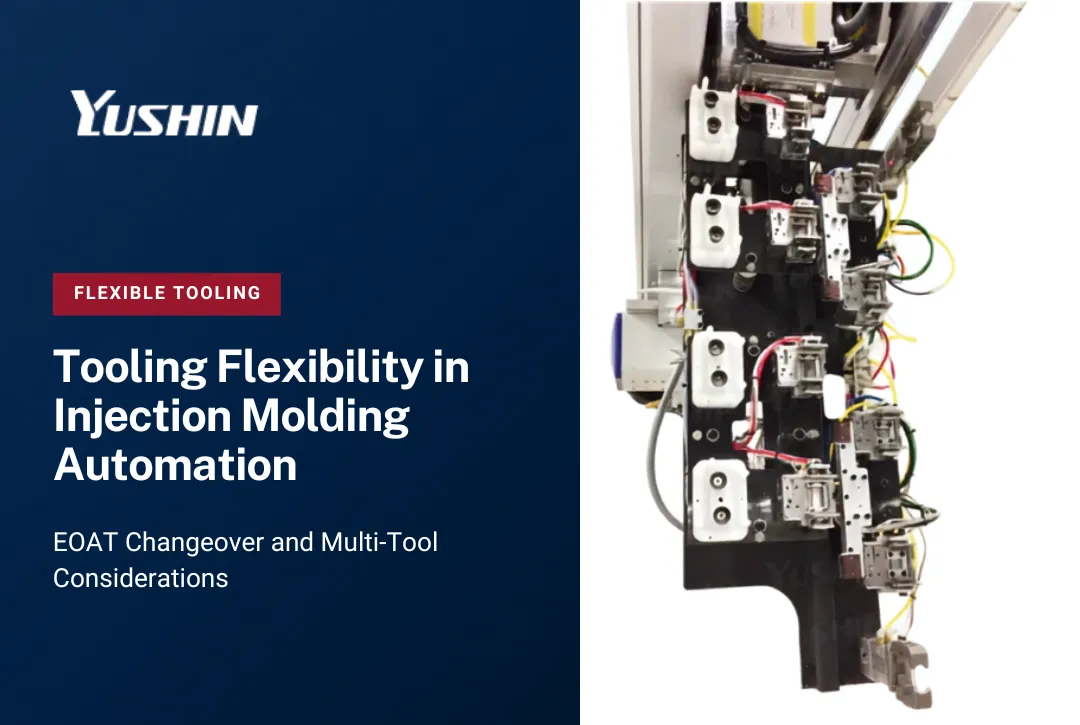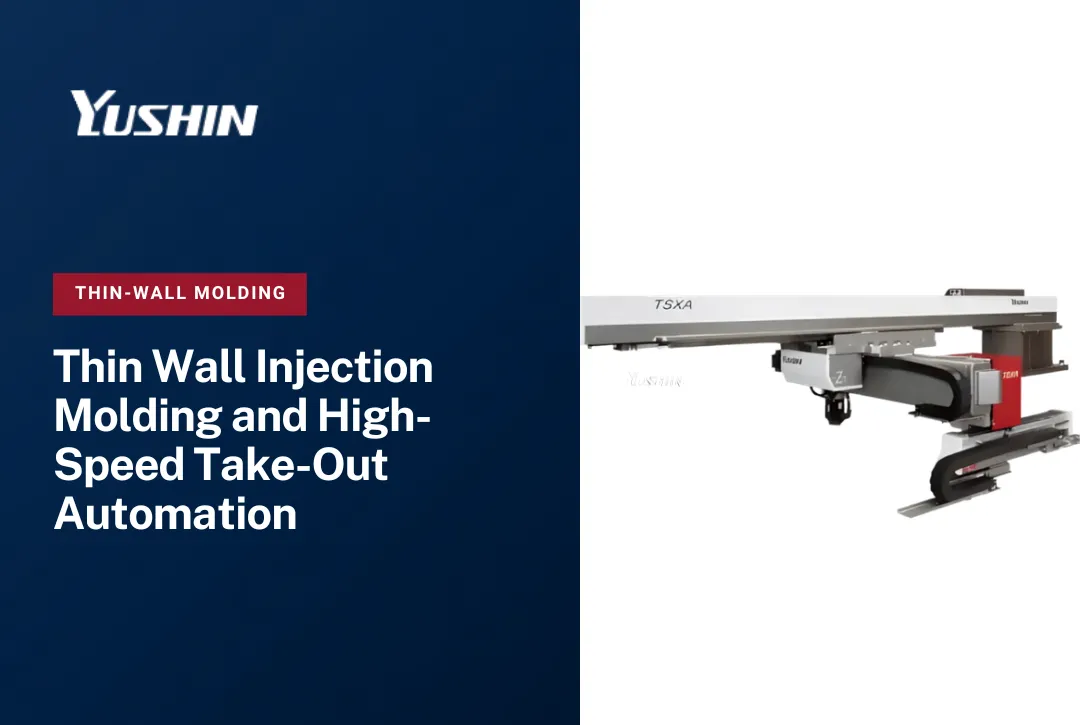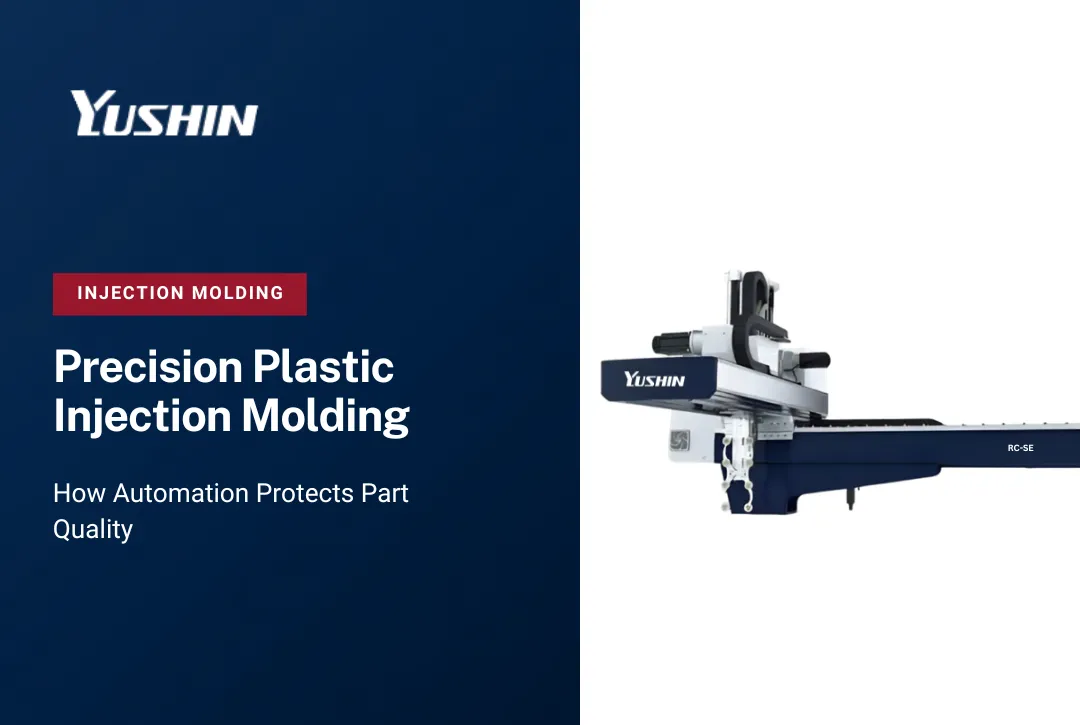

End-of-arm tooling (EOAT) is the part of a take-out robot system that actually contacts the molded part. It is also, increasingly, the most application-specific and engineering-intensive part of injection molding automation. As molds get more complex, parts get more fragile, and applications like insert loading and overmolding become more common, EOAT demand and complexity are both increasing. Yushin America positions engineered EOAT as a core part of its automation systems—not a generic accessory bolted onto a standard robot.
Rather than treating EOAT as a broad market forecast, this article focuses on the application trends increasing EOAT complexity in injection molding automation.
What Is EOAT and Why Does Demand Depend on Application Complexity?

EOAT (end-of-arm tooling) is the gripper, vacuum fixture, or combination tooling mounted at the end of a take-out robot's arm. It is the direct interface between the robot and the molded part during extraction, transfer, and placement.
Unlike the robot itself, which can often be selected from a standard product line based on IMM size and payload, EOAT is frequently custom-engineered for the specific part, mold, and application. This is the core reason EOAT demand and complexity are increasing: as injection molding applications become more demanding, the EOAT required to handle them successfully becomes more specialized.
Why EOAT Demand Is Growing in Injection Molding

Multi-Cavity Molds
High-cavitation molds—producing 8, 16, 32, or more parts per cycle—require EOAT that grips all cavities simultaneously with consistent force. As molders push for higher output per cycle through increased cavitation, EOAT complexity increases proportionally: more contact points, more consistent force distribution, and often greater total EOAT weight that affects robot payload selection.
Fragile and Thin-Wall Parts
Thin-wall packaging, medical components, and other fragile parts cannot tolerate the grip force variation that thicker, more robust parts can absorb. EOAT for these applications requires precise grip force calibration, careful contact point selection, and often vacuum-based tooling engineered specifically for the part's surface geometry.
Insert Loading and Overmolding
Insert molding and overmolding applications require EOAT that can handle both an insert (or a part from a prior molding operation) and the finished molded part—often within the same cycle. This is one of the most engineering-intensive EOAT categories, frequently requiring coordination with NC servo wrist units for controlled part or insert orientation. Insert loading and overmolding are important Yushin America application capabilities, and EOAT design is central to supporting them successfully.
Automotive and Large-Part Applications
Large automotive components—bumper fascias, instrument panel substrates, structural parts—require EOAT that distributes grip force across large, sometimes flexible surfaces without causing deformation or cosmetic damage. Multi-point vacuum or mechanical grip systems for these parts represent a distinct EOAT engineering category from small-part tooling.
Medical and Electronics Precision Applications
Medical device components and electronics parts often combine small size with tight tolerance and cleanliness requirements. EOAT for these applications must avoid contamination, control static, and grip precisely without damaging delicate features—driving demand for specialized, application-specific tooling rather than generic grippers.
Downstream Placement Requirements

As molding cells increasingly integrate downstream automation—inspection stations, packaging, palletizing—EOAT must not only extract the part reliably but also place it precisely for the next automated step. This adds placement accuracy and orientation control requirements to EOAT design that were not necessary when parts were manually handled after extraction.
EOAT as a Yushin America Engineering Differentiator
Because EOAT is frequently the most application-specific part of a take-out robot system, EOAT engineering capability is a meaningful differentiator between automation suppliers. Yushin America designs and builds EOAT as part of complete automation system integration—not as a generic accessory selected from a catalog.
This matters most in exactly the growth areas described above: multi-cavity handling, fragile part protection, insert loading, overmolding, large-part cosmetic protection, and precision applications. A robot without properly engineered EOAT will underperform regardless of the robot's own capabilities—EOAT design is often the deciding factor in whether an automation project succeeds.
Yushin EOAT-Related Product and Capability Fit
| EOAT-intensive application | Yushin capability |
|---|---|
| Multi-cavity, high-output molds | Engineered EOAT integrated with YD/YD2 Series or RC-SE |
| Insert loading, overmolding | Engineered EOAT plus NC servo wrist units |
| Large, cosmetic-sensitive automotive parts | Multi-point EOAT with MKA-2000S large full-servo traverse robot |
| Fragile, thin-wall parts | Vacuum-based EOAT with HSA-150S/HSA-250S super-high-speed take-out robots |
| Medical/electronics precision parts | Application-specific EOAT with YD-0310 compact take-out robot |
| Runner/sprue-only handling | Simplified EOAT on HOP Five, N-HOP, miniHOP, V-HOP sprue pickers |
Confirm EOAT design requirements with Yushin America based on your specific part, mold, and cycle time.
Selection Criteria That Drive EOAT Design

- Part geometry and material: Determines contact surface, grip method (vacuum vs. mechanical), and force calibration
- Number of cavities: Determines contact point count and consistency requirements across cavities
- Fragility and cosmetic sensitivity: Determines grip force limits and contact point placement
- Insert or overmolding involvement: Determines whether servo wrist coordination is needed
- Total EOAT weight: Included in robot payload calculation; can be a significant portion of total payload in complex applications
- Downstream placement accuracy requirements: Determines whether standard release is sufficient or precise orientation control is needed
When Standard EOAT Is Sufficient
Not every application requires highly engineered EOAT:
- Simple, robust, single-cavity parts: Standard vacuum or mechanical grippers are often sufficient
- Flat conveyor placement with no orientation requirement: Reduces EOAT complexity significantly
- Low-cavitation molds without fragility concerns: Standard tooling can handle these reliably
Application engineering note: Do not over-specify EOAT complexity for applications that do not require it—added engineering cost should match the actual handling challenge, not a generic assumption that complex is always better.
Implementation and Support
Yushin America provides EOAT engineering, installation, operator training, field service, and parts support as part of complete automation system integration.
- 24/7 phone support: 888-707-6268
- Over $1.3M in spare parts inventory with overnight shipping
- Yushin University: Yushin robot training and programming
- Yushin America field service and support
Frequently Asked Questions
Why is EOAT demand increasing in injection molding? EOAT demand and complexity are increasing because injection molding applications are becoming more demanding: higher cavitation for output, more fragile and thin-wall parts, more insert loading and overmolding, larger cosmetic-sensitive automotive parts, and tighter precision requirements in medical and electronics applications. Each of these trends requires more application-specific EOAT engineering.
What makes EOAT design complex for multi-cavity molds? Multi-cavity EOAT must apply consistent grip force and timing across every cavity simultaneously. Inconsistency between cavities creates part-to-part variation within the same shot. Higher cavitation also increases total EOAT weight, which affects robot payload selection.
How does EOAT support insert loading and overmolding? EOAT for insert loading and overmolding must handle both the insert or prior-operation part and the finished molded part, often within the same cycle. This frequently requires coordination with NC servo wrist units for controlled orientation. Yushin supports these applications through engineered EOAT designed around the specific insert and part requirements.
Does every injection molding application need custom EOAT? No. Simple, robust, single-cavity parts placed on a flat conveyor with no orientation requirement often work well with standard EOAT. Custom engineering is warranted when cavitation, fragility, insert handling, or precision placement requirements exceed what standard tooling can reliably deliver.
Is EOAT cost significant compared to the robot itself? For complex applications—high cavitation, insert loading, large cosmetic parts—EOAT design and fabrication can represent a substantial share of total automation system cost, sometimes comparable to the robot. Discuss EOAT requirements early in any automation cost conversation with Yushin America.
How does Yushin America approach EOAT engineering? Yushin designs and builds EOAT as part of complete automation system integration, working through contact point selection, grip force calibration, multi-cavity consistency, and placement accuracy specific to each application. This is positioned as a core engineering capability, not a generic accessory.
Conclusion
EOAT demand is growing because the applications injection molders are automating are becoming more demanding—more cavities, more fragile parts, more insert loading and overmolding, larger cosmetic-sensitive parts, and tighter precision requirements. EOAT design is frequently the deciding factor in whether an automation project succeeds, regardless of which robot is selected.
If your application involves multi-cavity handling, fragile parts, insert loading, overmolding, or precision placement requirements, contact Yushin America to discuss the EOAT engineering and robot configuration that fits your specific part and mold.