Introduction
Robotic arm systems have moved from science fiction to factory floors, operating rooms, and warehouse ceilings faster than most manufacturers anticipated. For anyone in industrial automation, understanding them is no longer optional.
The scale of adoption tells the story: the International Federation of Robotics reports 542,000 industrial robots installed in 2024, with the global operating stock rising 9% to 4.664 million units. The industrial robotics market, currently valued at $33.9 billion, is projected to reach $60.6 billion by 2030.
Those numbers reflect a straightforward reality: robotic arms are now mainstream capacity investments, not experimental ones. With dozens of types, configurations, and vendors on the market, choosing the right system matters far more than choosing the most advanced one.
This guide covers how robotic arms work, the major types, where they're deployed, and what separates purpose-built systems from general-purpose alternatives.
Key Takeaways
- Matching robot type to the task outperforms chasing the most sophisticated option
- Industrial manufacturing dominates, but healthcare, warehousing, and agriculture are expanding rapidly
- Purpose-built take-out robots outperform general-purpose arms in injection molding environments
- AI and advanced sensing are turning injection molding robots into adaptive, self-correcting systems
What Is a Robotic Arm System and How Does It Work?
A robotic arm system is a programmable mechanical manipulator engineered to replicate and extend human arm movement. Every system shares the same core architecture:
- Base — anchors the arm and provides rotational grounding
- Links — rigid structural segments that transmit force and motion
- Joints — rotary or linear connections between links
- End effector — the "hand" that interacts with the environment (gripper, welding torch, suction cup, or specialized tooling)
Degrees of Freedom
Degrees of freedom (DoF) defines how many independent movements an arm can make — one per joint. A rigid body in 3D space has six degrees of freedom: three linear and three angular (roll, pitch, yaw). This is why six-axis arms are the industrial standard: they can place an end effector at any position and orientation in three-dimensional space.
Arms with seven or more axes add redundancy, allowing them to navigate around obstacles without repositioning the entire robot — useful in confined or cluttered environments.
Actuators and Sensors
Actuators are the muscles of the system. Three main types exist:
- Electric servo motors — dominant in industrial applications; precise, programmable, and built around encoder-based feedback
- Pneumatic — fast and simple, but difficult to position accurately mid-stroke
- Hydraulic — high force output for heavy payloads, but less precise and harder to maintain
Electric servos dominate because encoders measure exact joint angles in real time, enabling continuous closed-loop correction. Complementary sensors extend this precision further:
- Force-torque sensors — detect resistance during gripping, essential for handling fragile parts
- Vision systems — allow the arm to perceive and adapt to its environment mid-task
Inverse Kinematics
When an operator defines a target position for the end effector, the controller calculates the joint angles needed to get there. That calculation is inverse kinematics — and modern control software handles it automatically. In practice, an operator inputs a target coordinate; the controller resolves all joint angles required to reach it without manual programming of each axis.
Common Types of Robotic Arm Systems
Articulated Robots
Articulated arms are the most prevalent industrial design, featuring three to six rotary joints arranged like a human shoulder, elbow, and wrist. Their wide range of motion and ability to reach around obstacles make them the default for welding, painting, machine tending, and part extraction in general manufacturing — though their multi-axis complexity is often more than injection molding take-out requires.
Articulated units held 62.52% of industrial robotics market share in 2025, making them the most widely deployed robot type across industrial applications.
SCARA and Cartesian Robots
SCARA (Selective Compliance Assembly Robot Arm) robots are fast, precise movers optimized for horizontal assembly and pick-and-place tasks. Two parallel rotary joints provide compliance in a selected plane, making them well-suited for electronics assembly and small-part handling.
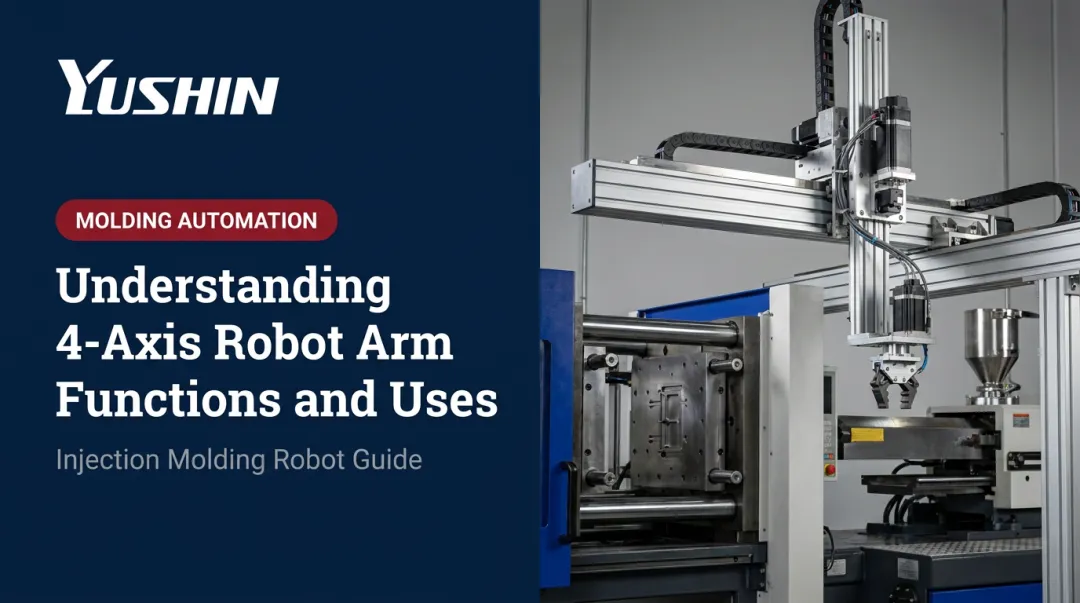
Cartesian (gantry) robots travel along linear X-Y-Z axes, offering straightforward programming and high repeatability for defined-path operations. Their geometry suits material handling, dispensing, and injection molding take-out particularly well. The 3-axis Cartesian structure delivers the accuracy and consistent cycle times that reliable part extraction demands.
Collaborative Robots (Cobots) and Delta Robots
Cobots are arms built for safe operation alongside human workers. Force-limiting sensors, lightweight construction, and rounded edges allow them to operate without fixed safety fencing (subject to risk assessment), making them practical for assembly, quality inspection, and machine loading in flexible cells.
Delta robots use a parallel-arm, closed-loop structure with base-mounted motors for extremely fast, lightweight pick-and-place. Food, pharma, and electronics lines running fast-moving conveyor product favor delta robots for their speed and precision on light items.
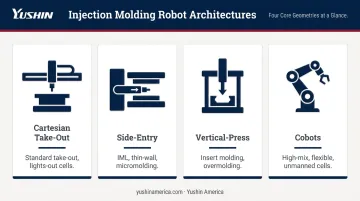
Each robot type suits a different production scenario. For injection molding processors, the practical choice typically comes down to four architectures:
- Cartesian take-out robots — standard traverse and high-speed take-out for most press sizes
- Side-entry robots — essential for in-mold labeling (IML), thin-wall packaging, and micromolding cells
- Vertical-press robots — designed for insert molding and overmolding on vertical-clamp machines
- Cobots — flexible deployment for high-mix, low-volume, or unmanned cell applications
Key Industrial and Commercial Applications of Robotic Arm Systems
Manufacturing and Assembly
Robotic arms weld automotive frames, assemble electronics, paint surfaces, and tend CNC machines around the clock. With 4.664 million robots operating globally, they've become the infrastructure of modern manufacturing — table stakes, not a differentiator.
Healthcare and Surgery
Surgical robotic arms have transformed procedural precision, with applications spanning joint replacement, minimally invasive procedures, prosthetics, and physical rehabilitation. Pre-operative 3D imaging creates patient-specific anatomy models that guide the arm in real time.
The results are measurable:
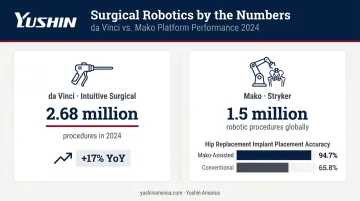
- Intuitive Surgical reported approximately 2.68 million da Vinci procedures in 2024, up 17% year-over-year
- Stryker's Mako system has surpassed 1.5 million robotic procedures globally
- A 2025 peer-reviewed study found Mako-assisted hip replacements achieved 94.7% implant placement accuracy within optimal zones, versus 65.8% for conventional surgery
Warehousing, Logistics, and Agriculture
In logistics, robotic arms sort parcels, pick items from bins, and palletize goods for e-commerce fulfillment. Major deployments include:
- Amazon Sparrow — uses computer vision and AI to pick individual items
- Amazon Cardinal — places packages up to 50 lbs into shipping carts
- Ocado — handled 30 million items in 2024 across automated fulfillment operations
Precision agriculture is following a similar path. Vision-guided arms now harvest delicate crops at scale, with a 2024 study in Scientific Reports demonstrating a 6-DoF harvesting arm achieving over 95% success rate in fruit grasping prediction.
Hazardous Environments and Space
Bomb disposal, nuclear material handling, and unsafe infrastructure inspection all rely on remotely operated robotic arms to protect human operators. In space, Canadarm2 — a 17-meter arm on the International Space Station — assembles and services orbital hardware. NASA's Perseverance rover carries a 2.1-meter robotic arm performing geological sampling on Mars, in an environment completely inaccessible to humans.
Robotic Arm Systems in Plastics Manufacturing and Injection Molding
The Specific Role of Take-Out Robots
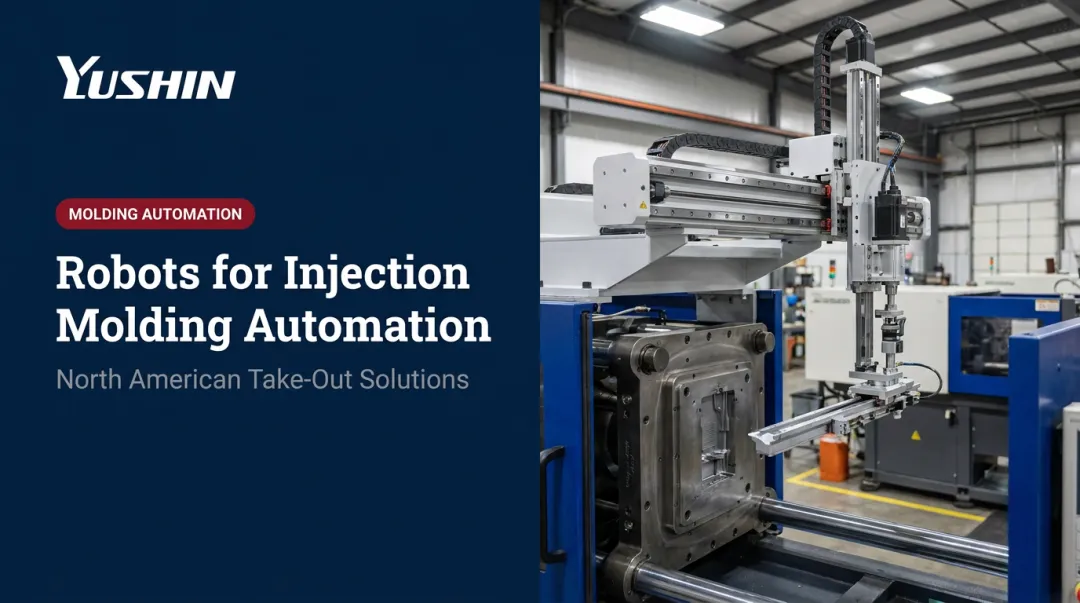
In injection molding, timing and consistency define part quality. Each cycle, the mold opens for a precise window. The take-out robot must enter, extract the part cleanly, and exit before the next shot begins — every time, without variation. Inconsistent extraction causes part defects, increases scrap, and limits how much of the process can run unattended.
Yushin America designs its take-out robots specifically around injection molding cycle demands: extraction speed, positioning precision, and cycle-to-cycle repeatability that general-purpose 6-axis articulated arms are not built to deliver.
Each series targets a specific cycle window, from standard production to sub-3-second IML throughput:
| Robot Series | Target Cycle | Application |
|---|---|---|
| YD/YD2 | Standard (>12 sec) | General-purpose, lights-out cells |
| HST | Sub-10 sec | Thin-wall packaging, caps & closures |
| HSA | Sub-5 sec | IML, ultra-short-cycle packaging |
| TSXA (side-entry) | Sub-3 sec | Flagship IML, maximum throughput |
| MKA-2000S | Large-part cycles | Automotive bumpers, 800–3,000 ton presses |
Lights-Out Manufacturing
Purpose-built take-out systems enable extended unattended production when combined with the right downstream and monitoring infrastructure. MCA, a documented lights-out case study, ran 80–100 hours per week fully lights-out, molding 540 million components over five years with online scrap below 1%, zero defective parts per million, and 100% on-time delivery.
Two monitoring options support unattended production at different levels of the product line:
- INTU LINE IoT (FRA Series): Tracks production counts, cycle times, error tallies, and uptime ratios from any smartphone or PC. Runs on cellular networks — no LAN cables or IT integration required.
- YC Email Notification Module (YC/YCII Series): Sends alerts for take-out failures, E-stop activations, and conveyor-full conditions to multiple recipients simultaneously. Operators set robot and press response behavior for each error type independently.
Both systems give personnel real-time visibility without anyone on the floor, which is the operational foundation for extended lights-out shifts.
Downstream Integration
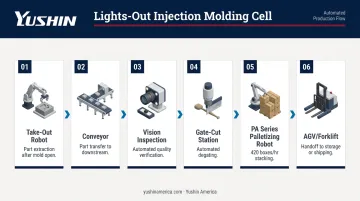
Remote monitoring handles visibility, but a complete lights-out cell also needs the full part-to-pallet workflow to run without manual handoffs:
- Take-out robot extracts the part immediately after mold open
- Conveyor transfers parts to downstream stations
- Vision inspection verifies quality without operator involvement
- Gate-cut station automates degating as a continuous step
- PA Series Compact Palletizing Robot receives, orients, and stacks parts onto pallets — the PA-40 is rated at 420 boxes per hour
- AGV or forklift completes the handoff to storage or shipping
PLASTICS reports that many smaller processors see automation payback periods under 12 months for certain automation investments, and plastics manufacturing already sits at 162 robots per 10,000 employees with 1,646 robots installed by plastic molders in 2023.
How to Choose the Right Robotic Arm System
Start with Application Definition
Before evaluating hardware, establish four parameters:
- Payload — part weight plus end effector weight
- Required reach — sized to mold and platen geometry
- Minimum DoF — defined by task complexity and cell layout
- Target cycle time — determines which speed tier is appropriate
Mismatched systems — over-specified or under-powered — consistently drive up costs and delay production launch. For injection molding specifically, press tonnage is the first filter. Yushin's lineup spans from 20-ton micromolding presses (SXC series) to 3,000-ton automotive presses (MKA-2000S), with distinct series for each range.
Evaluate the Full Ecosystem
The arm alone doesn't determine success. Assess:
- Software: ease of programming, recipe portability across mold changes
- Sensor compatibility: vision, force-torque, encoder integration
- Vendor experience: in your specific process, not just robotics generally
- Technical support: response time, remote diagnostics, spare parts availability
For injection molding specifically, purpose-built systems from dedicated suppliers ship with process knowledge already built in. Yushin's E-touch Series controllers, for example, include:
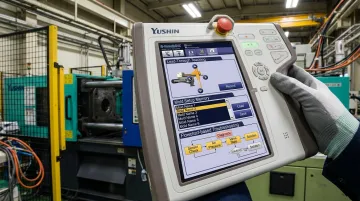
- Lead-Through Teaching for fast setup without programming expertise
- 300 mold setup memory for rapid changeovers
- Flowchart-based troubleshooting and predictive maintenance alerts
These features are designed for operators, not robotics specialists — which matters when a mold change happens on second shift.
TCO follows directly from these ecosystem decisions.
Factor in Total Cost of Ownership
Purchase price is only one line item. Full TCO includes:
- Installation and programming: traditional industrial integration can run tens to hundreds of thousands of dollars
- Routine maintenance: scheduled service and wear-item replacement
- Spare parts: availability and lead time affect unplanned downtime cost
- Unplanned downtime: the most underestimated TCO factor in high-volume production
UFACTORY lists research-grade collaborative arms starting from $6,000 (5-axis) to $11,000 (7-axis). Industrial systems scale significantly from there. Specialized purpose-built systems like injection molding take-out robots vary by configuration and application — contact vendors directly for application-specific quotes.
Frequently Asked Questions
How does a robotic arm system work?
A robotic arm uses powered joints (actuators), a controller running motion-planning software, and real-time sensor feedback to move an end effector to precise positions. The controller calculates required joint angles via inverse kinematics and continuously adjusts based on encoder and sensor data during motion.
How much does a robotic arm system cost?
Costs vary widely by application and configuration. Entry-level collaborative robots start in the low five figures; full industrial take-out robot systems for injection molding are priced by press tonnage range, axis count, and downstream integration requirements. Contact a Yushin America representative for application-specific pricing.
How quickly do injection molding take-out robots pay for themselves?
Most injection molding operations see payback within 12–24 months through reduced labor costs, shorter cycle times, and lower scrap rates. Facilities running high-cavitation or lights-out production typically recover the investment faster.
What types of robotic arms are most commonly used in manufacturing?
In plastic injection molding — the largest single application for dedicated automation robots — Cartesian-geometry (3-axis servo traverse) take-out robots are the standard. Their linear motion profile suits the repetitive, high-speed demands of mold extraction. Side-entry robots handle in-mold labeling and micromolding cells where top-entry access isn't practical.
What is a take-out robot in injection molding?
A take-out robot is a purpose-built robotic arm that automatically extracts molded parts from the mold immediately after each injection cycle. It maintains consistent cycle timing, protects part quality, and enables downstream automation including inspection and palletizing — making lights-out manufacturing feasible.
What are the key benefits of robotic arm systems in industrial automation?
Key benefits for injection molding operations include:
- Continuous output — robots run 24/7 without fatigue or shift changes
- Repeatable precision — consistent extraction timing reduces defects and scrap
- Worker safety — removes operators from hazardous or ergonomically damaging tasks
- Scalability — robots adapt as production volumes or part specifications change