
Industrial robotics for manufacturing includes many robot architectures, but plastics processors should start with a more practical question: what task must the robot perform in and around the molding cell?
A standard take-out robot, high-speed robot, side-entry robot, sprue picker, servo-wrist configuration, collaborative robot, and palletizing system solve different production problems. This guide focuses on matching the application, part and EOAT payload, mold access, cycle time, downstream process, maintenance needs, and service requirements to the appropriate automation approach.
Key Takeaways
- Common robot architectures include articulated, SCARA, Cartesian, Delta, and cylindrical robots; collaborative operation is a separate application and safety concept rather than a mechanical robot architecture
- Matching payload, speed, and integration to your specific application matters more than raw specs
- Total cost of ownership includes maintenance, training, and downtime beyond the sticker price
- Vendor service network and response time directly affect your uptime and ROI timeline
- Yushin America builds injection-molding take-out robots backed by 50+ years of automation experience
What Is an Industrial Robot?
The International Organization for Standardization defines an industrial robot, under ISO 8373, as an automatically controlled, reprogrammable, multipurpose manipulator programmable in three or more axes. It can be fixed or mobile, and it's built for industrial automation applications.
That's a broad definition covering a wide range of hardware. The main mechanical categories include:

- Articulated robots – rotary joints, typically six-axis, for flexible orientation
- SCARA robots – fast, rigid vertically, compliant horizontally
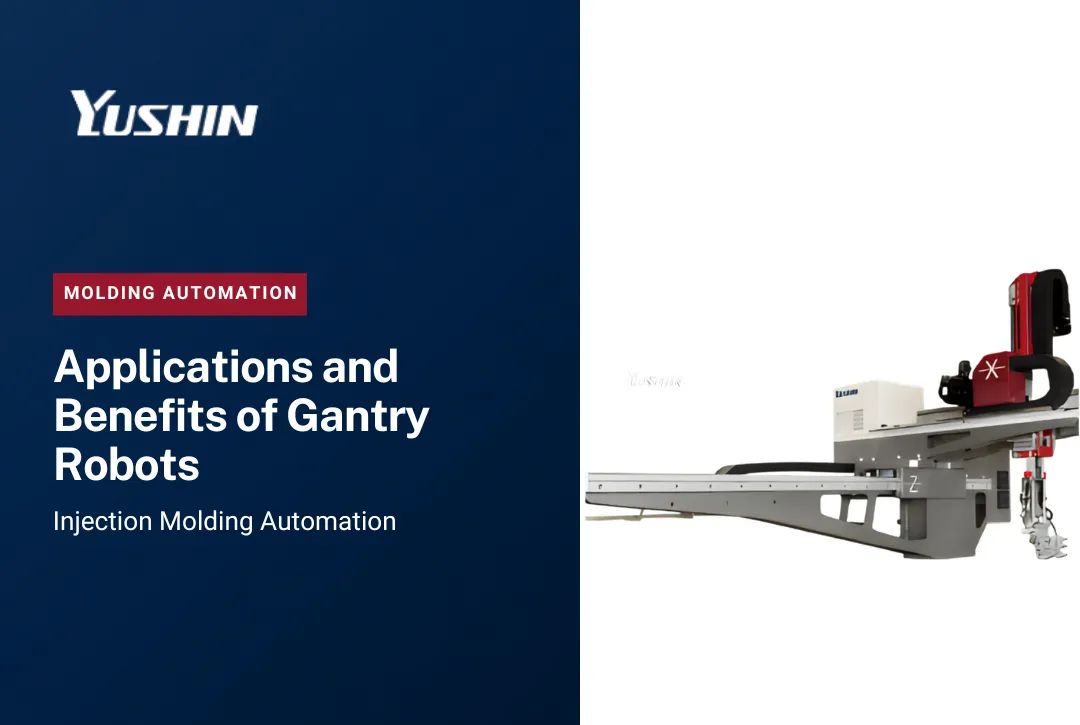
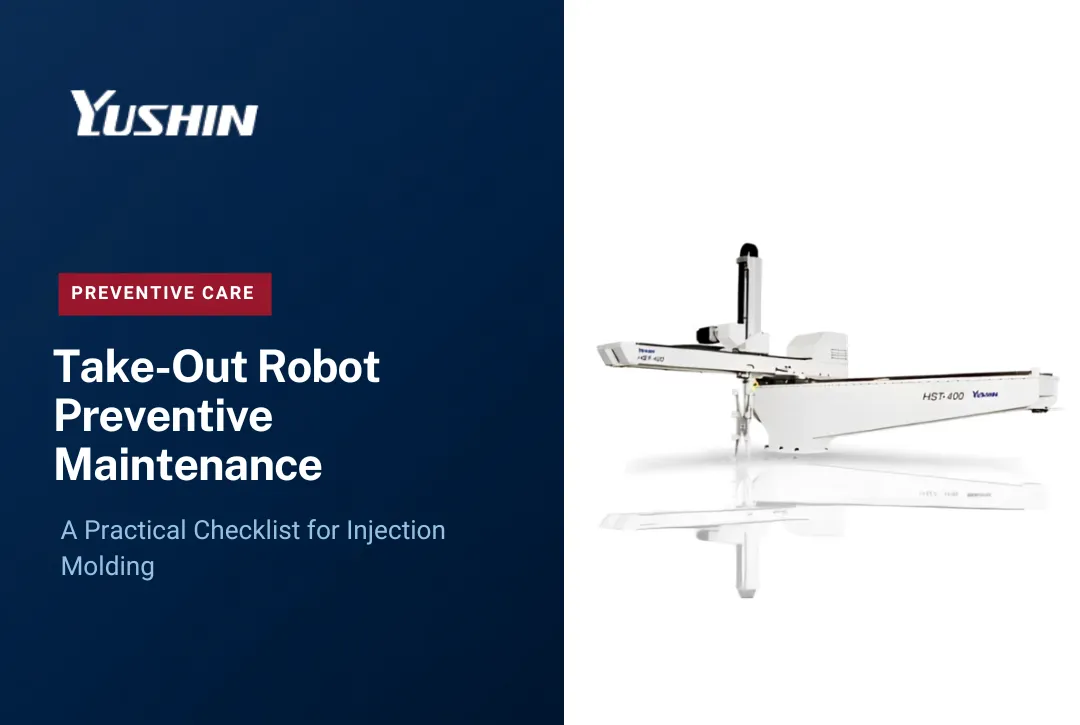
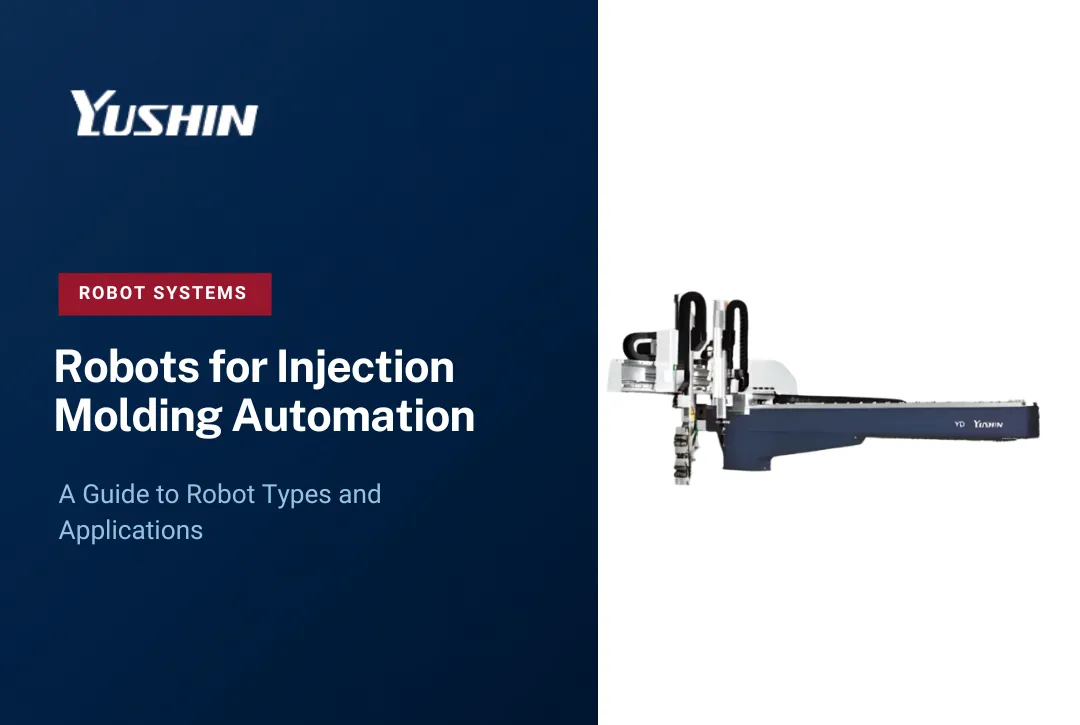
- Cartesian robots – linear axes moving in a rectangular work envelope, common in injection molding take-out
- Delta/parallel robots – lightweight arms for high-speed, light-load handling
- Cylindrical robots – combine rotary and prismatic joints for a cylindrical workspace
- Collaborative robots (cobots) – describe an application, not a mechanical class; they're designed to share workspace with people
We'll unpack the differences between these categories further in the FAQ below. For now, let's look at what's actually inside the machine.
Manipulator/Arm and End-of-Arm Tooling (EOAT)
The arm and its end-of-arm tooling determine what a robot can physically do. A gripper built for gentle part extraction won't weld, and a welding torch mount won't palletize.
EOAT is often the most overlooked variable in a robot purchase. Custom tooling for double-wing part extraction, insert molding, or in-mold labeling can change cycle time by seconds, and seconds compound fast at high volume.
Controller and Programming Interface
The controller and its teach pendant or software define how quickly your team can program, adjust, and troubleshoot the robot. A clunky interface slows commissioning and increases operator errors.
Look for:
- Recipe portability across robot models (so operators don't retrain on every upgrade)
- Touchscreen HMI with visual troubleshooting
- Remote access for diagnostics without a service call
Sensors and Vision Systems
Sensors and machine vision handle three jobs: precision positioning, quality inspection, and safety monitoring around human workers. Missing-part detection through vacuum sensors, fiber optics, or cylinder switches catches defects before they reach downstream packaging.
Benefits of Industrial Robots for Manufacturers
Manufacturers don't automate for novelty. They automate because the numbers work.
Core operational benefits include:
- Higher throughput through reduced cycle times and continuous, unattended operation
- Consistent part quality with fewer defects than manual handling produces
- Improved workplace safety by removing workers from repetitive, hazardous, or awkward-motion tasks
- Long-term cost savings through reduced scrap and reallocated labor
A 2022 Plastics Technology account on injection molding automation reported that take-out robots reduced damaged parts and rejects while keeping cycle times regulated and consistent. That consistency is critical in plastics, where a single missed dimension can void an entire run.
Take-out robots can reduce mold-open time when robot handling is the actual cycle constraint. Automation can also support unattended or reduced-attendance production when the complete cell - including EOAT, downstream equipment, safety systems, fault handling, and monitoring - is engineered for that operating model. The appropriate level of unattended operation depends on the complete application, not the robot alone.
What to Consider When Choosing the Best Industrial Robot for Manufacturing

There's no universally "best" industrial robot. The right choice depends on your application, part geometry, production volume, and what's already installed on your floor.
The factors below connect technical specs to the outcomes that actually matter: cycle time, downtime, and cost per unit.
Application, Payload, and Reach
Start here. Welding, assembly, pick-and-place, and machine tending (like injection molding take-out) each demand different arm geometry, speed profiles, and tooling. Getting this wrong first means every downstream decision compounds the mismatch: a robot sized for pick-and-place won't handle heavy palletizing loads, and vice versa.
Once you've nailed the application, match payload and working envelope to the actual weight and size of your parts, not just the average across your product line. Undersized payload capacity causes reliability issues and premature wear, while oversized capacity wastes floor space and capital.
Yushin's lineup illustrates why robot sizing must be application-specific. Compact take-out robots address smaller injection molding applications, while the MKA-2000S large take-out robot is designed for molding machines of 1,500 tons or larger and handles 30–50 kg including EOAT. Final selection should be based on the actual IMM, mold dimensions, part and EOAT weight, stroke requirements, and cycle time.
Speed, Precision, and System Integration
Cycle speed and repeatability determine how consistently a robot performs at volume. ISO 9283 standardizes how these performance metrics are tested, but there's no single universal "typical" range since every model's numbers depend on the specific test conditions.
Compare datasheets under matched conditions, not marketing claims in isolation. Faster take-out cycles directly reduce scrap tied to part damage during handling.
Speed means little if the robot can't talk to your existing equipment. A robot that can't communicate with your injection molding press, PLCs, or conveyors becomes a retrofit project instead of a plug-and-play upgrade, and protocol mismatches are a common, expensive surprise during commissioning.
Ask vendors directly:
- What press brands has this controller been tested with?
- What communication protocols does it support?
- Does recipe programming carry over across robot models in your fleet?
Total Cost of Ownership and Vendor Support
The purchase price is one line item in a much longer equation. Full TCO includes:

- Maintenance contracts and spare parts
- Operator and technician training
- Energy consumption
- Integration and installation labor
- Downtime costs during commissioning
McKinsey's research on manufacturing automation found an expected payback period of one to three years for automation investments generally, though application-specific figures can vary from that broader benchmark.
Hardware quality only gets you halfway toward that payback. The manufacturer's service network determines how fast you're back up after a failure, so ask any vendor for these metrics:
- Mean time to repair (MTTR) – average repair time after a failure
- Spare parts availability – how quickly replacement components ship
- Response time – phone, remote, and on-site support windows
ISO 22400-2 defines these availability and reliability metrics precisely, so ask vendors to quote numbers using this standard rather than vague service promises.
How Yushin America Fits the Selection Process
Yushin America specializes in robots and automation for plastics molding. For a plastics manufacturer evaluating industrial robotics, the relevant Yushin capabilities include standard and high-speed take-out robots, large-format and side-entry robots, sprue pickers, engineered EOAT, controlled orientation, downstream automation, and palletizing.
Robot selection should still begin with the application rather than the brand. The correct configuration depends on the IMM, mold, part geometry, payload including EOAT, cycle time, access requirements, required orientation, and downstream process.
Long-term support should also be part of the selection decision. Yushin America provides field service and technical support, OEM parts support, and robot training and programming for Yushin equipment.
Conclusion
The right industrial robot matches your application, payload, integration requirements, and volume. Popularity alone doesn't guarantee that fit.
Chasing brand recognition without checking these fundamentals is how manufacturers end up with underused capacity or, worse, equipment that can't keep pace with production demands.
Robot selection isn't a one-time decision, either. As your production volume, part mix, and press fleet evolve, revisit whether your current automation still delivers the throughput and ROI you need.
If you are comparing robot architectures for a plastics manufacturing application, contact Yushin America to review the IMM, part, EOAT, mold access, cycle time, and downstream requirements before choosing the robot configuration.
Frequently Asked Questions
How is robotics used in manufacturing industries?
Manufacturers use robots for welding, assembly, pick-and-place, machine tending, and palletizing. Automotive, electronics, and plastics processing rely on these applications most heavily, often combining several within a single production line.
What are the 5 types of industrial robots?
Manufacturing relies on five main types:
- Articulated — rotary joints for flexible orientation
- SCARA — fast movement on rigid vertical, compliant horizontal axes
- Cartesian — linear axes within a rectangular envelope
- Delta — lightweight parallel arms for high-speed handling
- Cylindrical — combines rotary and prismatic joints
What's the difference between a cobot and a traditional industrial robot?
Collaborative robots are designed for applications where people and robots may work in closer proximity, but the required safeguarding still depends on the complete application and its risk assessment. Some collaborative applications may operate without traditional perimeter fencing when the risk assessment and safety configuration permit it. Traditional industrial robot cells commonly use guarding or other protective measures appropriate to their speed, payload, tooling, and operating environment.
How much does an industrial robot cost for a manufacturing plant?
Cost varies widely based on payload, application complexity, and integration needs. Total cost of ownership, including maintenance, training, and spare parts, matters more than the upfront equipment price alone.
What industries use industrial robots the most?
Electrical and electronics manufacturing led 2024 installations at 24%, with automotive close behind at 23% and metal/machinery at 16%. Plastics and rubber processing remains a major adopter as well.
How long does it take to see ROI from an industrial robot investment?
Payback periods depend heavily on the application, but many manufacturers see returns within one to three years through reduced labor costs, higher throughput, and lower scrap rates.