
Introduction
Plastic moulding companies operate in a process-intensive environment where every production decision has a direct cost. From the moment a mould opens to the moment a finished part reaches a shipping box, dozens of variables affect output rate, part quality, and labor efficiency.
Automation sits at the center of most of those decisions. Whether to add a take-out robot, integrate an automated inspection station, or move toward a fully coordinated production cell - these are choices plastic moulding companies make regularly as volumes grow, labor costs increase, and customer quality requirements tighten.
This article is written for people inside moulding operations: process engineers, plant managers, and operations leaders who are evaluating the next step in their automation journey.
The Operational Decisions Facing a Plastic Moulding Company

Every injection moulding operation makes ongoing decisions about where automation adds value and where manual handling remains the right choice. These decisions span the full production cycle.
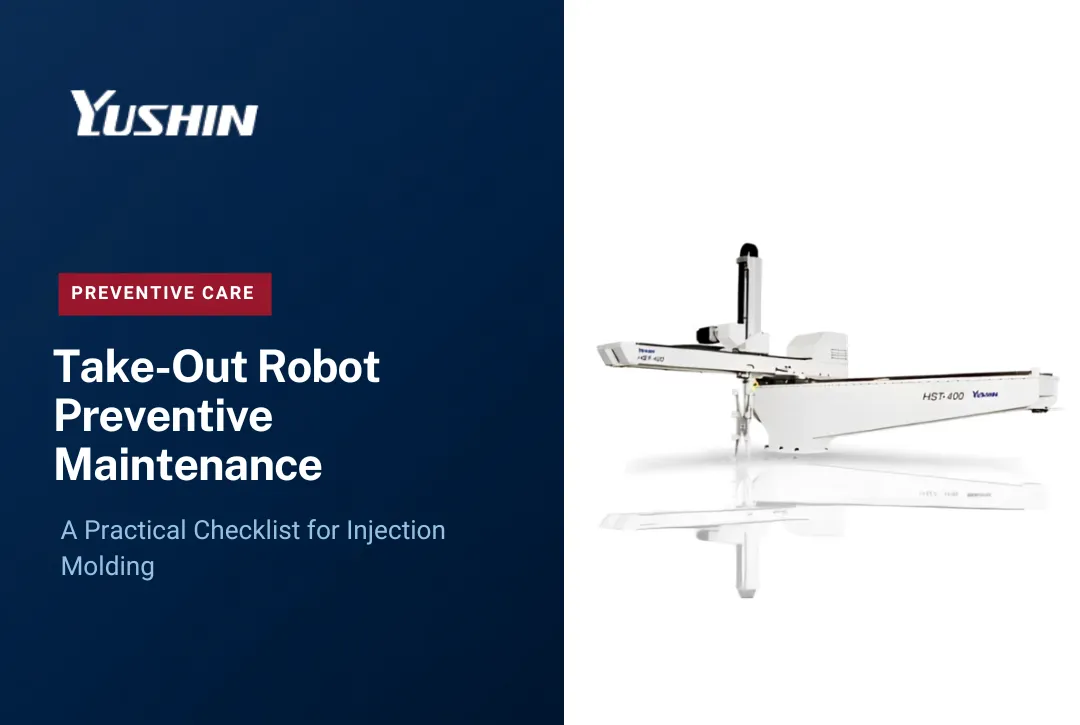
Manual vs. automatic part removal is one of the common automation decisions in a molding operation. A take-out robot can make the extraction sequence more repeatable and reduce the portion of cycle-time variation associated with manual part removal. Unattended or reduced-attendance production requires the complete cell - not only the take-out robot - to be engineered for that operating model.
EOAT engineering - end-of-arm tooling - connects the robot to the molded part. EOAT should be evaluated against the specific part geometry, cavity layout, gripping method, payload, mold access, and downstream handling requirements. An EOAT configuration that does not fit those requirements can reduce the performance of an otherwise suitable robot.
Multi-cavity handling can add complexity because the EOAT must be matched to the actual cavity layout and required part-removal sequence. A change in cavity count, spacing, part geometry, or mold configuration may require changes to the EOAT and robot setup.
Insert loading presents a choice between manual operator placement before each shot and automated insert loading integrated into the robot cycle. Automated insert loading improves repeatability, reduces misloads, and allows the operator to step back from the press.
In-mould labelling (IML) takes automation further by integrating label placement into the moulding cycle itself. IML requires precise label positioning, a robot capable of placing labels under cycle-time pressure, and EOAT designed for both the label and the finished part.
Inspection can range from periodic statistical sampling by a QC technician to automated in-process vision inspection that checks every part, every cycle. The right approach depends on part criticality, customer requirements, and the defect types that are most likely in the process.
Assembly and secondary operations - joining components, inserting inserts post-mould, trimming gates - can be integrated into the automated cell or handled at a separate downstream station. The sequence and proximity of these operations affects total cycle time and floor layout.
Conveyor integration determines how parts flow from the press to downstream processes. A simple take-out robot depositing parts on a flat conveyor is very different from a coordinated system that orients parts, checks orientation with a sensor, and presents them to an assembly station in a specific position.
Packing can be manual, semi-automated, or fully automated. Depending on the application, automation may count parts, place them into trays, bags, boxes, or other containers, and coordinate container changes. Whether automated packing creates a strong labor or throughput benefit depends on production volume, pack pattern, operating schedule, and the existing manual process.
Palletizing is one possible end-of-line automation step where cartons, trays, or other loads need to be stacked in a defined pattern. Automation can reduce repetitive manual handling and provide consistent programmed placement, but its value depends on line rate, load characteristics, pallet pattern, available space, and operating requirements.
Changeover time should be considered during automation design, especially when one cell runs multiple molds, parts, or EOAT configurations. Quick-change tooling, stored programs, accessible connections, and clear setup procedures can reduce the time and effort required to move between production jobs.
Preventive maintenance should follow the equipment manufacturer's requirements. Robots and supporting automation may require scheduled inspection, lubrication, belt-tension checks, cleaning, or other maintenance depending on the equipment. Planning these activities can help reduce avoidable maintenance-related interruptions.
Robot parts and service availability affects how quickly a production issue can be addressed. When comparing automation suppliers, molders should review field-service coverage, technical-support availability, OEM parts support, and the support model for production-critical issues.
Integrating new automation with existing presses is a practical constraint most moulding operations face. Not every press needs the same solution. A new high-volume press may justify a full integrated cell, while an older press running lower volumes may benefit from a simpler take-out robot without downstream automation.
Automation Maturity: Where a Moulding Operation Stands Today

There is no single correct automation level for a plastic moulding company. The right level depends on part volume, part complexity, labor availability, and business goals. The following stages describe a practical progression, but not every operation should move through every stage.
Stage 1 - Manual moulding support: The operator removes parts from the mould, checks quality manually, and places parts on a conveyor or in a bin. This is appropriate for low-volume production, highly complex parts that require human judgment in handling, or operations with highly variable production schedules that make robot programming impractical.
Stage 2 - Automatic take-out: A take-out robot extracts parts the moment the mould opens and deposits them on a conveyor or into a collection bin. Labor is removed from the press cycle. The operator is freed for quality monitoring, material handling, and other tasks. Automatic take-out is a common starting point for molding operations that want to remove repeated manual part extraction from the press cycle.
Stage 3 - Take-out with downstream operations: The robot extraction feeds into one or more downstream steps - orientation, degating, inspection, cooling, or other secondary operations - before parts reach the packing station. These steps may be manual or automated, but the part flow from press to packing station is coordinated.
Stage 4 - Integrated automated cell: Multiple steps from part extraction through downstream handling are automated and coordinated. EOAT, conveyors, inspection, packing, and robot motion may be engineered together as a system. Depending on material supply, fault handling, inspection, safety, downstream capacity, and monitoring, a complete cell may support reduced-attendance or unattended operation. This requires application-specific cell engineering.
Stage 5 - Connected multi-process or factory automation: Multiple cells, production data, and processes are integrated at the facility level. Production monitoring spans the plant. Data from individual cells feeds into scheduling, quality tracking, and maintenance planning. This level is appropriate for larger operations with multiple presses and a strategy for data-driven production management.
What Separates a High-Performing Automated Moulding Cell

Well-functioning automated cells share a set of practical characteristics that distinguish them from cells that underperform despite using similar equipment.
EOAT matched to the actual part and process is an important part of cell design. Tooling should be specified for the actual part, cavity layout, payload, mold access, gripping method, and downstream handling requirements rather than assumed to transfer unchanged from another application.
Downstream equipment sized to the required cell output. A conveyor, inspection system, packing station, or other downstream process should have sufficient capacity for the expected production flow. Evaluating these capacities together helps reduce the risk of moving the production constraint from the press or robot to a downstream station.
Changeover time planned into the cell design from the start. Cells designed with changeover in mind - quick-change EOAT mounts, clearly labeled connections, standard tooling interfaces - change over faster and with fewer errors than cells where changeover was treated as an afterthought.
Preventive maintenance schedules followed consistently. Robot manuals define the inspection, lubrication, belt-tension, and other maintenance requirements that apply to the equipment. Documenting and completing these tasks on schedule can help identify wear and maintenance needs before they contribute to unplanned downtime.
Service and OEM parts availability from the robot supplier. Production-critical automation should be evaluated together with the supplier's field-service coverage, technical support, parts availability, and long-term equipment support.
Yushin America: Automation for Plastic Moulding Companies
Yushin America supplies automation equipment and systems to plastic moulding companies. Yushin does not manufacture plastic parts or provide contract moulding services - the company's role is as an automation supplier and integration partner to injection moulding operations.
Yushin's product and service range covers the full scope of production cell automation that moulding companies typically need:
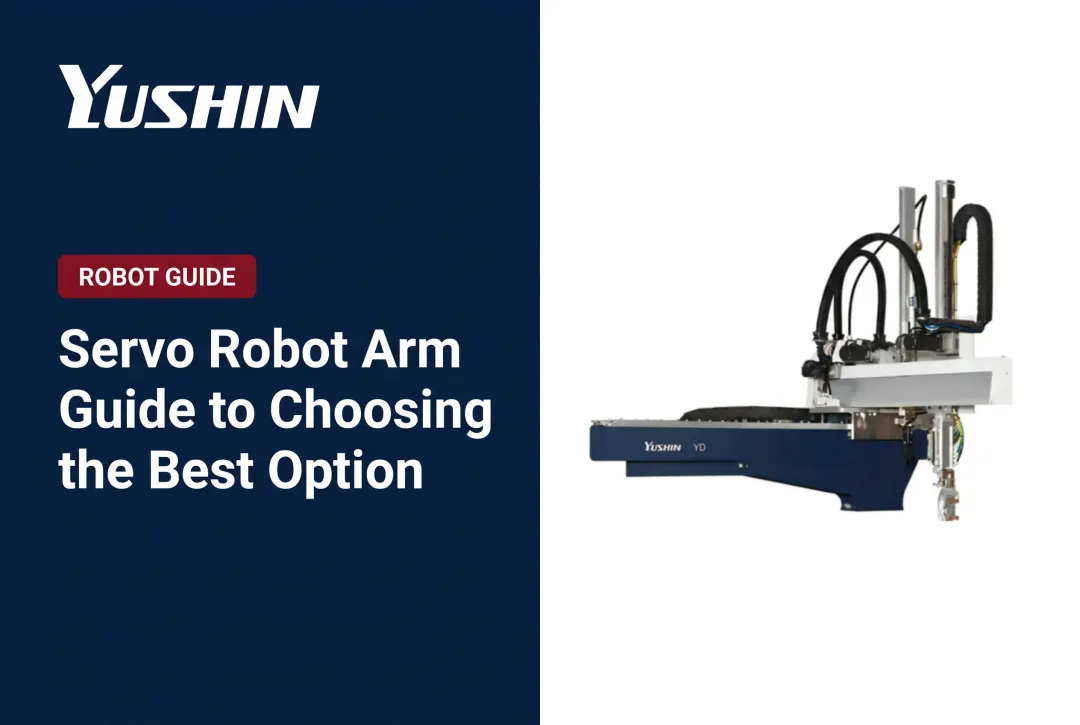
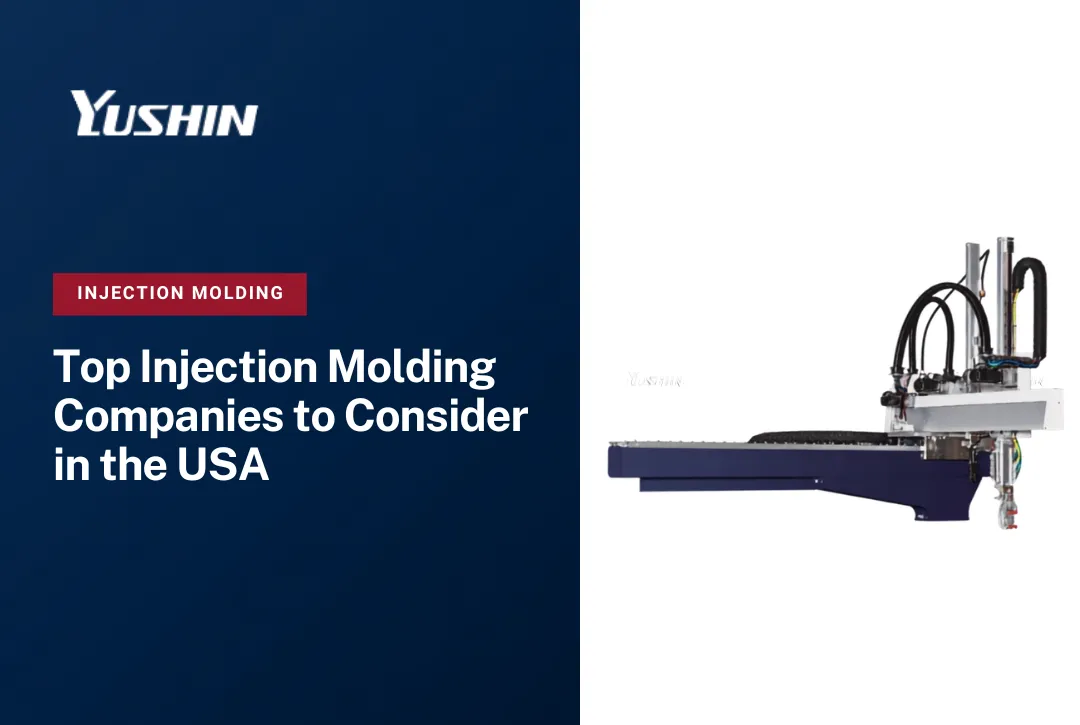
- YD/YD2 standard take-out robots and a broad range of take-out systems for different press sizes, cycle times, and part types
- Application-specific end-of-arm tooling (EOAT) engineered for the part, cavity count, and downstream requirements
- Insert loading automation for pre-shot insert placement
- IML automation for in-mould label placement integrated into the moulding cycle
- Vision inspection integration for in-process part checking
- Downstream conveyors, assembly stations, packing systems, and palletizing
- Safety systems and cell integration hardware
- Installation, field service, and preventive maintenance programs
- OEM parts and technical training
- Systems integration for complete production cells from press to pallet
Yushin America was established in 1988 to support North American sales and service. Its parent company, Yushin Company of Kyoto, Japan, was founded in 1973 and entered the take-out robot market in 1978.
Conclusion
Automation decisions in a plastic moulding operation are not one-time choices. They evolve as production volumes grow, part complexity increases, labor availability changes, and customer quality requirements tighten. The moulding company that took a first step with a basic take-out robot three years ago may now be ready to integrate inspection, coordinated packing, or full cell automation.
The practical question is not whether to automate, but which step makes sense now - given current press utilization, labor costs, part mix, and capital availability.
Contact Yushin America to review your current automation level and identify the right next step. Whether you are evaluating a first take-out robot or planning a fully integrated cell, Yushin's application engineers can assess your operation and recommend an approach matched to your actual production requirements.
Frequently Asked Questions
When does it make sense for a plastic moulding company to add a take-out robot?
A take-out robot may be worth evaluating when manual part removal affects cycle consistency, staffing requirements, part handling, or the production schedule. Payback is application-specific and should be calculated from the actual equipment cost, labor requirements, production volume, cycle-time effect, operating schedule, maintenance, and downstream process.
How much does EOAT customization add to an automation project?
EOAT cost and engineering effort depend on the part, cavity layout, gripping method, sensors, payload, mold access, and required downstream functions. Application-specific EOAT can be designed around those requirements rather than forcing a generic tooling configuration to perform a task it was not designed for. Yushin provides EOAT engineering as part of its automation capabilities.
Can a take-out robot be added to an existing injection moulding press, or does it require a new machine?
Existing injection molding presses may be candidates for take-out automation, but compatibility must be reviewed for the specific machine and application. Relevant factors can include mold-open space, machine dimensions, mounting requirements, mold access, robot interface requirements, stroke, payload, and downstream cell layout. A Yushin application engineer can review the specific press before a robot is selected.
What is the typical maintenance requirement for an injection moulding take-out robot?
Take-out robots require periodic lubrication, belt tension checks, servo drive inspections, and controller maintenance at intervals specified in the manufacturer's manual. Following the manufacturer's preventive-maintenance schedule can help identify wear, lubrication needs, belt-tension issues, and other service requirements before they contribute to production problems. Yushin provides maintenance documentation and offers preventive maintenance programs through Yushin America's field service team.
How does IML automation differ from standard take-out automation?
Standard take-out automation extracts a finished part after the mould opens. IML automation adds a label placement step before the mould closes - the robot places a pre-printed label in the mould cavity, the part is then moulded around it, and the robot extracts the finished labelled part. IML cells require more precise timing, label-handling EOAT, and careful integration with the moulding cycle. Yushin designs and integrates IML systems as complete production cells.
What should a moulding company look for when evaluating automation suppliers?
Look for a supplier with application experience in injection moulding specifically - not just general industrial robotics. Key considerations include whether the supplier engineers EOAT for your part (not just sells the robot), whether field service and OEM parts are available locally, and whether the supplier can integrate the full cell from take-out through packing. A supplier who has done the same application before will identify problems in the design phase rather than during commissioning.