
What Injection Molding Automation Actually Covers

The injection molding production sequence runs from the machine through to finished goods. Automation can be applied at any point in that sequence:
IMM → take-out robot → EOAT → inspection or secondary operation → conveyor or handling → packing → palletizing
Within that sequence, the level of automation applied to any given cell can range from minimal to fully integrated:
- Sprue or runner removal only - a sprue picker removes the runner from a cold-runner tool; the part itself may still be handled manually
- Automatic part take-out - a robot extracts the finished part from the mold on every cycle
- Part orientation - a servo wrist unit controls the angle and position of the part during extraction and placement, critical when parts must be placed in a defined orientation for downstream operations
- Insert loading - the robot places metal inserts, bushings, or other components into the mold before the mold closes, enabling insert molding or overmolding
- In-mold labeling (IML) - the robot places a pre-printed label inside the mold before injection; the label bonds to the part during the shot
- Vision inspection - camera-based inspection can be integrated after extraction to evaluate defined part features or defect criteria according to the application's inspection strategy
- Degating - automated removal of gate marks or runners from the extracted part within the cell
- Assembly - combining two or more molded components, or a component with an insert, within the automated cell
- Conveyor integration - parts transfer from the robot to a conveyor and flow to downstream operations without manual handling
- Packing and box loading - parts are placed directly into shipping containers or trays in the correct orientation and count
- Palletizing - finished cartons or trays are stacked onto pallets at the end of the production line
- Fully integrated production cells - all steps above are coordinated under a single control architecture, with the robot, downstream systems, and the molding machine communicating cycle-to-cycle
No single automation component covers all of these steps. A take-out robot handles extraction. EOAT determines how the part is gripped and where it goes. Downstream systems handle everything after the part clears the mold. Each layer requires its own engineering.
Automating One Task vs. Automating the Cell

There is a meaningful difference between adding a single automation task to an otherwise manual cell and building a complete automated molding cell where every step is designed to work together.
Adding one task - for example, installing a take-out robot on a press that previously ran manually - removes one source of variability and may reduce cycle time by enabling faster mold-open sequences. But the cell upstream and downstream of that robot is still manual. If an operator is still hand-packing parts at the end of the press, the robot has not created an automated production cell. It has automated one step in a mostly manual cell.
A complete automated cell means the part moves from mold to finished goods with minimal manual intervention. The take-out robot, the EOAT, any vision or secondary operations, the conveyor, and the packing system are all specified together so they are compatible in speed, part handling, and control. The robot is not running faster than the conveyor can accept parts. The conveyor is not backing up because the packing station is understaffed. Each step is sized to match the others.
Multi-cell and factory-level integration adds another layer by coordinating multiple automated cells, material flows, monitoring functions, and downstream processes across a facility. The exact controls, production-data systems, scheduling tools, and monitoring architecture depend on the plant and project scope. This requires systems-integration work beyond an individual robot or downstream component.
Each level requires different engineering, different integration, and different ongoing support. A take-out robot alone does not create an automated production cell.
Where Automation Can Improve Production

Automation does not improve production universally or automatically. Where it can have a measurable effect depends on what is constraining output or quality in the existing process. The following are areas where automation, when properly applied, can affect production outcomes:
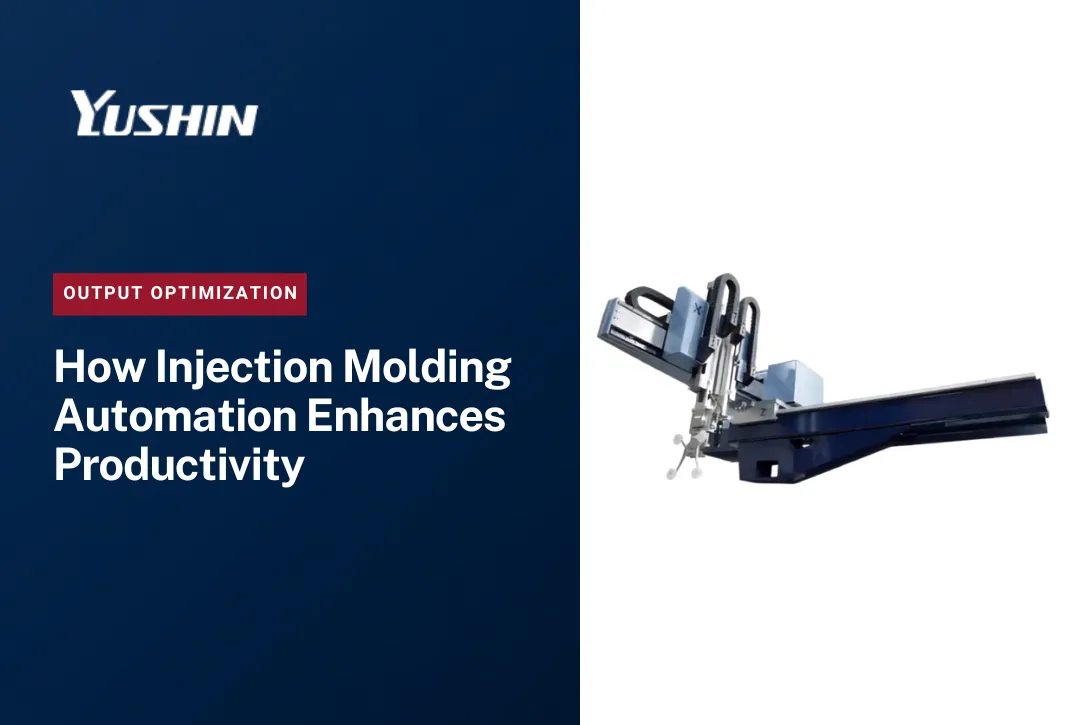
Mold-open time - a servo take-out robot can reduce the time the mold must stay open compared to manual extraction. Consistent, fast extraction allows the mold to close and the next shot to begin sooner, which tightens the overall cycle time where extraction was the limiting factor.
Repeatable take-out - consistent extraction removes cycle-to-cycle variation introduced by manual handling. Thermal variation between cycles caused by timing differences can produce dimensional differences that only appear during inspection.
Manual handling steps - every time a person handles a part between molding and finished goods is a potential source of damage, contamination, or dimensional variation. Automation can reduce the number of those handling steps.
Changeovers - well-designed automation with quick-change EOAT and saved robot programs can reduce changeover time when moving from one part to another. Poorly designed automation makes changeovers longer. The design matters.
Downstream bottlenecks - if packing or palletizing is the constraint, the press and the take-out robot are limited by that downstream bottleneck regardless of how fast they run. Adding a faster take-out robot to a cell where packing is the constraint does not increase output.
Scrap from handling - controlled EOAT and defined placement positions reduce part damage that occurs during manual handling, particularly for thin-walled, optical, or high-surface-finish parts.
Staffing constraints - automation can support production consistency when qualified labor is limited or when running second and third shifts. It does not eliminate the need for skilled people - it changes where those people are needed and what they are doing.
Inspection throughput - automated vision systems can increase inspection capacity and can be configured for in-line inspection where the application requires it. Inspection frequency and acceptance criteria depend on the customer's quality plan, regulatory requirements, part features, and inspection-system design.
The most important principle: the best automation investment targets the actual production constraint rather than automating a task simply because it can be automated. A faster robot does not help a cell where the bottleneck is downstream. A vision system does not help a cell where the constraint is cycle time. Before selecting an automation component, identify where the constraint actually is.
Yushin America's Automation Capabilities
Yushin America provides robots and automation across the full injection-molding production sequence. Their product and systems portfolio covers the range of automation levels described above:
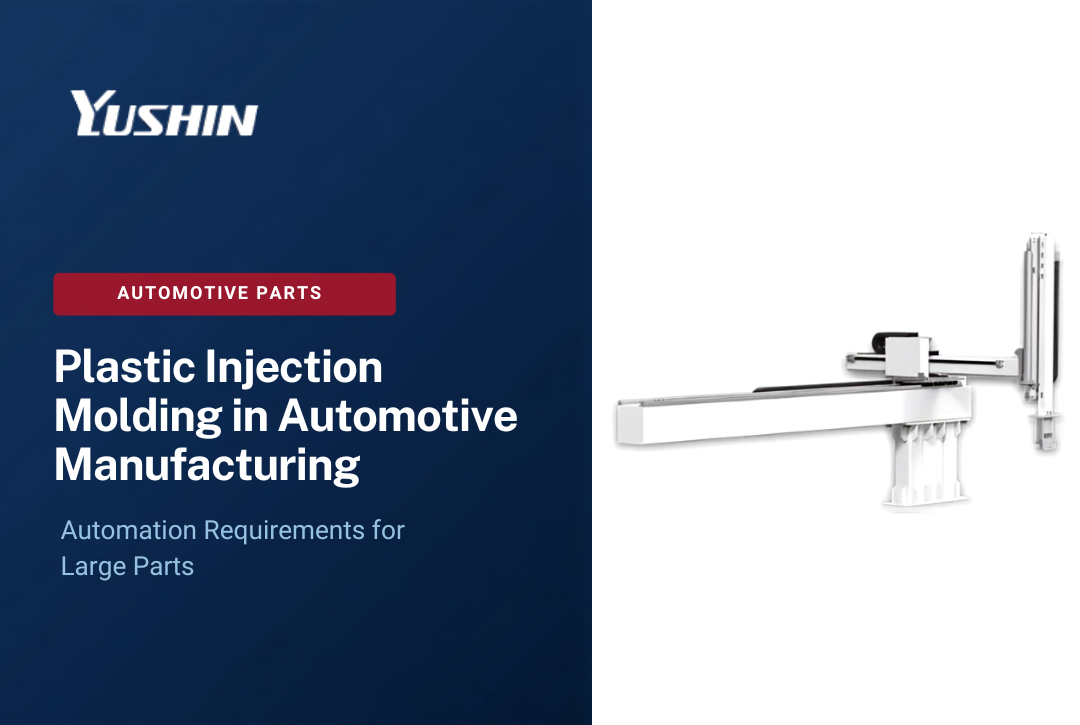
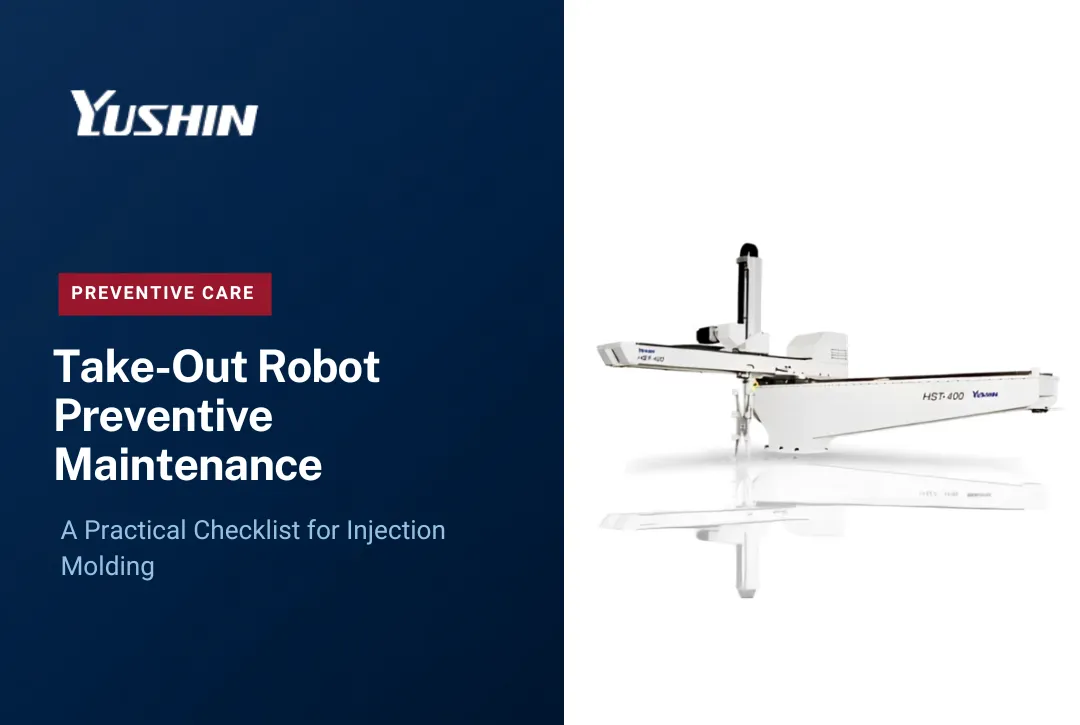
- YD/YD2 standard take-out robots - servo traverse robots for part extraction across a broad range of injection molding machine sizes, from compact presses up through large-tonnage machines
- End-of-arm tooling (EOAT) - application-specific tooling engineered for each part geometry, production task, and downstream requirement, including double-wing tooling for simultaneous product and sprue handling
- NC servo wrist units - additional servo axes for controlled part orientation where the application requires precise placement angle at the take-out or downstream position
- Insert loading and overmolding automation - robot-assisted insert placement before mold close, integrated with the take-out sequence
- IML automation - in-mold labeling systems where the robot places the label and retrieves the finished labeled part
- Vision inspection integration - camera-based quality checks incorporated into the extraction cycle
- Conveyors and downstream automation - part transfer and secondary operation integration within the cell
- Assembly, packing, and box loading - downstream automation steps between the robot and finished goods
- PA Series palletizing robots - compact end-of-line palletizing designed for injection molding environments
- Safety guarding and cell integration - physical and control-level integration of all components within the cell
- Systems integration and full factory automation - engineering and project support for coordinating multiple cells and processes into broader factory automation for injection molding operations
Yushin America supplies the robots and automation; the injection molding machine is the customer's equipment. Yushin's role is to automate what happens around and downstream of the press.
Deciding What to Automate

Before selecting an automation component, the more useful starting point is a clear picture of the production sequence and where the constraint actually sits. Three questions help focus that analysis:
What step in the production sequence is the current constraint? Is it extraction speed, mold-open time, downstream packing capacity, inspection throughput, or something else? If the answer is not clear from production data, that is where the analysis should start.
Is that constraint caused by robot speed, EOAT design, downstream capacity, or something else entirely? A slow extraction can be caused by the robot, by an EOAT design that requires a complex motion path, by a mold design that requires a long cooling time before the robot can enter, or by a downstream system that cannot accept parts fast enough. Each of those causes points to a different solution.
Would adding automation at that point actually improve the constraint, or would the bottleneck simply move? A press running fast cycles with a slow manual packing operation will not become more productive by adding a faster take-out robot. The packing step is the constraint. Once packing is automated, a different step may become the constraint. Working through the sequence systematically - rather than automating the most visible step - leads to investments that produce measurable improvement.
Automation decisions made without this analysis often result in equipment that technically works but does not improve the production outcome it was purchased to address.
Conclusion
Plastic injection molding automation spans the full sequence from part extraction to finished goods, and it can be applied at levels ranging from a single sprue picker to a fully integrated multi-cell factory system. The right level for any operation depends on where the constraint is, what is causing it, and whether automation at that point would genuinely improve the outcome.
Review the complete molding sequence - from the mold to shipping - and identify the current constraint before deciding what to automate. Contact Yushin America to discuss your specific application and where automation is most likely to move the needle.
Frequently Asked Questions
What is the difference between a sprue picker and a take-out robot in injection molding?
A sprue picker removes only the runner or sprue from a cold-runner mold. It does not handle the finished part. A take-out robot extracts the finished part from the mold on every cycle, and typically handles the part through placement on a conveyor or into a secondary operation. Many cells use both: a take-out robot for the part and a separate mechanism for the sprue, or a single robot with double-wing EOAT that handles both simultaneously.
Does adding a take-out robot automatically create a fully automated molding cell?
No. A take-out robot automates the extraction step only. If packing, inspection, and material handling downstream of the robot are still manual, the cell is partially automated at best. A fully automated cell requires each step in the production sequence - extraction, orientation, conveyor, inspection, packing, and palletizing - to be specified and integrated together so they are compatible in speed, capacity, and control.
How does end-of-arm tooling affect automation performance?
Significantly. The EOAT is the interface between the robot and the part. If the EOAT is not designed for the specific part geometry, it can require longer motion paths, slower speeds, or more complex robot programs to avoid part damage. EOAT that supports quick-change also affects changeover time when the cell runs multiple parts. EOAT should be treated as part of the automation-system design because its geometry, weight, gripping method, and changeover requirements directly affect how the robot handles the part.
When does it make sense to add vision inspection to an automated molding cell?
Vision inspection may be appropriate when specific part features or defect criteria can be evaluated reliably by an in-line camera system, when additional inspection throughput is required, or when the customer's quality plan calls for automated verification. The required inspection frequency may be 100%, sampled, or another defined strategy depending on the application. Integration should be designed so that the inspection step fits the required handling and cycle sequence.
How do downstream bottlenecks interact with take-out robot speed?
A take-out robot can only run as fast as the slowest step downstream of it will accept. If a conveyor, packing station, or palletizer cannot process parts as fast as the robot can deliver them, the robot must slow down or pause - effectively limiting the cell to the downstream rate. This is why automation decisions should assess the full sequence. Specifying a faster robot without addressing a downstream bottleneck typically does not increase throughput.
What is the difference between automating a single cell and integrating multiple cells into factory automation?
Automating a single cell means specifying and integrating the robot, EOAT, downstream handling, controls, and supporting equipment for one press or production process. Factory-level automation can extend coordination across multiple cells, material flows, monitoring functions, and downstream operations. The exact scheduling, reporting, control, and data architecture depends on the facility and project scope and should not be assumed to be part of every automation project.