
High volume injection molding is fundamentally a systems problem. The injection molding machine (IMM) produces parts. But every step that follows - take-out, inspection, secondary operations, packing, palletizing - has to keep pace with that machine. When any one step falls behind, the press waits, or parts pile up uncontrolled. Either outcome costs you output.
This article focuses on what actually determines throughput and consistency once you are running at scale: the automation that bridges the IMM to the rest of the line, and the factors that make or break its reliability cycle after cycle.
The Production Flow Matters End to End

A useful mental model for high volume molding automation is the full sequence:
IMM → take-out → EOAT → inspection / secondary operation → packing → palletizing
Every link in that chain has a capacity and a failure mode. A press running a 6-second cycle with a 32-cavity tool produces parts at a rate the rest of the line must absorb. If take-out slows the cell down, or if packing cannot keep pace, the press does not run at its potential - regardless of what the mold or machine can do.
The job of automation is not simply to remove parts. It is to keep every station running at its designed rate, consistently, across millions of cycles.
Repeatable Cycle Execution
The word "cycle time" in injection molding is often used loosely. The mold cycle - fill, pack, hold, cool, eject - is one thing. The cell cycle - mold open, robot entry, part extraction, robot exit, mold close - is another. Both have to run reliably on every single shot.
Variability in either dimension compounds quickly. A robot that takes an unpredictable extra half-second to clear the mold because of vibration or settling delay does not produce one bad cycle. It shifts the mold-close trigger on every following cycle until an operator intervenes. At high cavitation and short cycle times, that kind of drift is not a minor nuisance - it is the difference between hitting your daily output target and missing it.
Repeatability is not a nice-to-have. It is the baseline requirement.
Take-Out Time and Its Contribution to Cycle Time
Robot take-out time is a direct component of cell cycle time. The sequence is: mold opens, robot enters the mold area, extracts parts, exits, mold closes. The robot must complete its entry, extraction, and exit within the mold-open window before the close cycle can resume.
Any extension of that window adds directly to cycle time. At a 6-second shot cycle running 24 hours, shaving one second from take-out time recovers thousands of cycles per day. At a 10-second cycle, the proportional impact is smaller but still meaningful at scale.
This is why take-out speed matters - but speed is not the only variable. The robot also has to settle before extraction so the EOAT contacts parts reliably. A robot that enters the mold area quickly but takes excessive time to damp out its own vibration does not necessarily produce a faster cell cycle.
Robot Settling and Vibration

When a robot arm decelerates at the extraction point, it introduces vibration into the structure. That vibration has to dissipate before the EOAT can reliably engage parts. If the system moves to extraction before settling is complete, the result is inconsistent part contact, potential mold damage from EOAT impact, or dropped parts.
Structural rigidity is the primary variable here. A robot built with a robust frame that minimises deflection under load and at speed will settle faster and maintain more consistent EOAT positioning than a lighter structure that flexes more during acceleration and deceleration.
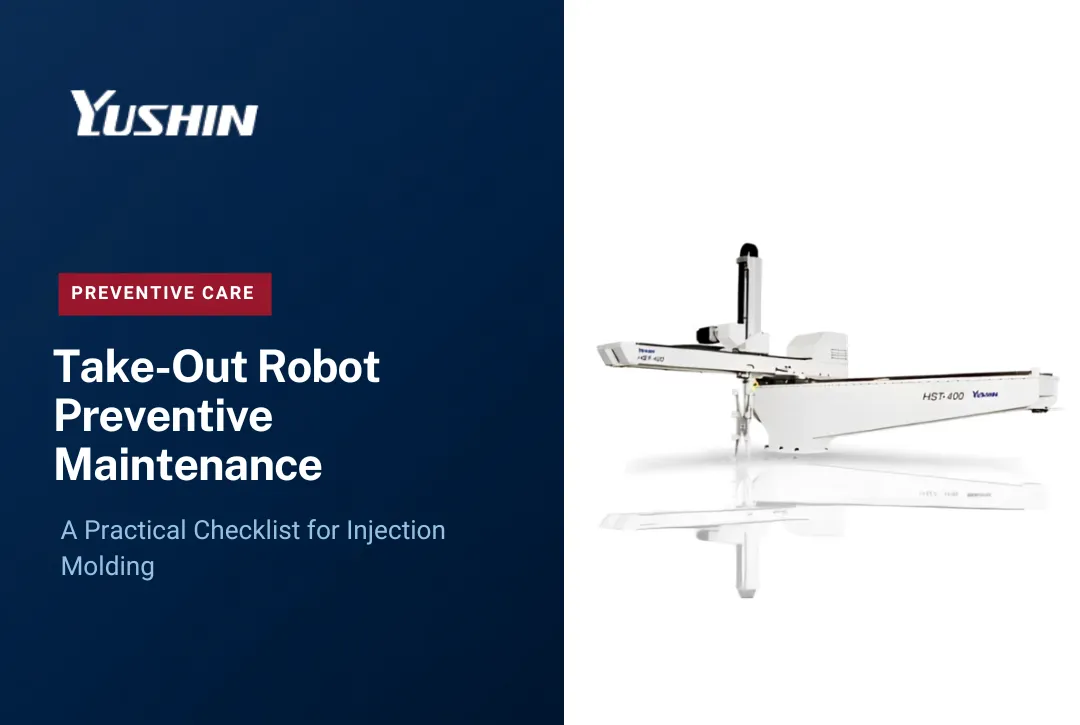
This is one of the design priorities behind Yushin's HST high-speed take-out robots. HST uses a purpose-built high-speed design that reduces moving mass while combining structural and vibration-control measures intended to shorten settling time and support stable high-speed motion. It should not be described as simply a standard robot fitted with larger motors.
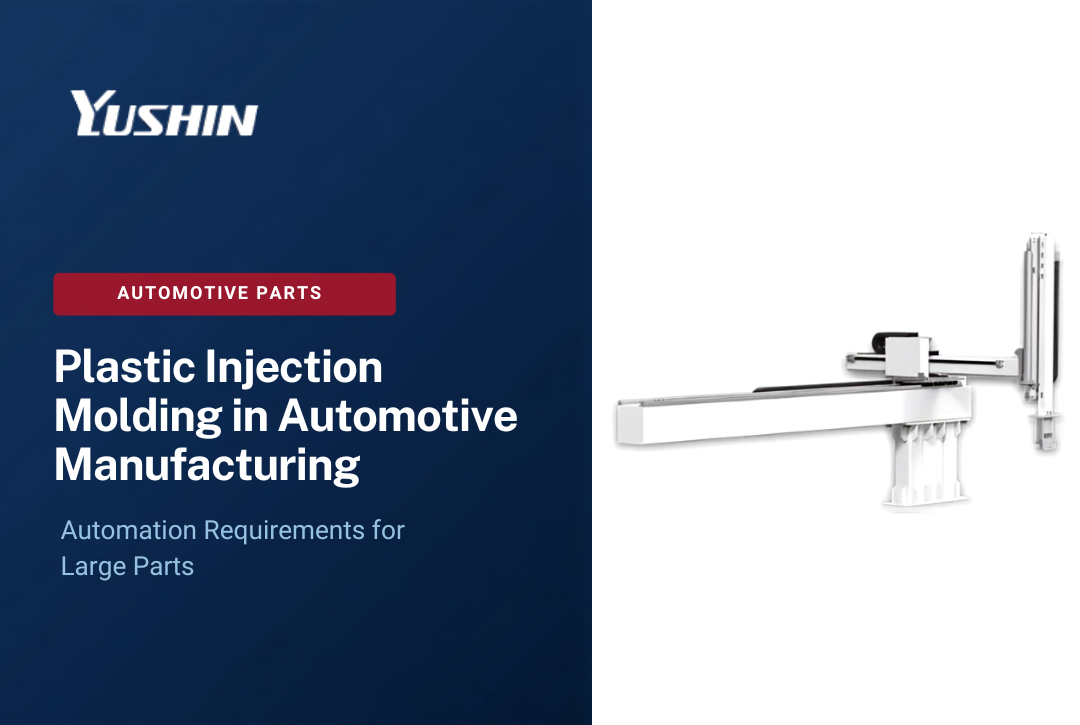
For standard molding applications where the fastest high-speed platform is not required, Yushin's YD/YD2 standard take-out robots provide application-focused take-out automation with design features intended to improve rigidity, reduce vibration, and support consistent molded-part handling.
Multi-Cavity Handling and EOAT Consistency
A 16-cavity mold produces 16 parts per cycle. The EOAT has to engage all 16 cavities simultaneously and extract them without variation. If tooling geometry, suction cup placement, or gripper force is not matched precisely to the part and cavity layout, some cavities will be missed, some parts will be damaged, and some will drop before they reach the conveyor.
EOAT is not a commodity item in high volume operations. It is an engineered component specific to the part geometry, the cavity count, the material, and the molding parameters. Tooling that was designed for a different part, or that has worn beyond its tolerance, introduces variation that shows up as scrap, dropped parts, and unplanned stops.
Key EOAT considerations for high volume molding:
- Cavity coverage - every cavity must be served simultaneously; misalignment on even one position causes incomplete extraction
- Material compatibility - suction cup compound, gripper jaw material, and mounting hardware all degrade at different rates depending on the resin being run
- Wear monitoring - a worn suction cup or gripper component may continue functioning under some conditions but become less reliable as cycle count, heat, and operating demands increase
- Changeover design - EOAT that can be exchanged quickly reduces the cell downtime associated with part changeovers
Part-Removal Reliability and Mold-Open Time
A failed extraction - where a part is not removed from the cavity before the mold begins to close - is among the most costly stops in a high volume cell. The mold closes on the part, tooling is damaged, the press stops, and a maintenance intervention is required. At high cavitation, the tooling replacement cost alone can be significant.
Reliable extraction depends on the robot executing its motion profile consistently within the mold-open window. That window is defined by the molding process: the mold opens, the robot enters, extracts, and exits, and only then does the close sequence resume. If the robot takes longer than the programmed window - because of a settling delay, a communication lag, or a mechanical issue - the system has to either extend the mold-open time (adding to cycle time) or trigger a fault stop.
In high-speed cells, the margin between the robot exit and the start of the close sequence is deliberately tight. That means the robot's timing consistency has to be very high. Any mechanical degradation, vibration issue, or controller timing drift that introduces variability into that window becomes a reliability risk.
Scrap and Part-Damage Risk
High-volume operations surface a tension between extraction speed and part integrity. A robot moving at maximum speed through the mold area extracts parts quickly - but abrupt deceleration at the extraction point creates the vibration and settling problem described above. Aggressive motion profiles that are not matched to the structural capability of the robot produce parts that are contacted inconsistently, dropped onto conveyors at angles that cause cosmetic damage, or delivered to downstream stations with dimensional variation from handling stress.
The practical answer is not simply "run slower." It is to use a robot whose structural design can support fast motion with adequate rigidity, so that speed and stability are not in direct conflict. A well-designed high-speed take-out robot can run faster than a standard robot while producing more consistent EOAT contact and part delivery - because its frame dissipates vibration more effectively.
For fragile parts, thin-wall containers, or applications where cosmetic finish is critical, the extraction motion profile and EOAT design need to be reviewed as a system, not optimized in isolation.
Changeovers
In a high-mix operation, the time required to change a cell from one part to another directly affects available production hours. A cell that takes four hours to change over is a cell that cannot run the second part for four hours.
Changeover time in a robot cell has several components: EOAT exchange, robot program recall or re-teach, downstream conveyor and packing line reconfiguration, and process verification before production resumes. Robots with recipe-based controllers that store programs by part number can reduce the re-teach element substantially. EOAT designed with quick-release mounting reduces the mechanical exchange time.
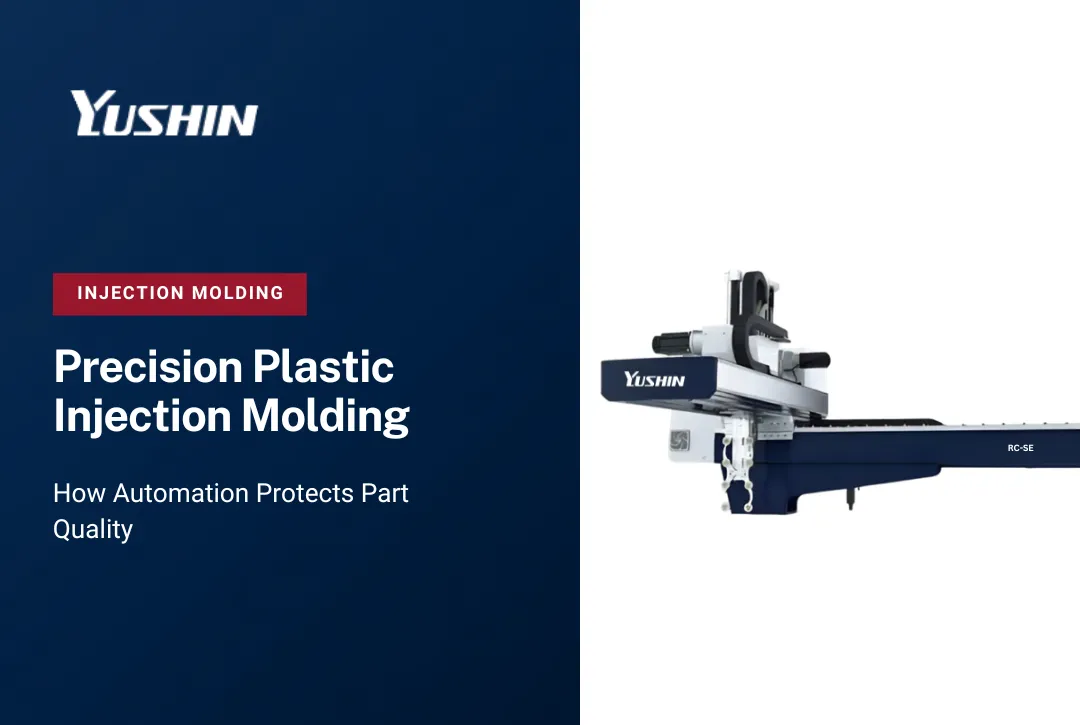
Yushin's RC-SE high-end high-speed take-out robot is another option where high-speed take-out is required across a broad range of injection molding machine sizes. Its verified features include vibration control, Smart ECO Vacuum, and predictive-maintenance functionality. Final suitability depends on the specific molding application and cell requirements.
Downtime: Planned vs. Unplanned
All manufacturing equipment stops. The question is whether those stops are planned or unplanned, and how long each one lasts.
Planned downtime - scheduled maintenance, tooling changes, robot program updates - can be structured around production windows. The press cell is idle during planned maintenance, but the stop was anticipated and its duration can be managed.
Unplanned downtime is the more damaging category. A servo drive failure, a worn belt that snaps during a production run, or an EOAT component that fails mid-shift stops the cell without warning. The repair time includes diagnosis, parts sourcing, and reassembly - none of which were built into the production schedule.
The operational impact of unplanned downtime is not just the hours lost while the cell is stopped. It is also the scheduling disruption to downstream operations, the overtime required to recover output, and the quality risk when operators rush to restart.
Preventive Maintenance
The most reliable way to reduce unplanned downtime is a consistent preventive maintenance programme. For injection molding robots, that programme typically includes:
- Manufacturer-specified maintenance schedules - intervals for lubrication, belt inspection, and component replacement are defined by the robot manufacturer based on cycle count and operating conditions, not calendar time alone
- Visual inspections - regular checks of belt tension, cable routing, EOAT mounting integrity, and suction cup condition catch degradation before it becomes a failure
- Lubrication - linear guides, ball screws, and pivot points require lubrication at defined intervals; under-lubricated components wear faster and introduce play that affects positioning accuracy
- Belt tension - timing belts on servo axes stretch over time; a belt that is out of specification affects axis positioning and, in high-speed applications, can produce vibration that compounds the settling problem
- Controller-based maintenance tracking - modern robot controllers can log cycle counts and flag maintenance intervals based on actual usage rather than estimated time, which is more reliable for high-volume cells where a month of operation may represent more cycles than a lower-volume cell runs in a year
Yushin America's service and support programmes are designed to support planned maintenance for operating cells, including OEM spare parts and technical service. For high-volume operations, having a defined service relationship with the robot supplier - rather than treating maintenance as a break-fix activity - reduces the risk that a minor issue becomes a major unplanned stop.
Parts and Service Availability
A robot cell in a high-volume facility is not an asset that can wait two weeks for a part. When a servo drive, a controller board, or an EOAT component fails, the press is down until the replacement arrives. Local parts availability and responsive technical support are not procurement considerations - they are operational requirements.
For operations running multiple shifts, access to qualified technical support and available replacement parts is an important factor in choosing an automation supplier. Yushin America provides North American technical support, field service, and OEM parts support for Yushin equipment, helping molders plan for both routine maintenance and production-critical service needs.
Downstream Bottlenecks
A common pattern in high volume molding cells is investment in press and robot capability that outpaces downstream capacity. The robot extracts parts quickly and deposits them onto a conveyor. The conveyor feeds a packing station. If the packing station cannot process parts as fast as the robot delivers them, parts accumulate at the transition point, handling quality degrades, and the robot's speed advantage is wasted.
The production flow from IMM to palletized output has a limiting step. Finding that step - not just in the robot cell but across the full line - determines where investment and attention actually improve throughput.
Packing and Palletizing Capacity
End-of-line automation is often the last consideration in a high-volume cell build, and frequently the first bottleneck discovered after the press and robot are commissioned.
The PA Series palletizing robots from Yushin America address the end-of-line constraint directly. The PA Series is a compact cantilever-design palletizer built for end-of-line packaging in injection molding facilities. It is designed to integrate with the output of a molding cell without requiring the floor space of a conventional industrial palletizer, and it is capable of handling the box rates that a high-output molding cell produces.
Running a high-speed take-out robot into a manual packing and palletizing operation creates a visible mismatch. The robot is consistent; the manual operation introduces variable timing, handling variation, and a throughput ceiling that the press and robot will hit during any sustained high-output run.
Closing that gap requires treating end-of-line automation as part of the cell design, not as an add-on after commissioning.
Identifying the Real Constraint

The central question in any high volume molding operation is: where is the actual bottleneck? Not where it is assumed to be, but where throughput is actually being limited.
In some cells, the press cycle is the constraint - the molding process itself is at its optimum and cannot run faster without quality issues. In those cells, the robot and downstream automation need to be sized to keep pace with the press without adding their own delays.
In other cells, the robot is the constraint - take-out time, settling delays, or reliability issues are extending the cell cycle beyond what the molding process requires. Upgrading to a higher-rigidity, purpose-built take-out platform addresses the actual limiting factor.
In still other cells, the constraint is downstream - packing, inspection, or palletizing cannot absorb what the press and robot produce. In those cases, upgrading the take-out robot produces no throughput improvement; the investment needs to go to end-of-line capacity.
The right automation decision starts with knowing which of these is true for your operation. Yushin America works with molders to evaluate the full cell - not just the robot - and match the automation to where the constraint actually sits. If you want to talk through what is limiting throughput in your operation, contact Yushin America.
Frequently Asked Questions
Why does robot settling time affect cell cycle time in high-speed molding?
When a robot arm decelerates at the extraction point, residual vibration has to dissipate before the EOAT can reliably contact parts. If the robot moves to extraction before settling is complete, EOAT contact is inconsistent and parts may be dropped or damaged. The time required for settling adds to the mold-open window and therefore to cell cycle time. Robots with more rigid structural designs reduce settling time because less vibration is introduced in the first place.
What makes EOAT a reliability variable in high volume operations?
EOAT is the physical interface between the robot and the part. At high cycle counts, suction cups wear, gripper jaws lose geometry, and mounting hardware fatigues. Tooling that was precise at the start of a production run may have enough wear after several hundred thousand cycles to introduce extraction inconsistency. Regular inspection, wear-based replacement schedules, and tooling designed specifically for the part geometry and cavity count reduce this risk.
How does take-out robot choice affect mold-open time?
The robot must complete entry, extraction, and exit within the mold-open window. A robot that takes longer to settle, or that requires a slower motion profile to maintain extraction reliability, extends that window. A robot designed for structural rigidity and fast settling can operate with a tighter mold-open window, which contributes to shorter overall cell cycle time.
Should I specify NC servo wrist units on a high-speed take-out robot?
It depends on the application. NC servo wrists add axes that can handle complex part orientations - useful when parts need to be rotated or repositioned during extraction. However, wrist mass and the additional motion involved can affect settling time, take-out time, and overall rigidity in a high-speed cell. Whether a servo wrist is appropriate requires application-level engineering review. For high-speed cells, that evaluation should happen before specification, not after commissioning. Yushin America's NC servo wrist units are part of a broader application discussion.
Can packing and palletizing become bottlenecks in high volume molding cells?
Yes. Packing and palletizing can become downstream bottlenecks when their capacity does not match the output of the press and take-out automation. Parts or packaged product may accumulate, manual operations may limit line rate, or additional labor may be required to keep up. End-of-line automation should therefore be sized against the actual output and packaging requirements of the complete molding line.
How should preventive maintenance be scheduled for a high-volume robot cell?
Manufacturer-specified intervals based on cycle count are more reliable than calendar-based schedules for high-volume operations, because a cell running three shifts accumulates cycles faster than a single-shift operation. Controllers that track cumulative cycle counts and flag maintenance intervals take the guesswork out of scheduling. Visual inspections - belt tension, lubrication condition, EOAT wear - should be built into shift-start procedures rather than performed reactively after a fault.